
Madagascar: A World Apart Photography Tour Report 2025
26 November 2025

The tiny sapphire-blue coloured Malagasy Kingfisher as it perches on a stalk by Lac Alarobia, in the Madagascar capital of Antananarivo (image by Virginia Wilde)

A wide-eyed Aye Aye shows its long-fingered hands. The middle finger on each hand is capable of rotating 360 degrees through a special ball and socket joint (image by Virginia Wilde)

A female Fosa rockets up a tree trunk so fast that you'd think she was a lemur herself. Known for their agile climbing skills, Fosas are solitary and elusive 'cat-like' animals that are Madagascar's forest predators in chief (image by Virginia Wilde)

'Yes, little one, that is your tail. And it's gonna be endlessly fascinating when you start using it to swing from trees.' An infant Verreaux's Sifaka - wrapped in its mother's fur - contemplates the wonder that is tails (image by Virginia Wilde)

A tiny Goodman's Mouse Lemur curls up around a leaf stalk in Madagascar's Analamazaotra National Park. Nocturnal Mouse Lemurs include- in their genus -some of the smallest primates in the world (image by Virginia Wilde)

A small troop of Ring-tailed Lemurs - tails held aloft - ready themselves to leap across a river in Isalo National Park, Madagascar (image by Virginia Wilde)

Female Black Lemurs are actually gingery-brown in colour, as this one in Madagascar's La Palmarium Reserve shows. Here, an infant holds on tight - believed to be the product of some lemur hybridisation (image by Virginia Wilde)

Portrait of a Coquerel's Sifaka and infant. Coquerel's were once considered a sub-species of Verreaux's but eventually granted full species status. These critically endangered lemurs are native to north-west Madagascar - but some are present in conservation reserves in the south of the island, where we photographed this pair (image by Virginia Wilde)

An animated-looking Indri hangs around at Madagascar's La Palmarium Reserve. Indris are the largest of all living lemurs - with males growing up to 72cm and weighing as much as 10kg. It is believed there are fewer than 10,000 Indri left in the world - with some estimates as low as 1,000 (image by Virginia Wilde)

The Common Myna has increased its range at such a rapid rate that many consider it an invasive species. Males can be aggressive in defending their territory. Even in Madagascar, they are thriving (image by Virginia Wilde)

Portrait of a Ring-tailed Lemur as she pads towards us. She is actually carrying a baby (tucked beneath her, mostly out of sight.) Ring-tailed Lemurs are probably Madagascar's most iconic species (image by Virginia Wilde)

More than Darwin's famous finches, Madagascar's Vanga are an exemplification of adaptive radiation - with 22 species filling a range of niches. Here, the Hook-billed Vanga flits about trees in Kirindy Forest (image by Virginia Wilde)

A Verreaux's Sifaka and her infant enjoy their arboreal vantage point - perfectly adapted to their forest home (image by Virginia Wilde)

What's better than one Giant Leaf-tailed Gecko? Two Giant Leaf-tailed Geckos! Their large eyes are highly sensitive to light - allowing them to see in colour, even at night (image by Virginia Wilde)

A colourful Parson's Chameleon catches an insect on the end of its tongue in the Andasibe region of Madagascar. Named after the British physician James Parson, in the 18th century, the Parson's is one of the world's largest chameleons (image by Virginia Wilde)

A troop of Ring-tailed Lemurs take it in turns to leap over a river in the canyonlands of Madagascar's Isalo National Park. Ring-taileds' are impressive jumpers - capable of leaping up to 30ft (9 metres) both horizontally and vertically (image by Virginia Wilde)

One of Madagascar's forest treats is the iridescently-jewelled Souimanga Sunbird, These hyperactive birds are difficult to catch sitting still, as they flit around so quickly (image by Virginia Wilde)

Portrait of a Diademed Sifaka - showing the stunning fur colouration that makes it almost seem as it has been daubed in paint. Tracking and photographing the Diademed in Analamazaotra National Park is one of the highlights of the tour (image by Virginia Wilde)

Traditional Madagascan fishing boats are known as Pirogues - outrigger canoes with a hull dug-out from a single log. The outrigger canoe tradition is thought to have arrived with settlers who crossed the Indian Ocean from the Indonesian archipelago around 600 AD (image by Virginia Wilde)

Ring-tailed Lemurs are highly social, female-dominant primates who, unsurprisingly, make excellent mothers. The whole troop will also work to protect the infant and mum, in the face of a Fosa attack (image by Virginia Wilde)

The endangered Verreaux's Sifaka are capable of making remarkable leaps through trees - with distances of 10 metres not uncommon. On the ground, they hop bipedally, making it look as if they are dancing (image by Virginia Wilde)

Fosas are incredibly adept at climbing trees and preying on lemurs. Their semi-retractable claws allow them to grip surfaces while their flexible ankles enable them to climb down trees head-first (image by Virginia Wilde)

Before you see a Black and White Ruffed Lemur, you will almost certainly hear one. Famed for their loud, raucous calls - combining howls, barks and whoops - these large and distinctive lemurs get their name from the large white ruff of fur around their necks (image by Virginia Wilde)

Oh Verreaux's Sifaka, how captivating your 'dancing' gait is. Researchers say this sideways hopping motion - very distinctive to sifakas - is a way of conserving energy when on the ground (image by Virginia Wilde)

A Madagascar Harrier Hawk sits on one of the branches of an Octopus Tree in Madagascar's Spiny Forest (image by Virginia Wilde)

An infant Red-fronted Brown Lemur sleeps soundly wrapped in its mother's fur; so cosy in there that it's hard to make out where infant begins and its mum's fur stops (image by Virginia Wilde)

We fell in love with the many different facial expressions of the fierce Fosa - especially as she climbed trees and bounded around the forest floor in Kirindy Forest Reserve, Madagascar (image by Virginia Wilde)

Aww, an infant Verreaux's Sifaka holds its mother tightly, showing the disproportionately large rear feet that help to propel it through the trees (image by Virginia Wilde)

Where have you been all my life, Tomato Frog?! Only Madagascar would produce a species of frog that can inflate itself to look like a tomato to confuse predators. These frogs can also release a toxic secretion under their skin. Regardless of whether you are a seven year old boy, this is the coolest animal alive (image by Virginia Wilde)

The Giraffe-necked Weevil is one of Madagascar's insect oddities. They are known for their elongated necks - which males use for combat, attracting mates and finding food (image by Virginia Wilde)

A Crowned Lemur displays the V-shaped 'crown' pattern of fur on its head, which gives these playful lemurs their name. This one larked about for ages in the trees of La Palmarium Reserve, Madagascar (image by Virginia Wilde)

Portrait of an Indri mother and infant against the sky in the Voi Community Reserve, in Andasibe, Madagascar. Of all the lemurs, Indri - the largest - most resemble teddy bears (image by Virginia Wilde)

'What big eyes you have, Aye Aye!' ' All the better to see you with, my dear!' Aye Ayes - like this juvenile - are found in widespread (but very fragmented) regions of Madagascar. They have bright eyes, bat-like ears and ever-growing incisors (like those of rodents) (image by Virginia Wilde)

Portrait of an Eastern Lesser Bamboo Lemur in the Andasibe region of eastern Madagascar. As its name suggests, this gentle primate feeds mainly on bamboo and has one of the greatest degrees of manual dexterity of any lemur (image by Virginia Wilde)

Crowned Sifaka have almost cartoon faces - making them a joy to watch. Found in the deciduous forests of northwestern Madagascar, they are nonetheless present in some more southern small conservation reserves (image by Virginia Wilde)

The Leaf-tailed Geckos are among Madagascar's most fascinating creatures. These endemic, nocturnal, forest-dwelling lizards are known for their incredible powers of camouflage and for their hypnotic marble eyes. This Giant Leaf-tailed Gecko blended in to a tree trunk in the eastern region of Andasibe (image by Virginia Wilde)

Black-and-white portrait of a Crowned Lemur and her day-old infant. Born the night before we visited La Palmarium and spotted her, this gorgeous baby lemur looked serene, tucked in its mother's fur (image by Virginia Wilde)

Red-bellied Lemurs have a particularly rich chestnut-brown fur coat. They are endemic to eastern Madagascan rainforests and lives in notably cohesive monogamous family groups (image by Virginia Wilde)

At first just a flash of orange in the undergrowth. That then became a prized sighting of the strikingly-coloured Madagascar Pygmy Kingfisher in the Analamazaotra National Park (image by Virginia Wilde)

When I have too much coffee, this is my face too! A beautiful Crowned Sifaka with another cartoonish expression. Found in the deciduous forests of northwestern Madagascar, they are nonetheless present in some more southern conservation reserves, where we photographed this individual (image by Virginia Wilde)

Portrait of a juvenile Aye Aye in eastern Madagascar, proudly displaying the bat-like ears that give these lemurs exceptional hearing abilities (image by Virginia Wilde)

By far the prettiest rat I've ever seen, the Malagasy Giant Jumping Rat looks more like a rabbit than anything else. These critically endangered rodents can jump more than a metre straight up in the air and spend their daylight hours in deep and complex burrows (image by Virginia Wilde)

'Now I'm the King of the Swingers, the Jungle VIP.' A Diademed Sifaka makes a bid for the title, with its impressive swinging across an overhead branch in Madagascar's Analamazaotra National Park (image by Virginia Wilde)

Madagascar's most famous lemur - the Ring-tailed (known locally as 'Maki') - displays its long black and white striped tail whose ring pattern gives it its name (image by Virginia Wilde)

A Parson's Chameleon's tongue can measure up to 21 inches long and can shoot out, going from 0 to 60mph in as little as 1/100th of a second. No wonder it's a challenge to capture a (nearly) sharp shot! (image by Virginia Wilde)

An Indri with an almost teddy-bear look - clasps its hands around a tree in Madagascar's rainforest. Indri are the only other mammal known to sing with a human-style sense of rhythm (image by Virginia Wilde)

A Satanic Leaf-tailed Gecko flashes its hypnotic eyes - which can turn a devilish red in certain individuals - while resting on a branch in the Andasibe region of Madagascar (image by Virginia Wilde)

A moment of calm for a Verreaux's Sifaka mother and infant, after the mum finally felt safe to come down to the forest floor and feed on berries, in Kirindy Forest (image by Virginia Wilde)

A trio of Diademed Sifaka lark about in the Andasibe region of Madagascar. Diademed are one of the largest lemur species, with the ability to jump more than 10 metres between trees in a single leap (image by Virginia Wilde)

Daytime can be hot and energy-sapping in the deciduous forests of Madagascar's Kirindy Reserve. This pair of Red-fronted Brown Lemurs scratch around for fruit amid the leaft-litter (image by Virginia Wilde)

A shaft of light illuminates the grey and orange plumage of a Benson's Rock Thrush - a songbird with a particular stronghold in the rocky canyons of Madagascar's Isalo National Park (image by Virginia Wilde)

When the season is right, a shallow pool of water forms beside Madagascar's iconic Avenue of the Baobabs. This enables some beautiful reflections in our landscape shots, even in the bright light of midday (image by Virginia Wilde)

A juvenile female Crowned Lemur - displaying greyer fur than the male - enjoys hanging around in her arboreal home in La Palmarium Reserve, Madagascar (image by Virginia Wilde)

A female Fosa pads across the forest floor in Kirindy, Madagascar, at sunset. Only around 2,500 of these beautiful long-tailed carnivores are thought to remain in the wild (image by Virginia Wilde)

"See that there, son. That's a pile of berries. And we are heading that way imminently." A mother Verreaux's Sifaka eyes some food, shortly before feasting on the ground (image by Virginia Wilde)

An Olive-capped Coua spreads its wings as it rests briefly in the sand of the Spiny Forest in south-west Madagascar (image by Virginia Wilde)

Deep in Madagascar's Spiny Forest, a mint-green Antimena Chameleon inches along a branch (image by Virginia Wilde)

An adorable Grey Mouse Lemur peers out of a tree hole - containing as many as 12 other Mouse Lemurs - in Madagascar's Kirindy Forest (image by Virginia Wilde)

An alert female Fosa in Madagascar’s Kirindy Forest. Fierce Fosa prey on birds, wild pigs, frogs, rodents and lizards. They are Madagascar's only predator that will sometimes target large lemurs, utilising their speed and camouflage during hunting (image by Virginia Wilde)

'Upside down, right-way up, upside down again.' The topsy-turvy life of a Black and White Ruffed Lemur - larking about in the Madagascan trees (image by Virginia Wilde)

'There, there, little one.' Ring-tailed Lemurs make excellent mothers, sisters and aunts - with the whole troop working to help bring up infants (image by Virginia Wilde)

A local village boy strolls past a group of towering Grandidier's Baobabs in Kirindy, Madagascar (image by Virginia Wilde)

'Jump, Red-bellied Lemur, jump!' Trying to catch lemurs as they leap through the air is one of the photographic challenges of Madagascar (image by Virginia Wilde)

A Grey Mouse Lemur - one of the smallest lemur species - tucks into the crevice of a tree, before heading out at nighttime to hunt. These tiny mammals are actually fierce hunters and will opportunistically eat small reptiles and amphibians as well as insects and fruits (image by Virginia Wilde)

A daytime stroll along the 'Avenue of the Baobabs' - Madagascar's iconic Road No.8 - can be a gentle experience. All around, people are dwarfed by the majestic Grandidier's baobab trees (image by Virginia Wilde)

By far the prettiest rat I've ever seen, the Malagasy Giant Jumping Rat looks more like a rabbit than anything else. These critically endangered rodents can jump more than a metre straight up in the air and spend their daylight hours in deep and complex burrows (image by Virginia Wilde)

A Running Coua lives up to its name by sprinting across the sand in Madagascar's Spiny Forest near Ifaty - sending sand flying. Quirky Running Couas - endemic like all Couas - are the speediest ground birds in all of Madagascar (image by Virginia Wilde)

Not a hedgehog (nor any relation to a hedgehog). But a 'Lesser Hedgehog Tenrec' - a completely different order of mammals that evolved independently. Seen here in the soft sands of the Spiny Forest (image by Virginia Wilde)

Finding a Radiated Tortoise in the wild is quite a feat. These critically endangered reptiles are prized in the illegal pet trade for their beautiful patterned shells. We found one wandering in the sands of the Spiny Forest, Ifaty (image by Virginia Wilde)

Can you spot the gecko in these yellowing leaves? The impressively-camouflaged Lined Leaf-tailed Gecko drew shouts of 'how cool!' from our tour group. And it is. Undoubtedly very cool (image by Virginia Wilde)

Portrait of a nocturnal Pale fork-marked Lemur, usually heard in its western forests home before it is seen - with adults utilising a succession of different calls, some resembling the bleating of a goat (image by Virginia Wilde)

The sociable Common Brown Lemur have distinct orange eyes and play an important role in rainforest seed dispersal. Seen here with an infant in Andasibe, Madagascar (image by Virginia Wilde)

A Diademed Sifaka infant clutches her mother tightly as she clambers across a branch 100ft above the forest floor. Being a lemur baby is a high-wire act. You can't afford to let go at those heights! (image by Virginia Wilde)

A Giant Coua struts across a forest path in Kirindy, Madagascar. Giant Coua are the largest of the ten endemic Coua species (image by Virginia Wilde)

A Diademed Sifaka looks imploringly at its troop member - while both display the handsome tricolour colouration that make many consider them to be the world's most beautiful lemurs (image by Virginia Wilde)

Our stay in Isalo Rock Lodge involved sleeping in individual chalets with balconies looking out onto some impressively craggy terrain (image by Virginia Wilde)

A Ring-tailed Lemur looks lost in thought, sticking out its tongue, as it rests upon the pretty hillsides of Madagascar's Isalo National Park. Known as 'Maky' in Madagascar, Ring-taileds are probably also the world's best known lemur species (image by Virginia Wilde)

Zebu carts are a major source of transport all over Madagascar. Here some locals ride along the island's iconic Road number 8 - the Avenue of the Baobabs (image by Virginia Wilde)

The beautifully striking Red-legged Golden Orb Spider weaves its web on the banks of Lac Alarobia, in Madagascan capital Antananarivo (image by Virginia Wilde)

A female Fosa shows the teeth that can make her a fierce hunter of lemurs, as she rests in the leaf-litter in Kirindy Forest Reserve, Madagascar (image by Virginia Wilde)

Brookesia (or Leaf Chameleons) include species considered to be the world's smallest chameleons. With some as small as 2.1 cm long - and with 'grumpy-looking' faces - their bodies are laterally compressed and their eyes move independently of each other (image by Virginia Wilde)

A White-breasted Mesite scurries about on the forest floor in Kirindy Forest, Madagascar (image by Virginia Wilde)

A muscular Fosa showing its incredible tree-climbing abilities. Fosas - Madagascar's largest carnivorous mammals - have semi-retractable claws and flexible ankles, which allow them to climb trees with ease. Fosas are related to mongooses, but were once mistakenly considered to be species of primitive cat. (image by Virginia Wilde)

A male Black Lemur peers out from its tree trunk lookout - scanning the forest floor in the hope of food or mischief! (image by Virginia Wilde)

And her exceptionally long tail - which helps to provide balance while climbing up and down trees (image by Virginia Wilde)

A juvenile Black and White Ruffed Lemur stares in fascination at the small group of photographers walking through a forest reserve in the Andasibe region of Madagascar (image by Virginia Wilde)

One of the most striking features of the already-striking Aye Aye is its long black fluffy tail that is larger than their body. Their bodies are also covered with white guard hairs they can raise when agitated to make themselves appear larger (image by Virginia Wilde)

A male Verreaux's Sifaka displays the powerful musculature on its hind legs - enabling hugely acrobatic leaps through Madagascar's forest canopy (image by Virginia Wilde)

Indri are one of the world's most critically-endangered lemurs, and cannot survive at all in captivity. These intelligent primates are so sensitive to confinement or environment stressors that their only hope is for conservation efforts in their rainforest home to succeed (image by Virginia Wilde)

The Fosa's tail is typically 22 to 31 inches (60-80cm) long - roughly the same length as its head and body. This long, slender tail is essential for balance and agility - helping it navigate and leap through the forest canopy in search of prey (image by Virginia Wilde)

A male Black Lemur plays with some bamboo in the La Palmarium Reserve, Madagascar. Black Lemurs have an unusual habit of biting toxic millipedes and rubbing the poison (which is not toxic to them) on their skin. It is believed that the toxins have pleasurable psychoactive effects on the lemurs (image by Virginia Wilde)

Two Indri hanging together in the trees. Of all the lemurs, the Indri bears the closest resemblance to apes. Local Malagasy call these lemurs 'babakoto' after a myth telling how an Indri saved the life of a dying boy named Koto (image by Virginia Wilde)

A Sub-desert Mesite peers out from a roosting spot. These elusive ground-dwelling birds roost communally overnight, before separating during the day to search for insects and small fruits (image by Virginia Wilde)

If Spiderman were a lemur, he'd be a Verreaux's Sifaka. Their treetop leaps feel precarious and terrifying - but are, almost without fail, perfectly executed (image by Virginia Wilde)

A brightly-coloured Madagascar Hoopoe digs for grubs in the leaflitter at Kirindy Forest, Madagascar. Hoopoes are known for their 'butterfly-like' flight and a unique low cooing song (image by Virginia Wilde)

'Eyes Front! Left foot forward!' A Parson's Chameleon rotates its eyes to look ahead in the Andasibe region of Madagascar. Chameleon eyes can swivel independently of one other, providing a nearly 360-degree field of view (image by Virginia Wilde)

A tiny Madagascar Reed Frog on the banks of Lake Ampitabe, Madagascar - one of more than 300 species of frog in this island nation (image by Virginia Wilde)

Portrait of an Indri mother and infant against the sky in the Voi Community Reserve, in Andasibe, Madagascar. Of all the lemurs, Indri - the largest - most resemble teddy bears (image by Virginia Wilde)

'He said what?!' A Black and White Ruffed Lemur looks genuinely shocked as it plays with a stick. The critically endangered Black and White Ruffed are among the most charismatic lemur species in Madagascar (image by Virginia Wilde)

A juvenile (two-year-old) Aye Aye approaches its mother, hoping she will permit him some of her food, in eastern Madagascar (image by Virginia Wilde)

The population of amphibians in Madagascar is made up exclusively of frogs - with 311 named species here and more discovered all the time. This Madagascar Bright-eyed Frog was fun to photograph on the shores of Lake Ampitabe (image by Virginia Wilde)

A Malthes Green-eared Chameleon edges out to grasp onto a nearby leaf in the Andasibe region of Madagascar. These chameleons are known for their large occipital lobes that resemble elephant ears when flared under stress (image by Virginia Wilde)

Emerging from the darkness, an Aye Aye - the world's largest nocturnal primate. Considered a bad omen by some in Malagasy culture, and persecuted, this gentle lemur feeds mostly on insect larvae. It uses its specialised middle finger to tap trees and listen for the echoes before digging out the larvae (image by Virginia Wilde)

Comical-looking Verreaux's Sifaka have expressions that make them look permanently surprised. But their athleticism - enabled by their powerful hind legs and balancing tail - is undeniably impressive (image by Virginia Wilde)

Madagascar is a powerhouse of plant biodiversity - including more than 11,000 endemic plant species. Here, some pitcher plants on the shores near La Palmarium. (image by Virginia Wilde)

An energetic Diademed Sifaka launches itself from a branch, while a mother and infant are distracted by the rest of the troop in the Analamazaotra National Park, Madagascar. Diademed Sifakas are considered by many to be the most beautiful of all lemurs (image by Virginia Wilde)
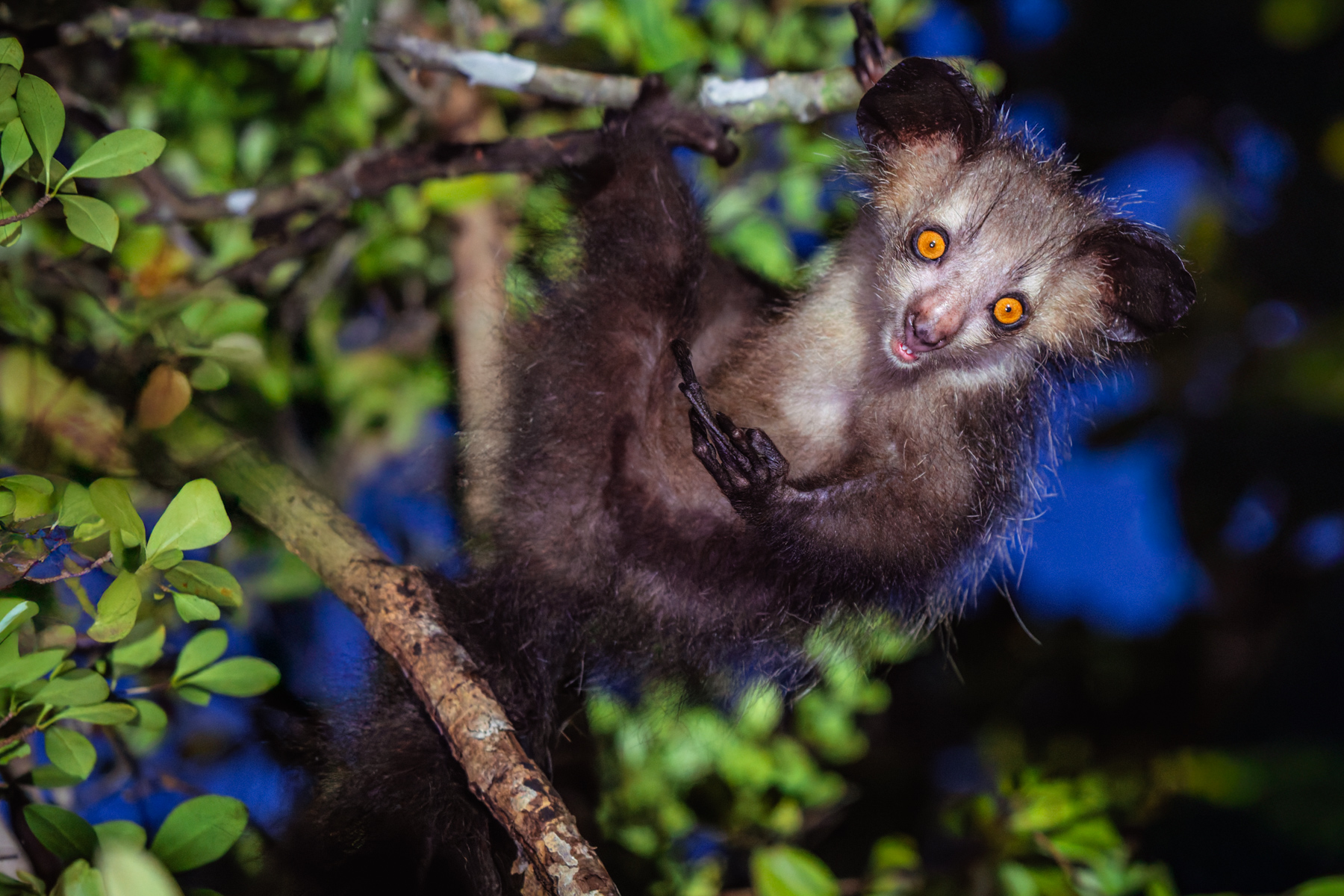
A curious Aye Aye stares down from the forest canopy in eastern Madagascar. The Aye Aye - undoubtedly one of the world's most bizarre mammals - is shy, misunderstood and sadly persecuted for its odd appearance (image by Virginia Wilde)

The almost death-defying leaps of Verreaux's Sifaka never cease to impress. One of the most acrobatic of all lemurs, these powerful animals have incredibly powerful legs (image by Virginia Wilde)

Madagascar's endemic White-browed Owl, with its handsome brown barred underparts and white polka dot plumage (image by Virginia Wilde)

'Fosa, Fosa, what's on your mind?' A female Fosa stares intently ahead - looking similar to the cougar she is often compared to (image by Virginia Wilde)

The playful Crowned Lemur - here showing the rufous 'crown' of its name - larks about in Madagascar's Le Palmarium Reserve (image by Virginia Wilde)

There's a reason that the adorable Crowned Lemur ranks so highly among clients' favourite of all lemurs. These highly-expressive and playful primates just love to engage with people (image by Virginia Wilde)

A Red-fronted Brown Lemur heckles a troop member in the trees above her, while her infant clings on tightly. Red-fronted Brown Lemurs are known for their more equitable gender relations, being unusual among prosimians for not showing marked female dominance (image by Virginia Wilde)

A Subdesert Mesite - endemic to southwest Madagascar - shows the long curved bill that it uses to probe the soil for food (image by Virginia Wilde)

Portrait of a Mossy Leaf-tailed Gecko, showcasing its hypnotic eyes, in the forest of Madagascar's Analamazaotra National Park (image by Virginia Wilde)

This Madagascan praying mantis - a species known as the Ghost Mantis - is known for its distinct camouflage to mimic a dry, weathered leaf (image by Virginia Wilde)

Black and White Ruffed Lemurs are indefatigably curious - read nosy - when it comes to any goings on around them in the rainforest. These charismatic lemurs had several tour members laughing at their antics (image by Virginia Wilde)

A Giant Coua picks its way through foliage in Madagascar's Zombitse National Park. Giant Couas are more than 60cm in length and - like all Couas - are believed to have originated from a particular Asian Ground Cuckoo (image by Virginia Wilde)

Considered to be one of the world's most elusive birds, the Long-tailed Ground Roller is a prize sighting in Madagascar's Spiny Forest (image by Virginia Wilde)

A nocturnal Red-tailed Sportive Lemur peers down from its treetop vantage point in the Kirindy Forest Reserve, Madagascar (image by Virginia Wilde)

Sunset at the iconic Avenue of the Baobabs, with the magnificent Grandidier's baobabs reflected in a rainwater pool (image by Virginia Wilde)

A mother Verreaux's Sifaka tucks into jujube berries, as her infant clings on to her chest. Critically-endangered Verreaux's Sifakas - also known as 'Dancing Lemurs' - are on the latest list of the World's 25 Most Endangered Primates (image by Virginia Wilde)

If you are an infant Verreaux's Sifaka, your most important life skill is learning to hang on to your mother tightly! As this little guy knows all too well (image by Virginia Wilde)

Despite its name, the Madagascar Pratincole is not endemic to Madagascar and migrates to the coast of East Africa in the winter. This elegant bird (halfway between a tern and a shorebird in shape) loves to rest on a particular island we pass on the way to La Palmarium Reserve (image by Virginia Wilde)

A male Frances's Sparrowhawk rests on a branch in Kirindy Forest Reserve, Madagascar. One of four subspecies of Frances's Sparrowhawk, pairs will sometimes cooperatively hunt together to capture prey (image by Virginia Wilde)

'I'm over here! Peek-a-boo!' Crowned Lemurs are known for their gentle natures and playfulness - as those who have spent time with them in Madagascar's La Palmarium Reserve can verify (image by Virginia Wilde)

One of the cutest lemurs out there, an Eastern Bamboo Lemur shows the tip of its tongue as it perches between branches in the Andasibe region of Madagascar (image by Virginia Wilde)

'Who? Me?' It's the animated faces of many lemur species that's among the facets that make them such a joy to photograph. So many lemurs ooze charisma! Here, a Red-fronted Brown Lemur checks out what's happening in nearby trees (image by Virginia Wilde)

We watched the full moon peeking over the rocky canyons in Isalo - all while enjoying sundowner drinks on a nearby plateau (image by Virginia Wilde)




The tiny sapphire-blue coloured Malagasy Kingfisher as it perches on a stalk by Lac Alarobia, in the Madagascar capital of Antananarivo (image by Virginia Wilde)
A wide-eyed Aye Aye shows its long-fingered hands. The middle finger on each hand is capable of rotating 360 degrees through a special ball and socket joint (image by Virginia Wilde)
A female Fosa rockets up a tree trunk so fast that you'd think she was a lemur herself. Known for their agile climbing skills, Fosas are solitary and elusive 'cat-like' animals that are Madagascar's forest predators in chief (image by Virginia Wilde)
'Yes, little one, that is your tail. And it's gonna be endlessly fascinating when you start using it to swing from trees.' An infant Verreaux's Sifaka - wrapped in its mother's fur - contemplates the wonder that is tails (image by Virginia Wilde)
A tiny Goodman's Mouse Lemur curls up around a leaf stalk in Madagascar's Analamazaotra National Park. Nocturnal Mouse Lemurs include- in their genus -some of the smallest primates in the world (image by Virginia Wilde)
A small troop of Ring-tailed Lemurs - tails held aloft - ready themselves to leap across a river in Isalo National Park, Madagascar (image by Virginia Wilde)
Female Black Lemurs are actually gingery-brown in colour, as this one in Madagascar's La Palmarium Reserve shows. Here, an infant holds on tight - believed to be the product of some lemur hybridisation (image by Virginia Wilde)
Portrait of a Coquerel's Sifaka and infant. Coquerel's were once considered a sub-species of Verreaux's but eventually granted full species status. These critically endangered lemurs are native to north-west Madagascar - but some are present in conservation reserves in the south of the island, where we photographed this pair (image by Virginia Wilde)
An animated-looking Indri hangs around at Madagascar's La Palmarium Reserve. Indris are the largest of all living lemurs - with males growing up to 72cm and weighing as much as 10kg. It is believed there are fewer than 10,000 Indri left in the world - with some estimates as low as 1,000 (image by Virginia Wilde)
The Common Myna has increased its range at such a rapid rate that many consider it an invasive species. Males can be aggressive in defending their territory. Even in Madagascar, they are thriving (image by Virginia Wilde)
Portrait of a Ring-tailed Lemur as she pads towards us. She is actually carrying a baby (tucked beneath her, mostly out of sight.) Ring-tailed Lemurs are probably Madagascar's most iconic species (image by Virginia Wilde)
More than Darwin's famous finches, Madagascar's Vanga are an exemplification of adaptive radiation - with 22 species filling a range of niches. Here, the Hook-billed Vanga flits about trees in Kirindy Forest (image by Virginia Wilde)
A Verreaux's Sifaka and her infant enjoy their arboreal vantage point - perfectly adapted to their forest home (image by Virginia Wilde)
What's better than one Giant Leaf-tailed Gecko? Two Giant Leaf-tailed Geckos! Their large eyes are highly sensitive to light - allowing them to see in colour, even at night (image by Virginia Wilde)
A colourful Parson's Chameleon catches an insect on the end of its tongue in the Andasibe region of Madagascar. Named after the British physician James Parson, in the 18th century, the Parson's is one of the world's largest chameleons (image by Virginia Wilde)
A troop of Ring-tailed Lemurs take it in turns to leap over a river in the canyonlands of Madagascar's Isalo National Park. Ring-taileds' are impressive jumpers - capable of leaping up to 30ft (9 metres) both horizontally and vertically (image by Virginia Wilde)
One of Madagascar's forest treats is the iridescently-jewelled Souimanga Sunbird, These hyperactive birds are difficult to catch sitting still, as they flit around so quickly (image by Virginia Wilde)
Portrait of a Diademed Sifaka - showing the stunning fur colouration that makes it almost seem as it has been daubed in paint. Tracking and photographing the Diademed in Analamazaotra National Park is one of the highlights of the tour (image by Virginia Wilde)
Traditional Madagascan fishing boats are known as Pirogues - outrigger canoes with a hull dug-out from a single log. The outrigger canoe tradition is thought to have arrived with settlers who crossed the Indian Ocean from the Indonesian archipelago around 600 AD (image by Virginia Wilde)
Ring-tailed Lemurs are highly social, female-dominant primates who, unsurprisingly, make excellent mothers. The whole troop will also work to protect the infant and mum, in the face of a Fosa attack (image by Virginia Wilde)
The endangered Verreaux's Sifaka are capable of making remarkable leaps through trees - with distances of 10 metres not uncommon. On the ground, they hop bipedally, making it look as if they are dancing (image by Virginia Wilde)
Fosas are incredibly adept at climbing trees and preying on lemurs. Their semi-retractable claws allow them to grip surfaces while their flexible ankles enable them to climb down trees head-first (image by Virginia Wilde)
Before you see a Black and White Ruffed Lemur, you will almost certainly hear one. Famed for their loud, raucous calls - combining howls, barks and whoops - these large and distinctive lemurs get their name from the large white ruff of fur around their necks (image by Virginia Wilde)
Oh Verreaux's Sifaka, how captivating your 'dancing' gait is. Researchers say this sideways hopping motion - very distinctive to sifakas - is a way of conserving energy when on the ground (image by Virginia Wilde)
A Madagascar Harrier Hawk sits on one of the branches of an Octopus Tree in Madagascar's Spiny Forest (image by Virginia Wilde)
An infant Red-fronted Brown Lemur sleeps soundly wrapped in its mother's fur; so cosy in there that it's hard to make out where infant begins and its mum's fur stops (image by Virginia Wilde)
We fell in love with the many different facial expressions of the fierce Fosa - especially as she climbed trees and bounded around the forest floor in Kirindy Forest Reserve, Madagascar (image by Virginia Wilde)
Aww, an infant Verreaux's Sifaka holds its mother tightly, showing the disproportionately large rear feet that help to propel it through the trees (image by Virginia Wilde)
Where have you been all my life, Tomato Frog?! Only Madagascar would produce a species of frog that can inflate itself to look like a tomato to confuse predators. These frogs can also release a toxic secretion under their skin. Regardless of whether you are a seven year old boy, this is the coolest animal alive (image by Virginia Wilde)
The Giraffe-necked Weevil is one of Madagascar's insect oddities. They are known for their elongated necks - which males use for combat, attracting mates and finding food (image by Virginia Wilde)
A Crowned Lemur displays the V-shaped 'crown' pattern of fur on its head, which gives these playful lemurs their name. This one larked about for ages in the trees of La Palmarium Reserve, Madagascar (image by Virginia Wilde)
Portrait of an Indri mother and infant against the sky in the Voi Community Reserve, in Andasibe, Madagascar. Of all the lemurs, Indri - the largest - most resemble teddy bears (image by Virginia Wilde)
'What big eyes you have, Aye Aye!' ' All the better to see you with, my dear!' Aye Ayes - like this juvenile - are found in widespread (but very fragmented) regions of Madagascar. They have bright eyes, bat-like ears and ever-growing incisors (like those of rodents) (image by Virginia Wilde)
Portrait of an Eastern Lesser Bamboo Lemur in the Andasibe region of eastern Madagascar. As its name suggests, this gentle primate feeds mainly on bamboo and has one of the greatest degrees of manual dexterity of any lemur (image by Virginia Wilde)
Crowned Sifaka have almost cartoon faces - making them a joy to watch. Found in the deciduous forests of northwestern Madagascar, they are nonetheless present in some more southern small conservation reserves (image by Virginia Wilde)
The Leaf-tailed Geckos are among Madagascar's most fascinating creatures. These endemic, nocturnal, forest-dwelling lizards are known for their incredible powers of camouflage and for their hypnotic marble eyes. This Giant Leaf-tailed Gecko blended in to a tree trunk in the eastern region of Andasibe (image by Virginia Wilde)
Black-and-white portrait of a Crowned Lemur and her day-old infant. Born the night before we visited La Palmarium and spotted her, this gorgeous baby lemur looked serene, tucked in its mother's fur (image by Virginia Wilde)
Red-bellied Lemurs have a particularly rich chestnut-brown fur coat. They are endemic to eastern Madagascan rainforests and lives in notably cohesive monogamous family groups (image by Virginia Wilde)
At first just a flash of orange in the undergrowth. That then became a prized sighting of the strikingly-coloured Madagascar Pygmy Kingfisher in the Analamazaotra National Park (image by Virginia Wilde)
When I have too much coffee, this is my face too! A beautiful Crowned Sifaka with another cartoonish expression. Found in the deciduous forests of northwestern Madagascar, they are nonetheless present in some more southern conservation reserves, where we photographed this individual (image by Virginia Wilde)
Portrait of a juvenile Aye Aye in eastern Madagascar, proudly displaying the bat-like ears that give these lemurs exceptional hearing abilities (image by Virginia Wilde)
By far the prettiest rat I've ever seen, the Malagasy Giant Jumping Rat looks more like a rabbit than anything else. These critically endangered rodents can jump more than a metre straight up in the air and spend their daylight hours in deep and complex burrows (image by Virginia Wilde)
'Now I'm the King of the Swingers, the Jungle VIP.' A Diademed Sifaka makes a bid for the title, with its impressive swinging across an overhead branch in Madagascar's Analamazaotra National Park (image by Virginia Wilde)
Madagascar's most famous lemur - the Ring-tailed (known locally as 'Maki') - displays its long black and white striped tail whose ring pattern gives it its name (image by Virginia Wilde)
A Parson's Chameleon's tongue can measure up to 21 inches long and can shoot out, going from 0 to 60mph in as little as 1/100th of a second. No wonder it's a challenge to capture a (nearly) sharp shot! (image by Virginia Wilde)
An Indri with an almost teddy-bear look - clasps its hands around a tree in Madagascar's rainforest. Indri are the only other mammal known to sing with a human-style sense of rhythm (image by Virginia Wilde)
A Satanic Leaf-tailed Gecko flashes its hypnotic eyes - which can turn a devilish red in certain individuals - while resting on a branch in the Andasibe region of Madagascar (image by Virginia Wilde)
A moment of calm for a Verreaux's Sifaka mother and infant, after the mum finally felt safe to come down to the forest floor and feed on berries, in Kirindy Forest (image by Virginia Wilde)
A trio of Diademed Sifaka lark about in the Andasibe region of Madagascar. Diademed are one of the largest lemur species, with the ability to jump more than 10 metres between trees in a single leap (image by Virginia Wilde)
Daytime can be hot and energy-sapping in the deciduous forests of Madagascar's Kirindy Reserve. This pair of Red-fronted Brown Lemurs scratch around for fruit amid the leaft-litter (image by Virginia Wilde)
A shaft of light illuminates the grey and orange plumage of a Benson's Rock Thrush - a songbird with a particular stronghold in the rocky canyons of Madagascar's Isalo National Park (image by Virginia Wilde)
When the season is right, a shallow pool of water forms beside Madagascar's iconic Avenue of the Baobabs. This enables some beautiful reflections in our landscape shots, even in the bright light of midday (image by Virginia Wilde)
A juvenile female Crowned Lemur - displaying greyer fur than the male - enjoys hanging around in her arboreal home in La Palmarium Reserve, Madagascar (image by Virginia Wilde)
A female Fosa pads across the forest floor in Kirindy, Madagascar, at sunset. Only around 2,500 of these beautiful long-tailed carnivores are thought to remain in the wild (image by Virginia Wilde)
"See that there, son. That's a pile of berries. And we are heading that way imminently." A mother Verreaux's Sifaka eyes some food, shortly before feasting on the ground (image by Virginia Wilde)
An Olive-capped Coua spreads its wings as it rests briefly in the sand of the Spiny Forest in south-west Madagascar (image by Virginia Wilde)
Deep in Madagascar's Spiny Forest, a mint-green Antimena Chameleon inches along a branch (image by Virginia Wilde)
An adorable Grey Mouse Lemur peers out of a tree hole - containing as many as 12 other Mouse Lemurs - in Madagascar's Kirindy Forest (image by Virginia Wilde)
An alert female Fosa in Madagascar’s Kirindy Forest. Fierce Fosa prey on birds, wild pigs, frogs, rodents and lizards. They are Madagascar's only predator that will sometimes target large lemurs, utilising their speed and camouflage during hunting (image by Virginia Wilde)
'Upside down, right-way up, upside down again.' The topsy-turvy life of a Black and White Ruffed Lemur - larking about in the Madagascan trees (image by Virginia Wilde)
'There, there, little one.' Ring-tailed Lemurs make excellent mothers, sisters and aunts - with the whole troop working to help bring up infants (image by Virginia Wilde)
A local village boy strolls past a group of towering Grandidier's Baobabs in Kirindy, Madagascar (image by Virginia Wilde)
'Jump, Red-bellied Lemur, jump!' Trying to catch lemurs as they leap through the air is one of the photographic challenges of Madagascar (image by Virginia Wilde)
A Grey Mouse Lemur - one of the smallest lemur species - tucks into the crevice of a tree, before heading out at nighttime to hunt. These tiny mammals are actually fierce hunters and will opportunistically eat small reptiles and amphibians as well as insects and fruits (image by Virginia Wilde)
A daytime stroll along the 'Avenue of the Baobabs' - Madagascar's iconic Road No.8 - can be a gentle experience. All around, people are dwarfed by the majestic Grandidier's baobab trees (image by Virginia Wilde)
By far the prettiest rat I've ever seen, the Malagasy Giant Jumping Rat looks more like a rabbit than anything else. These critically endangered rodents can jump more than a metre straight up in the air and spend their daylight hours in deep and complex burrows (image by Virginia Wilde)
A Running Coua lives up to its name by sprinting across the sand in Madagascar's Spiny Forest near Ifaty - sending sand flying. Quirky Running Couas - endemic like all Couas - are the speediest ground birds in all of Madagascar (image by Virginia Wilde)
Not a hedgehog (nor any relation to a hedgehog). But a 'Lesser Hedgehog Tenrec' - a completely different order of mammals that evolved independently. Seen here in the soft sands of the Spiny Forest (image by Virginia Wilde)
Finding a Radiated Tortoise in the wild is quite a feat. These critically endangered reptiles are prized in the illegal pet trade for their beautiful patterned shells. We found one wandering in the sands of the Spiny Forest, Ifaty (image by Virginia Wilde)
Can you spot the gecko in these yellowing leaves? The impressively-camouflaged Lined Leaf-tailed Gecko drew shouts of 'how cool!' from our tour group. And it is. Undoubtedly very cool (image by Virginia Wilde)
Portrait of a nocturnal Pale fork-marked Lemur, usually heard in its western forests home before it is seen - with adults utilising a succession of different calls, some resembling the bleating of a goat (image by Virginia Wilde)
The sociable Common Brown Lemur have distinct orange eyes and play an important role in rainforest seed dispersal. Seen here with an infant in Andasibe, Madagascar (image by Virginia Wilde)
A Diademed Sifaka infant clutches her mother tightly as she clambers across a branch 100ft above the forest floor. Being a lemur baby is a high-wire act. You can't afford to let go at those heights! (image by Virginia Wilde)
A Giant Coua struts across a forest path in Kirindy, Madagascar. Giant Coua are the largest of the ten endemic Coua species (image by Virginia Wilde)
A Diademed Sifaka looks imploringly at its troop member - while both display the handsome tricolour colouration that make many consider them to be the world's most beautiful lemurs (image by Virginia Wilde)
Our stay in Isalo Rock Lodge involved sleeping in individual chalets with balconies looking out onto some impressively craggy terrain (image by Virginia Wilde)
A Ring-tailed Lemur looks lost in thought, sticking out its tongue, as it rests upon the pretty hillsides of Madagascar's Isalo National Park. Known as 'Maky' in Madagascar, Ring-taileds are probably also the world's best known lemur species (image by Virginia Wilde)
Zebu carts are a major source of transport all over Madagascar. Here some locals ride along the island's iconic Road number 8 - the Avenue of the Baobabs (image by Virginia Wilde)
The beautifully striking Red-legged Golden Orb Spider weaves its web on the banks of Lac Alarobia, in Madagascan capital Antananarivo (image by Virginia Wilde)
A female Fosa shows the teeth that can make her a fierce hunter of lemurs, as she rests in the leaf-litter in Kirindy Forest Reserve, Madagascar (image by Virginia Wilde)
Brookesia (or Leaf Chameleons) include species considered to be the world's smallest chameleons. With some as small as 2.1 cm long - and with 'grumpy-looking' faces - their bodies are laterally compressed and their eyes move independently of each other (image by Virginia Wilde)
A White-breasted Mesite scurries about on the forest floor in Kirindy Forest, Madagascar (image by Virginia Wilde)
A muscular Fosa showing its incredible tree-climbing abilities. Fosas - Madagascar's largest carnivorous mammals - have semi-retractable claws and flexible ankles, which allow them to climb trees with ease. Fosas are related to mongooses, but were once mistakenly considered to be species of primitive cat. (image by Virginia Wilde)
A male Black Lemur peers out from its tree trunk lookout - scanning the forest floor in the hope of food or mischief! (image by Virginia Wilde)
And her exceptionally long tail - which helps to provide balance while climbing up and down trees (image by Virginia Wilde)
A juvenile Black and White Ruffed Lemur stares in fascination at the small group of photographers walking through a forest reserve in the Andasibe region of Madagascar (image by Virginia Wilde)
One of the most striking features of the already-striking Aye Aye is its long black fluffy tail that is larger than their body. Their bodies are also covered with white guard hairs they can raise when agitated to make themselves appear larger (image by Virginia Wilde)
A male Verreaux's Sifaka displays the powerful musculature on its hind legs - enabling hugely acrobatic leaps through Madagascar's forest canopy (image by Virginia Wilde)
Indri are one of the world's most critically-endangered lemurs, and cannot survive at all in captivity. These intelligent primates are so sensitive to confinement or environment stressors that their only hope is for conservation efforts in their rainforest home to succeed (image by Virginia Wilde)
The Fosa's tail is typically 22 to 31 inches (60-80cm) long - roughly the same length as its head and body. This long, slender tail is essential for balance and agility - helping it navigate and leap through the forest canopy in search of prey (image by Virginia Wilde)
A male Black Lemur plays with some bamboo in the La Palmarium Reserve, Madagascar. Black Lemurs have an unusual habit of biting toxic millipedes and rubbing the poison (which is not toxic to them) on their skin. It is believed that the toxins have pleasurable psychoactive effects on the lemurs (image by Virginia Wilde)
Two Indri hanging together in the trees. Of all the lemurs, the Indri bears the closest resemblance to apes. Local Malagasy call these lemurs 'babakoto' after a myth telling how an Indri saved the life of a dying boy named Koto (image by Virginia Wilde)
A Sub-desert Mesite peers out from a roosting spot. These elusive ground-dwelling birds roost communally overnight, before separating during the day to search for insects and small fruits (image by Virginia Wilde)
If Spiderman were a lemur, he'd be a Verreaux's Sifaka. Their treetop leaps feel precarious and terrifying - but are, almost without fail, perfectly executed (image by Virginia Wilde)
A brightly-coloured Madagascar Hoopoe digs for grubs in the leaflitter at Kirindy Forest, Madagascar. Hoopoes are known for their 'butterfly-like' flight and a unique low cooing song (image by Virginia Wilde)
'Eyes Front! Left foot forward!' A Parson's Chameleon rotates its eyes to look ahead in the Andasibe region of Madagascar. Chameleon eyes can swivel independently of one other, providing a nearly 360-degree field of view (image by Virginia Wilde)
A tiny Madagascar Reed Frog on the banks of Lake Ampitabe, Madagascar - one of more than 300 species of frog in this island nation (image by Virginia Wilde)
Portrait of an Indri mother and infant against the sky in the Voi Community Reserve, in Andasibe, Madagascar. Of all the lemurs, Indri - the largest - most resemble teddy bears (image by Virginia Wilde)
'He said what?!' A Black and White Ruffed Lemur looks genuinely shocked as it plays with a stick. The critically endangered Black and White Ruffed are among the most charismatic lemur species in Madagascar (image by Virginia Wilde)
A juvenile (two-year-old) Aye Aye approaches its mother, hoping she will permit him some of her food, in eastern Madagascar (image by Virginia Wilde)
The population of amphibians in Madagascar is made up exclusively of frogs - with 311 named species here and more discovered all the time. This Madagascar Bright-eyed Frog was fun to photograph on the shores of Lake Ampitabe (image by Virginia Wilde)
A Malthes Green-eared Chameleon edges out to grasp onto a nearby leaf in the Andasibe region of Madagascar. These chameleons are known for their large occipital lobes that resemble elephant ears when flared under stress (image by Virginia Wilde)
Emerging from the darkness, an Aye Aye - the world's largest nocturnal primate. Considered a bad omen by some in Malagasy culture, and persecuted, this gentle lemur feeds mostly on insect larvae. It uses its specialised middle finger to tap trees and listen for the echoes before digging out the larvae (image by Virginia Wilde)
Comical-looking Verreaux's Sifaka have expressions that make them look permanently surprised. But their athleticism - enabled by their powerful hind legs and balancing tail - is undeniably impressive (image by Virginia Wilde)
Madagascar is a powerhouse of plant biodiversity - including more than 11,000 endemic plant species. Here, some pitcher plants on the shores near La Palmarium. (image by Virginia Wilde)
An energetic Diademed Sifaka launches itself from a branch, while a mother and infant are distracted by the rest of the troop in the Analamazaotra National Park, Madagascar. Diademed Sifakas are considered by many to be the most beautiful of all lemurs (image by Virginia Wilde)
A curious Aye Aye stares down from the forest canopy in eastern Madagascar. The Aye Aye - undoubtedly one of the world's most bizarre mammals - is shy, misunderstood and sadly persecuted for its odd appearance (image by Virginia Wilde)
The almost death-defying leaps of Verreaux's Sifaka never cease to impress. One of the most acrobatic of all lemurs, these powerful animals have incredibly powerful legs (image by Virginia Wilde)
Madagascar's endemic White-browed Owl, with its handsome brown barred underparts and white polka dot plumage (image by Virginia Wilde)
'Fosa, Fosa, what's on your mind?' A female Fosa stares intently ahead - looking similar to the cougar she is often compared to (image by Virginia Wilde)
The playful Crowned Lemur - here showing the rufous 'crown' of its name - larks about in Madagascar's Le Palmarium Reserve (image by Virginia Wilde)
There's a reason that the adorable Crowned Lemur ranks so highly among clients' favourite of all lemurs. These highly-expressive and playful primates just love to engage with people (image by Virginia Wilde)
A Red-fronted Brown Lemur heckles a troop member in the trees above her, while her infant clings on tightly. Red-fronted Brown Lemurs are known for their more equitable gender relations, being unusual among prosimians for not showing marked female dominance (image by Virginia Wilde)
A Subdesert Mesite - endemic to southwest Madagascar - shows the long curved bill that it uses to probe the soil for food (image by Virginia Wilde)
Portrait of a Mossy Leaf-tailed Gecko, showcasing its hypnotic eyes, in the forest of Madagascar's Analamazaotra National Park (image by Virginia Wilde)
This Madagascan praying mantis - a species known as the Ghost Mantis - is known for its distinct camouflage to mimic a dry, weathered leaf (image by Virginia Wilde)
Black and White Ruffed Lemurs are indefatigably curious - read nosy - when it comes to any goings on around them in the rainforest. These charismatic lemurs had several tour members laughing at their antics (image by Virginia Wilde)
A Giant Coua picks its way through foliage in Madagascar's Zombitse National Park. Giant Couas are more than 60cm in length and - like all Couas - are believed to have originated from a particular Asian Ground Cuckoo (image by Virginia Wilde)
Considered to be one of the world's most elusive birds, the Long-tailed Ground Roller is a prize sighting in Madagascar's Spiny Forest (image by Virginia Wilde)
A nocturnal Red-tailed Sportive Lemur peers down from its treetop vantage point in the Kirindy Forest Reserve, Madagascar (image by Virginia Wilde)
Sunset at the iconic Avenue of the Baobabs, with the magnificent Grandidier's baobabs reflected in a rainwater pool (image by Virginia Wilde)
A mother Verreaux's Sifaka tucks into jujube berries, as her infant clings on to her chest. Critically-endangered Verreaux's Sifakas - also known as 'Dancing Lemurs' - are on the latest list of the World's 25 Most Endangered Primates (image by Virginia Wilde)
If you are an infant Verreaux's Sifaka, your most important life skill is learning to hang on to your mother tightly! As this little guy knows all too well (image by Virginia Wilde)
Despite its name, the Madagascar Pratincole is not endemic to Madagascar and migrates to the coast of East Africa in the winter. This elegant bird (halfway between a tern and a shorebird in shape) loves to rest on a particular island we pass on the way to La Palmarium Reserve (image by Virginia Wilde)
A male Frances's Sparrowhawk rests on a branch in Kirindy Forest Reserve, Madagascar. One of four subspecies of Frances's Sparrowhawk, pairs will sometimes cooperatively hunt together to capture prey (image by Virginia Wilde)
'I'm over here! Peek-a-boo!' Crowned Lemurs are known for their gentle natures and playfulness - as those who have spent time with them in Madagascar's La Palmarium Reserve can verify (image by Virginia Wilde)
One of the cutest lemurs out there, an Eastern Bamboo Lemur shows the tip of its tongue as it perches between branches in the Andasibe region of Madagascar (image by Virginia Wilde)
'Who? Me?' It's the animated faces of many lemur species that's among the facets that make them such a joy to photograph. So many lemurs ooze charisma! Here, a Red-fronted Brown Lemur checks out what's happening in nearby trees (image by Virginia Wilde)
We watched the full moon peeking over the rocky canyons in Isalo - all while enjoying sundowner drinks on a nearby plateau (image by Virginia Wilde)


It’s curious how some places linger with you. Or why Madagascar – mistress of the disarming and strange – can resonate quite as deeply as it does.
This profoundly unique island – where everything is slightly sideways – tugs at my sleeve more often than I’d admit; charming, confounding and confronting in equal measure.
For wildlife-lovers, it’s unquestionably a place of singular imagination: a misfit, long-adrift landmass where evolution abandoned all restraint to run its own madcap experiments.
Its forests, mangroves and canyons hold the last concentrations of species found nowhere else on Earth. Its enchanting life-forms are threatened not by exotic predators but by hungry people and feeble governance.
Madagascar captivates, while also challenging: a conflicting blend of surreal and (occasionally) mentally taxing, making it a more testing destination than some for travellers.
But to see a Fosa bound up a tree, watch a siafka ‘dance’, hear an Indri sing – and, frankly, witness anything that the otherworldly Aye-aye chooses to do – well, it genuinely feels special. As I know, so many of the 2025 Wild Images tour group would heartily agree.
And that’s the thing with Madagascar. The encounters and ‘moments’ are so unlike others that you can’t help but feel a whack in the solar plexus.
And that’s not to mention the saucer-eyed mouse lemurs, playful Ring-taileds, Day-Glo chameleons and scores of enigmatic birds. This is a diverse mix for any wildlife adventure.
This year’s ‘Madagascar: A World Apart’ tour had many of the most magical wildlife encounters I’ve ever had on this island. We photographed 21 species of lemur (many just mere feet away), including so many adorable infants that I abandoned attempting to count them.
Then there were 12 species of chameleon and more than 90 species of birds – including prized sightings of endemic Coua, Vanga, Mesite and Kingfisher. Not to mention Tenrec, Fosa, geckos, frogs and all manner of animal and floral oddities.
Yet, as we wandered the forests and reserves, Madagascar’s increasingly authoritarian – and failing – government was overthrown in a coup d’etat. The days of city protests culminating in the President fleeing overseas and the military taking charge.
While undoubtedly an unusual background for a wildlife tour, Wild Images’ years of experience and contacts in this country made us sure we could keep everyone safe and well insulated from the socio-political friction.
Heartbreakingly, many groups cancelled their tours, devastating the eco-tourist income on which the National Parks and local conservation workers rely. Almost half of Madagascar’s 112 lemur species are critically endangered; unfailingly gentle and beautiful animals who face a precarious future.
But amidst the upheaval, the warmth of the Malagasy people combined with some truly outstanding wildlife encounters to make the 2025 ‘Madagascar: A World Apart’ tour very wonderful indeed.
THE TOUR BEGINS: ANTANANARIVO, MADAGASCAR’S WHIRLWIND CAPITAL CITY
A drumbeat of citizen protests had just begun when we endeavoured to meet in Antananarivo, Madagascar’s sprawling capital, to start this year’s tour.
An immediate night-time curfew imposed on all citizens and travellers inevitably caused ruptures in flight schedules – meaning several group members had tougher journeys than normal to arrive. From a tour-leading perspective, these government measures necessitated a raft of backup plans. Thankfully, pretty much all of which were never needed.
Making sure we avoided the centre of the city – and while waiting for three more clients to touch down in ‘Tana – I took a couple of guests to explore Lake Alarobia, a hidden gem birdwatching refuge that teems with life.
Here, several hundred white-faced whistling ducks dotted the water, while the skies were alive with herons and egrets. We spent most of our time photographing a resting sapphire-blue Malagasay Kingfisher and some impressively large Golden Orb-Web Spiders.
On our way back, we paused at a local market and then at the rice paddy fields, trying to get close to a small flock of Black Herons – a fascinating species that open their expansive wings like umbrellas to create shallow water shadows, helping them to fish.

Almost 30% of Madagascar’s GDP is generated from rice production. It also provides more than half of the daily calories consumed here (image by Virginia Wilde)
Antananarivo, like many hillside cities, has its hopes of healthy expansion hamstrung not only by the steep terrain but by widespread poverty and a rapidly growing population.
Founded in the 17th century as a fortress town – a strategic outpost during the era of pirates and explorers – ‘Tana’ (as locals affectionately call it) has been shaped by its toppled kingdoms and colonial legacies, in equal measure.
Meaning ‘City of the Thousand’ in Malagasy, after the number of soldiers used to guard the city during its decades of skirmishes, the capital is bookended by two large forts and 12 sacred hills.
Sadly, this year it was too much of a risk to explore anywhere near the city centre, but the cacophony of daily life in ‘Tana’s surrounding streets can be fascinating to witness.
All of the group (except one, who was delayed by a day) met for dinner at the French-owned Hotel Le Chat’o to kick off the tour. We were joined by Fabrice – our Malagasy co-leader – and, quite honestly, one of the finest tour guides I’ve ever worked with.
You need tolerance, optimism, doggedness and a healthy sense of humour to lead groups through Madagascar. Thankfully, Fabrice has it in spades.
EXPLORING MADAGASCAR’S SOUTHWEST: THE SPINY FOREST, ONE OF THE WORLD’S STRANGEST ECOSYSTEMS
The Wild Images tour uses Tana as a base from which to radiate out to several of Madagascar’s most wildlife-rich regions, partly due to the problems in driving, but also thanks to the frequently erratic schedule changes of the country’s only domestic airline.
Unsurprisingly, the ongoing political upheaval meant that our flights were even more precariously positioned than usual. On our first morning, Fabrice and I endeavoured to get the group onto a suddenly announced earlier flight to Tulear, necessitating an hour (at least) of wrangling. But one – thanks wholly to the charm of Fabrice – that paid off.
Touching down in the coastal city of Tulear in Madagascar’s south-west region, we were met by our 4×4 drivers, Elias and Marcelo, before finding a takeaway pizza restaurant for lunch and stocking up on vehicle snacks and water at the supermarket.
Then onwards for a pretty hour-long drive, along stretches of mangrove and sandy coast, to reach the town of Ifaty.
Our focus here: two expanses of Spiny Forest that make up some of the last tracts still standing of this rapidly-disappearing ecosystem.
The Spiny Forest is a strange, almost otherworldly landscape. Its sandy soils furnish a woodland of botanical oddities that include the towering Octopus tree, spiky Silver Thicket (a plant that looks like a torture device), and swollen Fony Baobabs. All that survives on barely 500 millimetres of rain each year.
Recognised by scientists as one of the world’s most important eco-regions, it’s also home to some of the world’s most endangered species. Once, this terrain rumbled with giant lemurs the size of gorillas – and ten-foot-tall elephant birds. Now only fragments remain.
Before our first wildlife walk, we checked into our base, the welcoming – and gently charming – Hotel Nautilus, set by the turquoise waters of the Mozambique Channel. Here, the French hotel owners are kind, the ageing pet Labrador’s tail whacks on the sand, and the hotel’s elderly, elegant waiter, Robinson, is renowned for his homemade baobab rum and honey.
Over the following two days, we split our time between the Spiny Forest reserve of Reinala and the smaller ‘Mosa’s Forest’ – named after the patriarch who first guarded this tract of woodland.
Amid the sub-arid thorn scrub and deciduous trees, we notched up sightings of Oustalet’s Chameleon (the world’s biggest) and Antimena Chameleon, Lesser Hedgehog Tenrec and Dumeril’s Boa. We then added the Three-eyed Lizard, Kung Fu Cricket and the critically-endangered, but ‘world’s most beautiful’ tortoise, the Radiated Tortoise.
As the light faded, we were distracted by a particularly photogenic Praying Mantis, before finding our first lemurs: the tiny Grey Mouse Lemur and regionally-endemic Peter’s Sportive Lemur.
Bird highlights in the Spiny Forest included the Chaberts and Sickle-billed Vanga, Madagascar Nightjar, Sub-desert Mesite and the Crested and Running Coua – shepherded expertly towards us by guides Bebe, Olivier and Janga.
Raptor sightings were also strong here – with endemic Kestrels and Harrier Hawks soaring around us, plus a Madagascar Scops Owl.
On one of the afternoons, we took a Zebu-cart ride into the forest, pulled surprisingly fast past the baobabs by some local cattle. Much of this region’s economy is, in part, powered by the efforts of Zebu: rural Madagascar’s main form of transport.

One of the more unusual experiences for tour groups – a Zebu cart ride into the Spiny Forest near Ifaty, Madagascar (image by Virginia Wilde)
Earlier, part of the group headed out to the local Mangily Saltpans and lake, in search of plovers and flamingoes. Others then lunched at ‘Chez Freddies’, my favourite neighbourhood restaurant that serves platters of seafood while playing soul music.
By this stage of the tour, it would be remiss not to mention that stomach upsets were particularly prevalent this year. Nevertheless, we all endeavoured to soldier on, picking up reasonably quickly, to enjoy this unusual region.
ZOMBITSE AND ISALO NATIONAL PARK: IN SEARCH OF RARE BIRDS AND THE RING-TAILED LEMUR
There is no getting around that the drive from the Spiny Forest to Isalo – along Madagascar’s dreaded ‘National Route Seven’ – is an ordeal. Even though it’s been barely 12 months since I was last here, the deterioration in the road surface was stark. This road is, undoubtedly, more pot-hole than road. And bone-jarringly so.
Added to this is the fact that Madagascar’s south-west is one of the poorest regions in all of the country – a reality that cannot fail to impact on the traveller who passes through.
Yet the drive can also be a fascinating one, winding past villages of market stalls and children being ridden to school on bicycle rickshaws. Later on, the sapphire mining ‘boom’ towns add another dimension to Madagascan society – one that’s already a hodgepodge of influences: part African, part Indonesian, part French.
To break up the eight-hour slog, we stopped in Zombitse National Park, a humid and densely vegetated reserve that serves as an important transition zone between dry deciduous and spiny forest ecosystems. It’s also uniquely home to more lemurs and a highly endemic bird (the Appert’s Tetraka) that only exists in Zombitse and on a nearby mountain.
Despite pains to avoid the midday heat, with these road conditions, it was unavoidable. Especially as one of our vehicles slowly sputtered to a halt, with engine problems, just as we crested a hill towards the National Park.
Fabrice scrabbled to come up with a solution – thankfully in the form of our Isalo guide, and mutual friend, Nirian, who drove to collect us.
Meanwhile, in the reserve itself, we were quickly cheered by an immediate sighting of our first troop of Verreaux’s Sifaka, complete with adorable infants!
These critically-endangered lemurs are among my very favourites. Their idiosyncratic ‘dancing’ gait, permanently surprised expression, and gentle nature make them both charismatic photo-subjects and an absolute joy to see in the wild.
Although walking in Zombitse can be tough-going – with some bush-whacking required to spot the more elusive birds – we nevertheless got our glimpse of the Appert’s Tetraka, as well as sightings of Panther Chameleon, Madagascar White-browed Owl and Paradise Flycatcher.
After lunch at a nearby lodge, we pressed on towards Isalo; the landscape changing again as rocky outcrops gave way to sandstone cliffs.
Here, our base was the luxurious Isalo Rock Lodge, with chalets (complete with sunken bathtubs) that look out at the sweeping plains.
We just had time to drop our bags before climbing some steps up to a plateau, where sundowner drinks awaited us, as the fading light turned the sky orange and night fell over the valley below.

We watched the full moon peeking over the rocky canyons in Isalo – all while enjoying sundowner drinks on a nearby plateau (image by Virginia Wilde)
The following morning, we headed into Isalo National Park – a beautiful reserve full of waterfalls, rivers, and canyons (and inhabited by the nomadic Zebu cattle-farming Bara people) – and the preferred home of Madagascar’s iconic Ring-tailed lemurs.
Walking up to the forest glade where we know the Ring-tailed love to play, our local guide Nirian pointed out a succession of unusual insects and birds – the Snout and Nymph bugs, Twig-mimic Mantis, Madagascar Coucal and the regionally-endemic Benson’s Rockthrusth.
Although we did get some images of Verreaux’s Sifaka and Ring-tailed Lemurs, time was against us in the National Park – largely due to our booked flight the following evening being struck out by the curfew. So we faced having to journey all the way back to Tulear that night.
After a BBQ lunch, we headed back down through the canyon and into the 4x4s. A further vehicle breakdown meant Nirian’s brother drove half of us all the way back to Tulear – with both vehicles finally arriving just after nightfall. The journey was dusty and long. It was – by far – our toughest day, but the good humour of this year’s tour group was the exact balm needed to cope with it as well as we did.
ONWARDS TO KIRINDY: ON THE TRAIL OF THE FOSA AND NEW LEMURS
Flying back into ‘Tana the following morning, we found ourselves with an unscripted spare day in the capital. Again, steering well clear of the areas favoured by the rioters (whose demands for adequate water, electricity and a right to protest were, to anyone’s measure, more than reasonable), we instead headed to a lemur reserve and botanical garden on the outskirts of the city.
Here, a number of species of locally-occurring lemurs, and two introduced from more northern regions, roam freely in the reserve flanked on one side by the Katsaoka River.
Different lemur species – such as the Black Lemur, Coquerel’s Sifaka and Crowned Sifaka – have their own territories within the reserve. Most years, some of the park’s most critically endangered species are able to be reintroduced from here, back into the wild.
After an enjoyable few hours of photography (and a tasty lunch), we headed to a specialised Madagascan Vanilla supplier, enjoyed by previous tour groups.
Following a short film on the laborious process of farming vanilla, we stocked up on chocolate, vanilla pods, spices and other treats before returning to our base hotel of Le Chat’o for the evening.
Our destination the next morning: the Kirindy Forest Reserve – a large privately-managed forest sanctuary that has long featured in any ‘must-see’ Madagascar wildlife itineraries.
Nestled within the Menabe-Antimena Protected Area, Kirindy‘s dry deciduous forest is the largest remaining piece of this vital ecosystem in the entire region. It’s also packed with one of the greatest densities of primates anywhere in the world (with eight species of lemur) and a stronghold for the elusive Fosa.
On top of this, Kirindy holds deep cultural and spiritual significance for local communities.
Flying into the coastal resort town of Morondava, we transferred into our next convoy of friendly 4x4s, picking up snacks and water, before driving north for two hours along a sandy road.
We stopped briefly at the Avenue of the Baobabs (aware that we would return to this location for a sunset photography session in a few days’ time) before pulling up to the Akiba Eco-lodge, on the fringes of the reserve, for lunch and an afternoon wildlife walk.
I personally love the trail walks around Akiba, a lodge with a treetop restaurant that looks out onto a pair of entwined ‘lovers’ Grandidier’s baobabs.

I love taking clients to spend time on the forest walks around Akiba Lodge in Kirindy. Here is one of the twisted Grandidier’s Baobabs in the area – a tree affectionately called ‘The Lovers.’ (image by Virginia Wilde)
Within minutes, we had one of the most memorable encounters of our tour: a small troop of Verreaux’s Sifaka, complete with one particularly endearing infant, playing just a few feet in front of us in the trees. We had lovely light, and there was a special feel about our time here with these beautiful lemurs. We stayed, just watching and photographing the infant play, for almost an hour.
Over the following two days, we alternated our time between walks around Akiba and those starting from the Kirindy Forest Station. Here, just as for most of the tour, our routine typically revolved around early morning excursions at first light, followed by a mid-morning walk before the heat became too oppressive.
Back at our lodge, we would regroup for lunch, then head out again in the late afternoon, often into the night, when the forest revealed its most active inhabitants.
One of the technical challenges was mastering night photography, needed for the nocturnal lemurs, but especially in a macro-style setting for small species of frog or gecko.
Many tour members had never used flash or speedlights for wildlife shots before. But, with a bit of practice, nearly everyone managed to get decent images – even if some shots still came from the glow of a torch or a high ISO setting.
In this region, our base was the Relais du Kirindy Eco-lodge, located just 20 minutes from the forest station. This year, our guide was the wonderful Solange – a waitress turned conservation guide, thanks to her incredibly sharp eyesight and wildlife-spotting talent.
Our day walks around Akiba and Kirindy Forest yielded sightings of Fat-tailed Lemur, Red-fronted Brown and Grey Mouse – including one particularly cute individual who popped out of a treehole after smelling fruit.
Bird sightings included a number of Coua and Vanga species. White-headed Vanga, Sickle-billed and Madagascar Blue, with our Coua tally increasing with the Crested, Giant and Coquerel’s.
Other avian treats included sightings of the Greater and Lesser Vasa Parrot, Long-billed Tetraka, Souimanga Sunbird, Frances’s Sparrowhawk and White-breasted Mesite.
At night, we were lucky to have good sightings of the Red-tailed Sportive Lemur and Pale Fork-marked Lemur, whose lightning-streaked facial markings were even more impressive when it climbed a tree towards us, until it was almost within touching distance.
On one night-walk around Akiba, I found myself fascinated by a sleeping Sparrowhawk in the trees above. Not to photograph, just to see a bird who is normally so alert in a moment of calm.
On another evening, we drove to a local grove of Grandidier’s Baobab trees, just as the sun was about to fall. Here, we enjoyed interacting with a large group of local village children who found our presence there fascinating.

Local village children lark about in front of the camera, loving spending time with our group as we photographed a pasture of baobab trees near Kirindy, one evening (image by Virginia Wilde)
But for many in the group, there were three wildlife highlights in our time here in Kirindy that definitely stood out.
First up were our two late-morning sessions at the Akiba Lodge lemur feeding station. Here, silky cream-coloured Verreaux’s Sifaka leapt from the trees and hopped over to a pile of jujube berries – barely two metres from us, using their idiosyncratic ‘dancing lemur gait’ as they came and went.
When the Verreaux’s Sifaka retreated, in came the Red-fronted Browns; smaller but infinitely noisier, their grunts sounding like a domestic pig, their squabbles as frequent as human toddlers, and their tails held aloft in a seemingly permanent question mark.
We waited for what seemed like a long time for the Verreaux’s Sifaka with the smallest infant to feel secure enough to come down and feed right in front of us. In our first session, she was spooked by a passing guide. When she finally did in our second session, we felt elated. Our camera cards are full of moments.
Next up, our encounters with the Fosa – normally the most elusive of Madagascar’s iconic species. Luckily, a female Fosa is fairly frequently spotted on the trails around the Kirindy Forest Station. Local villagers say they believe she feels safe amid the bustle of forest workers playing boules and outdoor cooking. Sometimes she’s spotted several times a week, sometimes she vanishes for weeks on end.
But luckily for us, on two of our three early evenings here, there she was: Madagascar’s rare and fierce carnivore-in-chief. We were able to photograph her scaling trees, and were particularly taken with her downward climbing technique, aided by powerful retractable claws and articulated ankles. To see a Fosa – so unusual and so renowned for its agility – be so acrobatic in front of us was a privilege indeed.
Our last wildlife highlight in the Kirindy region was an unusual one. It involved a night-time walk through the forest and the ability to sit (or stand) quietly unmoving for up to two hours….watching a hole in the sand. Our target here – a sighting of the critically endangered Malagasy Giant Rat.
This rodent, also known as the ‘Giant Jumping Rat’, is a species that has mostly eluded me on past Madagascar tours. This surprisingly pretty rat, more similar in appearance to a rabbit than anything murine, lives in deep, complex forest burrows and is very reactive to noise.
But Fabrice assured me it was worth our effort. Sure enough, after about 90 minutes of waiting, while trying not to audibly breathe, the rat appeared. Immediately, Solange switched on her torch, projecting just enough light for us to try and get a snap with our cameras and flashes.
Thankfully, we had several chances as the rat scampered around its burrow. And Fabrice was right – what a surprisingly beautiful creature. And thanks to clients Scott and Javier, who had to stand for almost two hours, completely stationary in the dark, managing brilliantly not to fall over.
MORONDAVA, FISHING BOATS AND SUNSET AT THE AVENUE OF THE BAOBABS
Our days in Kirindy had been so full – and so successful – that we felt sated enough to wave goodbye to the reserve after breakfast on the last morning, and press on back to Morondava.
Driving back through the Avenue of the Baobabs, we again stopped briefly – this time to work out our best position for the full session that evening. This particular year was noticeably cooler than the past few.
The normal sapping heat was even replaced with skies that threatened rain in the southern regions. Possibly as a result of a wetter year, the cattle-grazing meadow in front of the avenue was filled with shallow water. Great for wading birds, even better for reflections of the trees.
So finding a composition at the grove was less of a challenge than usual, but for an excellent reason!
Pressing on towards Morondava, we stopped at the city’s harbour to photograph the fishing boats. Traditional Madagascan vessels are named ‘pirogues’ – a type of dugout canoe often with a single outrigger called a lakana. These small, often sail-powered boats are crucial for the livelihoods of communities, like the Vezo people, especially in the south and south-west.

Tour group members inspect some of the traditional Madagascan fishing boats – known as Pirogues. These outrigger canoes have a hull dug out from a single log (image by Virginia Wilde)
Luckily, one such pirogue sailed into the harbour as we were there, giving us a lovely sighting of a traditional way of life. Later attempts to walk out onto the sands and photograph more of these vessels were thwarted by a frustratingly low tide.
Our accommodation for the night: the upmarket Palissandre Côte Ouest Resort and Spa, where guests stay in thatched-roof beach chalets and sleep to the sound of waves crashing along the Nosy Kely Peninsula.
In mid-afternoon, we headed out to the famous ‘Allee Des Baobabs’, hoping for a sunset as deep-coloured as possible. The main attraction here: none other than the towering Grandidier’s Baobab (the largest and most revered of Madagascar’s six baobab species).
It’s not often that UNESCO recognises a grove of trees, but spend even a short amount of time watching the Zebu carts and local Malagasy villagers weaving along the road, like Liliput figures in the Land of Giants, and you can see why.
More often than not, a sunset photography session at the avenue can be a frustrating one; the grove’s reputation as a ‘Bucket List Destination’ leads to overcrowding. But the citizen protests over the past two weeks had caused a dramatic fall in tourist numbers. Indeed, only a day later, the government fell, and the President fled.
An unintended side-effect, of course, but our sunset session here was as relaxed an affair as I’ve ever known it. And we all got our shots of the ‘Kings of Baobabs’ standing tall, reflected in the water, with some hues of blue, orange and purple in the sky above.
IN SEARCH OF INDRI AND RAINFOREST LEMURS: THE ANDASIBE-MANTADIA NATIONAL PARK
Flying back into ‘Tana the following morning, the atmosphere in the capital had changed; almost as if the city itself had exhaled. Sure enough, the widely despised President was gone. And a military group is in the process of setting up an interim government.
We skirted the streets in our spacious bus, stopping in Fabrice and my favourite neighbourhood pizza restaurant ‘Aeropizza’ for lunch, before starting the five-hour drive north-west. I say five hours because a spate of construction work along this highway meant you can be stuck, stationary, in sections of the road, waiting for roadworks to be finished for up to an hour. Which inevitably happened to us.
The final sections of the Wild Image’s Madagascar tour – comprising the eastern rainforest of the Andasibe-Mantadia National Park, followed by the private lemur-stacked reserve of Le Palmarium – are unashamedly my personal favourite.
Arguably Madagascar’s premier rainforest reserve, this first national park destination combines Analamazaotra Reserve with the forests of Mantadia. And I always think that, if you were to imagine a rainforest, Andisabe-Mantadia is what it would look like: a tangled green jungle of ferns and hardwood trees, looped with vines.
I love hiking the jungle trails of these more northerly reaches, hoping for the Diademed Sifaka to leap and the Indris to sing.
Our main local guide here – the experienced ecologist Julien – had been in ‘Tana when our Morondava flight arrived, so he hopped onto our bus for the journey north with us.
No sooner had we arrived at our rainforest chalet accommodation, ‘Feon’ny Ala’, than we were out again, for a night walk before dinner, with Julien and his co-guide Sylvester, spotlighting along the road beside the reserve.
Here we had sightings of the wonderful Mossy Leaf-tailed Gecko and several tree frogs. As well as new lemur species – the Goodman’s Mouse Lemur and Woolly Lemur.
The following morning, we headed out on a four-hour rainforest hike in Analamazoatra National Park. Before we’d barely even started, we spotted a Blue Coua and a very cute Eastern Bamboo Lemur.
But the best was yet to come – a troop of Diademed Sifaka shifting silently, except for the rustle of leaves, through the trees. Renowned as one of the world’s most beautiful lemurs – with their tricolour colouration of black, white and cinnamon-orange – these large lemurs are normally only seen from a distance, or higher up in the canopy.
But we were able to follow these critically-endangered primates for more than an hour as they moved through the foliage; some with infants on their backs.
At one point, Julien stopped us on our path and told us to point our cameras at an overhanging branch ahead. Sure enough, the troop crossed right in front of us, swinging by their arms. It marked the best encounter I’ve ever had with these lemurs.
Other sightings that morning included our first Indri and her infant above us in the trees, together with Common Brown Lemurs and a Madagascan Tree Boa.
After lunch, we drove south again to visit a Chameleon Reserve. This park features very large aviaries in a botanical garden, all set up by a Swiss conservationist, to aid in the understanding and protection of these fascinating reptiles.
Here, many of us got phenomenal images of all manner of chameleon, gecko, snake, and frog species, such as the Panther, Parson’s and Mathe Elephant Ear Chameleon and the Golden Mantella Frog.
We had a number of impressive encounters here. First up was watching a Parson’s Chameleon catch an insect, its seemingly endless tongue shooting out at such a velocity that photographing it at all can be a challenge.
And then the incredible oddity that is Madagascar’s Tomato Frog. This large, bulbous amphibian – of bright orangey-red colouration – inflates itself to resemble a giant tomato to confuse would-be predators. You don’t have to be an eight-year-old boy to find that absolutely cool, by any measure.
Among the geckos: the Giant Leaf-tailed and Mossy Leaf-tailed (with their hypnotic eyes and uncanny ability to mirror tree bark) were only matched by the sinister-looking Satanic (Fantasticus) Leaf-tailed and the Line Leaf-tailed – a gecko whose powers of camouflage were so ‘out there’ that it took some clients a while to even spot them at all.
The following morning, we headed into the excellent Voi Community Reserve – a sizeable tract of rainforest that is protected and managed by local villagers. Our target here: the magical Indri, the largest of all living lemurs.
We hiked through the lower reaches of the reserve first, stopping to photograph the wonderful insect oddity that is Madagascar’s Giraffe-necked Weevil.
Quite how our guide, Julien, spotted and found one in the dense vegetation is anyone’s guess. But, nevertheless, he did, and we huddled around to photograph this bizarre-looking creature, with its long giraffe-style articulated neck, used for feeding and fighting.
Pressing on, we used the vines to climb uphill – before spotting a troop of Indri moving high up in the trees. Approaching a spot that was the nearest we were ever going to get to a clearing in the trees, we sat for an hour, waiting for the troop to fully awaken.
When they did, we were serenaded by the loudest – and most tonally impressive – of animal calls I’ve ever heard. Indri only other mammals on Earth known to possess a human-style sense of musical rhythm.
Attempts to describe the Indris’ song veer between comparisons with foghorns and helium-filled balloons to the mournful calls of humpback whales. When echoing around the rainforest canopy, it can also be deafening.
But I defy anyone not to hold their breath at the privilege of the experience. To stand close to such entrancing animals as they sang duets to each other was a charming and distinctive experience.
The critically endangered (and highly intelligent) Indri mate for life, never seeking out another if their partner dies.
In fact, Indri are so sensitive and so wedded to the forest that they cannot survive in captivity. Only one captive Indri ever made it to almost a year before finally going on hunger strike, pining for its treetop home.
As we tracked back down through the trees, most of the group were also fortunate to get some shots of the beautifully-coloured Madagascar Pygmy Kingfisher.
That afternoon, we headed to Vakuna Island – a small lemur reserve set around the vast sweeping grounds of a luxurious eco-lodge, complete with lakes and a large botanical garden.
Our multi-course lunch in the restaurant here was, without question, the culinary stand-out of the tour. We ate on a balcony overlooking a lake so packed with fish that the surface moved in a way that was more animal than water. No wonder a Malagasy Kingfisher was so keen to hunt here.
Afterwards, we jumped onto some small boats and had an enjoyable few hours wandering the grounds of the reserve with a local Vakuna guide – charmed by the encounters with Black-and-white Ruffed Lemur, Eastern Bamboo, and Red-fronted Brown.
On another larger island, separated by the river and inaccessible to humans other than the local conservation workers, we also had sightings of Red-Ruffed Lemur and Diademed Sifaka.
To top off this incredible day, we had our final night walk in the Andasibe region at the Voi Community Reserve – with sightings of a new lemur – an Eastern Woolly Lemur and her infant, to add to our record lemur sightings tally.
THE LEMUR HAVEN OF ‘LE PALMARIUM’: AYE AYES BY NIGHT, INDRI BY DAY
Back on the bus after breakfast the following morning, we left the Andisabe region for the very last stage of our tour: the private nature reserve of ‘La Palmarium’.
Situated on a peninsula whose name means ‘Nest of Dreams’ in Malagasy, this haven on the golden shores of Lake Ampitabe can be a photographer’s dream. But it’s only accessible by boat and, frankly, takes a long time to get to from anywhere.

At the lemur-rich reserve of La Palmarium, there’s a chance to stroll along some of the stunning beaches alongside Lake Ampitabe – and feel like you’re in a tropical paradise (image by Virginia Wilde)
For us, this meant an (almost) five-hour drive and an hour’s boat trip from the village of Manambato.
But this ferry trip, in particular, can be a pretty one. Life unfolds along this stretch of water that makes up the Pangalanes Canal system – dug specifically as a more convenient waterway for trading goods (far preferable to the perilously rough stretch of Indian Ocean that previously serviced this area).
Every year, like clockwork, Fabrice and I instruct tour members to get their cameras ready for the Madagascar Pratincole – a handsome tern-like bird that nests on a tiny island in the canal. This year was no exception. After the island, the canal opens up into the vast lake.
Le Palmarium’s forest was rescued from logging several decades ago; instead turned into a conservation reserve and haven for wild – some native, some introduced – lemur species.
As a consequence of its logging past, the vegetation on the reserve has morphed into a mosaic of remnants of natural lowland evergreen rainforest, combined with secondary forest, epiphytes, thickets and grassland.
An array of orchids and palms completes this verdant setting, which served as the backdrop to many of the group’s most artistic lemur portrait shots.
Guests stay in private wooden rainforest bungalows with verandas and hammocks, and sometimes keeping the lemurs off your porch is a task in itself.
This year, the barman had a tough time trying to keep a particular Black-and-White Ruffed Lemur individual from smashing the vodka bottles with its tail. These crafty primates have worked out that where there’s a cocktail bar, there’s likely slices of fruit!

‘A Black and White Ruffed Lemur walks into a bar, and the barman says: Why the long face…etc etc.’ Of all the lemurs, Black and White seem to be the cheekiest. This one has learned that where there’s cocktails, there’s slices of fruit to go into cocktails…. (image by Virginia Wilde)
After a late lunch at the reserve, we enjoyed our first wildlife walk with our eternally upbeat (and good friend) La Palmarium guide ‘Romeo’.
Over the following two days here, we were able to capture some fantastic lemur shots on a series of small hikes: close-ups of Black Lemurs, Common Brown, the cute Red-Bellied, and mid-sized Black-and-white Ruffed.
Probably my favourite smaller lemur species here are the Crowned Lemurs; such curious, photogenic and charismatic primates, with a rufous ‘crown’ atop their heads.
But it was our close encounter with the singing Indri that was another tour highlight for many. Following Romeo down a series of quiet forest trails – almost to the village on the other side of the peninsula – we found ourselves in a glade at eye-level (and almost within touching distance) of a troop of stunning Indri.
With their teddy-bear faces and long limbs – not to mention their singing prowess – to be permitted (by the lemurs themselves) to stand quietly quite so close to them is a rarity indeed.
Yet Wild Images stay at Le Palmarium for another particular reason: it is the best place in Madagascar to photograph Aye-ayes.
A troop of these incredibly strange – but unquestionably fascinating – lemurs live on a forested island about a 30-minute boat ride from the shores of Le Palmarium.
Introduced to the island after devastating levels of poaching, the Aye-ayes here breed, live and forage naturally, but are also offered coconuts by the local rangers, armed guards who sleep by the island’s main landing beach to deter hunters.
A number of small gladed areas facilitate the viewing of these elusive and nocturnal lemurs at eye level.
Such is the appeal of these primates that the Wild Images itinerary allows for two evening night-time photography sessions with them (in case sudden monsoon rains render one session less viable).
The encounters with the Aye-ayes on this year’s tour were, hands down, the best I’ve ever had in Madagascar. On both nights, two adults were joined by their juvenile, a plucky youngster determined to enjoy a bit of coconut or banana, despite the resource-hoarding grumpiness of its mother.
At times, the Aye-ayes crept so close to us that their bushy tails brushed our faces, moving around us for more than an hour before melting away again into the darkness. The experience really is nothing short of magical.
With the viewing area lit by eye-sensitive torches, just to spend time near these magnetic mammals at such close range feels like a huge privilege.
Placed in their own taxonomic family, Aye-ayes have an appearance that defies logical description. With ‘ear of bat, tooth of rodent, face of possum’, they sound more like an imaginary Lewis Carroll concoction than an actual animal.
Very noticeably, Aye-ayes have a very long middle finger, which they use for percussion foraging. The technique goes like this: Aye-ayes first drum on a tree to listen for the hidden larvae inside, before scooping up any at-home grubs.
Unfortunately, the Aye-ayes’ unique look has also been their downfall. According to local superstitions, these lemurs bring bad luck and must be killed on sight. Conservation outlooks remain bleak.
The rangers here in Le Palmarium have always really looked after Wild Images clients, helping us to get the best photographs and spend as much time with the Aye-ayes as possible.
In addition to the primates, even strolling along the sandy beaches, either to the pitcher plants to look for frogs, along the forest trails, or in the immediate grounds of the lodge, can be a delight. Our night walk also offered a last chameleon treat: a Brooksia species, among the world’s smallest chameleons, this one barely the size of a small leaf.
Although many of us could have stayed longer at Le Palmarium, it was time for the boat ride and long drive back to ‘Tana and for the end of our tour.
When I consider the socio-economic upheaval Madagascar endured while we were in the country – hopefully giving way to a more citizen-focused new government – I think we had an incredible tour.
But I don’t believe that any journey across the ‘Eighth Continent’, as Madagascar is often known, can be unremarkable. Here, to see wildlife at all, you need to walk in the forest amongst it, both day and night. The experience lends an immersive feeling that is hard to capture in words.
I was so very proud of the tenacity and vitality of this year’s tour group members. I know so many of them loved Madagascar’s wildlife as much as me.

All smiles with our excellent Kirindy guide Solange – a waitress turned wildlife guide due to her brilliant skills at finding Fosa and lemurs (image by Virginia Wilde)
Virginia Wilde
Virginia Wilde lives in Edinburgh with her two children, Esme and Albie. Virginia is a photojournalist with a life-long passion for wildlife and the natural world. She spent years working in conflict zones such as Afghanistan and Libya – but has returned to her love of nature and is now based in Scotland. Virginia has […]