
In Your Eyes – Interview with Mika Rutz – Uganda 2025
7th November 2025

The stare of a L’Hoest Monkey (image by Mika Rutz)
Tell us a little more about your photography journey. How long have you been taking photos?
I have been participating in birdwatching and wildlife observation tours for several years, but I couldn’t carry heavy DSLR equipment, so I was taking pictures with a lightweight compact camera or my mobile phone. Last year, my husband and I participated in the tour in Chile, „Walking with Pumas“. For this trip, we specifically searched for light-weight telephoto lenses and found a very good one that I can carry. With this lens and a very good but light camera body, I started taking photos more seriously and was amazed by the capabilities. I began to truly enjoy photography.

A pair of male Chimpanzees grooming each other at the edge of Kibale forest (image by Mika Rutz)
What are you passionate about besides photography? What do you do in your free time?
Apart from my activities as a teacher, I’m interested in environmental conservation for the preservation of biodiversity. I also dedicate time to volunteer activities focused on supporting others in the Japanese community living in our region of Germany.

Golden Monkey in Mgahinga Forest, Uganda (image by Mika Rutz)
What drew you to visit Uganda for wild photography?
Uganda is one of the few countries where you can observe endangered gorillas and wild chimpanzees in their natural habitat. It is also a treasure trove of wildlife. Having visited Uganda once before for birding, I wanted to focus more on photography and explore the country more deeply, putting more emphasis on mammals.

Grey Crowned Cranes displaying in southern Uganda (image by Mika Rutz)
What equipment did you use on our tour?
I used a Canon EOS R5 camera with a Canon 100-400 lens.

Chewing Silverback (image by Mika Rutz)
What were your first impressions of Uganda for photography?
The natural environment where wildlife lives is well protected and I was overwhelmed by the variety and number of animals. The people were kind and the scenery is wonderfully diverse and beautiful.

Beautiful Golden Monkeys foraging for termites in a dead log (image by Mika Rutz)
What surprised you about your trip there?
I knew there would be a visit to the Echuya Twa Forest community, but I didn’t expect to get so much insight in the indigenous people´s culture, way of life, and the wisdom they have gained from nature. For example, I was very impressed when they dug up a stingless bee hive from the ground and offered us the honey to taste.

The warm smile of an Echuya Twa boy in the forests of Uganda. Visiting the Twa on our tour is a wonderful side trip into Ugandan culture (image by Mika Rutz)
What were your frustrations on your trip?
There was no real frustration. Everything went smoothly, according to plan, or even better than expected.

Portrait of a Ugandan Mangabey (image by Mika Rutz)
Of all the trips you have undertaken, do you have a favorite destination you prefer to photograph?
There are many destinations I like for photography. But my own country Japan is surely one of those. Blessed with a wide range of climates from north to south, it has rich vegetation and is home to many species of birds and wildlife. No matter how many times I go back, there are always new discoveries to be made.

The quirky Jackson’s (or Three-horned) Chameleon (image by Mika Rutz)
Aside from the photography, what other aspects of the tour did you enjoy?
What I enjoyed most were the following: First, I enjoyed very much to learn more about photography from our professional tour guide, Inger; her advice was extremely helpful for me as a beginner. I also enjoyed the conversations within our tour group about nature and Ugandan society very much. Also, I was impressed by the passion and love for animals shown by our local guide, Paul and the national park rangers in their professional work. Finally, the hospitality of the hotel staff and the delicious meals in the beautifully situated accommodations.

A Shoebill ready to hunt (image by Mika Rutz)
What have you learned from your tour of Uganda?
When photographing wildlife, be mindful to minimise stress on the animals as much as possible. Anticipate their movements and act in a way that does not obstruct their path.
Pay attention to the light, background and eye level when taking photos.

Gorillas in Bwindi Impenetrable National Park (image by Mika Rutz)
Do you have any advice for photographers visiting Uganda?
Even if the target animal doesn’t appear, don’t be disappointed—after all, nature has its own rhythm. Try to capture the right moment, the most interesting action, the most interesting posture,
the most touching facial expressions, etc.
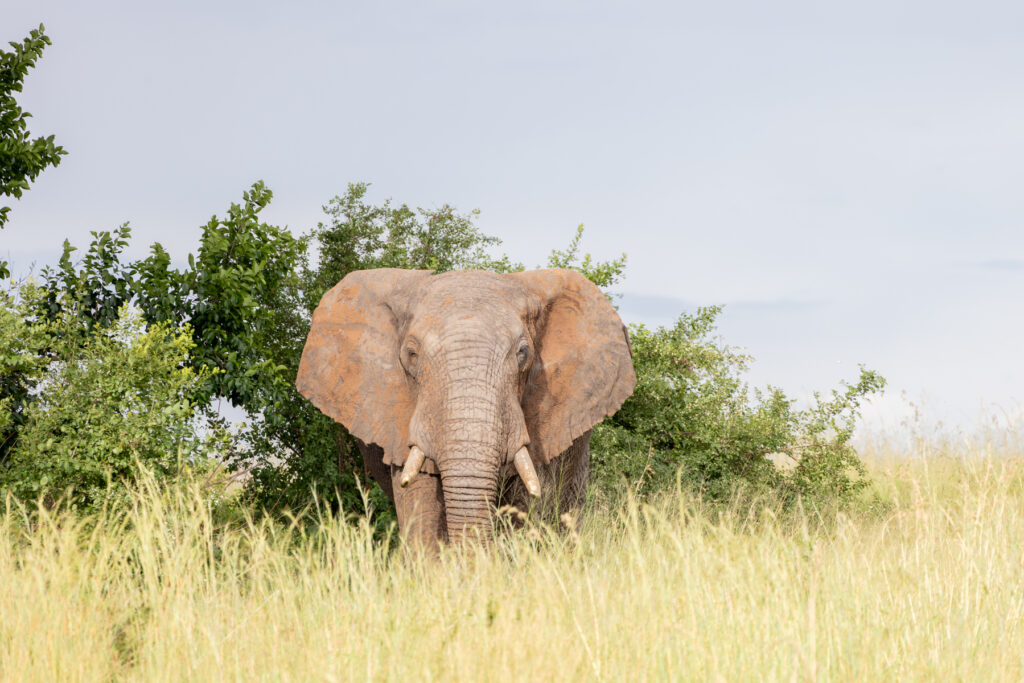
An elephant wanders towards us in Queen Elizabeth National Park (image by Mike Rutz)
Are there any images that are particularly special to you?
It was when we were driving for a long time through Queen Elizabeth National Park, searching for the tree-climbing lions. Finally, our local guide, Paul, spotted a lion sleeping in a tree. What an adorable young lion it was! As we were photographing it, we discovered another young lion, and to our surprise, there was even the mother resting in the same tree. We slowly moved the vehicle closer, while taking photos of them. Suddenly, the sky darkened, and a heavy downpour began. The lions, startled by the rain, climbed down from the tree and disappeared in a second. Still, the sight of those lions was truly unforgettable and remains one of the most special moments of the trip.

A sweet, curious Lion cub in Queen Elizabeth National Park (image by Mika Rutz)
Why did you enjoy these images so much?
It was partly because it was the first time we had ever seen wild lions. But we were so lucky to arrive there just before the rain, we could observe how they were resting, and we left quickly to get shelter.

Touching moment between a mother and baby rhino (image by Mika Rutz)
Would you return to Uganda for photography?
We had wonderful observations of all our target species, and I am very satisfied for the time being. There are still many other places I haven’t seen yet, so I’d like to explore those first.

Beautiful portrait of a Red Colobus Monkey. Normally very shy, good photos of this species are rare and very special (image by Mika Rutz)