
Petaca – Artist Mark Adlington’s Affection for one of Chile’s most famous Pumas
6th November 2025

“Petaca, queen of Patagonia. A year later, I am still haunted by her extraordinary aura of regal certainty. The 10 days spent in those mountains will always be with me. Despite being warned off by almost everyone, only 23 carat gold seemed appropriate, however unfashionable”. – Mark Adlington
Thank you for introducing us to your wonderful paintings and sculptures. Please tell us a little more about where you are from, where you now live and what inspires you to create art.
I was educated in the UK, but our family home was in the south west of Ireland, right on the Atlantic, and a childhood spent exploring rockpools and swimming with seals was instrumental in instilling a great love and curiosity for nature and wild places. I have always felt very happy in my own company, and have a natural capacity for wonder which gives me great patience (much needed !) when watching wild animals. In essence, I think it’s a drive to understand other species that compels me to draw, paint and sculpt – combined perhaps with an unwillingness to let go of the often magical experiences spent in their company.

A selection of Mark’s concept sketches of Petaca (image by Mark Adlington)
Who or what are your influences?
I grew up with a lot of Chinese brush paintings by early to mid-20th-century Chinese masters, and I think that has been influential in finding it normal not to place figures within the landscape ( which is the usual European convention ). I have always loved Palaeolithic animal paintings and sculpture -that combination of a superlative understanding of the subject matter with great simplicity. Beyond that, I have been influenced by a very eclectic range of artists and sculptors from Picasso to Marlene Dumas, and also particularly love 20th-century British painters like Peter Lanyon and Roger Hilton.

Mark at home in his studio during the late 90s (image courtesy of Mark’s website – markadlington.com)
Do you have a particular species you like more than others? Why do you feel drawn to that species? Do you have an ongoing body of work for that species?
People always ask me what my favourite species is, but in reality, it depends on the moment. I am a serial monogamist when it comes to animals and tend to concentrate pretty much exclusively on one species at a time, sometimes for many years. I suppose the one constant is the seals (both species) of my childhood, which I still spend long days with when at home in Ireland. Currently, though, I am obsessed with the puma, after a mind-blowing 10 days in Chilean Patagonia with Wild Images. In this case, though, it’s not just any puma, but Petaca in particular, who had, for me, a particular star quality – a combination of astuteness, intelligence, power and beauty which I found deeply compelling. I have built up a large collection of drawings, paintings and pastels and hope to show these with the sculptures I am currently working on.

Petaca and one of her cubs in the Mata Negra (image by Mark Adlington)
Tell us a little more about your creative process from the time you are in the field to when you come home and finish your pieces.
My process varies a lot depending on the species, although it always begins with as much time spent with the animal in question as I can possibly have. This time can be shortened by weather conditions ( for example to film underwater in Ireland you need a rare combination of weeks of calm conditions and light) or finances ( I would love to have spent a whole year on the mountain in Patagonia but this is an exclusive bucket list experience so I had to be content with the incredible 10 days that we had !). In an ideal world, I would sketch and film as well as observing passively, but it can be tempting to take reference photographs when time is short, particularly as the quality of a zoom lens gets you that much closer. In those instances, I do sometimes fill sketchbooks with studies of captive animals, despite a certain ambivalence about zoos, as it is invaluable to make marks with the speed and concentration that life drawing demands. After that, I spend long months or sometimes years in the studio trying to work out the best way to convey what I felt when in the presence of another species.

Petaca in the mixed grasslands and Mata Negra of Torres Del Paine (image by Mark Adlington)
Which is your favourite medium?
All media have advantages and disadvantages, and they do different jobs. Watercolour has a life of its own if you let it do its own thing, whereas oil paint needs more direction but is far more adaptable. Pastel is basically raw pigment and can have a timeless, earthy feel. It can take time to pair up an animal and a medium, and recently I even resorted to collage to try to convey seals in the complexity of the Atlantic underwater environment and kelp forests. A great joy was being able to work directly with water-based media in the desert in Oman and Sharjah because the air sucked the moisture from the page before the brush had even left it – impossible in damp European conditions. In the end, I am led by the challenges inherent in the species I am working with and try to adapt accordingly.
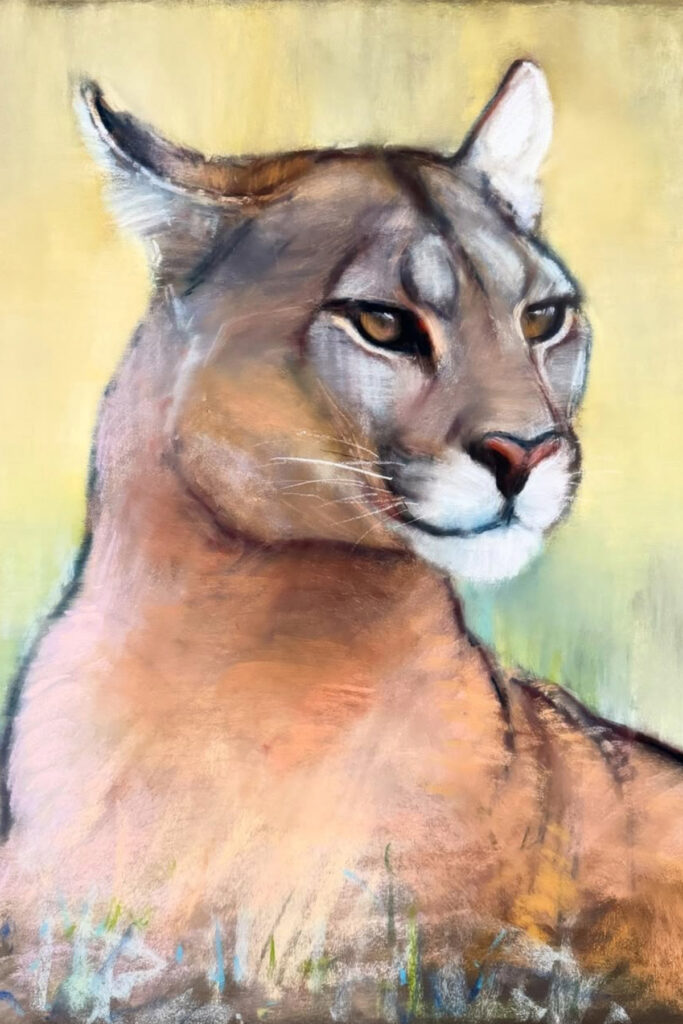
Mark has worked with soft pastels for decades but incredibly this was the first time he had used the paper that is designed for the medium. Portrait of Petaca in Pastels (painting by Mark Adlington)
During our tour to Chile, what drew you to Petaca in particular?
Thanks to superlative tracking from Jorge and Mauricio, I believe I was lucky enough to see 14 different pumas on the Wild Images tour – some for extended observation and some for a fleeting second. I noticed that Escarcha was a huge favourite with the photographers, with her beautiful grey coat and green eyes, and we had an extraordinary post-coital moment with the powerhouse that is Dark. For me, though, Petaca had a star quality which was more than physical beauty – she had a calm authority and intelligence which was compelling. Combine that with a powerfully muscular physique, striking facial structure and an inherent wildness, and I knew I had found my muse! Of course, the addition of her two 10-month-old cubs was the icing on the cake, and it has been wonderful to follow their progress via guides and photographers over the year.

Beautiful Petaca and her two 10-month-old cubs (image by Mark Adlington)
Your concept art for your sculpture of her is stunning. Did you start with pastels to create this?
Thank you! Most of the work I have made of Petaca is mixed media on paper using raw pigments and watercolour. I did begin a series of large pastels but was prevented from continuing by a shoulder injury, which in the end was a blessing in disguise, as it gave me pause for thought, and I noticed that the drawings and paintings were inherently sculptural, which led me to clay.

Petaca in clay. This was Mark’s first foray into clay sculpture (image by Mark Adlington)
Is your sculpture of Petaca your first work in bronze? You said you were warned off using gold. May we ask why? Is the sculpture a combination of bronze and gold?
I have cast a few things in the past – notably a large head of a Przewalski horse made directly in plaster. Casting things in bronze is a hugely skilled, time-consuming and expensive process. I borrowed a friend’s sculpture studio and materials to experiment with clay and immediately loved it. Without a kiln of my own, though or any technical experience of firing, the only way to be sure not to lose the work that I had put in was to take the pieces to the foundry and have them cast.

One of Mark’s sketched concepts of Petaca (image by Mark Adlington)
Can you walk us through the steps?
For this head, I worked in terracotta using a puma skull cast I found on eBay and a selection of my drawings. I made a makeshift armature from a bottle glued to a board, but eventually found it too column-like like so I made cuts instinctively to create the “bust “that I ended up with. It’s best to cast from wet clay that is leather hard, so I just about managed to get her to the foundry in time.
A mould is then made from which a cast is taken in wax, which you can then continue to work on if necessary. After that, the bronze is poured into the cavity left when the wax is melted out (hence the lost wax process).

Petaca in wax (image by Mark Adlington)
Once the skilled artisans in the foundry clean up and finish the bronze sculpture and it is then ready for patination. Patinating is yet another highly skilled art involving heating the sculpture with a flame thrower and mixing various chemicals to change the brassy colour of the raw bronze to taste.
Mark describes the final ‘patination’ of Petaca by Bronze Age as nerve-wracking (video by Mark Adlington)
I had a clear vision of this piece in gold leaf; however, as I have always been obsessed by Bourdelle’s head of Apollo in the Musée d’Orsay and felt there was a link with the intensity and regal nature of Petaca. Gold leaf is now often associated with bling and poor taste, so I got little encouragement from artist friends. However, by patinating the bronze first and then rubbing back and distressing the 23 carat gold once gilded, I am very happy with the end piece, which is hopefully classy and timeless like its subject!

Detail of Petaca’s gold touches on bronze (image by Mark Adlington)
What led you to work with Bronze Age London?
I had worked with Bronze Age many years ago and always got on well with the team. They are very encouraging and allow a much greater degree of involvement than other foundries. Geography was also a factor, as given the number of visits necessary over the whole process, a foundry outside London would have involved a lot of hours in traffic – my patience with nature is not unfortunately replicated in situations involving urban stress! Bronze Age has a well-deserved reputation for quality, which is essential when dealing with Fine Art.
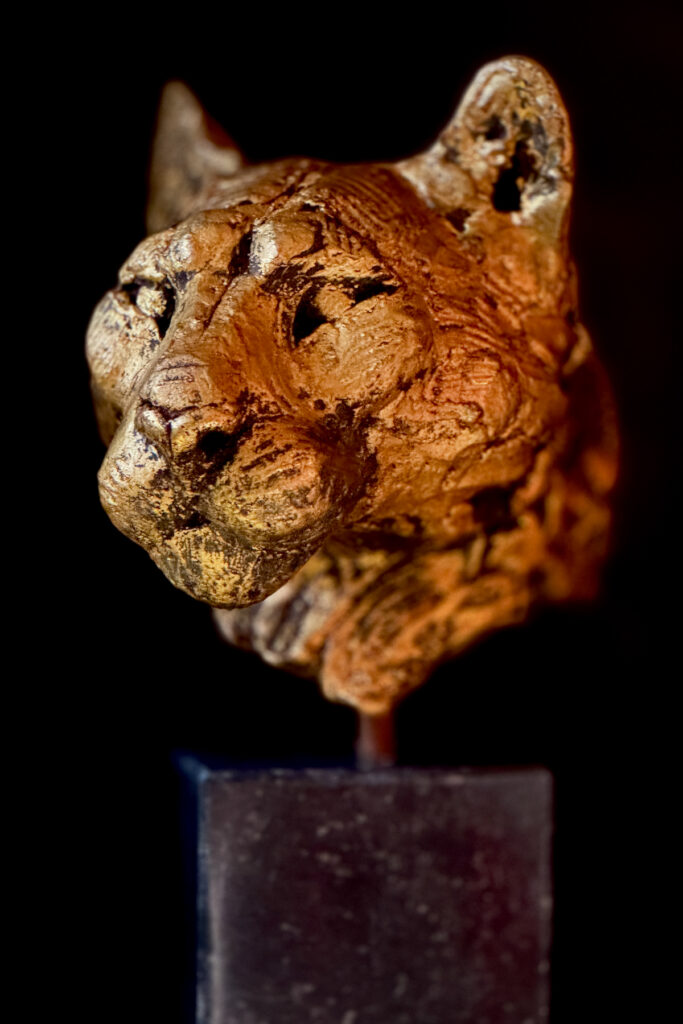
The finished piece (image by Mark Adlington)
How long did it take you to create the sculpture from concept to final product?
I suppose you would have to include the time planning how best to spend time in Patagonia, and at what time of year, and then getting there! Then processing that incredible month, editing film and photographs and drawing for 8 months, but if we are only talking about the making of the sculpture, then it was probably 3 or 4 months due to the many stages involved in the casting.

One of the versions of Petaca in bronze. The mount rock is a piece of granite from the foreshore of the Thames (image by Mark Adlington)
What are your plans for it? Will it be for sale? Do you plan to use it in any exhibitions?
There will probably be an edition of 7 casts for the gilded Petaca portrait. I am then hoping to include it in an exhibition with all the Patagonia work in 2026. Now that I have begun working in clay, I have many ideas for other puma sculptures, and Petaca will, of course, be the main model. I have started that conversation with my gallery, so watch this space!
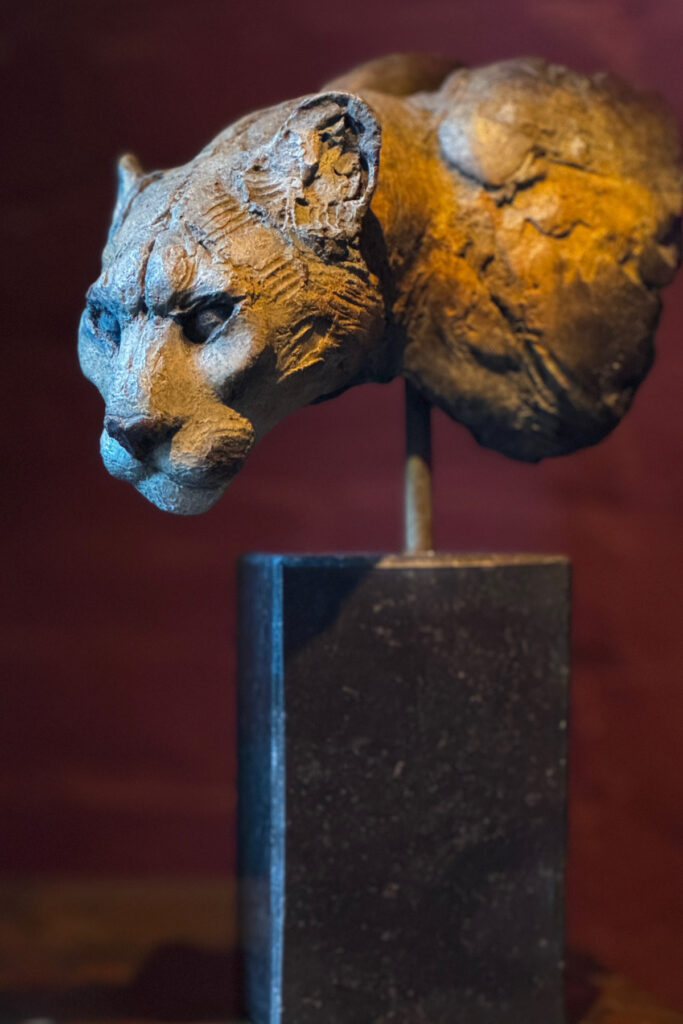
Finished Petaca in bronze (image by Mark Adlington)
What are your future plans?
I’m still very focused on Petaca, so I haven’t really thought beyond Patagonia for the moment. I feel that I have unfinished work in Africa, where I had begun to make great friends and contacts before the Pandemic, and at some point, I will have to be brave enough to tackle the Atlantic coast in Kerry, which is so close to my heart. No doubt something quite different will present itself along the way, though, and I will suddenly be plunged into the next obsession. Let’s see!

Mark has held exhibitions and has also published books on his art. For more information and how to purchase his work, please visit his website – markadlington.com
Where can people see and buy your work?
I have a lot of work on paper and canvas in my London studio, which can be visited by appointment via my website markadlington.com. There is an extensive bestiary collected over the past 30 years or so!
I can also be contacted via Instagram markadlington, which is probably the best place to keep up with the work.

Self-portrait of Mark in his ‘mountain office’ (image by Mark Adlington)
Previous Article
In Your Eyes – Interview with Robert Sachowski – Chile 2025