
In Your Eyes – Interview with Agne Vaitkeviciute – Galapagos 2025
25th November 2025

Stunning image of a Brown Pelican in flight (image by Agne Vaitkeviciute)
Tell us a little more about your photography journey. How long have you been taking photos?
I started taking photos when I was in school (a very long time ago). I had a very simple film camera at that time, and my photography was limited to some holiday snapshots.
When I turned 30 years old, I received a present from my parents – my first DSLR camera. I started using this camera on different occasions; however, I was not paying attention to the camera settings and was mainly using it on automatic mode.
My serious photographic journey started in 2020 during the outbreak of the COVID-19 pandemic, when travelling and even going to work became suddenly impossible. I started spending much more time with my camera in nature, photographing the fauna and flora of Luxembourg, where I have been living for the last 8 years. Photographing nature became my biggest passion, and now I cannot imagine my weekends and holidays without a camera in the natural world.

I took this shot of the very distinctive Sally lightfoot crab (Grapsus grapsus) during my photography trip to the Galapagos Islands in May this year. We arrived at the small port of Puerto Velasco Ibarra on Floreana Island and disembarked our small boat. While we were walking along the jetty, I noticed plenty of Sally lightfoot crabs. They were everywhere – on the jetty, rocks, resting iguanas (with whom they form a symbiotic relationship). One of them immediately attracted my attention: the crab was literally climbing the yellow-blue-coloured small stairs of the jetty. Luckily, the very determined crab was not in a hurry (even though they can be really fast!) and let me take several shots. It turned out to be a colourful photo with the vivid red, yellow, and blue colours of the crab contrasting so well with the yellow colour of the stairs of the jetty in the background. Those three dominating colours – yellow, blue, and red – and some casts of brown-grey of the jetty suit very well together and display the Sally lightfoot crab in its rather unusual environment. Sally Lightfoot crabs are very common, brightly-coloured coastal scavengers with a very general diet. That makes them special and an important part of the Galapagos ecosystem, as they keep the shore clean of any organic debris. They can jump from rock to rock, run in four directions, and, even more surprisingly, climb up vertical slopes! (image by Agne Vaitkeviciute)
What are you passionate about besides photography? What do you do in your free time?
There are many things I am passionate about when I am not taking photos. However, photography takes most of my free time, and I sometimes wish I had more time for other
hobbies. As a nature lover, I like spending time outside as much as possible. I enjoy trekking, travelling, swimming, reading, and learning new languages (I am currently learning
Luxembourgish). Twice per month, I volunteer in a refuge for wild animals (a wildlife rehabilitation centre). It’s always a very good feeling to help animals in need and help
them recover.

Galapagos Dove perched on Prickly Pear (image by Agne Vaitkeviciute)
What drew you to visit the Galapagos?
Mostly passion for nature and curiosity. A long time ago, when I was a child, I discovered a book about wild islands, including the Galapagos, on the shelf at my grandparents’ place. That book immediately caught my attention as I always enjoyed nature. At that time, I could only dream of visiting the Galapagos Islands. Many years after, in 2023, I had an opportunity to talk to a fellow nature photographer, and he mentioned he had been to so many wonderful places, including the Galapagos. After that conversation, I remembered the book I discovered a long time ago and said to myself, I really want to go to the Galapagos for photography. It was the right moment, and I made a decision fast, without much hesitation.

The old man of the Galapagos Islands – a Galapagos Tortoise (image by Agne Vaitkeviciute)
What camera gear did you use on your tour?
I had a Nikon Z8 camera body and three Nikon Z lenses: 180-600 mm, 24-200 mm and 100-400 mm. I also had an additional camera body, another Nikon Z8. In fact, theadditional camera belongs to my husband, Daniel, who was travelling with me. I realised later during the trip how useful this additional camera body was!

Portrait of a Lava Lizard (image by Agne Vaitkeviciute)
What were your first impressions of the Galapagos for photography?
At the beginning, I was a bit overwhelmed by such a wide variety of animals everywhere, so it wasn’t an easy task to decide which of them to photograph!
The rules of the Galapagos National Park allow walking on the islands on certain paths only and for a limited duration. This complicated photographing from the very beginning.
Sometimes it was impossible to take pictures as a certain animal was too close, too low, or too high, there was vegetation in between, etc., and I could not go to a better location as it was not allowed to leave the path. However, I fully understand the necessity of such rules, and I respected them.

I took this photo while on a photography trip to the Galapagos Islands in May this year. I was so fortunate to witness and photograph an elaborate courthship dance of this Waved albatross (Phoebastria irrorata) couple on Española Island of the Galapagos archipelago. Waved albatrosses are monogamous birds, and they have complex courtship rituals. This couple came to Espagnola Island to form a couple and breed, and their courtship dance involved coordinated movements such as bill circling, clacking, bowing, and head nodding. Waved albatrosses are critically endangered pelagic birds. Their main threat is fishing activities, as baited hooks used for such activities can be deadly for these fascinating birds. Another threat is plastic pollution (image by Agne Vaitkeviciute)
What surprised you about your trip there?
I was really surprised to see how touristic the Galapagos Islands are; there were plenty of tourists and different kinds of boats everywhere … This was indeed a different picture
compared to what I imagined before we landed on Baltra Island. I was positively surprised by how well prepared our guides and the crew of the catamaran were. They did their very best during the whole trip, and I am grateful to them all for making the Galapagos adventure a lifetime experience! All fellow tourists of our group were amazing, a big thank you to all of you!

Portrait of a young Galapagos Fur Seal (image by Agne Vaitkeviciute)
What were your frustrations on your trip?
Since I had never slept on a boat before, it was difficult to fall asleep on the catamaran at the very beginning of the trip. It took me a couple of days to get used to the constant
movement and the tropical climate. Limited/restricted time for walking on different islands, and the fact that we had to arrive and leave each island at a certain time complicated taking pictures. However, I fully understand the rules of the Galapagos National Park and the need to respect them. I also realised that most fellow tourists from our group had less interest in photography
and were more excited about just seeing different species of animals than photographing them. However, thanks to our guides, the itinerary could be modified a bit, and I got more time for photography on certain islands. It was indeed very helpful as I had more time to search for a better composition, light, and focus. Big thanks to you, Mike and Jairo! Having fallen down on Isabela Island, I realised my camera had been damaged. Luckily, thanks to my very well-prepared husband, Daniel, I could use his camera. That saved my trip.

I have taken this photo of these three male great frigatebirds (Fregata minor) on Genovesa Island during my photography trip to the Galapagos Islands in May this year. Great frigatebirds are birds emblematic of the Galapagos Islands, where they live in large numbers. As you can see in the photo, these three males are displaying with their inflated gular sacs in search of females. This is a very typical behavior of male great frigatebirds, which force air into their sac, causing it to inflate into a red balloon. As females fly overhead, the males move their heads from side to side, shake their wings, and emit calls. That was not an exception in this case.
Great frigatebirds are not the best friends of other seabirds as they not only feed on fish they catch, but also hunt other seabird chicks at their breeding colonies and even sea turtle hatchlings in coastal areas. Moreover, great frigatebirds chase other nesting seabirds and make them regurgitate their food. Obviously, this danger exists on Genovesa Island, where great frigatebirds nest in big numbers in the bushes shared with red-footed boobies and some other seabirds (image by Agne Vaitkeviciute)
Of all the animals you have photographed, which is your favourite destination to photograph?
I cannot say I have a favourite destination for photography. I try different locations as much as I can, and I enjoy taking pictures of both local and exotic animals.
I love long walks on the coast, and I really enjoy taking pictures of aquatic fauna. Maybe this is the reason why islands, including the Galapagos, always attract me so much?
While on the Galapagos Islands, I managed to photograph so many different interesting species – from Blue-footed booby to Waved albatross. I would definitely like to come
back here and take even better pictures of all these species.

Blue-footed Booby (image by Agne Vaitkeviciute)
Aside from photography, what other aspects of the tour did you enjoy?
I very much enjoyed the company of my fellow tourists, our guides, and the crew of the catamaran. Everybody in the group was super friendly during the tour; nobody complained when we had to get up early in the morning or during our walks on the islands. The crew provided the very best service during the trip; they were working day and night to make us enjoy the trip as much as possible. Our catamaran was great, we had comfortable cabins, and the food was amazing.
I tried snorkelling for the very first time in my life in the Galapagos, and I was stunned by how amazing the underwater world is! My husband Daniel bought a simple action camera for taking videos underwater, and we both used it while snorkelling. I enjoyed it so much that I am even considering learning scuba diving and starting to take pictures underwater. Easier said than done …

Light shines on the face of an iguana at sunset (image by Agne Vaitkeviciute)
What have you learned from your tour of the Galapagos?
A good shot is not always evident. As a photographer, you need to be prepared for any kind of situation, anticipate them, think about composition, react fast, and be able to change your camera settings within a second. Animals do not sit and wait; they move and change their position quickly. That was not an exception in the Galapagos, where I constantly had to adapt my camera settings to flying birds and shortly afterwards to resting sea lions, to name but a few. I realised I am not fast enough in certain situations, and I still have to improve this aspect of photography.
Animals living on the Galapagos Islands show no fear of humans. My long 180-600 mm telephoto lens was often unnecessary, and in some cases even a bad choice, as certain animals got very close to us. I lost precious time changing camera lenses and, on several occasions, regretted missing opportunities for better shots. Another reason to come back to the Galapagos.
The bright-blue sky of the Galapagos Islands complicated things further. I was sometimes struggling with this light; I did not want my pictures to be overexposed.
Finally, I have realised how important it is to anticipate what happens if your camera gets broken and be prepared for such situations before your trip, well in advance. As I mentioned before, I was lucky enough to be able to use the other Nikon Z8 camera body I shared with my husband during the trip.

Galapagos Penguin (image by Agne Vaitkeviciute)
What advice do you have for photographers visiting the Galapagos?
Please take preparations for granted and take an additional camera body and lenses, as you probably don’t want to come back with fewer or no photos at all if one of them or both gets damaged.
Also, learn to know your camera very well to be able to react quickly in the field and anticipate situations. Last but not least, in many situations, a long telephoto lens is not always necessary on
the Galapagos. Consider taking a shorter lens with you to be better situated if wildlife is literally right in front of you.

A comical pair of Blue-footed Boobys displaying (image by Agne Vaitkeviciute)
Which of the images are particularly special to you?
I have photographed so many amazing animal species that it is difficult to decide which pictures are particularly special to me.
Nevertheless, I would like to mention the ones with the emblematic Blue-footed boobies lifting their bright blue feet and dancing in front of each other during their sophisticated courtship rituals on North Seymour Island. Great and Magnificent frigatebirds flying high against the blue sky. Waved albatrosses engaged in their courtship on Espanola Island. And Marine iguanas are resting everywhere in the sun.

I have captured these Marine iguanas (Amblyrhynchus cristatus) on Fernandina Island during my photography trip to the Galapagos Islands in May this year. Marine iguanas, or Galápagos marine iguanas, are an emblematic species found only on the Galápagos Islands. When not diving in search of food (mostly algae), their typical behavior is to lie on the rocks/sand and rest. I have witnessed this behavior (or rather inactivity) during an afternoon walk on Fernandina Island. There were plenty of marine iguanas basking in the sun, but I found these three the most photogenic. They were not only enjoying the sun but were also sneezing to get rid of excess salt they ingested while feeding in the ocean. This behavior is super important as it helps to maintain a proper salt balance in their bodies. Unfortunately, marine iguanas are considered vulnerable or even endangered species, as cats and dogs introduced by humans prey upon their juveniles. El Niño events also decrease their population by diminishing their food supplies. Plastic pollution is another important threat (image by Agne Vaitkeviciute)
Why did you enjoy these images so much?
These photos witness a typical behaviour of these animals in their natural environment. I read so much about Blue-footed boobies, Frigatebirds, Waved albatrosses, and Marine iguanas before I landed on the Galapagos Islands. Having had an opportunity to photograph them was a dream come true.

Wharf traffic is never just boats on Galapagos (image by Agne Vaitkeviciute)
Would you return to the Galapagos for photography?
Definitely! I really need to take better Blue-footed boobies’ photos; there are certain things to improve here. I would like to have an opportunity to spend more time on
certain islands.

A Great Frigatebird in flight (image by Agne Vaitkeviciute)
You will have realised how obsessed I am with my picture quality. If you have some spare time, you are very welcome to visit my photography website and see some of my pictures, including the ones from the Galapagos: https://agnevaitkeviciute.com/galapagos-islands
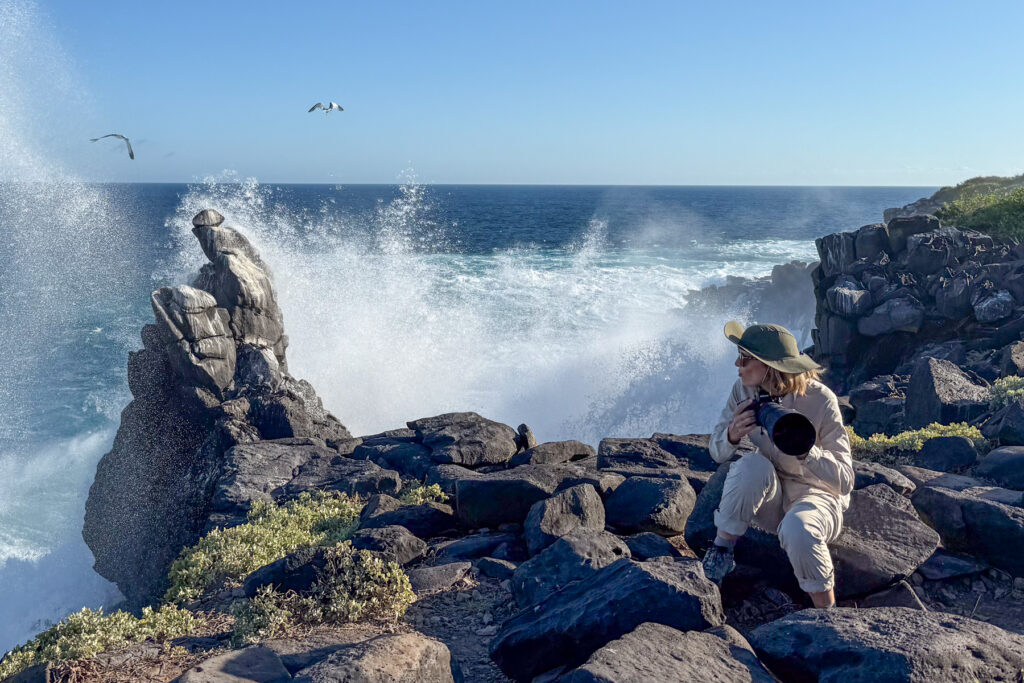
Agne braving the wild coast of Galapagos to photograph passing seabirds (image by Agne Vaitkeviciute)
Previous Article
In Your Eyes – Interview with Mika Rutz – Uganda 2025Next Article
One tiny boy. One huge story. Helping Antoine