
Namibia Wildlife Spectacular Tour Report 2026
5 October 2026
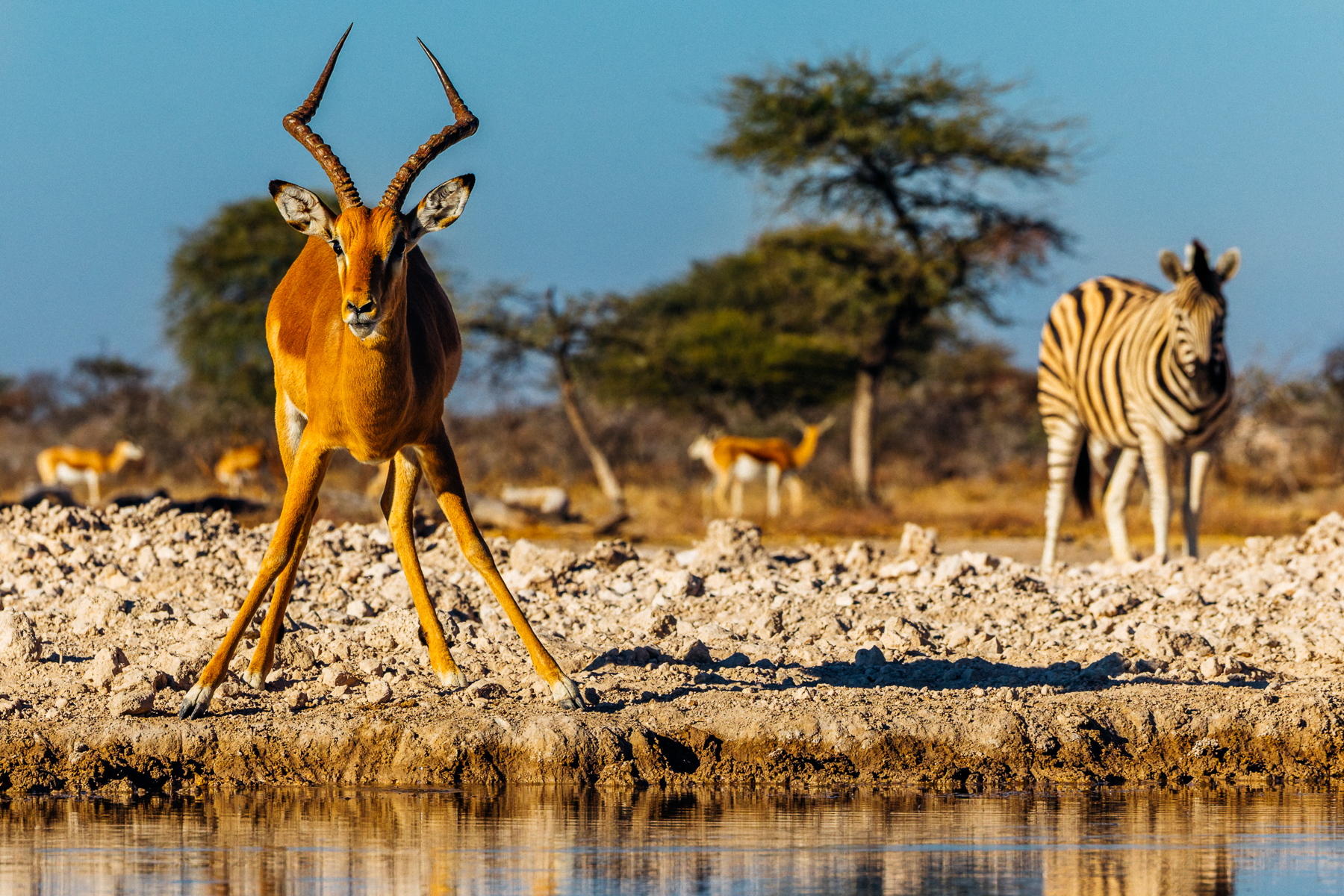
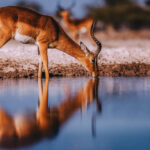
A Black-faced Impala spreads its front limbs wide so it can drink from a waterhole in Namibia's Onguma Reserve. Life in Namibia is dictated by where wildlife can find much needed hydration in arid environments (image by Virginia Wilde)
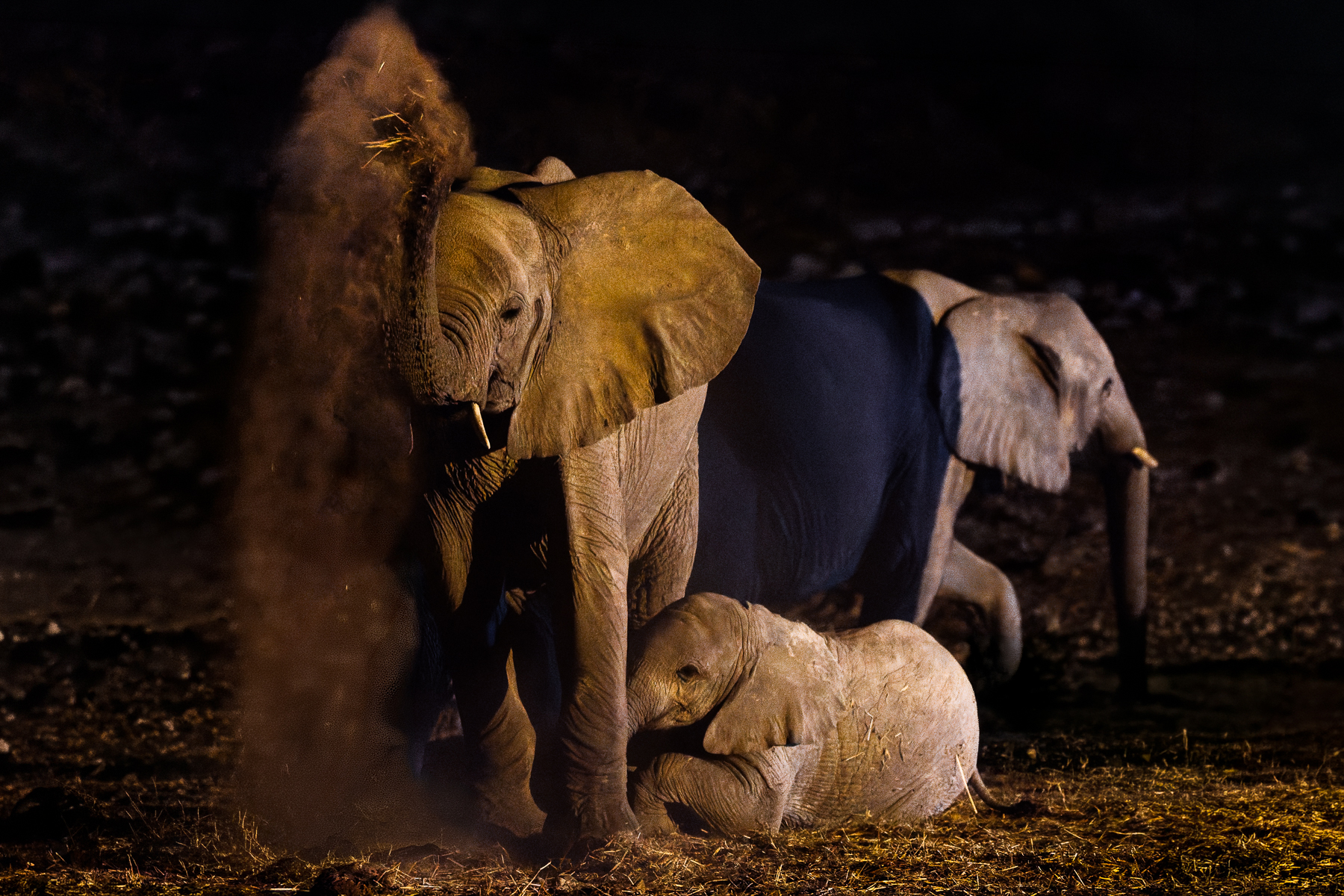
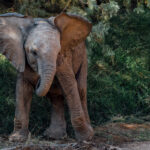
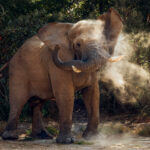
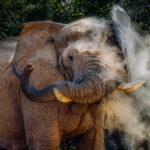
A juvenile African Savanna Elephant hurls dust over itself at Etosha National Park's Okaukuejo waterhole, after enjoying a deep drink. In Etosha, elephants walk 20km a day between reliable water sources, but travel 50 km or more during times of drought (image by Virginia Wilde)
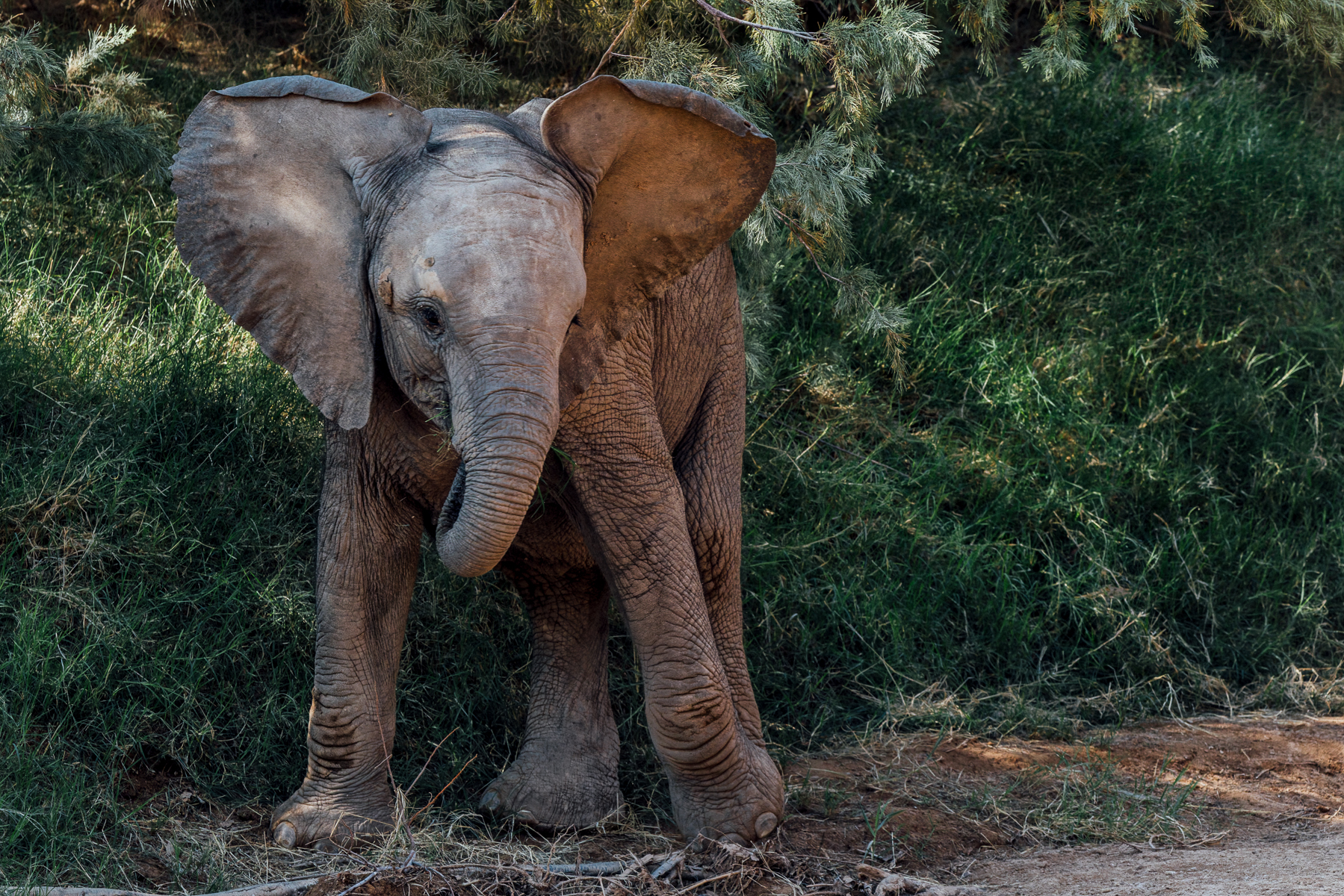
A juvenile desert-adapted African Savanna Elephant looks almost shy as it eats grass by the dried riverbank in Namibia's Hoanib River Valley. Young Elephants here have a steep learning curve if they are to survive in this harsh environment (image by Virginia Wilde)
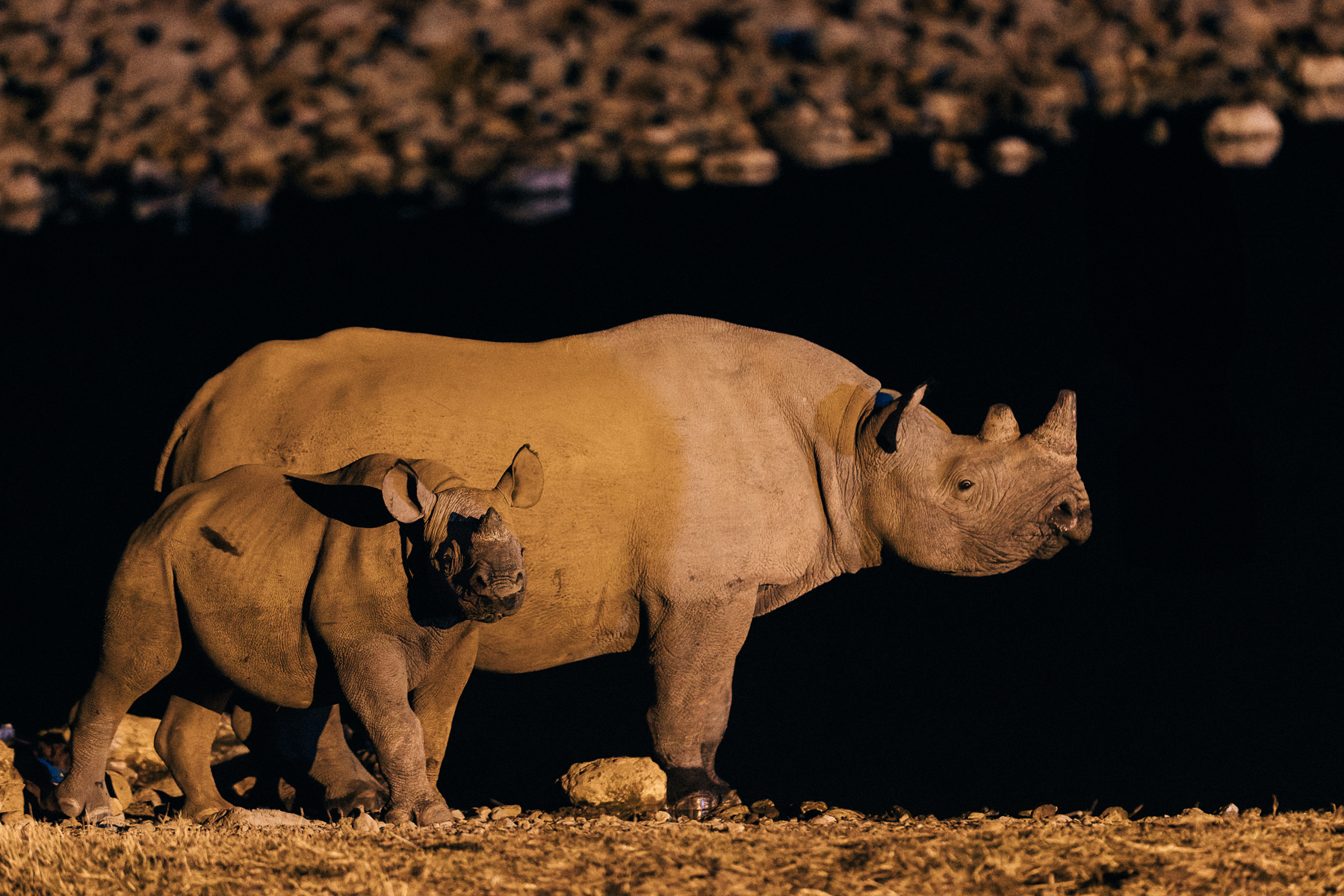
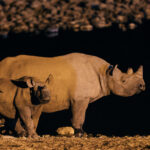
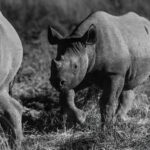
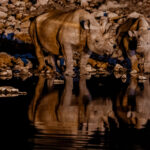
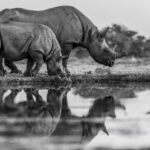
A mother and juvenile Black Rhinoceros cautiously approach the water's edge at Etosha National Park's Okaukeujo waterhole. This park is famous as a stronghold for the South-western subspecies of Black Rhino, holding 85% of the world's population (image by Virginia Wilde)
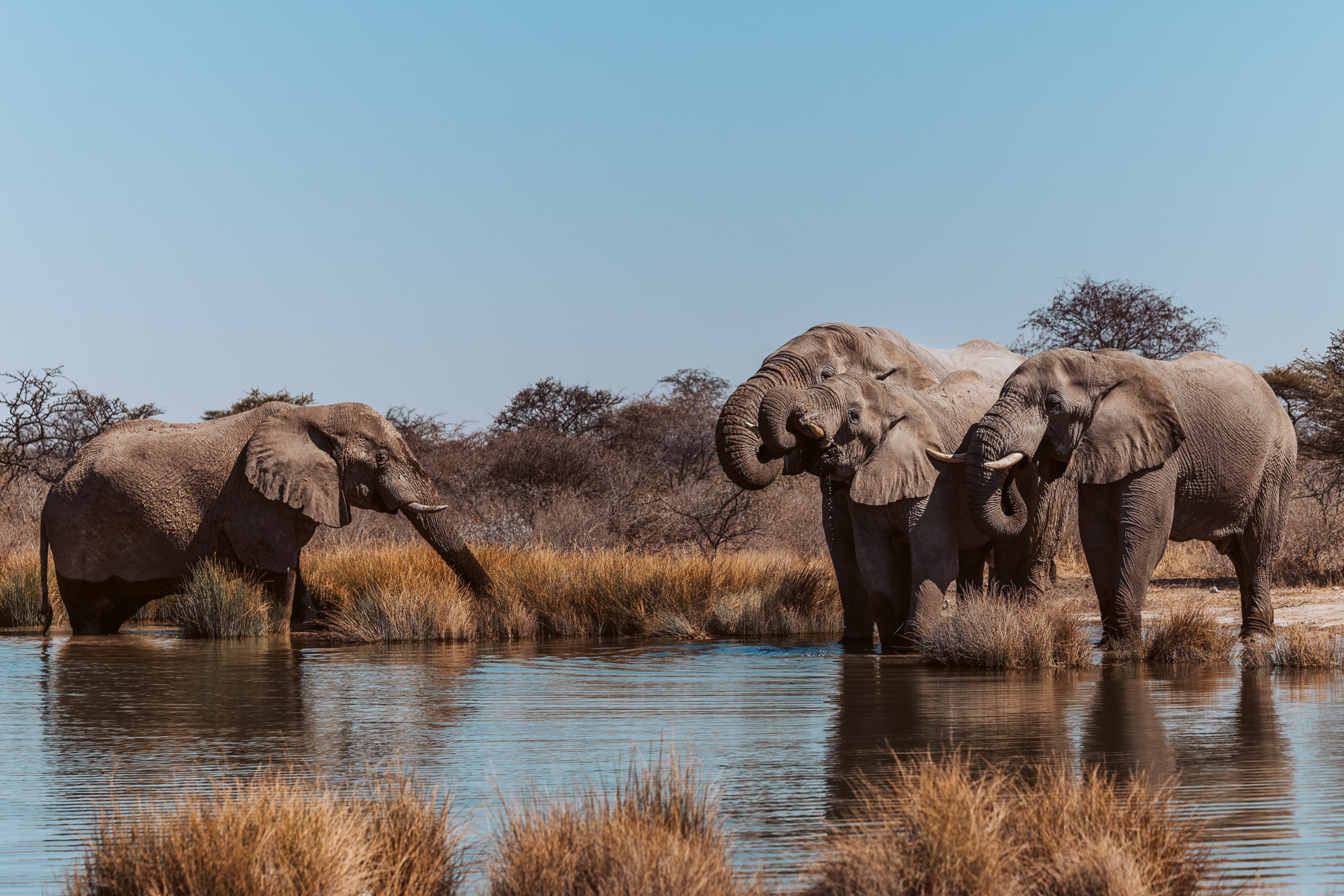
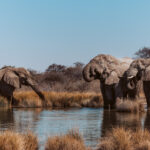
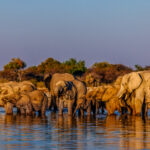
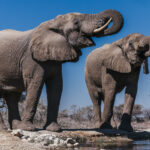
A small herd of African Savanna Elephants gather to drink at one of the largest waterholes in Namibia's Onguma Reserve - a sprawling wildlife sanctuary bordering the vast Etosha National Park (image by Virginia Wilde)
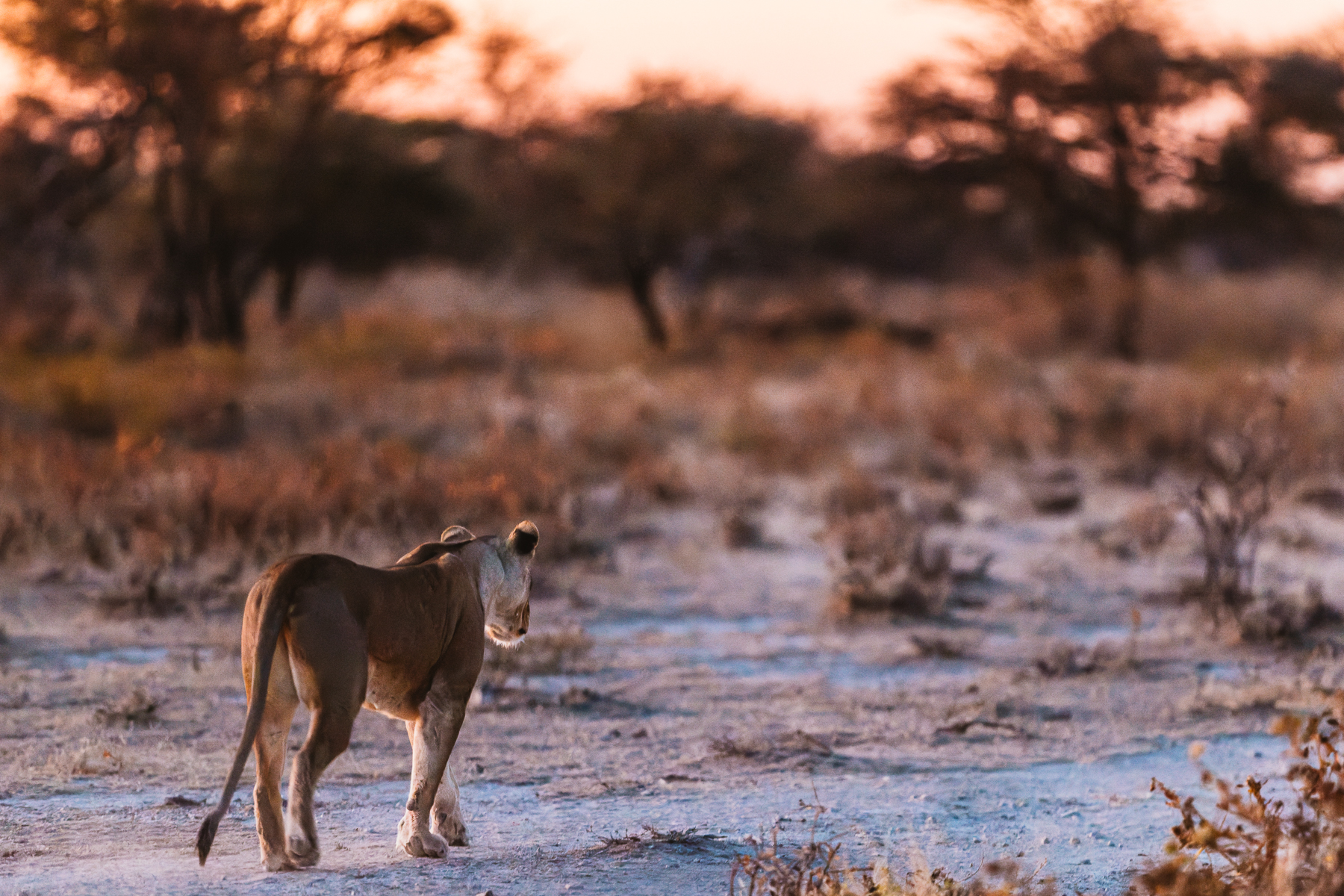
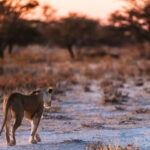
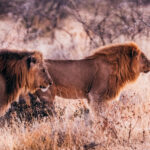
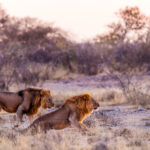
A Lioness pads her way through vegetation on the Onguma salt pan, while 100 metres behind her, two Lion brothers follow. The most likely explanation is that she was coming into oestrus - with the pair following her for several days while competing for mating opportunities (image by Virginia Wilde)
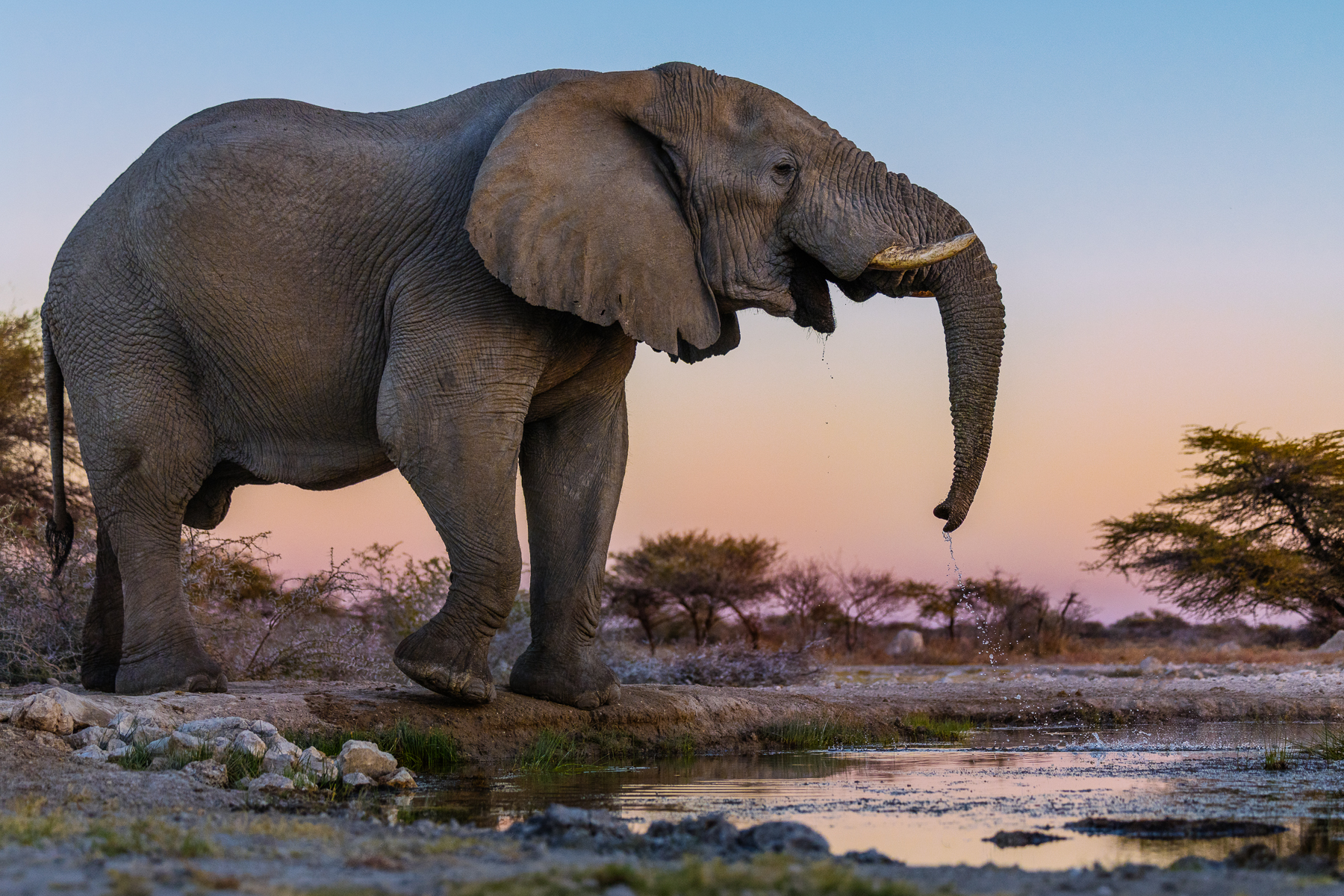
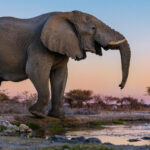
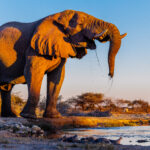
The sunken hide in Onguma Reserve, Namibia, allows for beautiful encounters with animals like this magnificent male African Elephant. To see an animal this large, this close, was breathtaking (image by Virginia Wilde)
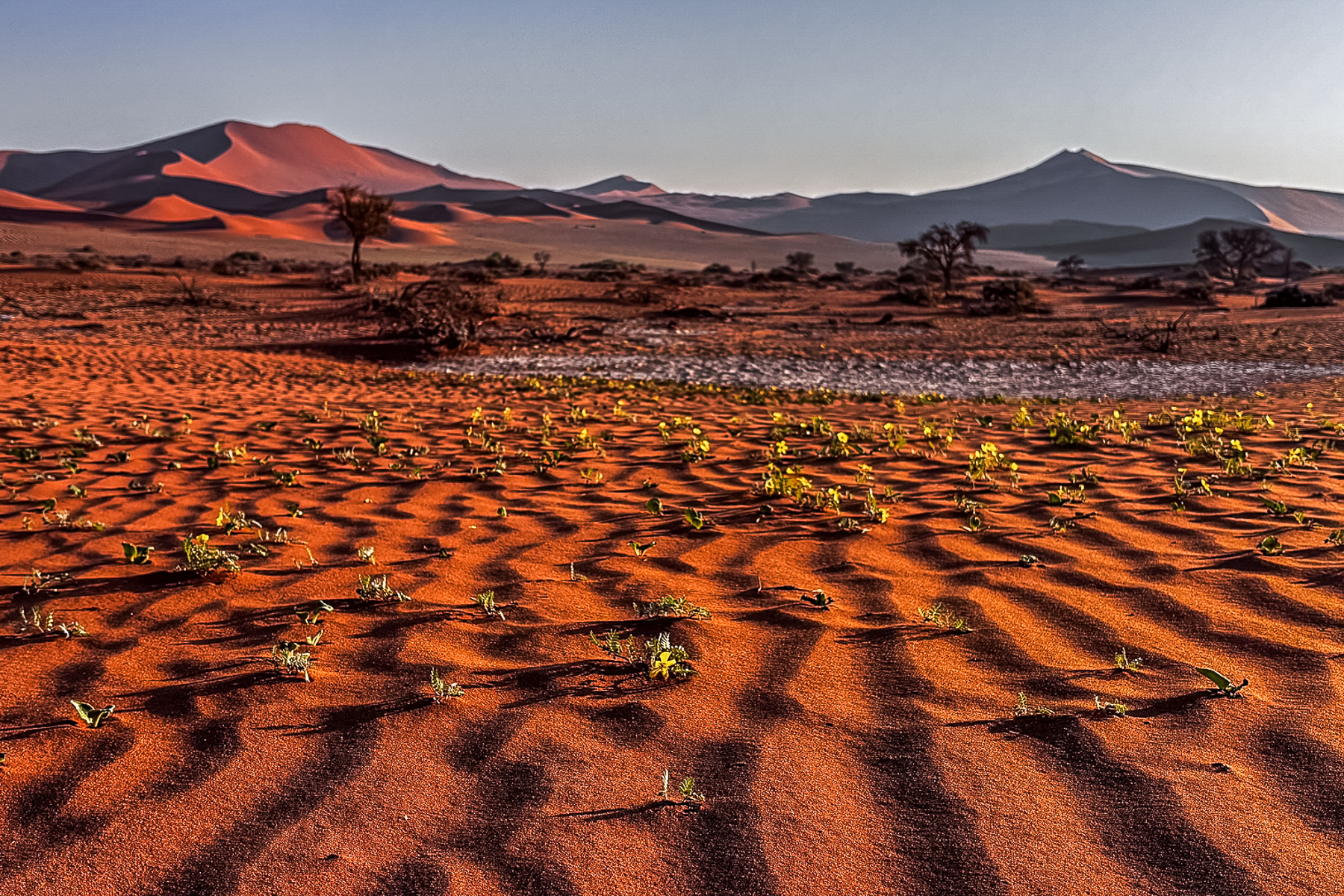
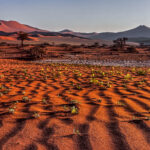
The Namib after rain is a desert transformed, with tiny shoots pushing through the rust-red sand beneath the great dunes of Sossusvlei (image by Virginia Wilde)
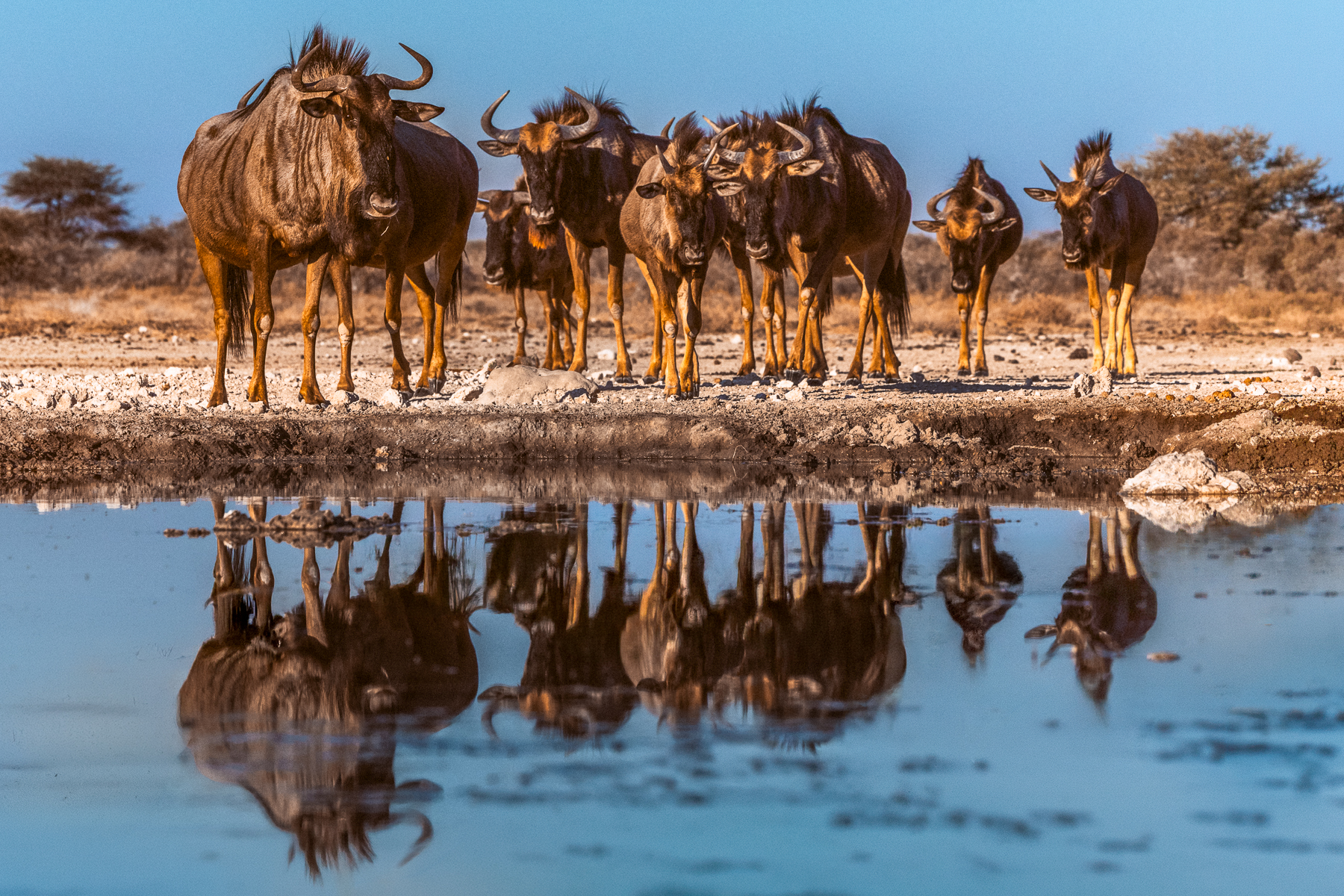
A herd of thirsty Blue Wildebeest walk towards the waterhole in Namibia's Onguma Reserve, stopping to drink before leaving as swiftly as they arrived (image by Virginia Wilde)
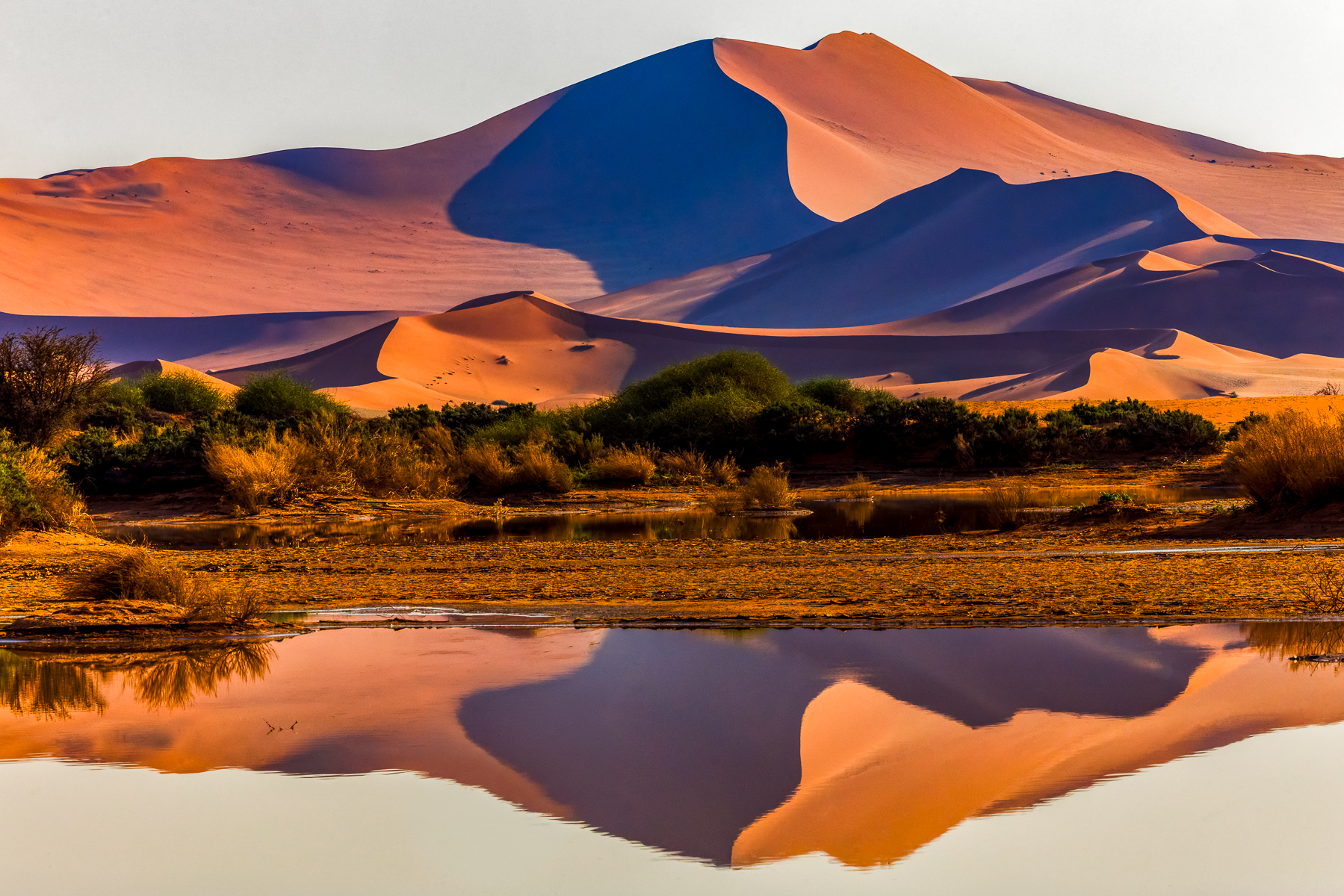
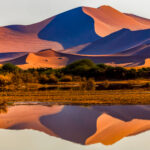
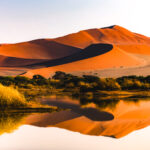
A wide-angle 'classic' view of the Sossusvlei dunes, but made all the more special thanks to the once-in-a-decade event where the ephemeral pans fill up with water, creating striking reflections. Here, the mirrored landscape doubles the sculptural forms of the Namib, bringing together the desert's renowned colour, light and geometry (image by Virginia Wilde)
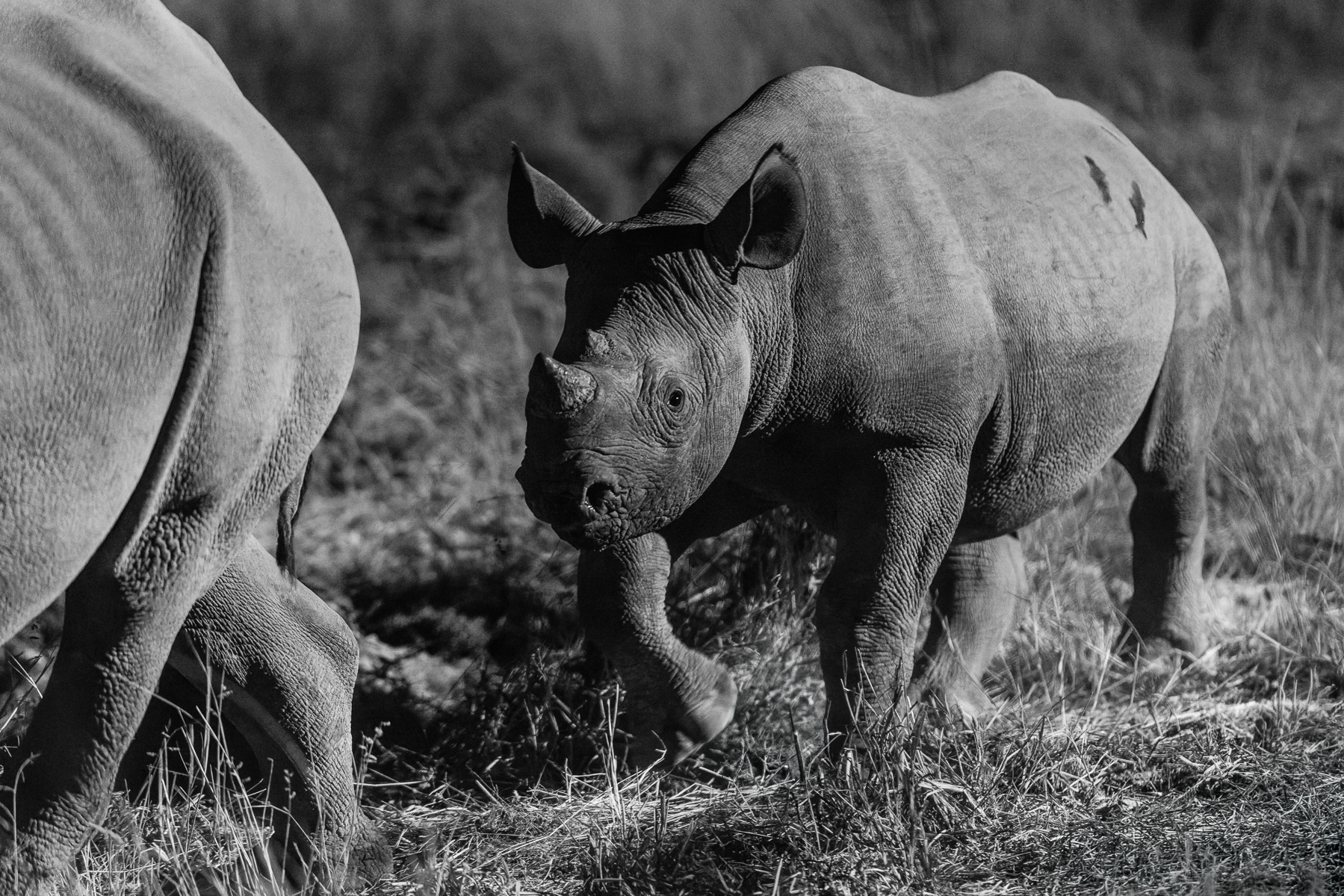
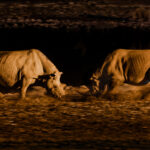
One of my favourite wildlife encounters of our 2026 Namibia tour was watching this juvenile Black Rhino caper about at the Okaukeujo waterhole - and its mum's endeavours to protect her young: charging at any male rhino that came too close (image by Virginia Wilde)
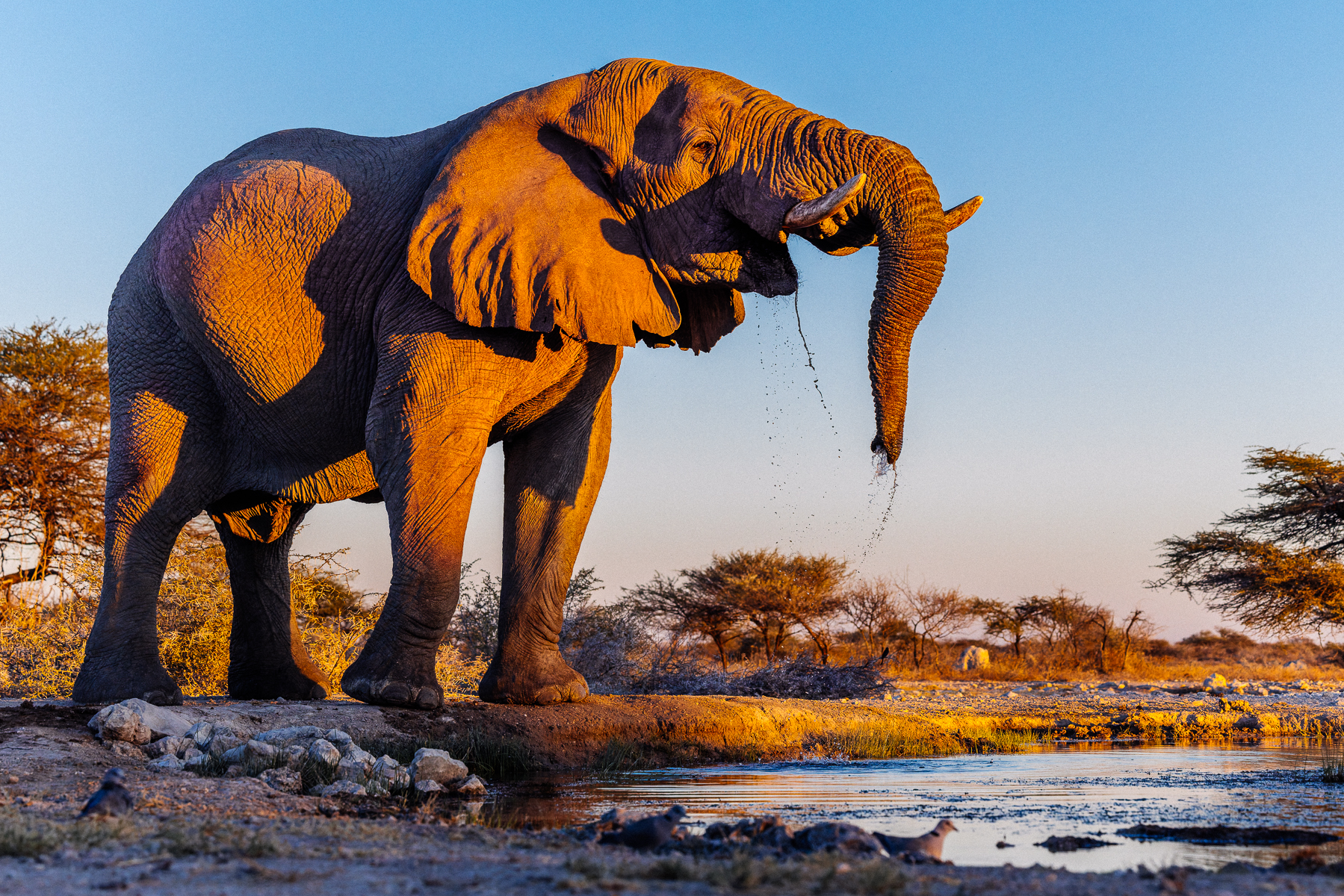
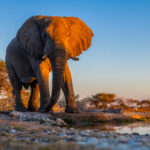
Beautiful sunset light falls on an African Savanna Elephant bull as he drinks from the waterhole in Namibia's Onguma Reserve - sending water droplets spraying (image by Virginia Wilde)
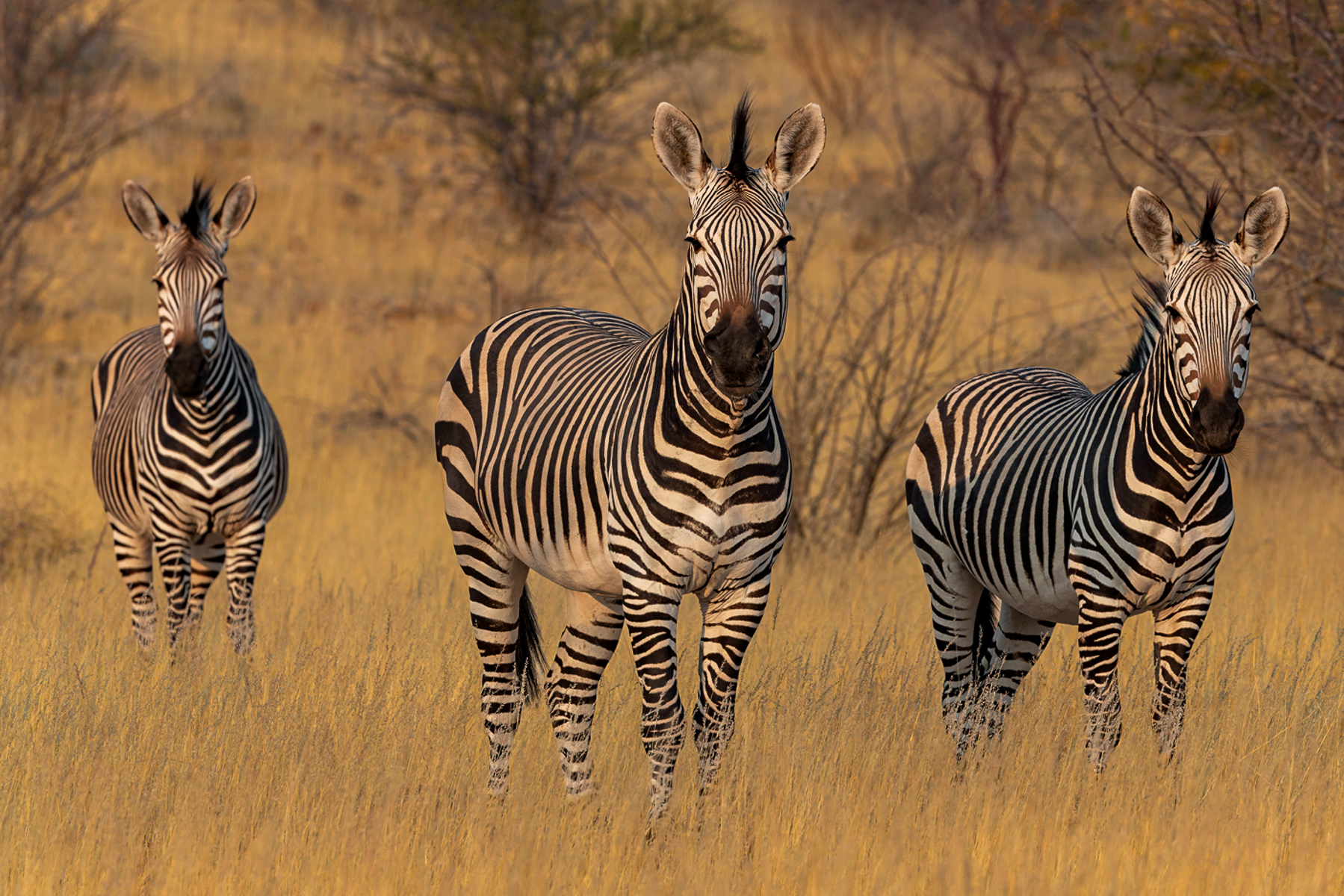
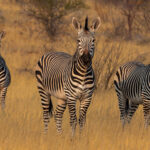
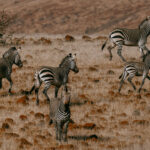
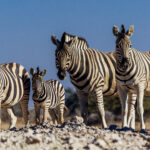
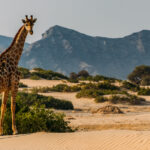
We were overjoyed to find this small herd of Hartmann's Mountain Zebra as we drove towards Namibia's Hoanib River Valley. Namibia is a major stronghold of this zebra subspecies, with smaller populations extending into southwestern Angola. They are exceptionally well adapted to steep, rocky and arid mountain country, able to negotiate terrain that is difficult for many other large herbivores (image by Mike Watson)
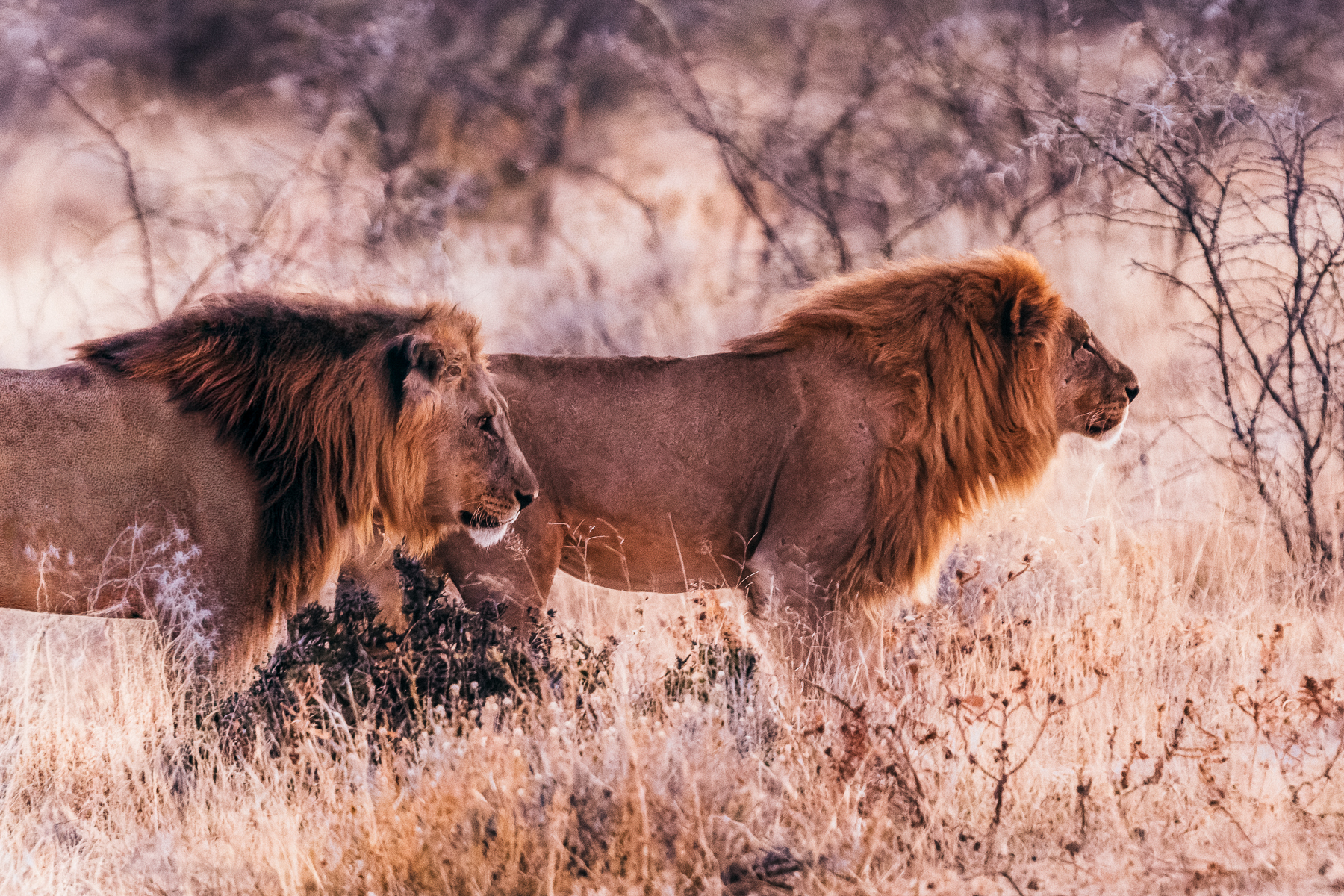
Soft light falls on a pale of wandering African Lions in the faded coloured vegetation of the Onguma Reserve. Like the neighbouring Etosha National Park, Onguma has a large salt pan system, left by the ancient Lake Etosha (image by Virginia Wilde)
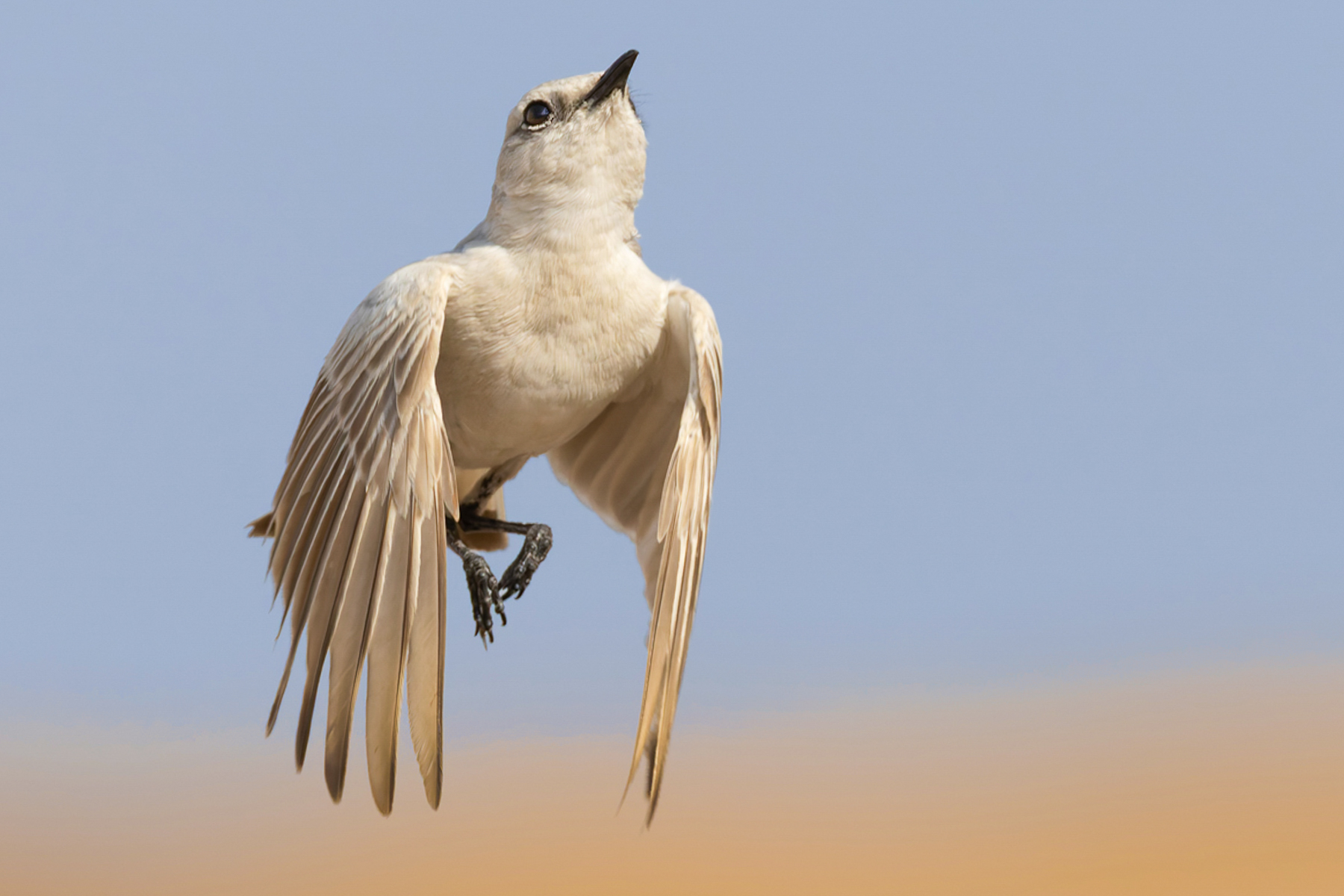
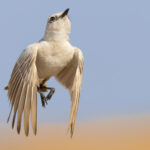
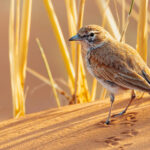
A Tractrac Chat soars upwards from the dunes of the Namib Desert, on the outskirts of the Namibian town of Swakopmund. Tractrac Chats are perfectly adapted to blend into their desert environment (image by Mike Watson)
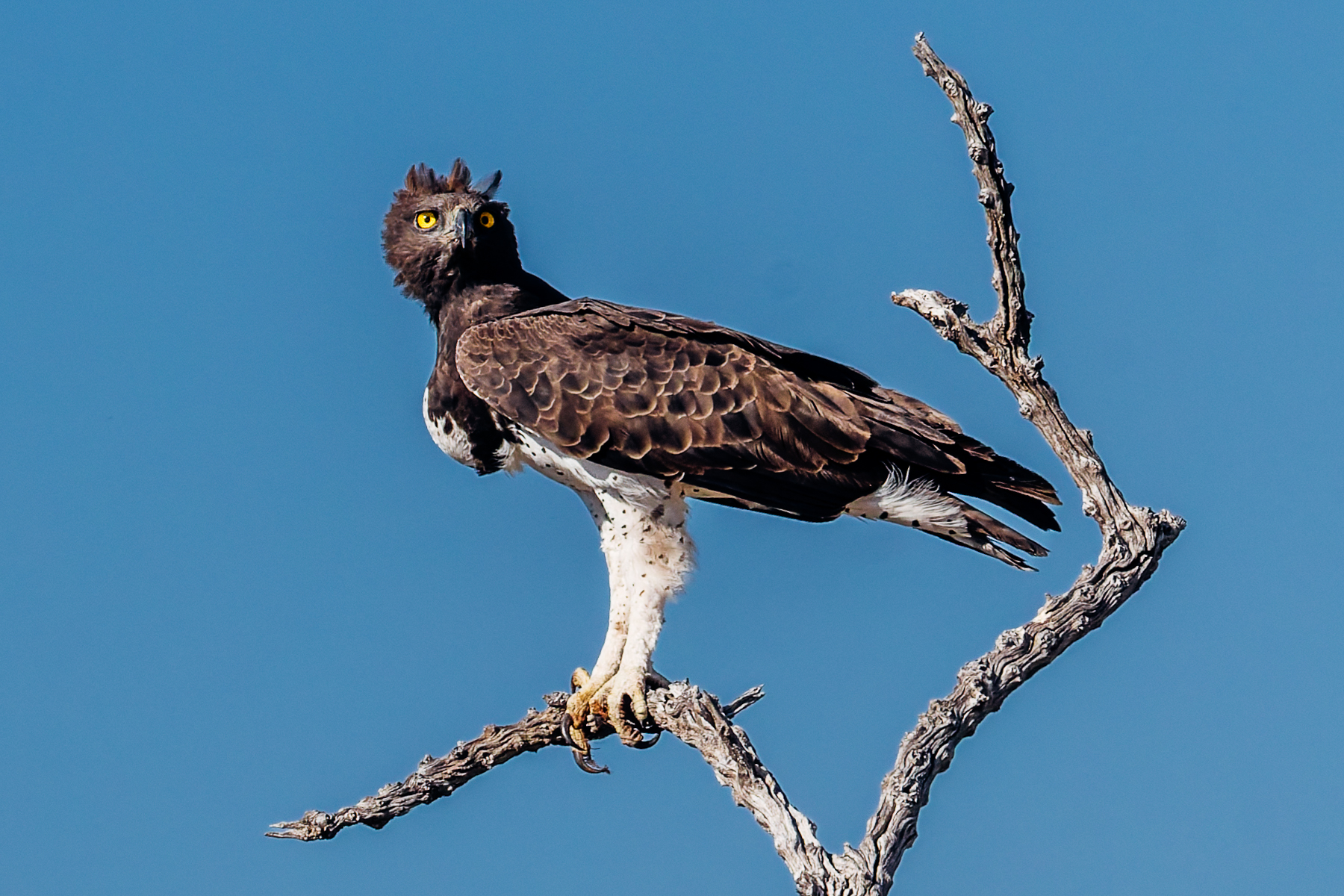
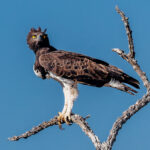
A Martial Eagle grips tightly to a branch in Namibia's Etosha National Park. These raptors are Africa's largest eagle, capable of taking down prey many times its own size (image by Virginia Wilde)
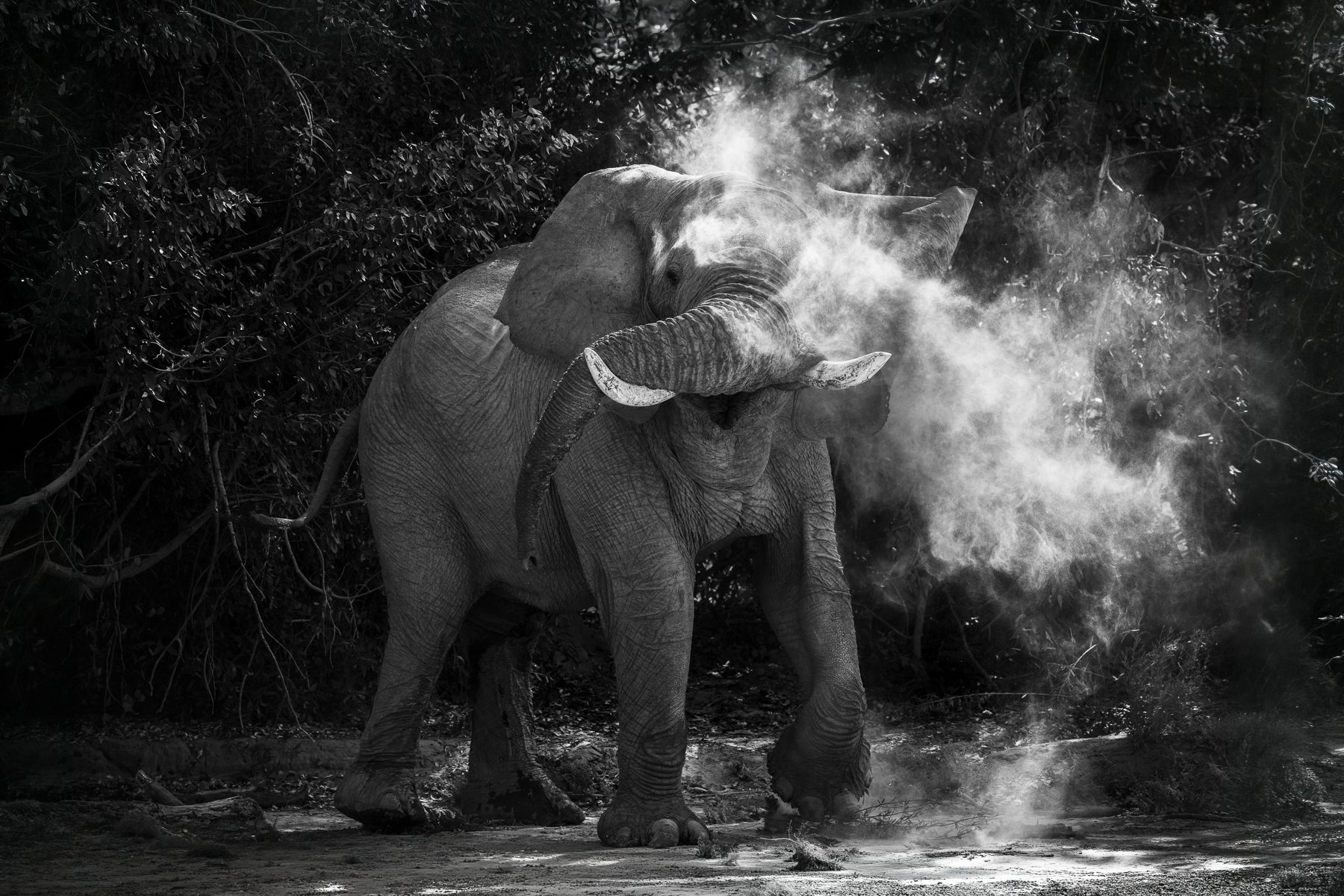
We kept our distance from this desert-adapted Elephant bull in Namibia's Hoanib River Valley. As he sprayed dust all around him, we spotted his temporin secretion - a liquid from the temporal glands that the males secrete during musth: a natural periodic condition marked by a spike in testosterone and accompanied by restless and highly dominant behaviour (image by Virginia Wilde)
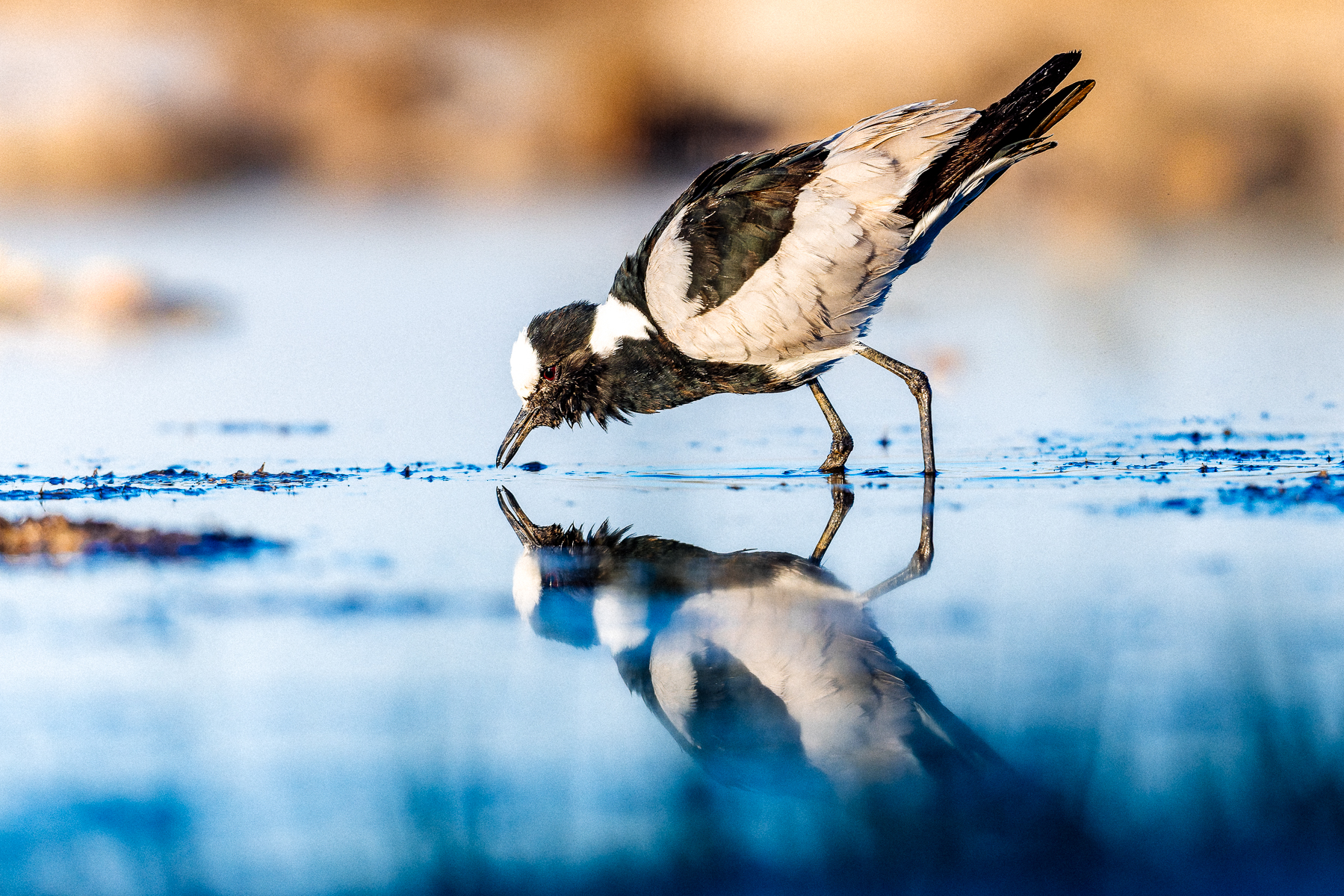
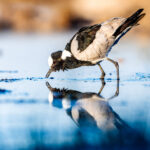
A Blacksmith Lapwing is mirrored almost perfectly in the still waters of a pool in Namibia's Onguma Reserve. Although commonly found, they are strikingly patterned and charismatic birds (image by Virginia Wilde)
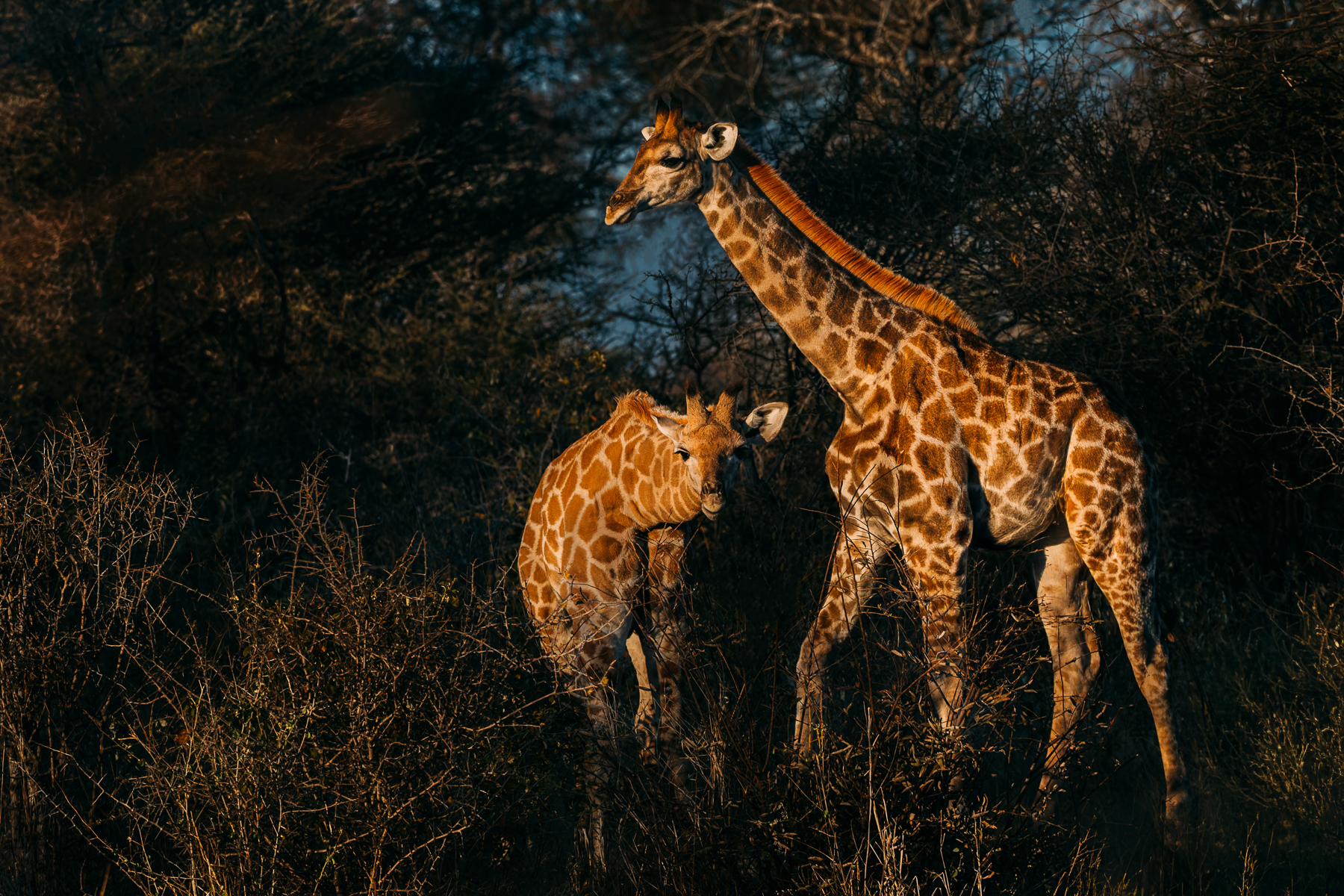
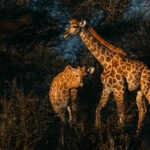
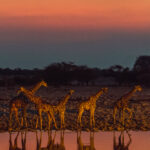
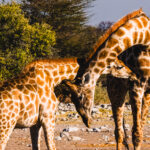
First light warms a pair of juvenile Angolan Giraffe, making their coats pop against the shadowed bushes in Namibia's Etosha National Park (image by Virginia Wilde)
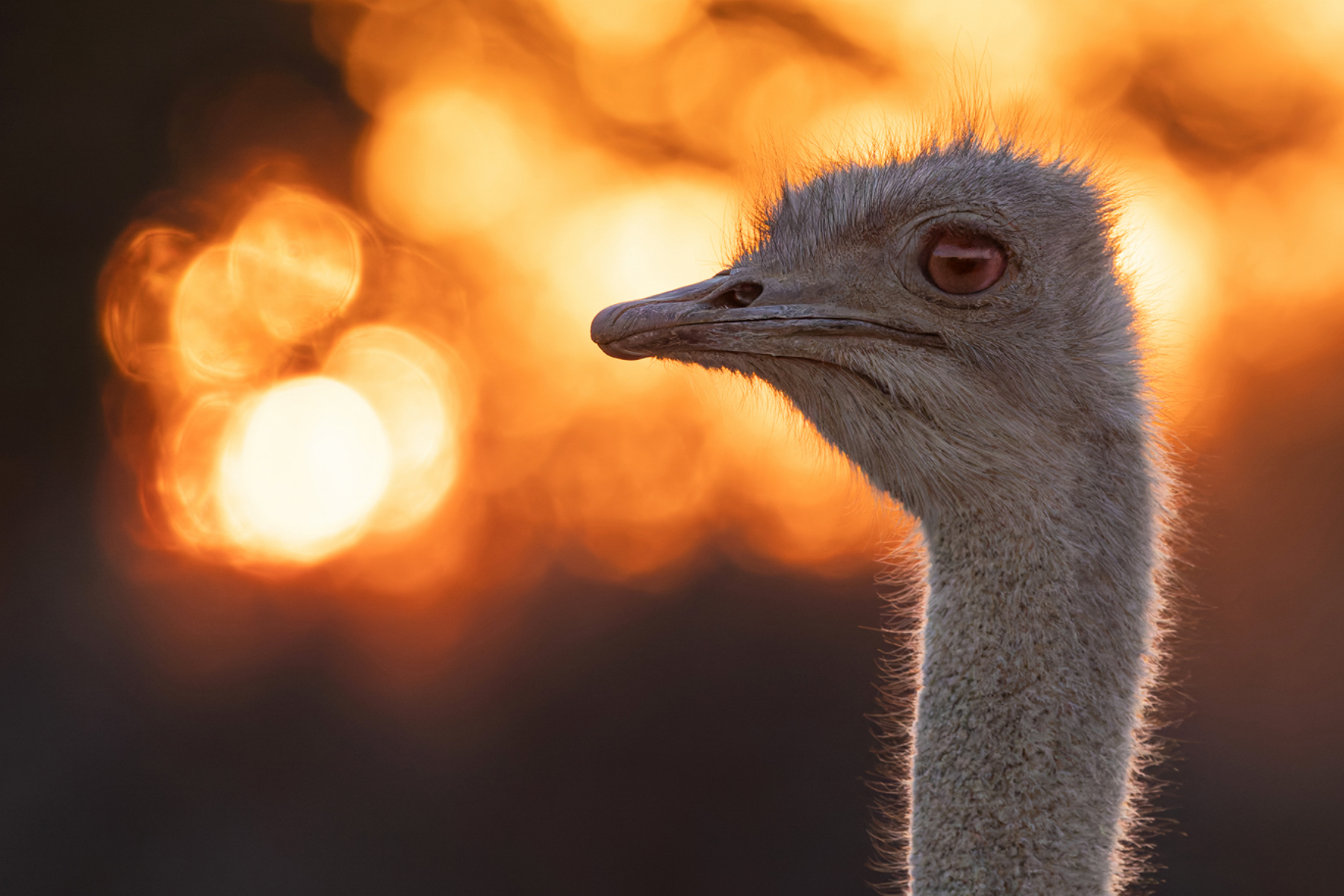
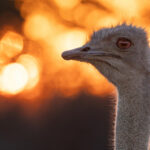
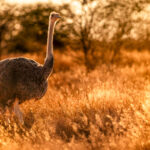
Dappled golden light from the setting sun makes the backdrop to this Southern Ostrich look as if it's on fire, in a portrait taken at Etango Ranch, Windhoek (image by Mike Watson)
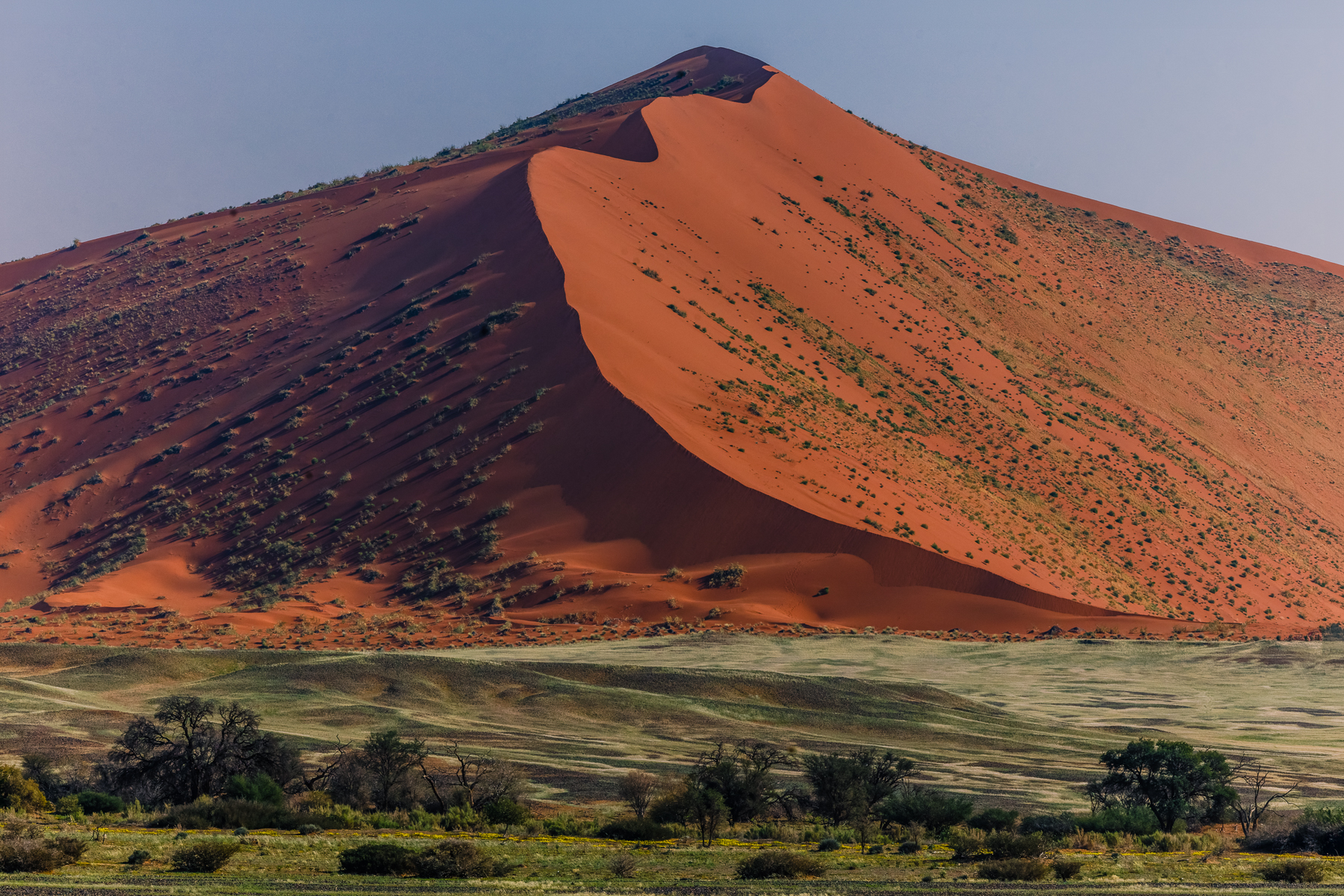
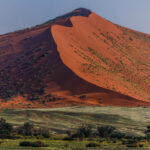
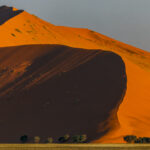
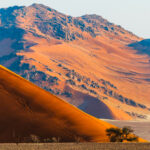
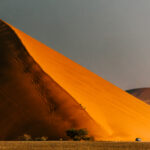
The impressive red flank of Sossusvlei's 'Dune 40' rises above a surprisingly green winter plain in the Namib Desert. Although our tour visit - in July - is in the driest part of the year at Sossusvlei, the region experienced heavy rainfall in the summer season, with higher-than-average vegetation growth this year (image by Virginia Wilde)
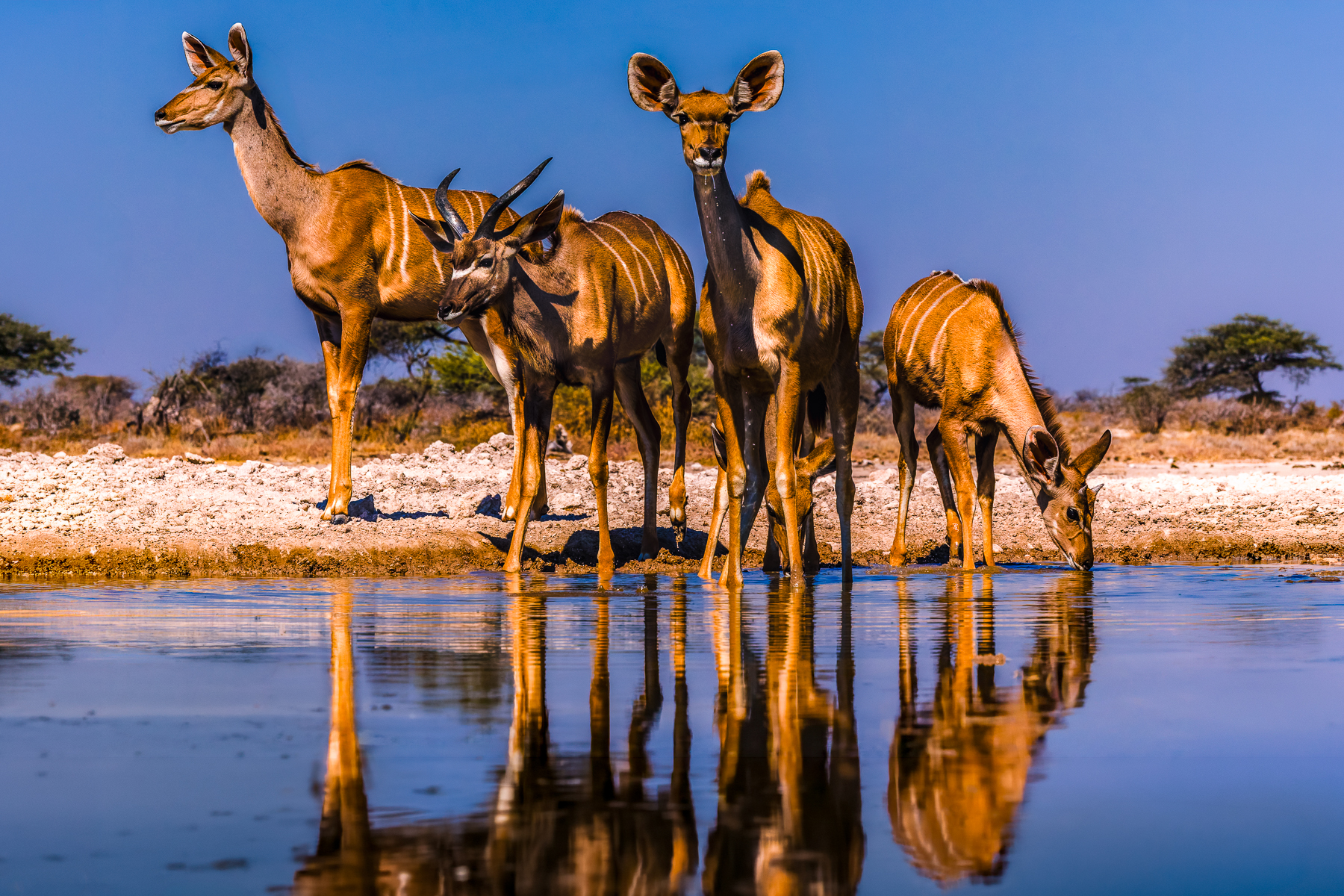
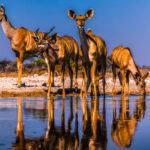
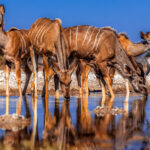
A cluster of four young Greater Kudu gather to drink at the Onguma Reserve waterhole, barely metres away from the sunken hide that enabled us to see so many beautiful wildlife scenes close up (image by Virginia Wilde)
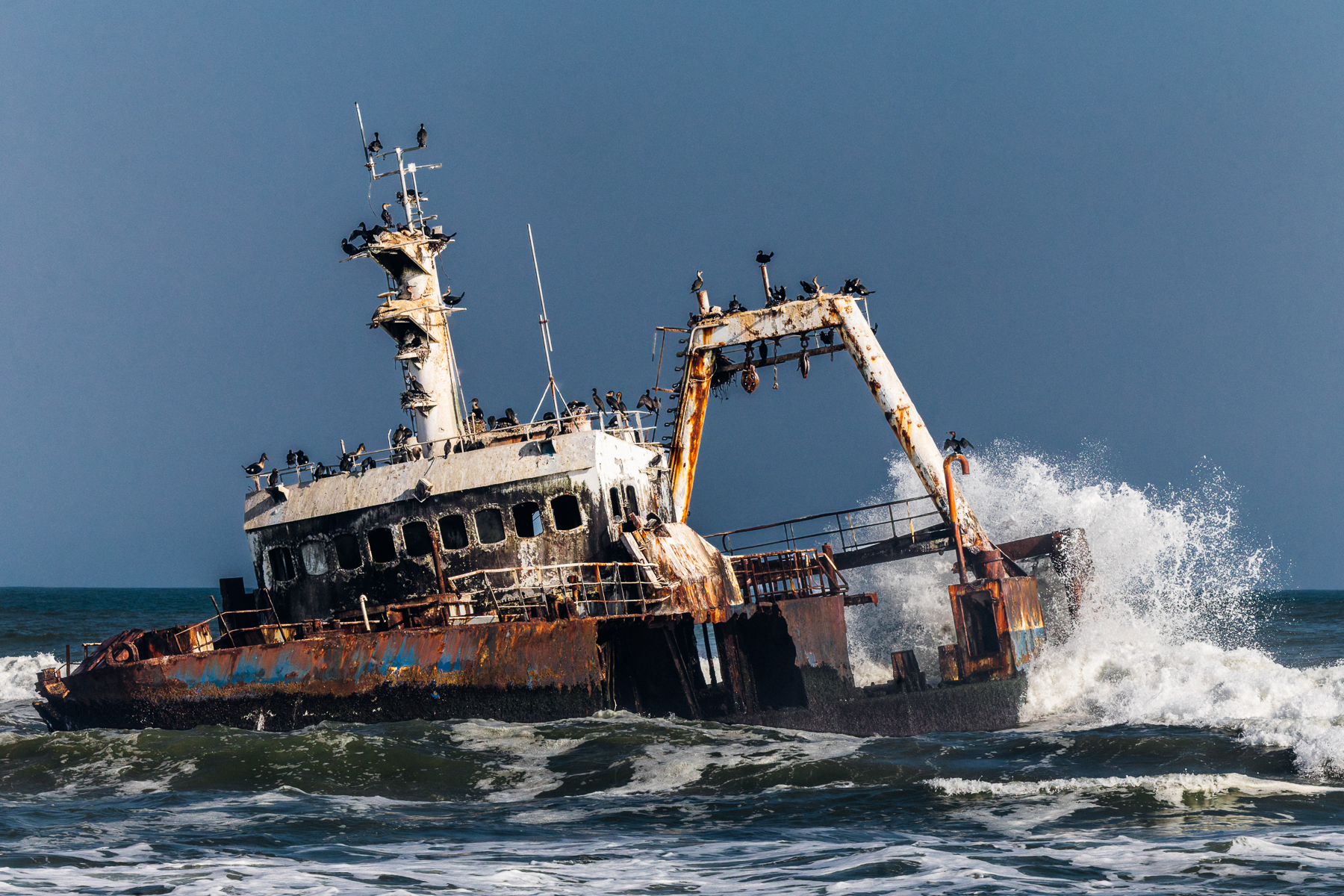
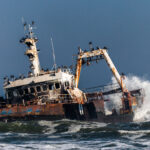
The wreck of the Zelia lies stranded on Namibia's Skeleton Coast, its rusting hull battered by the Atlantic surf. Hundreds of Cape cormorants have claimed the remains of the vessel as a perch, covering its masts and hull (image by Virginia Wilde)
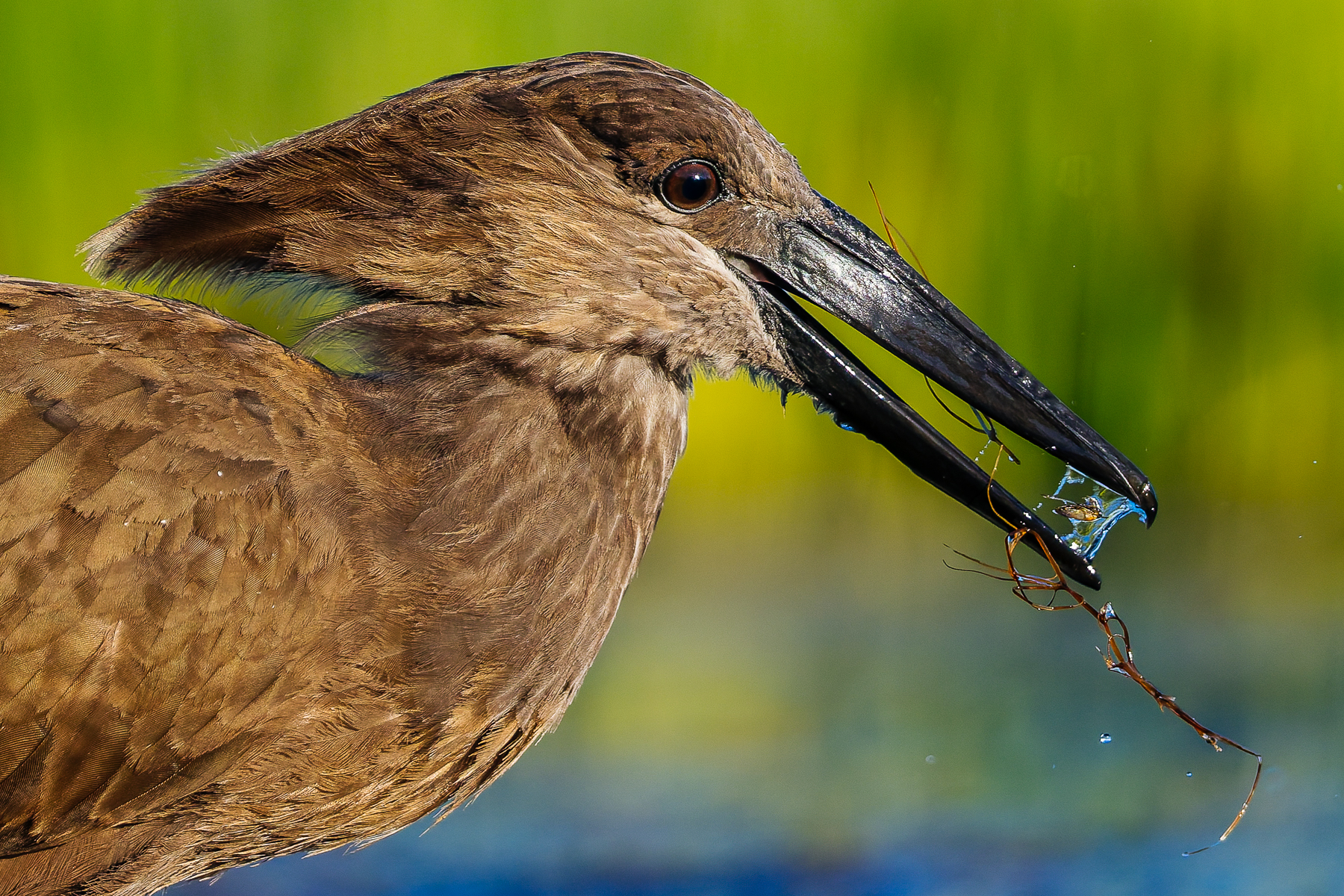
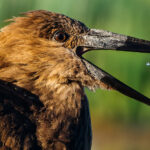
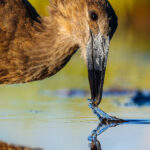
One of the highlights of our time in the Onguma hide was watching this Hamerkop's incredible fishing technique. He tirelessly worked the shallows of the waterhole, flushing prey upwards by shuffling his feet to disturb the sediment before raking his bill along the mud (image by Virginia Wilde)
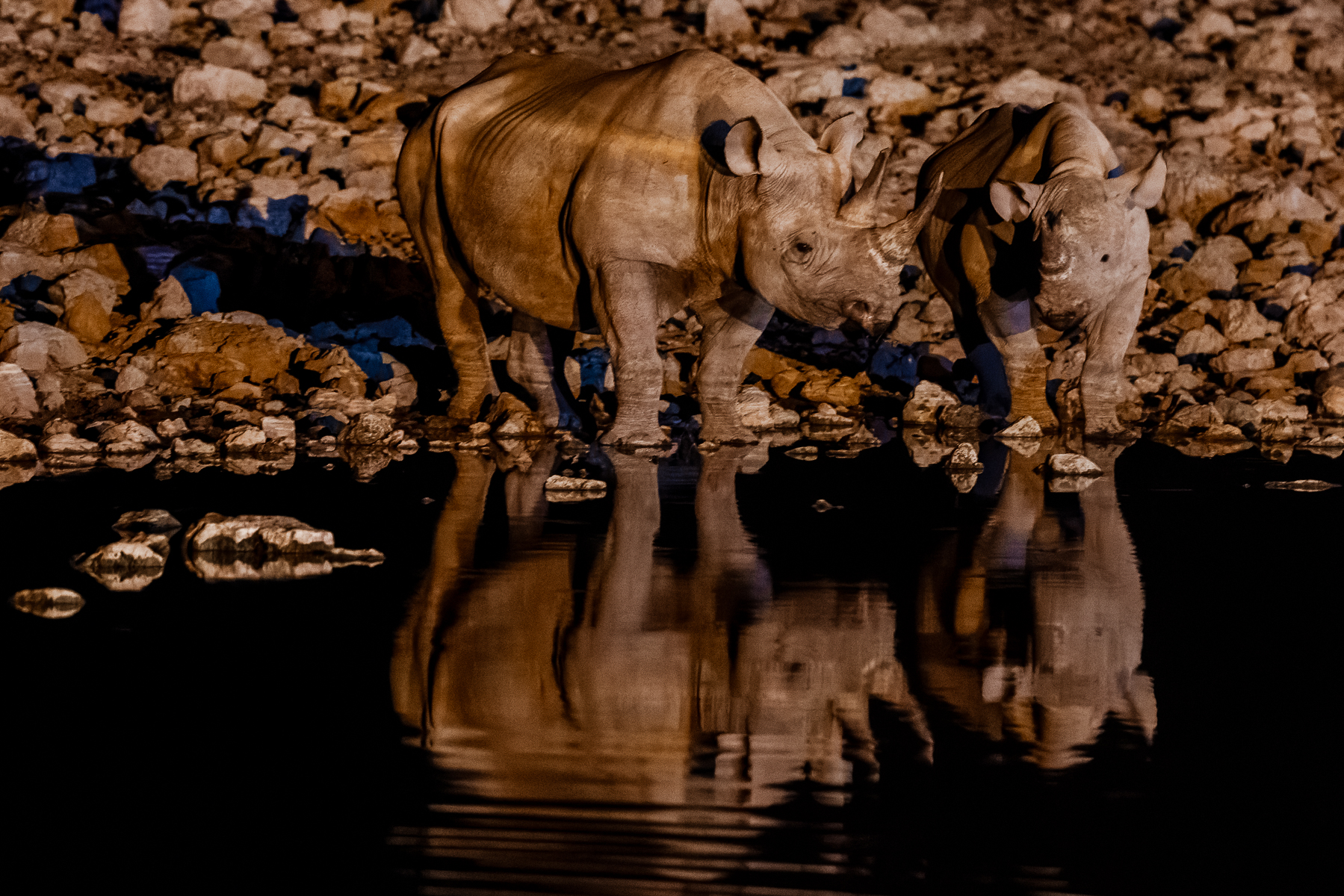
A mother and juvenile Black Rhinoceros spend time at the water's edge in Namibia's Etosha National Park. This pair were among eight Rhinos who assembled at the Okaukeujo waterhole - a real treat for those of us watching (image by Virginia Wilde)
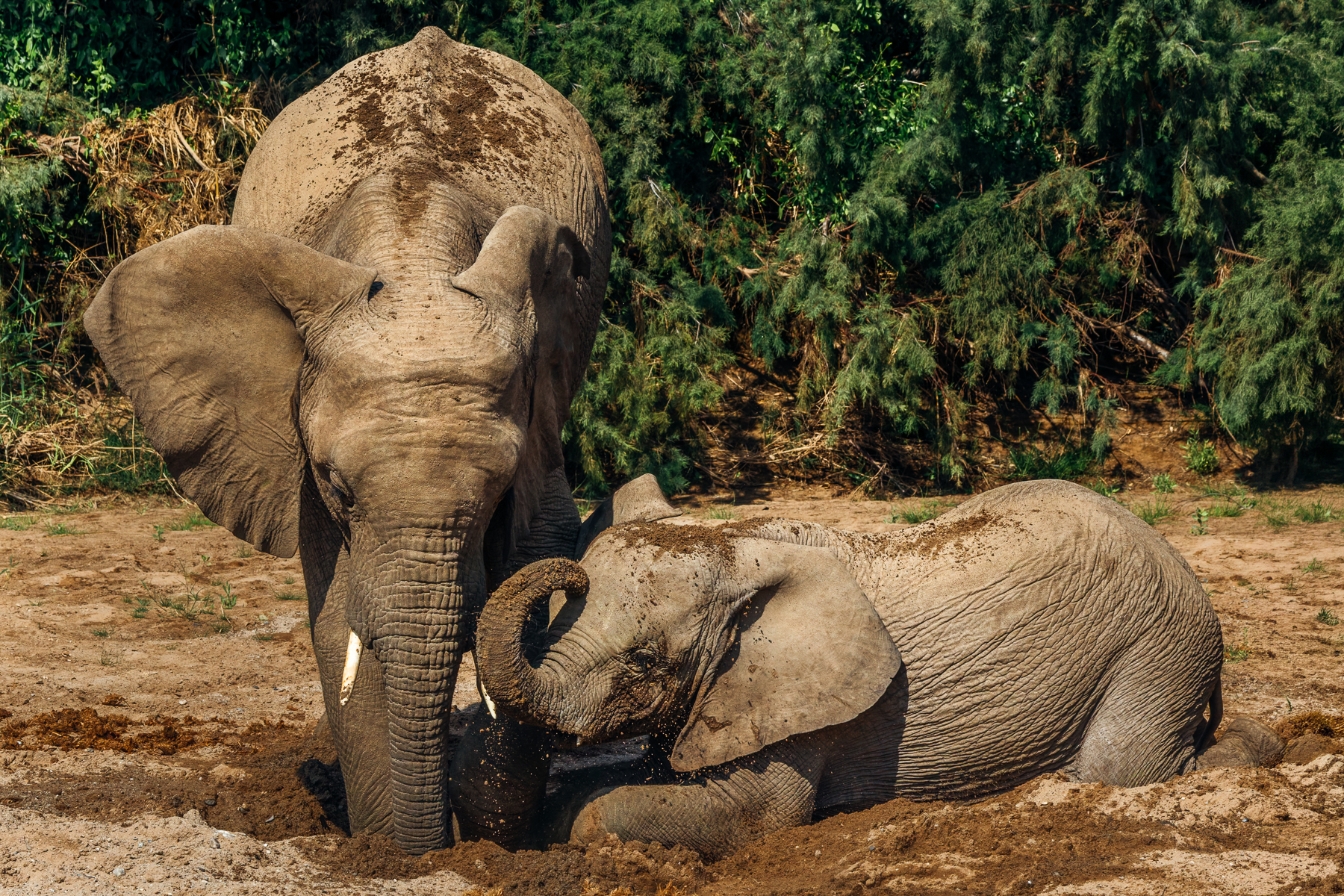
Few wildlife experiences have been so fascinating for me as watching desert-adapted African Savanna Elephants dig down through a dry riverbed with their feet and trunks to find groundwater. Namibia is home to 150 true desert-adapted elephants, in five ephemeral river systems (image by Virginia Wilde)
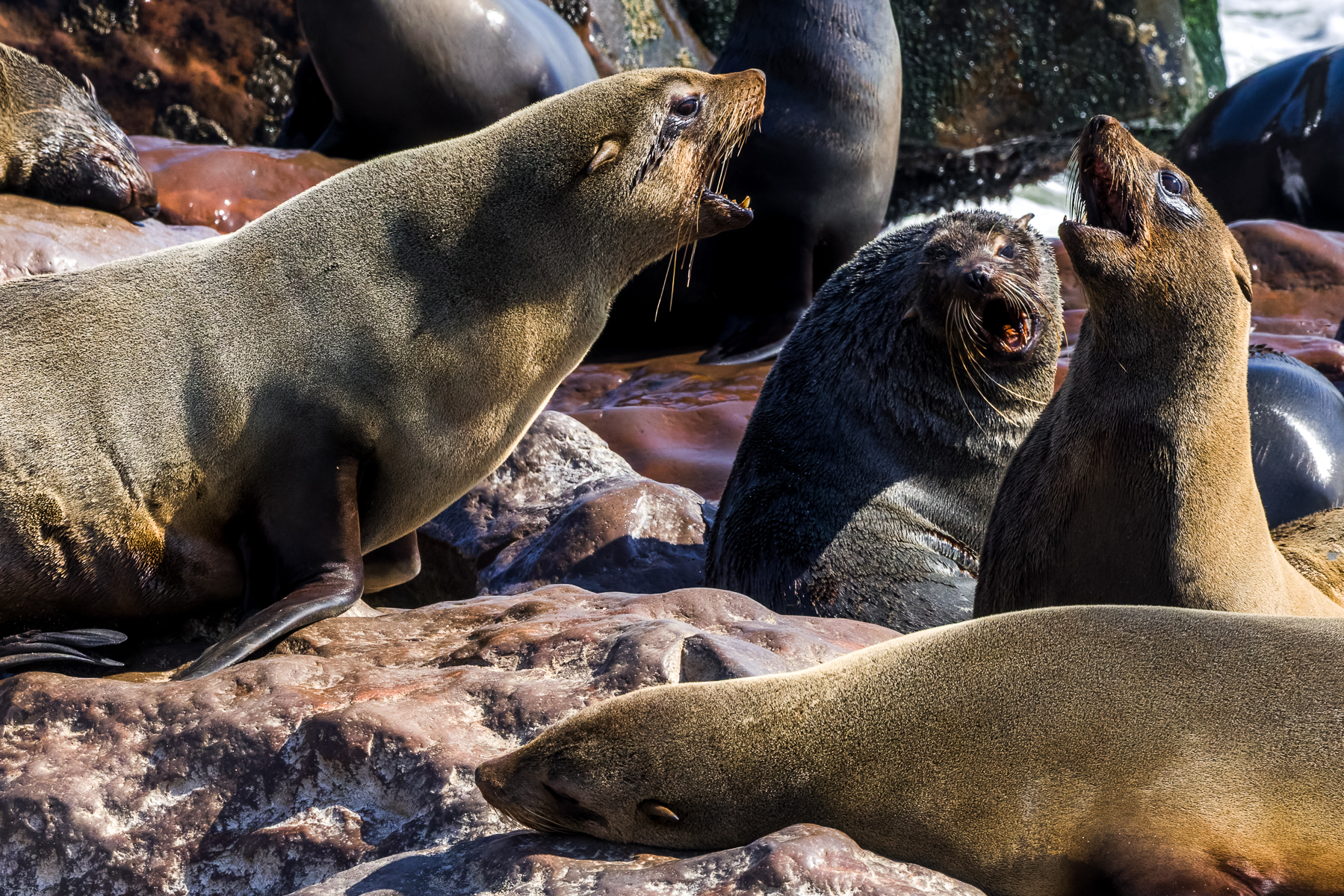
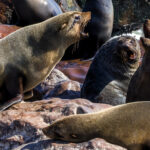
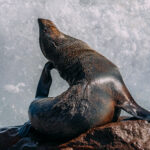
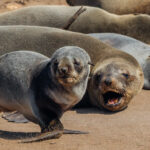
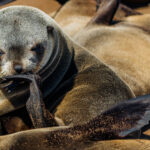
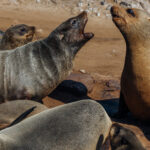
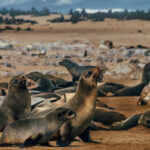
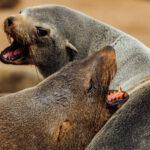
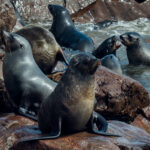
Life in the Cape Fur Seal colony is a continual drama of skirmishes over the best resting spots. Living in such large numbers has survival benefits - but trade-offs in terms of noise and interrupted sleep! (image by Virginia Wilde)
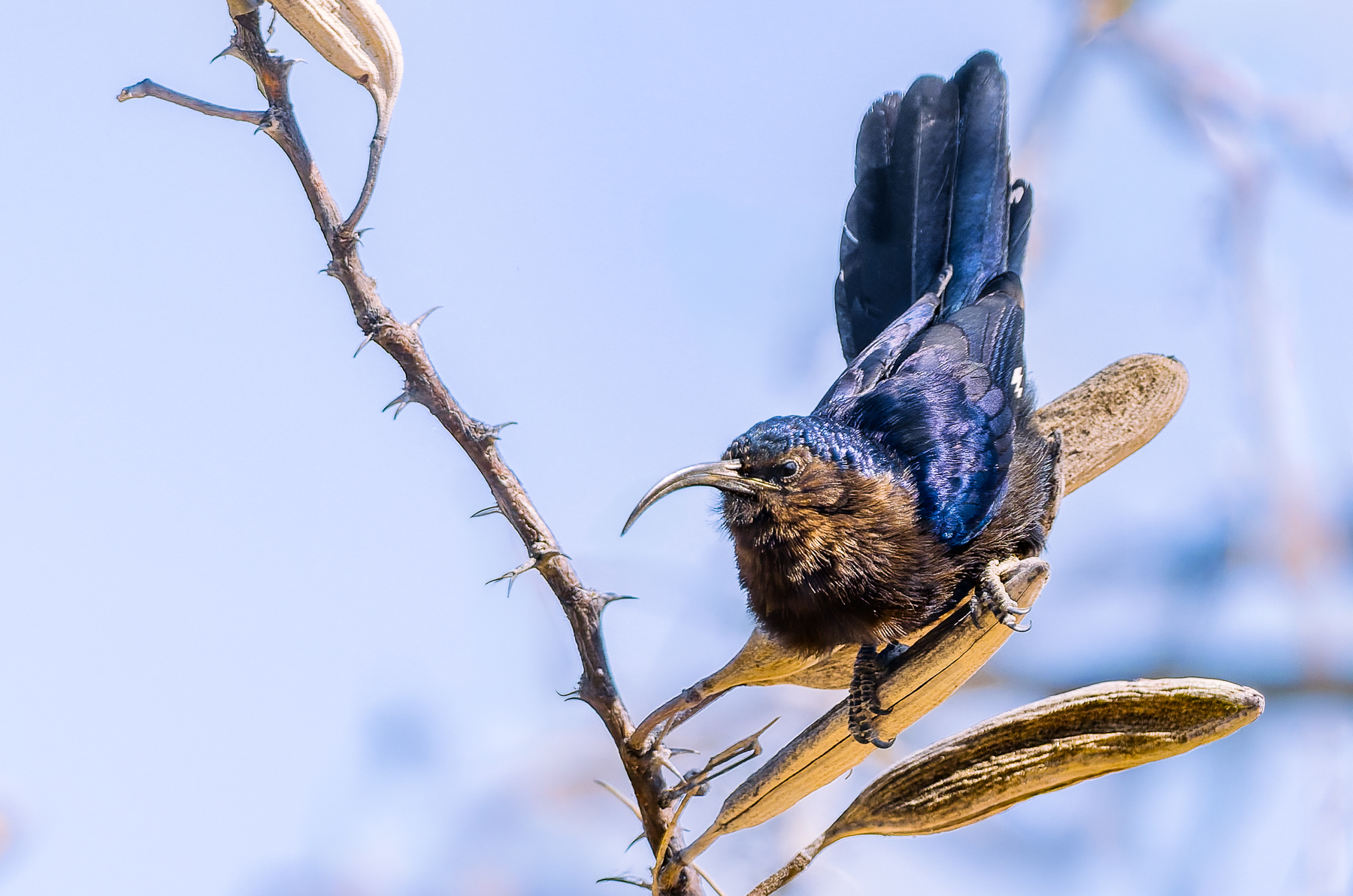
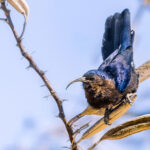
A Common Scimitarbill rests briefly on a leaf, before continuing to dart so quickly around the bushes in Namibia's Etango Ranch - that all my other images were blurry! (image by Virginia Wilde)
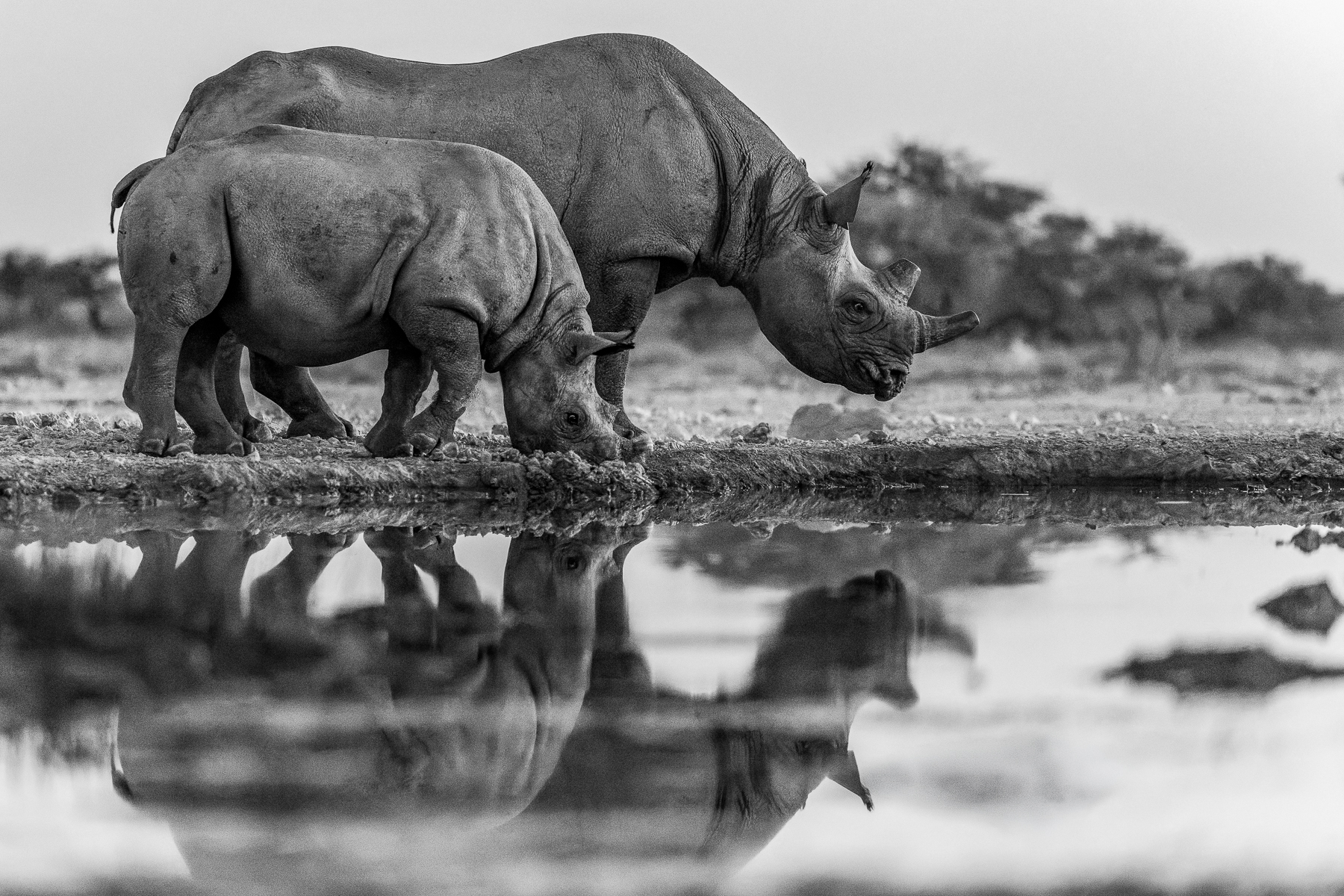
A mother and calf Black Rhino drink from a waterhole in Namibia's Onguma Reserve. Namibia has around 35% of the world's remaining Black Rhinos, with the vast majority the South-western Black Rhino (image by Virginia Wilde)
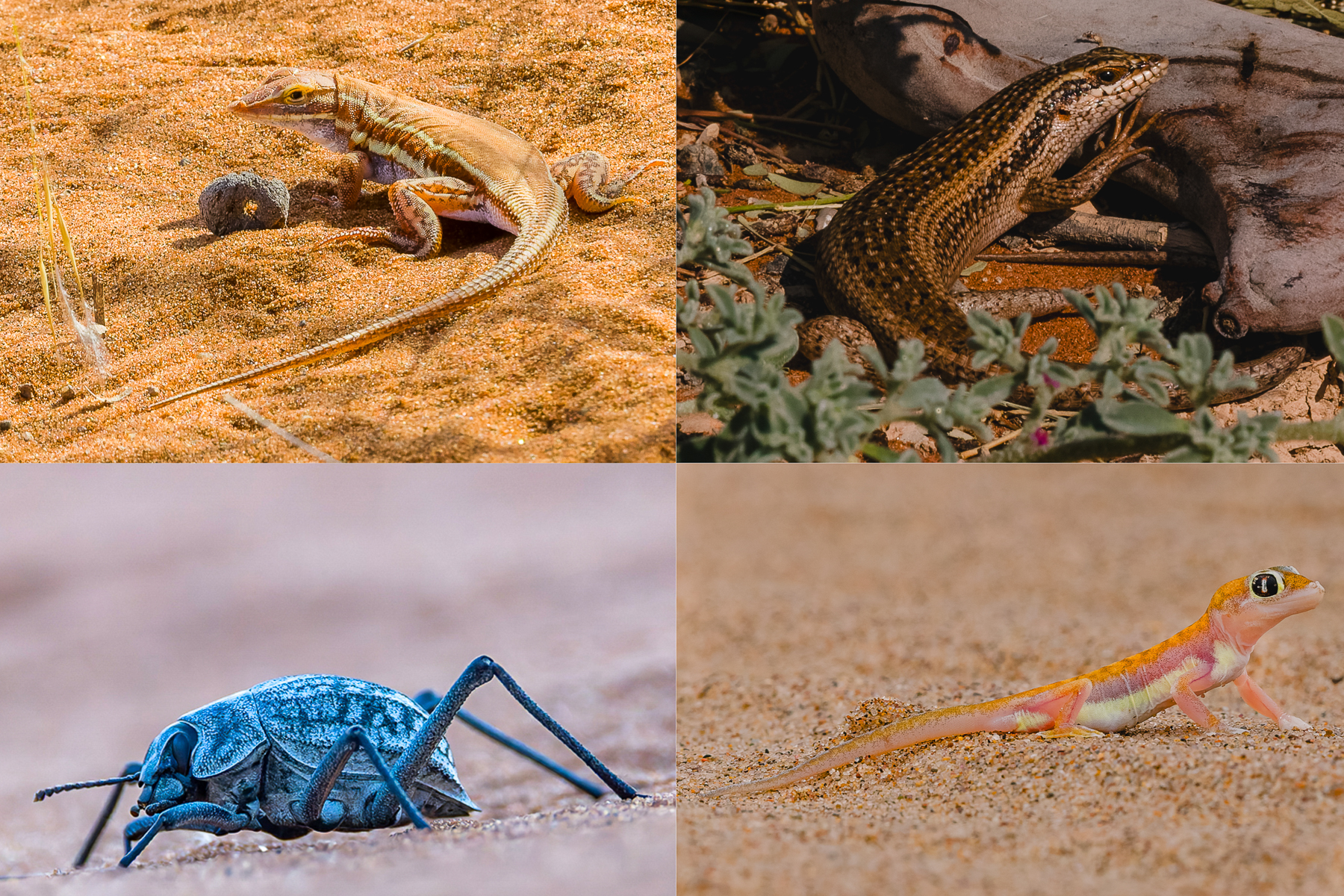
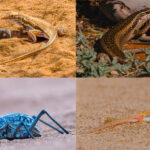
Some of the incredible reptile and invertebrate life to be found in Namibia's deserts. From top left and clockwise - Wedge-snouted Skink; Western Rock Skink; Namib Sand Gecko; Dappled Namib Darkling Beetle (image by Mike Watson)
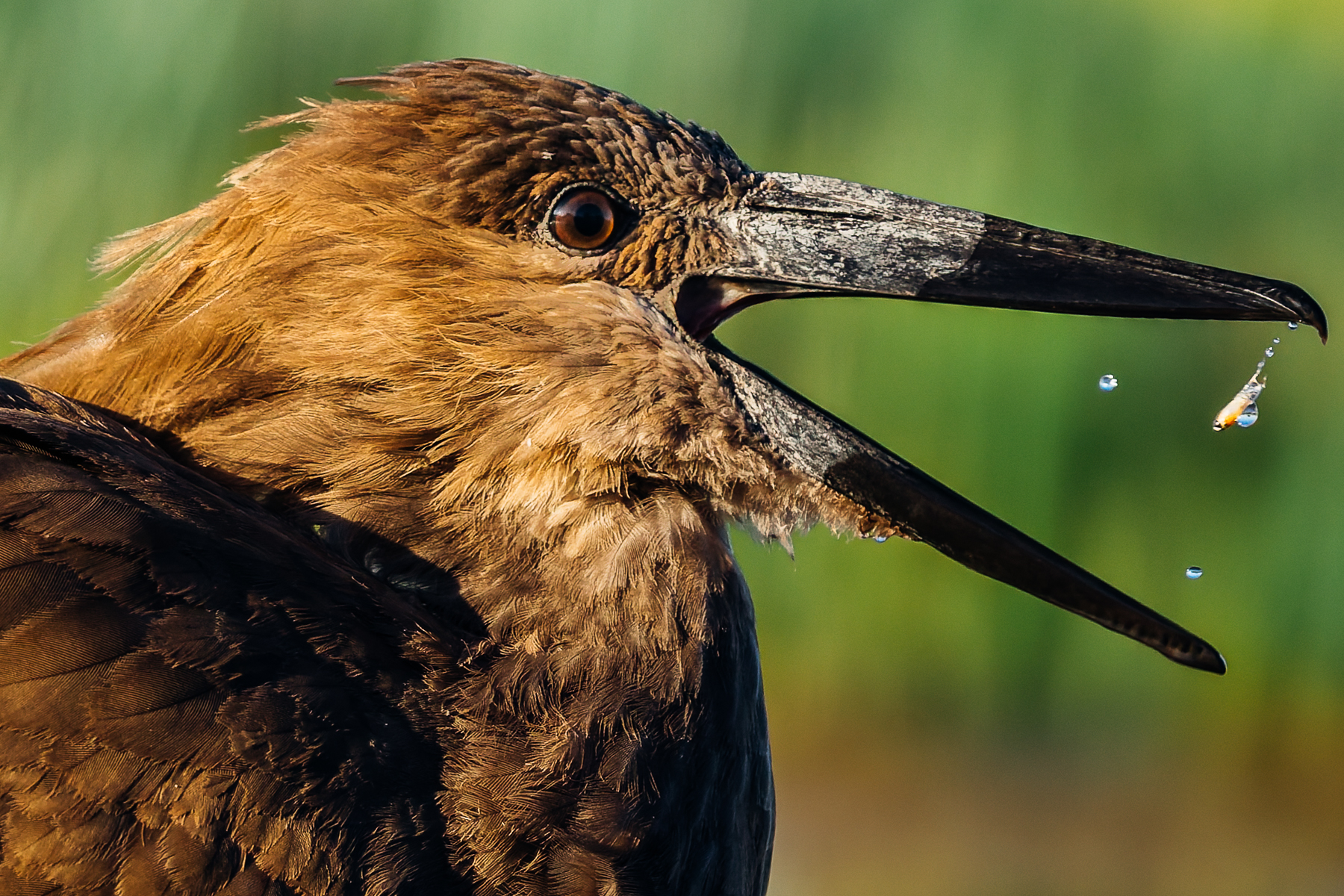
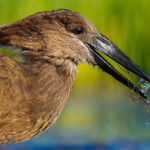
A tiny fish is caught mid-air between a Hamerkop's massive beak - testament to this wader's incredible hunting technique. Hamerkops' name means 'hammerhead' in Afrikaans - referring to its distinctive shaped head and bill (image by Virginia Wilde)
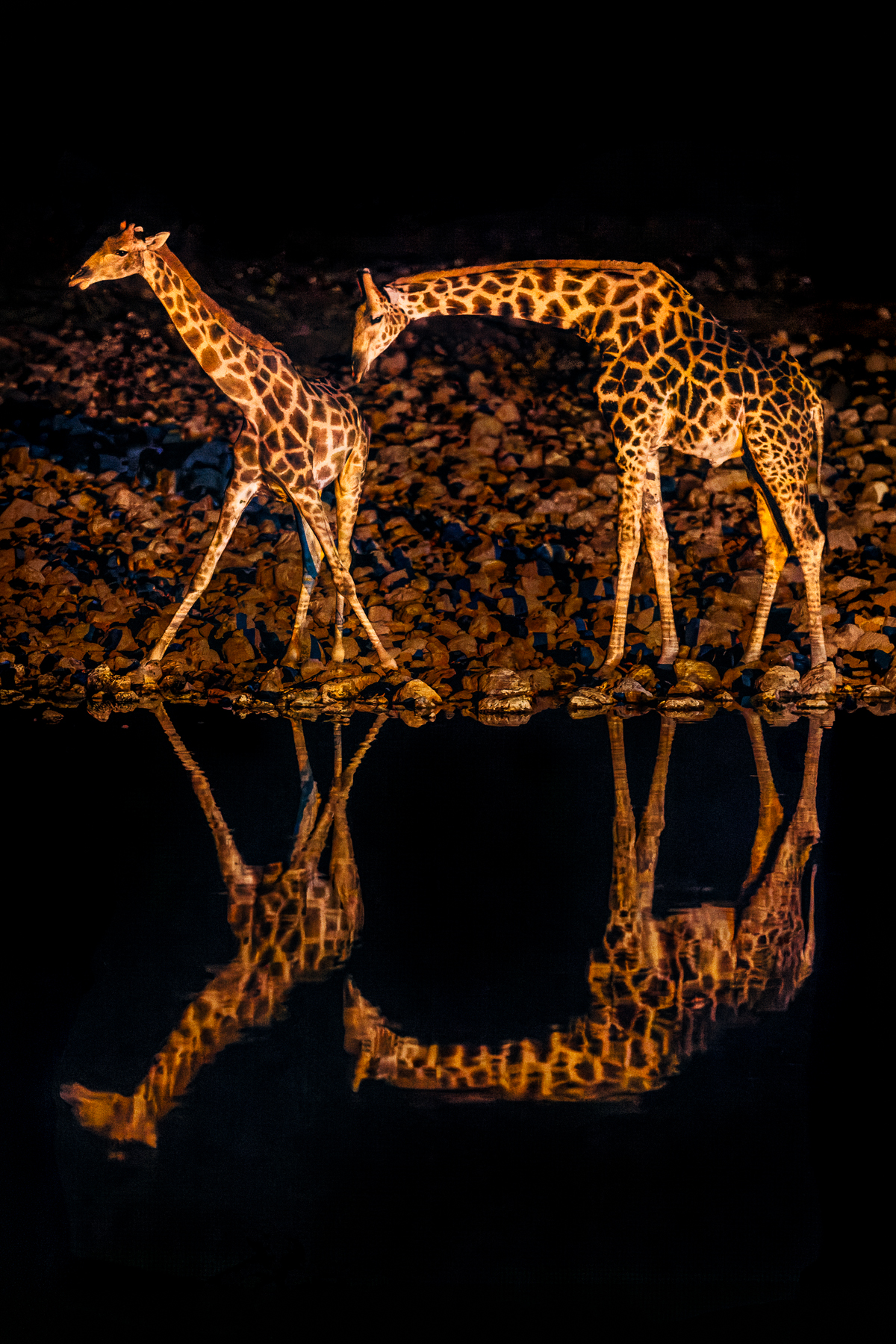
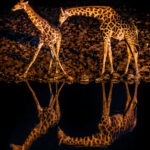
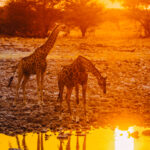
A pair of Angolan Giraffe drink from the waterhole at night, at Okaukuejo in Namibia's Etosha National Park. Angolan Giraffe (also known as the Namibian or Smokey Giraffe) have coat markings and patches that speckle all the way down to their hooves, unlike many other giraffe species whose markings stop at their knees (image by Virginia Wilde)
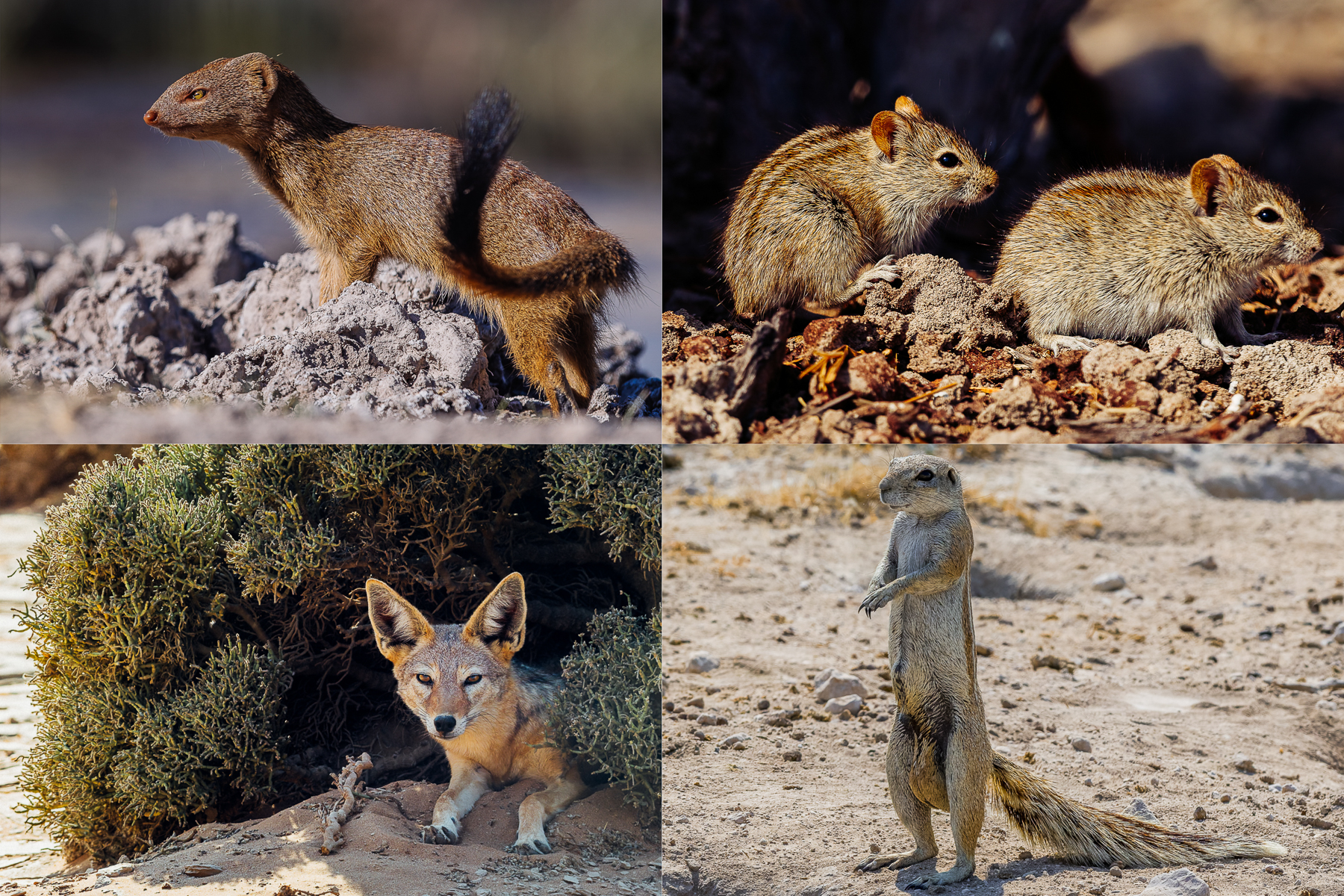
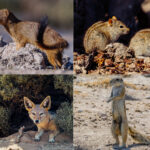
Smaller Mammals of Namibia, clockwise from top left: Angolan Slender Mongoose; Namaqua Rock Mouse; Cape Ground Squirrel and Black-backed Jackal (image by Virginia Wilde)
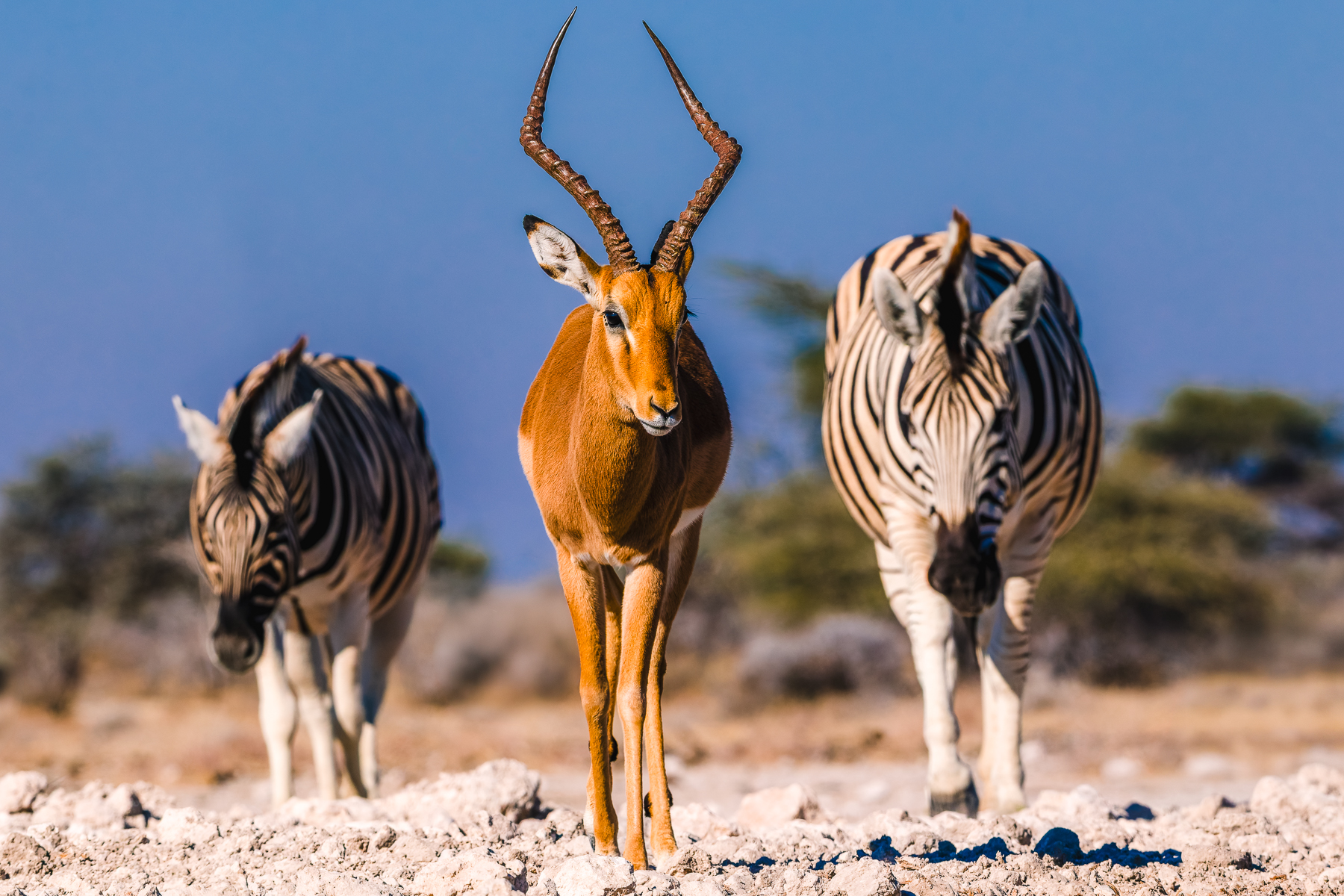
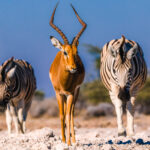
'Follow the Impala!' A Black-faced Impala appears to lead a mini procession of Zebra down to the waterhole in Namibia's Onguma Reserve (image by Virginia Wilde)
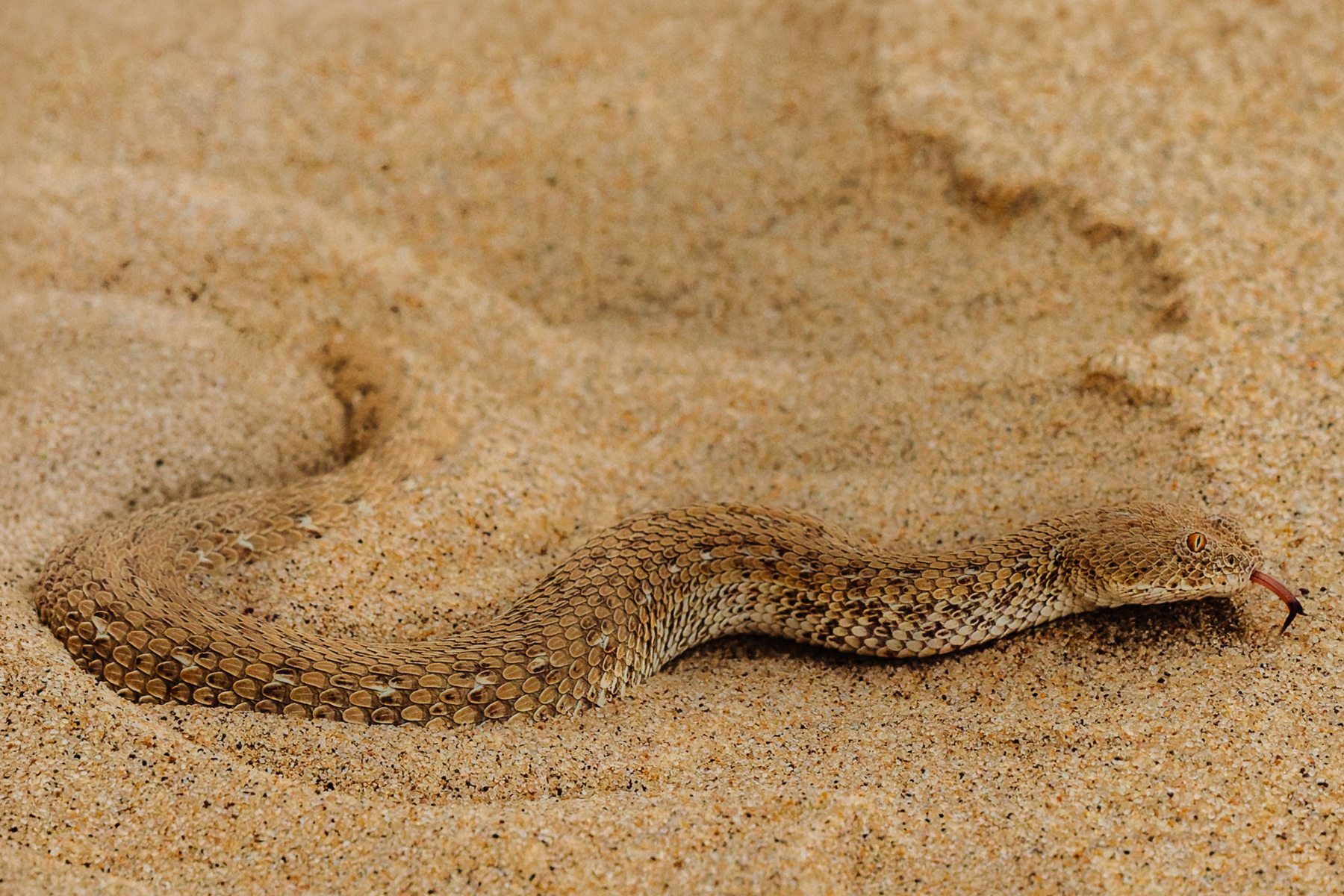
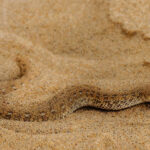
A beautiful Peringuey's Adder snakes through the sand in the Namib-Naukluft National Park. These stunning adders are endemic to the Namib Desert region, occurring only in coastal Namibia and southern Angola (image by Virginia Wilde)
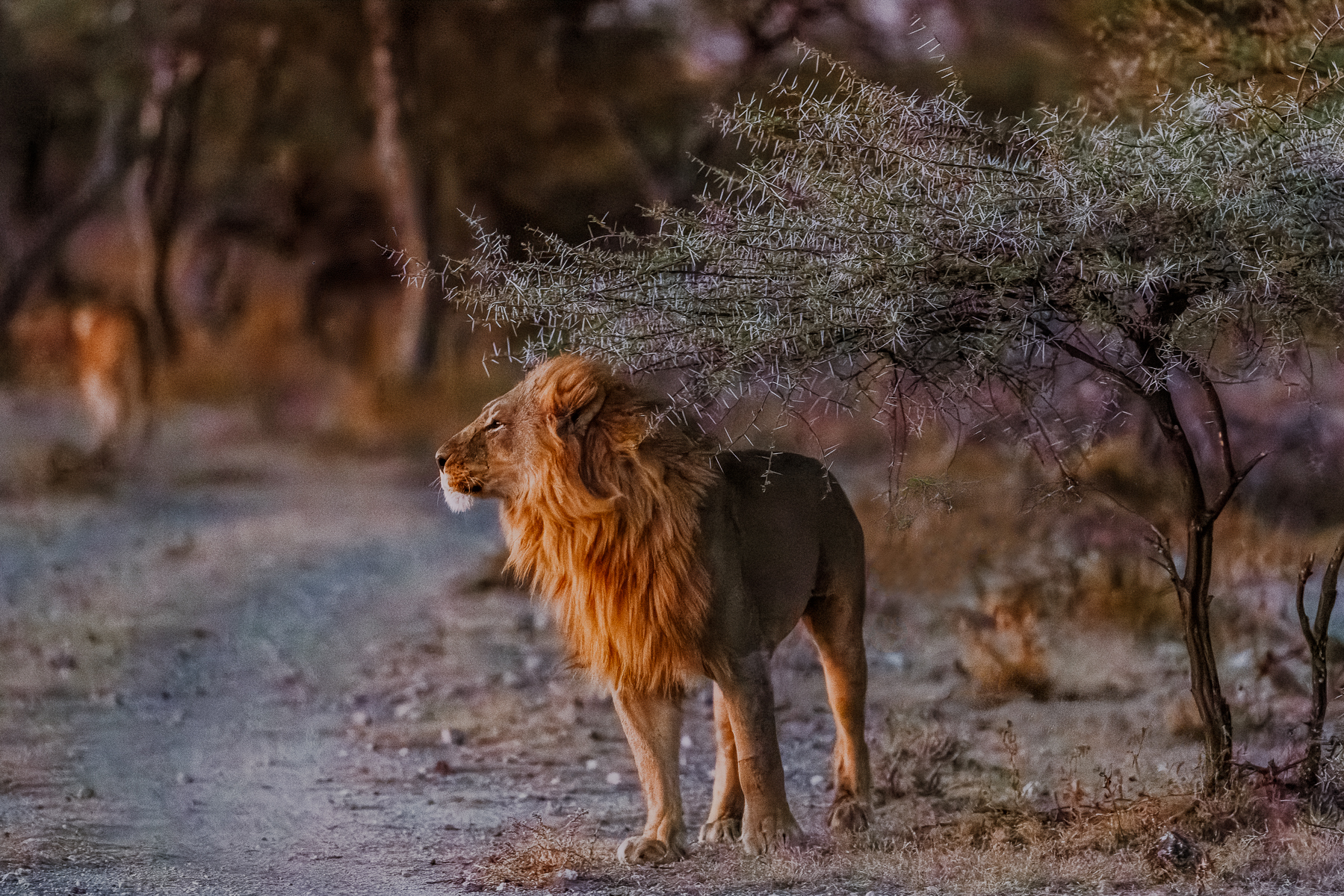
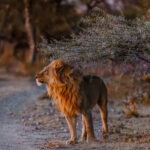
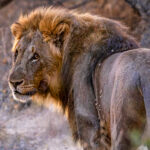
One of a pair of African Lion brothers that we saw in Namibia's Onguma Reserve just as night began to fall - and both of them as handsome as any lion I've ever seen (image by Virginia Wilde)
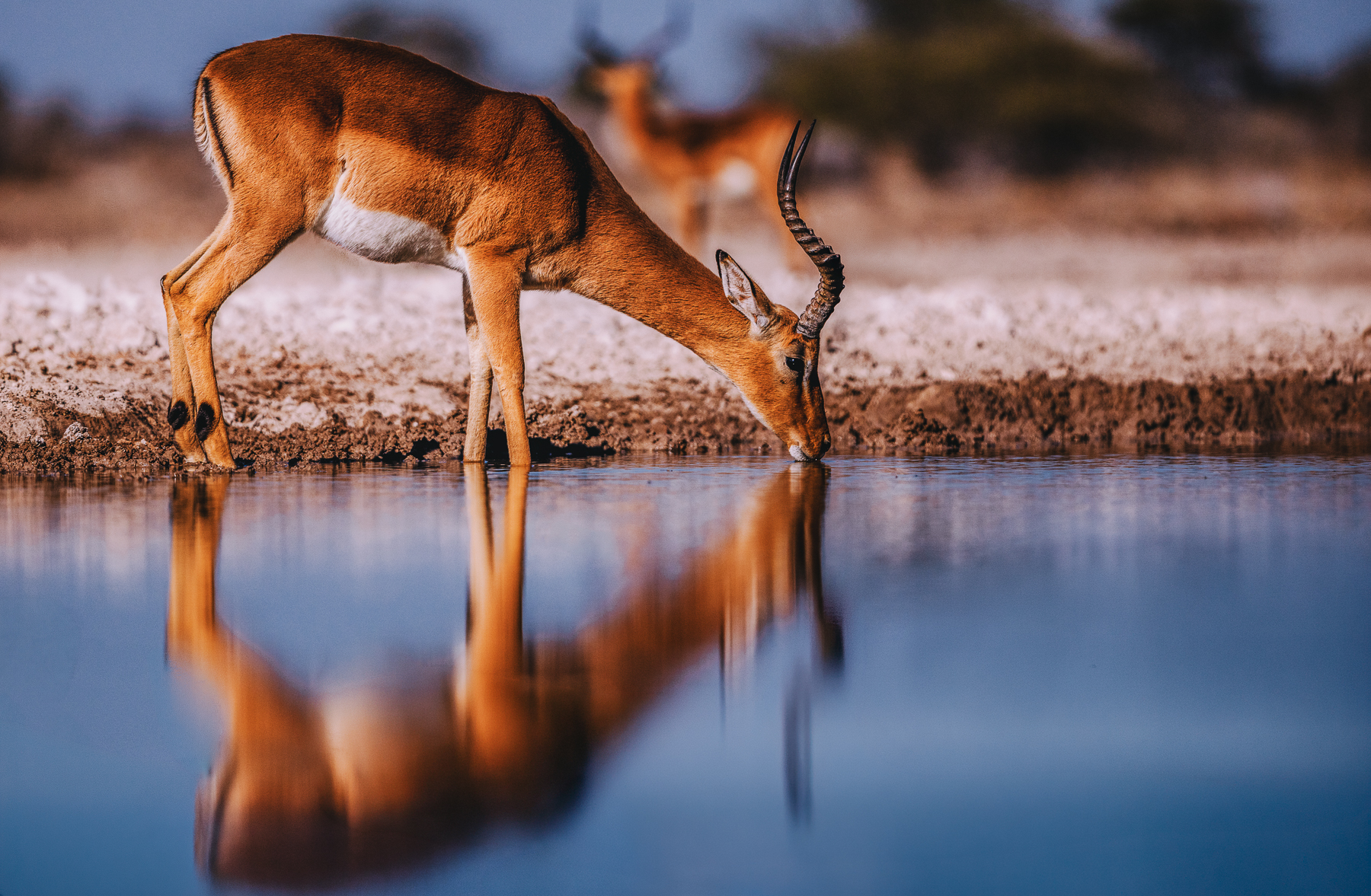
A Black-faced Impala is mirrored as it drinks from the waterhole in Namibia's Onguma Reserve. Black-faced Impala are the largest and darkest-coated of all Impala subspecies (image by Virginia Wilde)
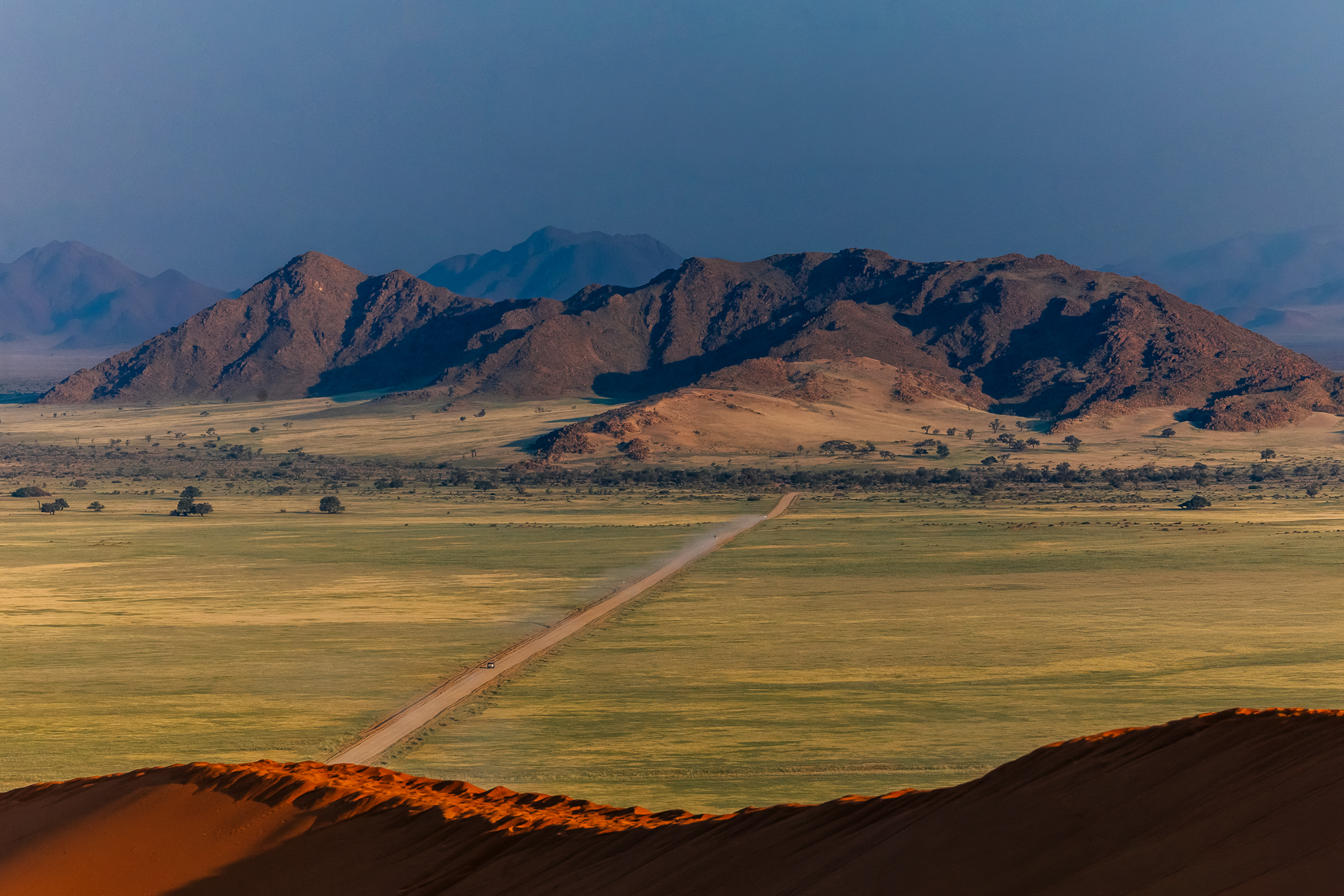
The view from Sossusvlei's 'Elim Dune', with the broad Tsauchab Valley and the mountains behind. The mountains mark the distant source of the ephemeral Tsauchab, which eventually disappears into the sands at Sossusvlei (image by Virginia Wilde)
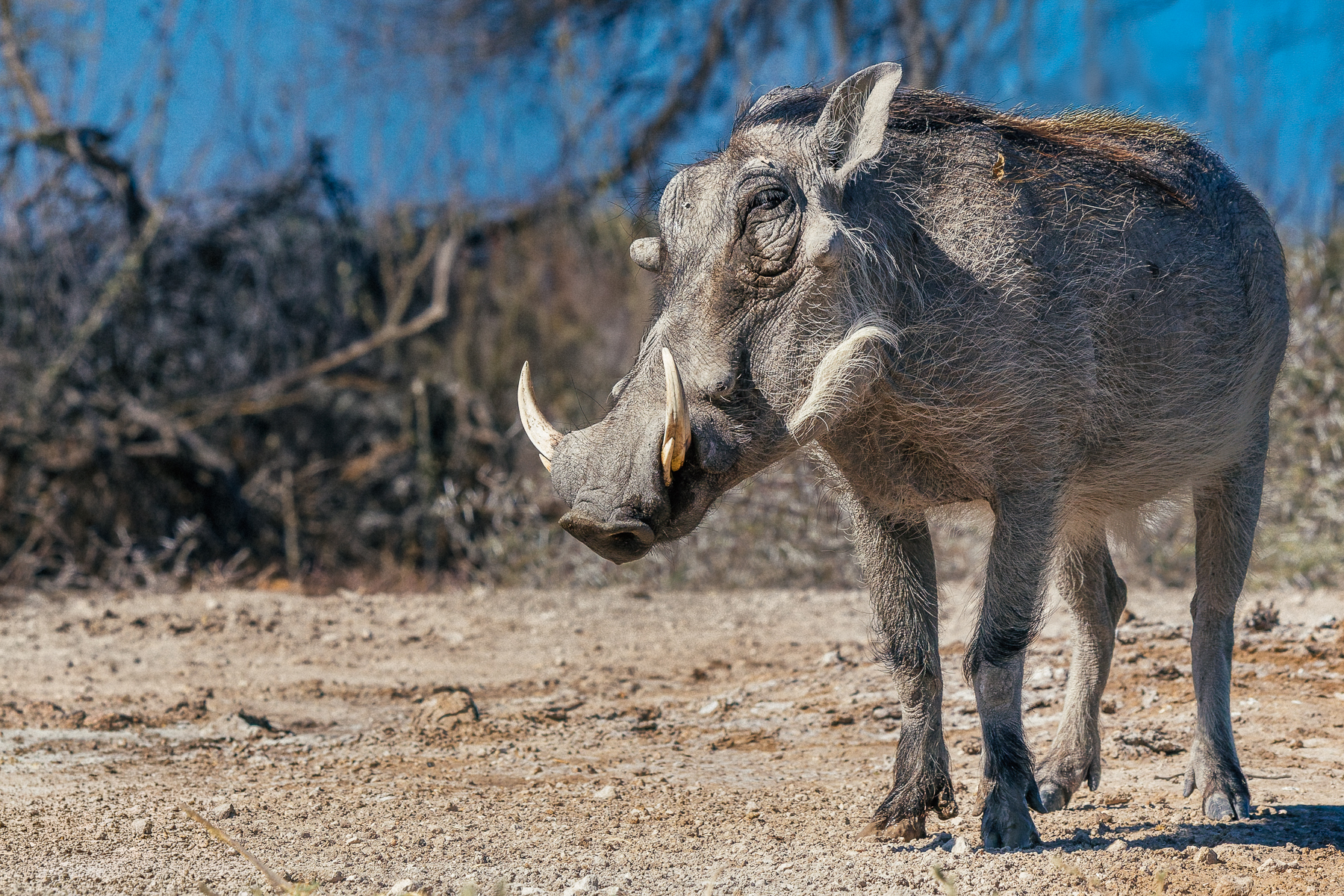
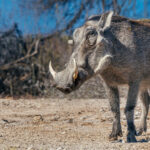
Portrait of a Common Warthog in Namibia's Onguma Reserve. Our sunken hide allowed us to get wonderful close-ups of animals that normally would run away (image by Virginia Wilde)
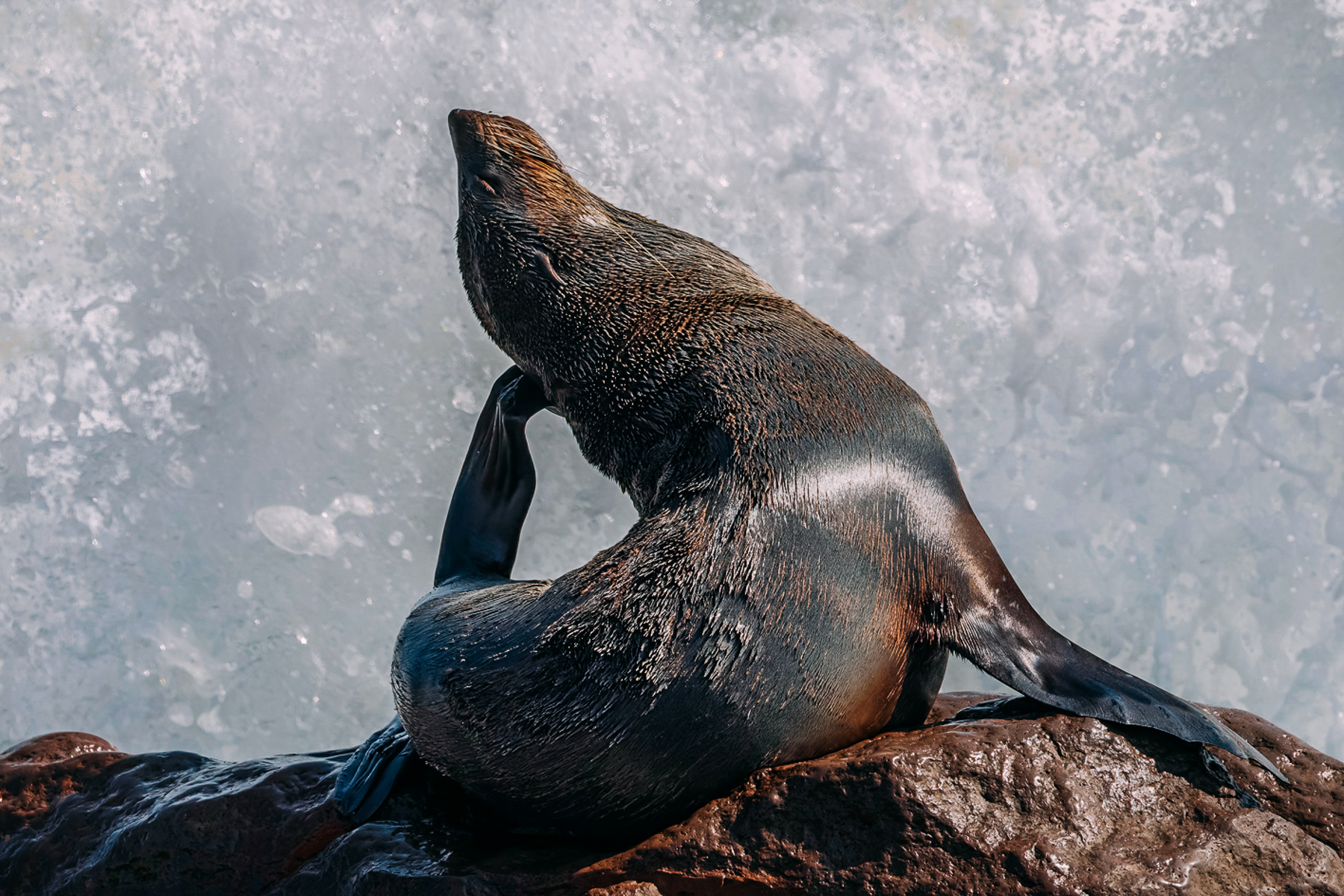
A tower of sea spray erupts behind a Cape Fur Seal, who appears oblivious as he attends to the more important task of scratching his ear with a flipper (image by Mike Watson)
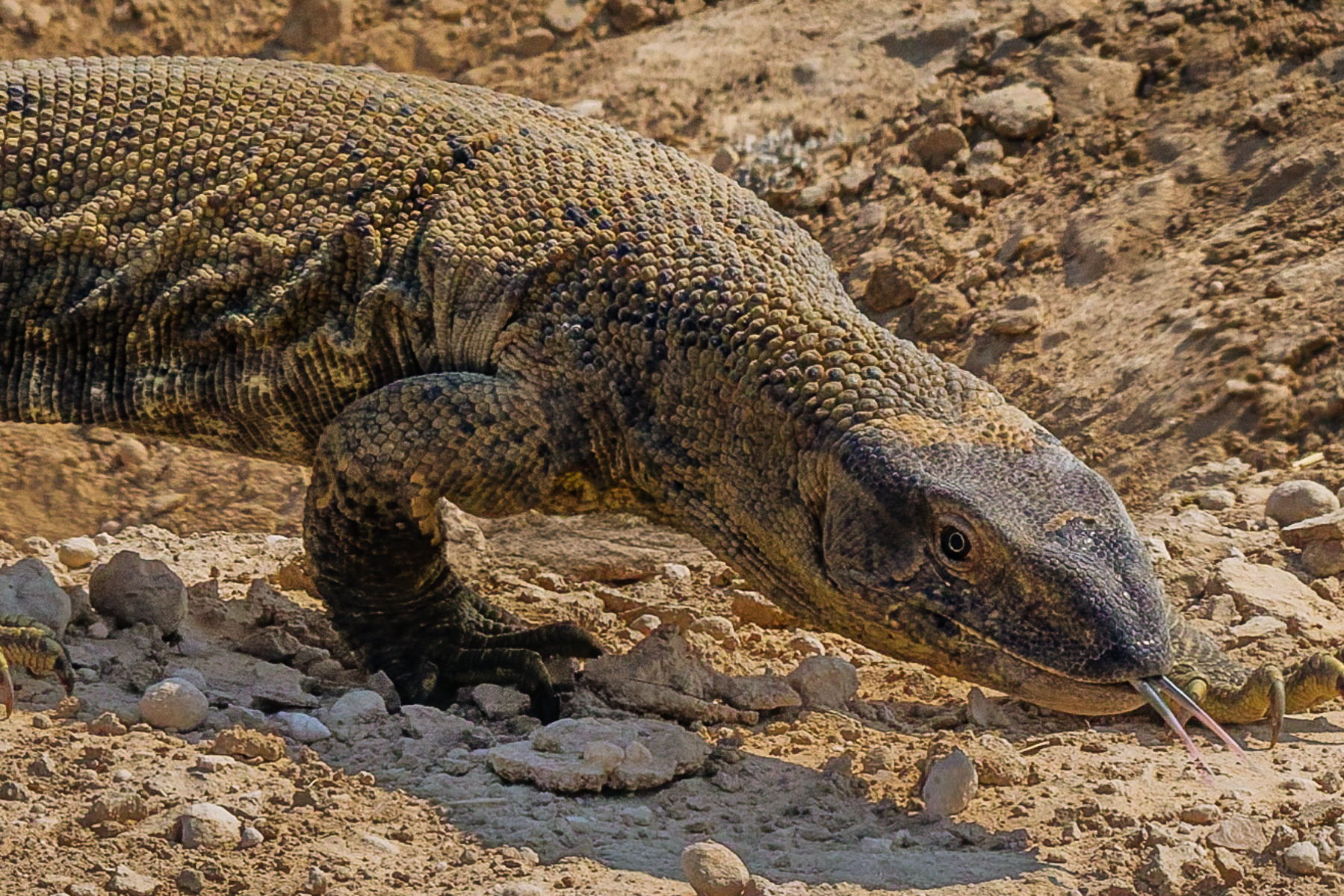
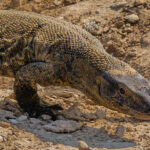
A Southern Rock Monitor lizard uses its tongue to sample the air for chemical information - vital for helping it detect prey, trails and potential mates. Taken in Namibia's Etosha National Park (image by Virginia Wilde)
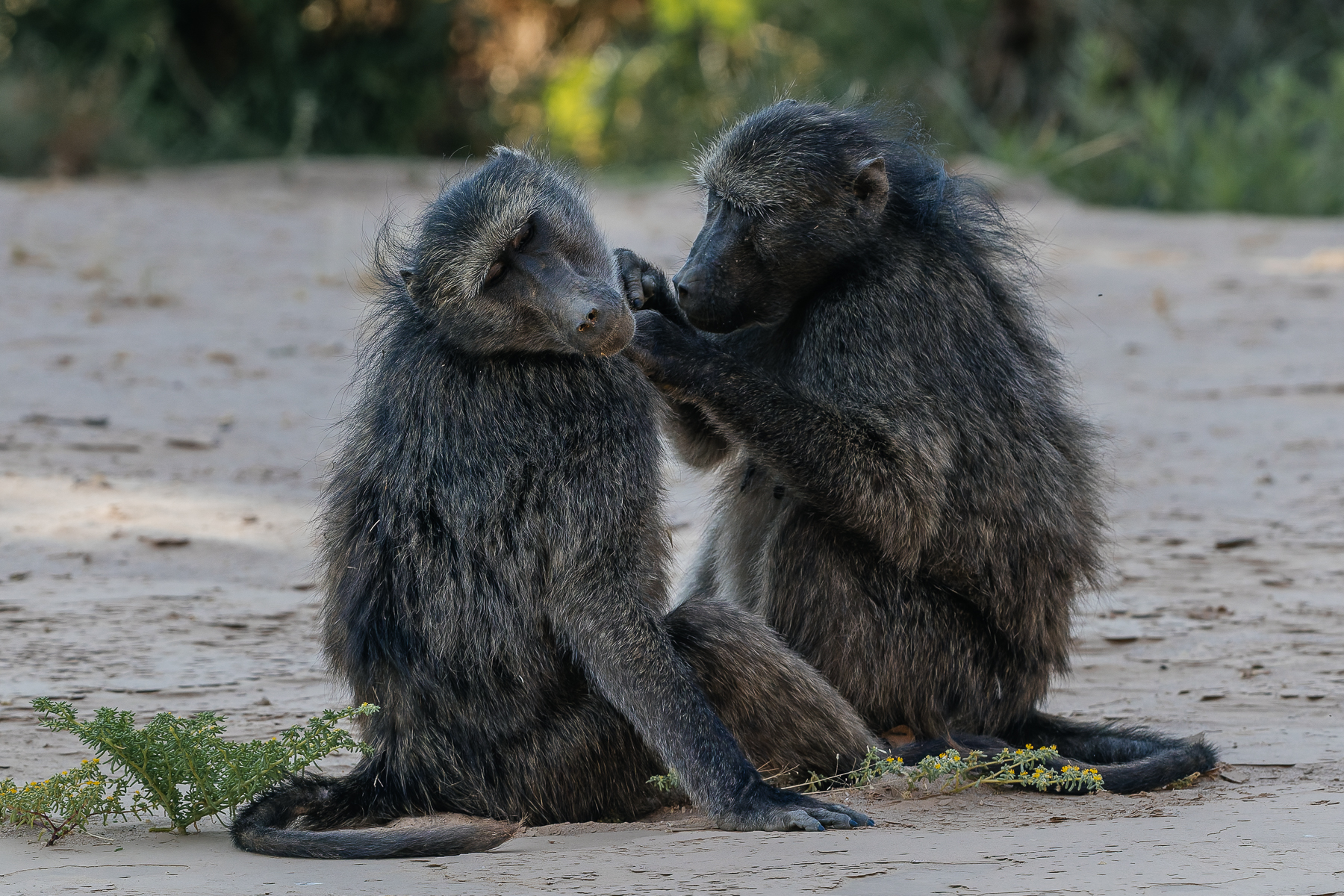
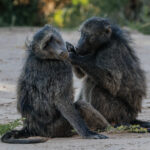
Grooming is a hugely important part of Chacma Baboon society, helping to strengthen social bonds as well as keeping fur free of parasites and debris (image by Virginia Wilde)
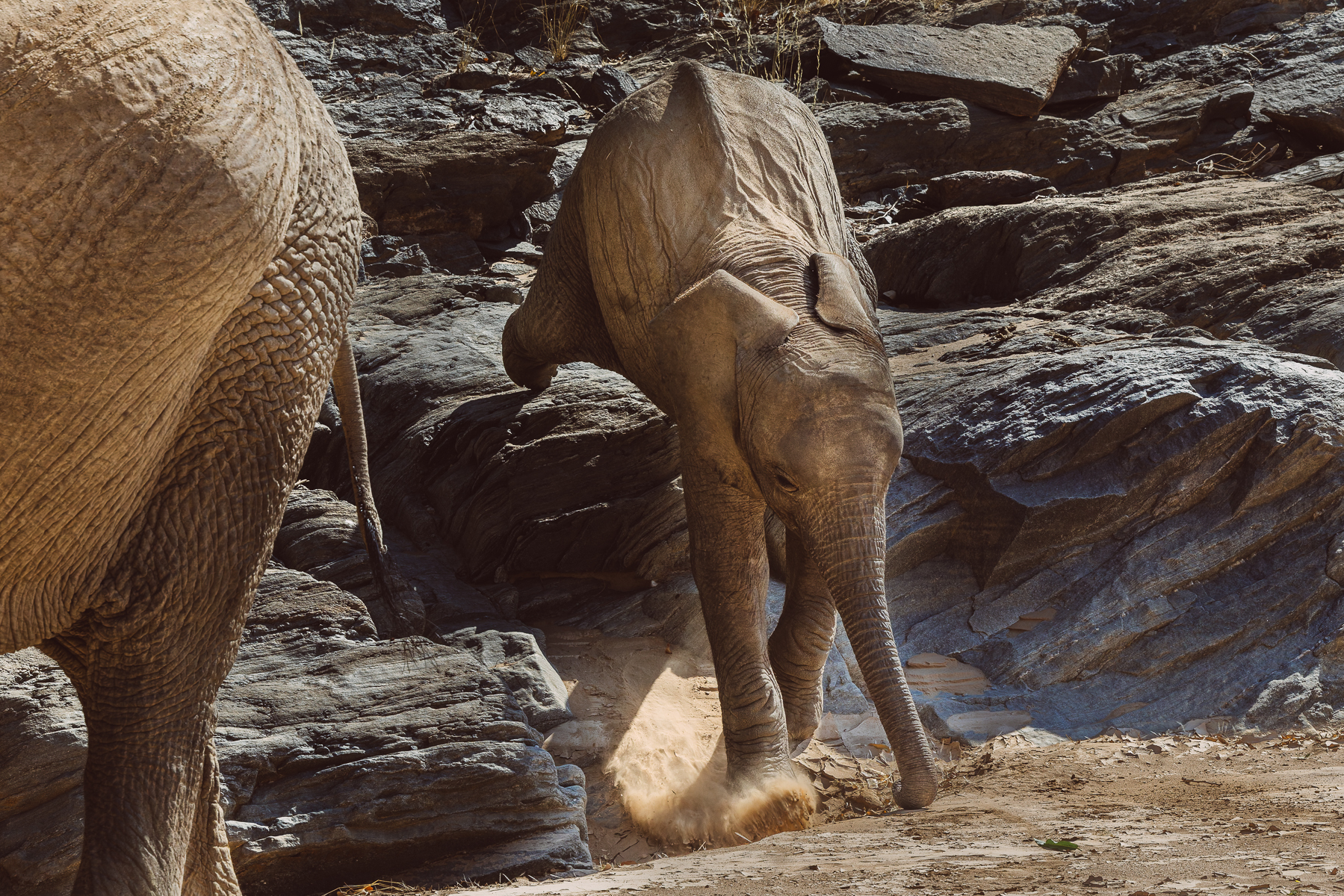
A desert-adapted African Savanna Elephant calf careers down a rocky outcrop in Namibia's Hoanib River Valley. These incredibly smart animals have learned to survive in this arid and harsh desert environment (image by Virginia Wilde)
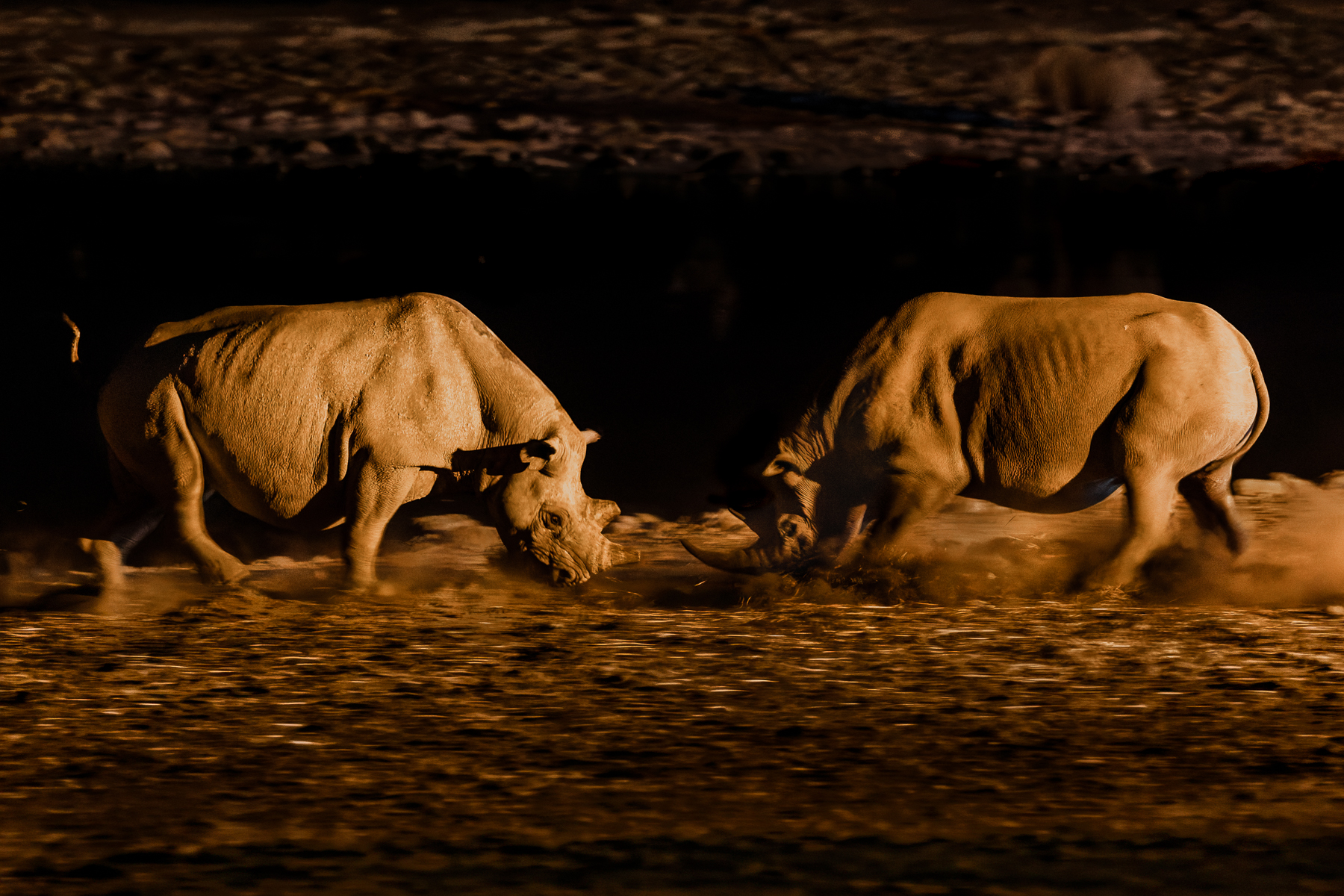
Charging Black Rhinos trade off against each other, as dust clouds billow around them. We watched this fiercely protective mother charge a male that had ventured too close to her calf, her protective instincts erupting in a sudden show of aggression (image by Virginia Wilde)
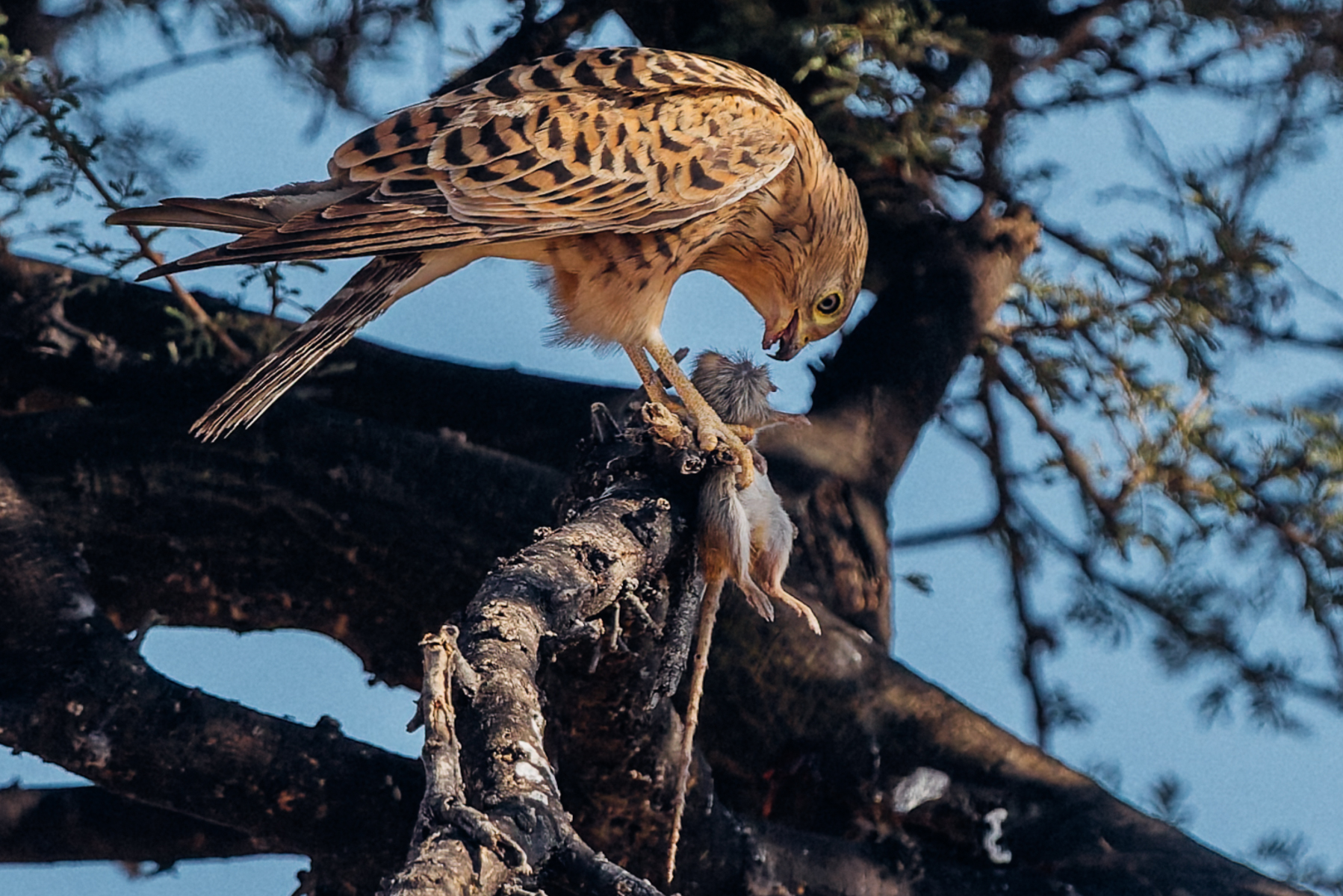
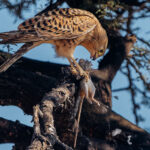
A Greater Kestrel starts to devour its rodent prey - having caught the surprisingly long mammal and carried it to a nearby tree, in Namibia's Etosha National Park (image by Virginia Wilde)
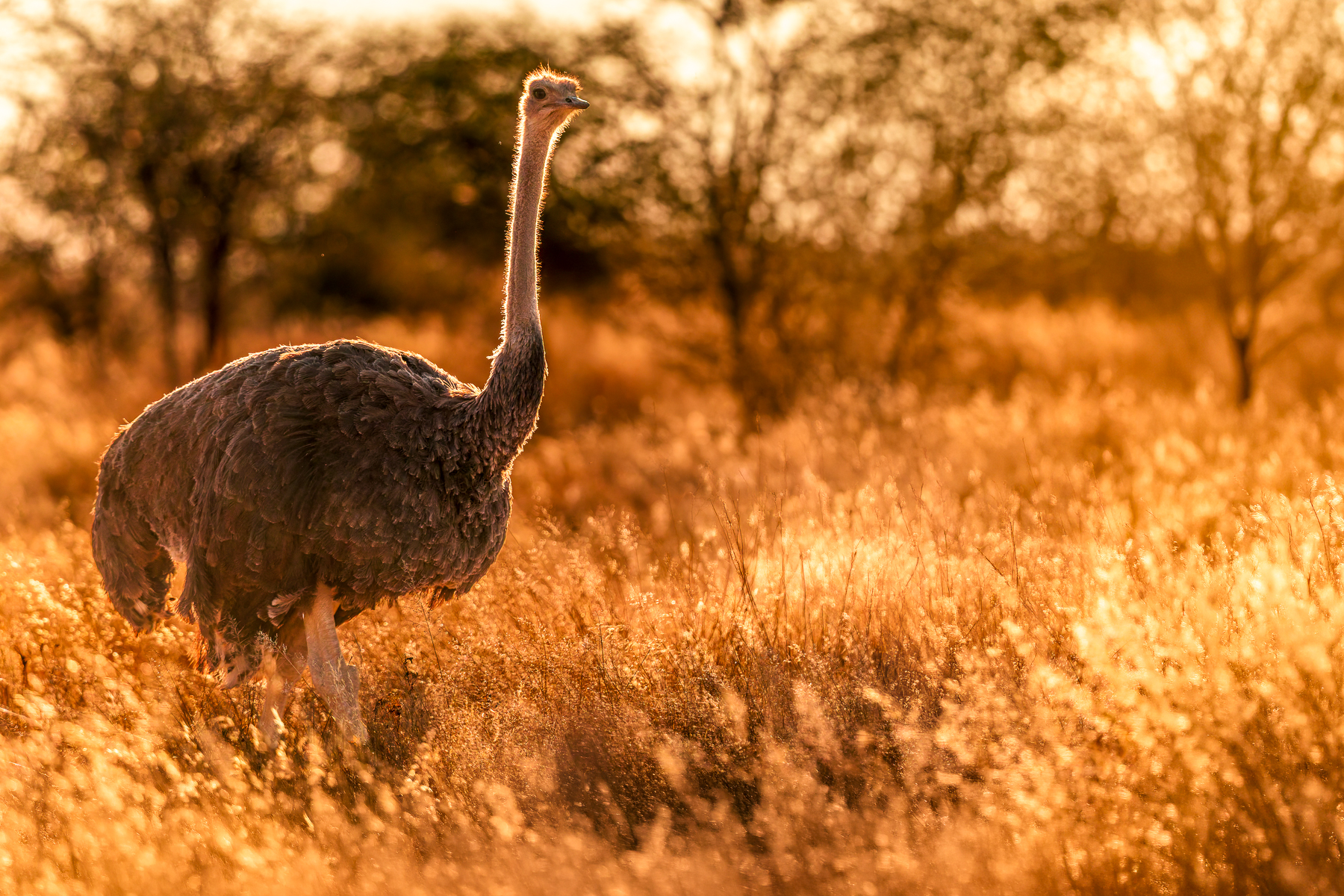
A female Southern Ostrich struts through a meadow at Namibia's Etango Ranch, with the setting sun turning the grass golden (image by Virginia Wilde)
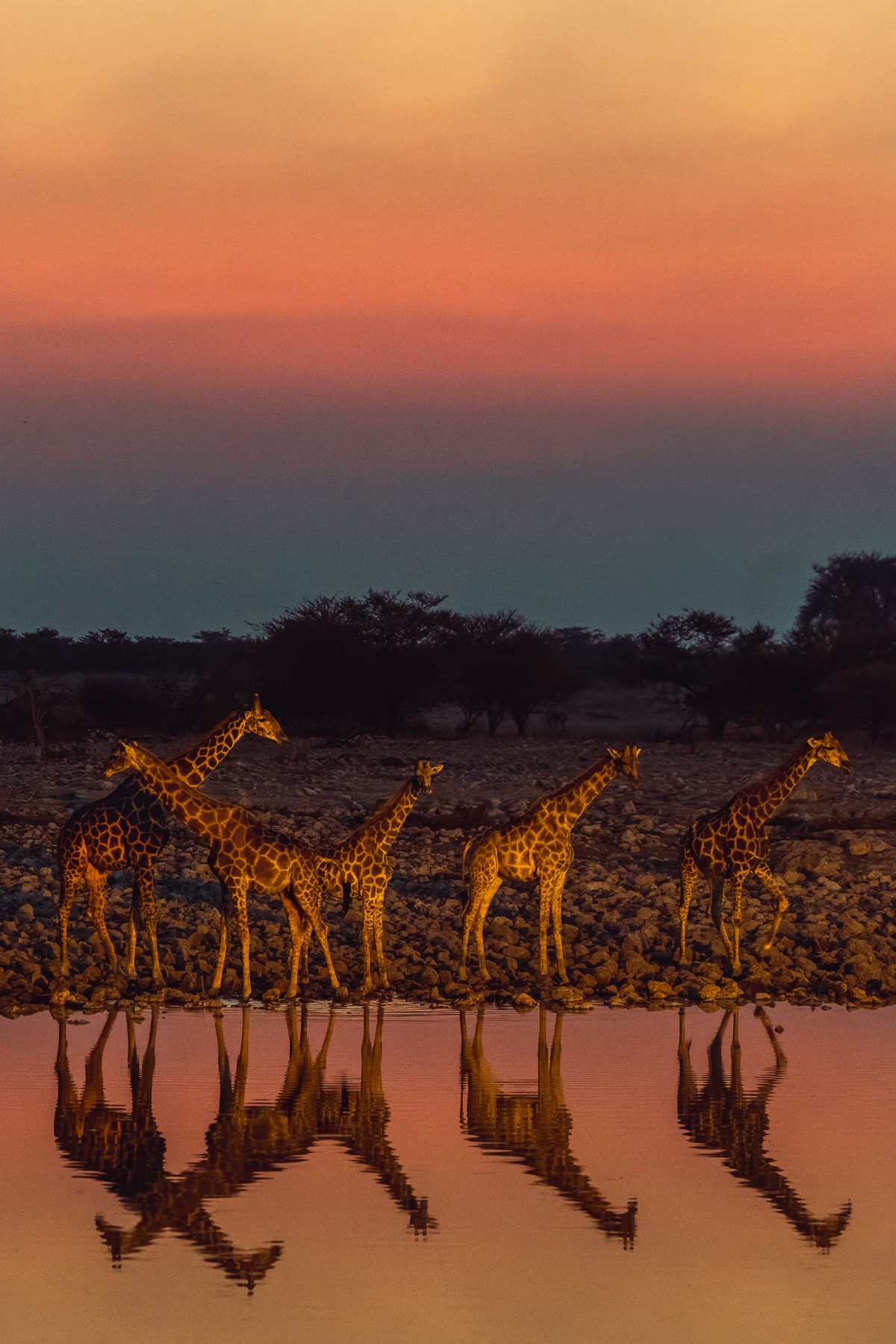
Five Angolan Giraffe drink from the Okaukuejo waterhole in the Etosha National Park as night falls. Giraffes are remarkably well suited to Etosha's dry landscape because they can browse vegetation that is far above the reach of most other herbivores, allowing them to exploit food even when grass and low-level vegetation become scarce (image by Virginia Wilde)
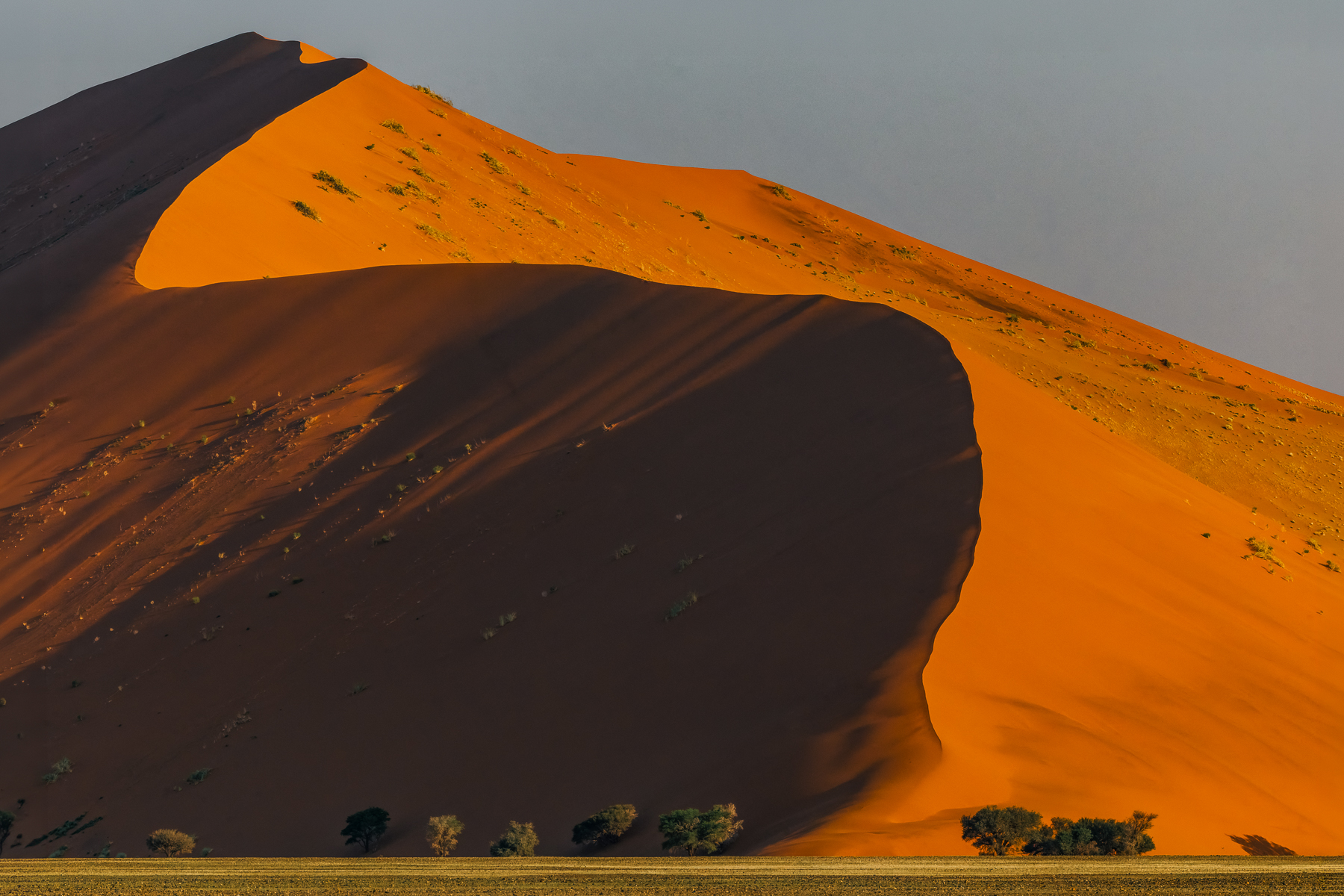
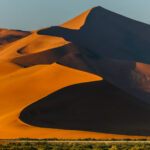
The Sossusvlei dune known as 'Big Mama' rises 200 metres (656ft) over the pan, showing a sweeping dark shadow across its face. 'Big Mama' lies north of 'Big Daddy' in the Namib Sand Sea UNESCO site (image by Virginia Wilde)
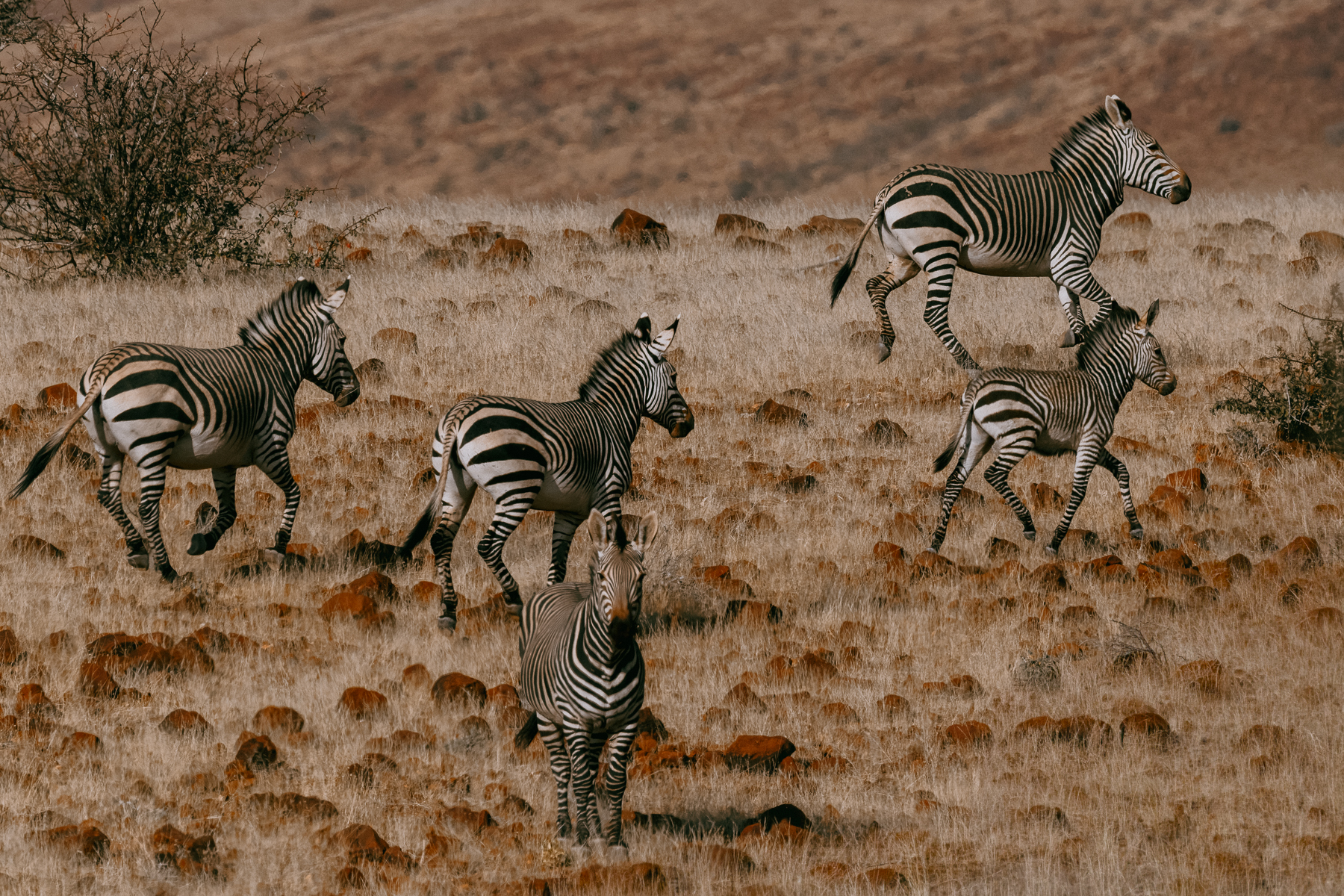
Unlike the more familiar Burchell's Plains Zebra, Hartmann's Mountain Zebra spend much of their lives in rugged mountain country, navigating steep slopes, rocky escarpments and sparse vegetation. This group has the unmistakable air of a family on the move (image by Virginia Wilde)
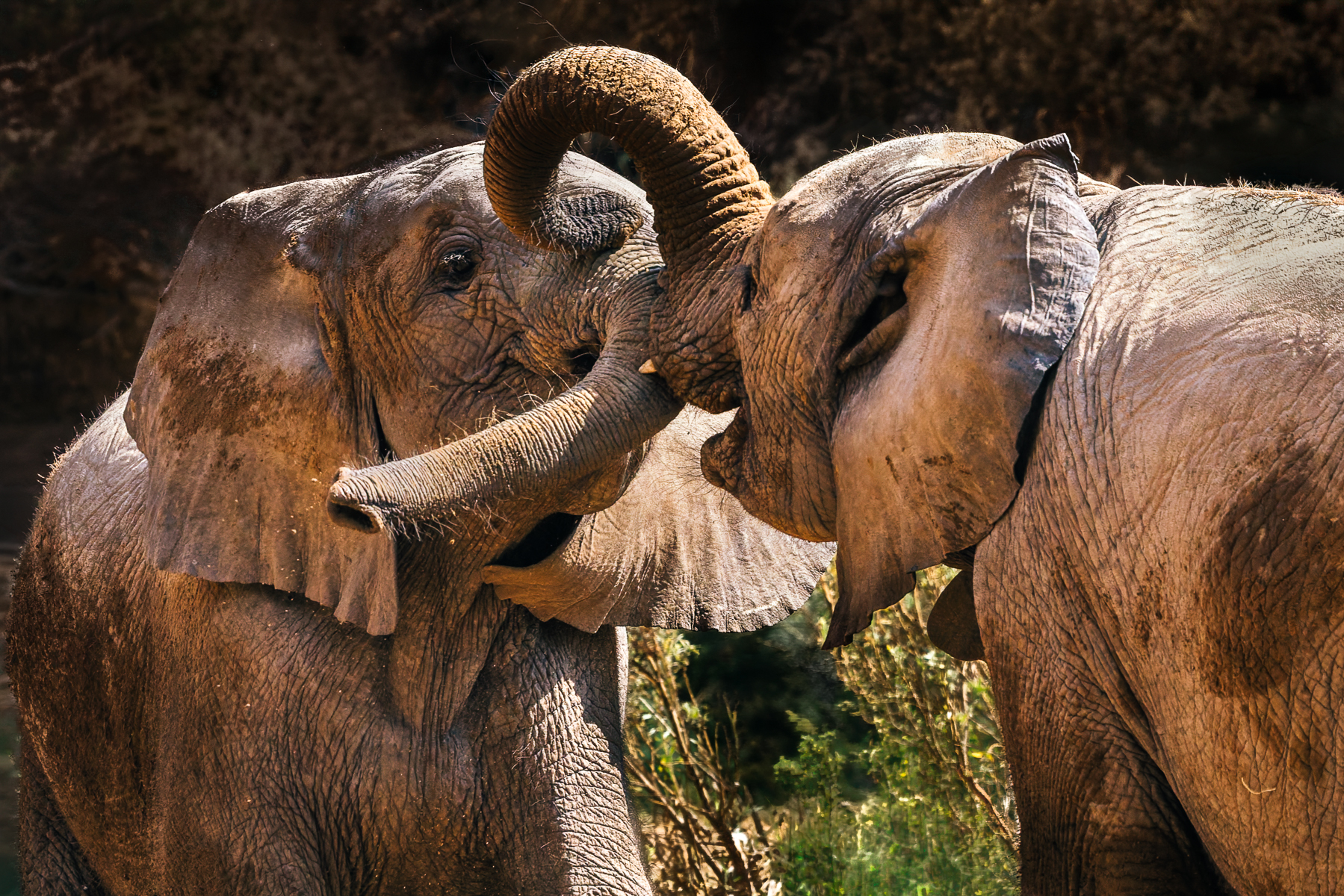
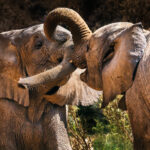
A pair of juvenile African Savanna Elephants joust with their trunks, playing together in the Hoanib River Valley. The birth rate for these desert-adapted elephants is low due to the demanding environment (image by Virginia Wilde)
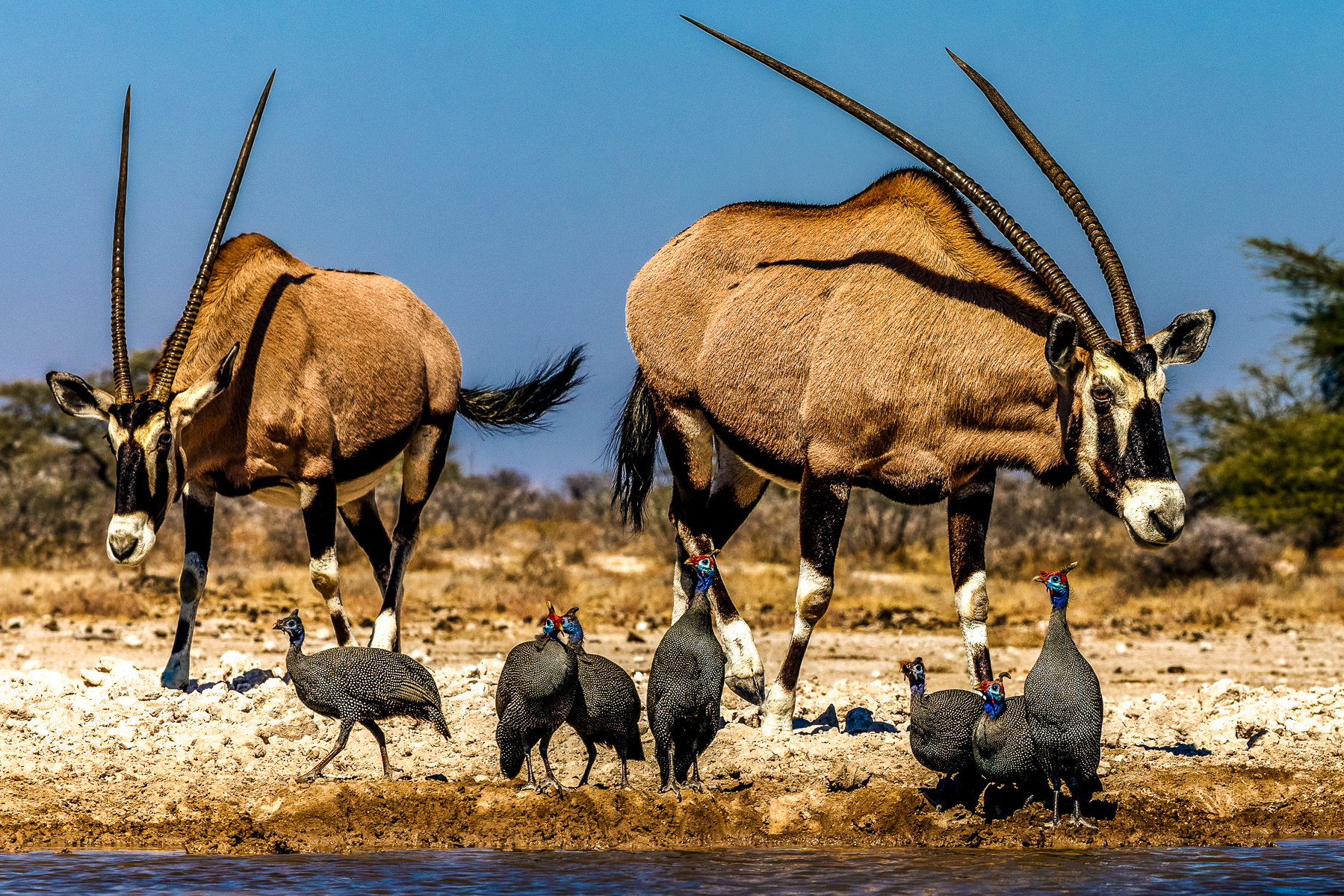
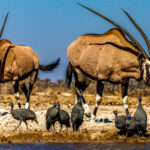
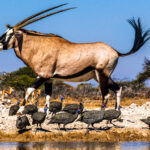
A striking pair of Gemsbok - with characteristic long speared horns - approach the Onguma waterhole to drink, leaving the slightly rattled-looking bunch of Helmeted Guineafowl unsure whether to hold their ground or make a swift sideways exit from their coveted waterside spot (image by Virginia Wilde)
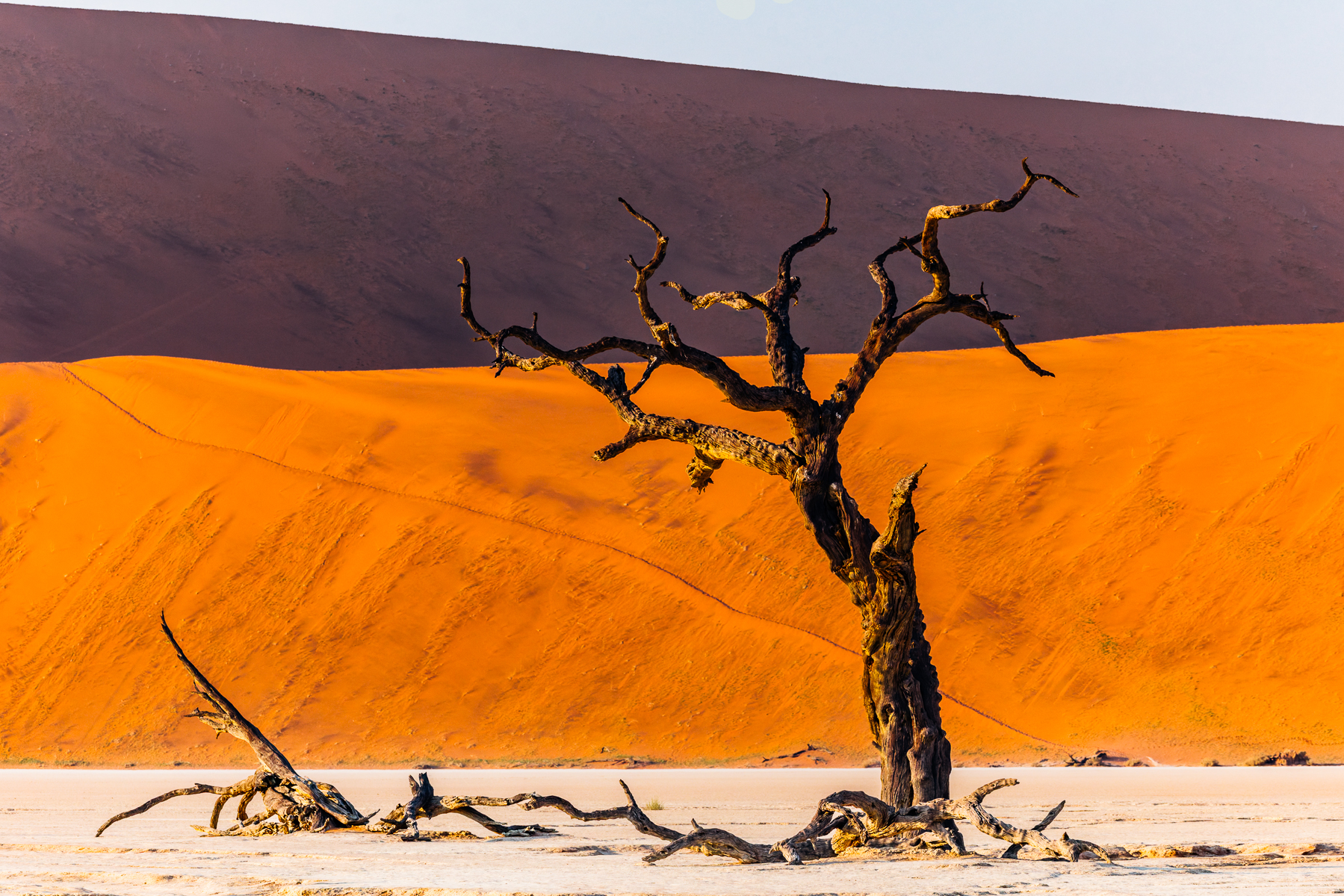
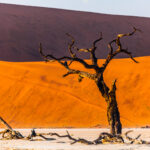
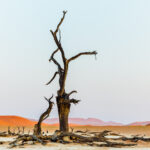
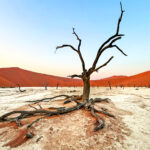
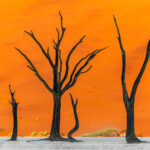
First light falls on an ancient Camel Thorn tree in Namibia's Deadvlei. The trees here died roughly 600-700 years ago, when water from the Tsauchab River was cut off by sand dunes. They are not petrified trees, but remarkably well-preserved dead wood (image by Virginia Wilde)
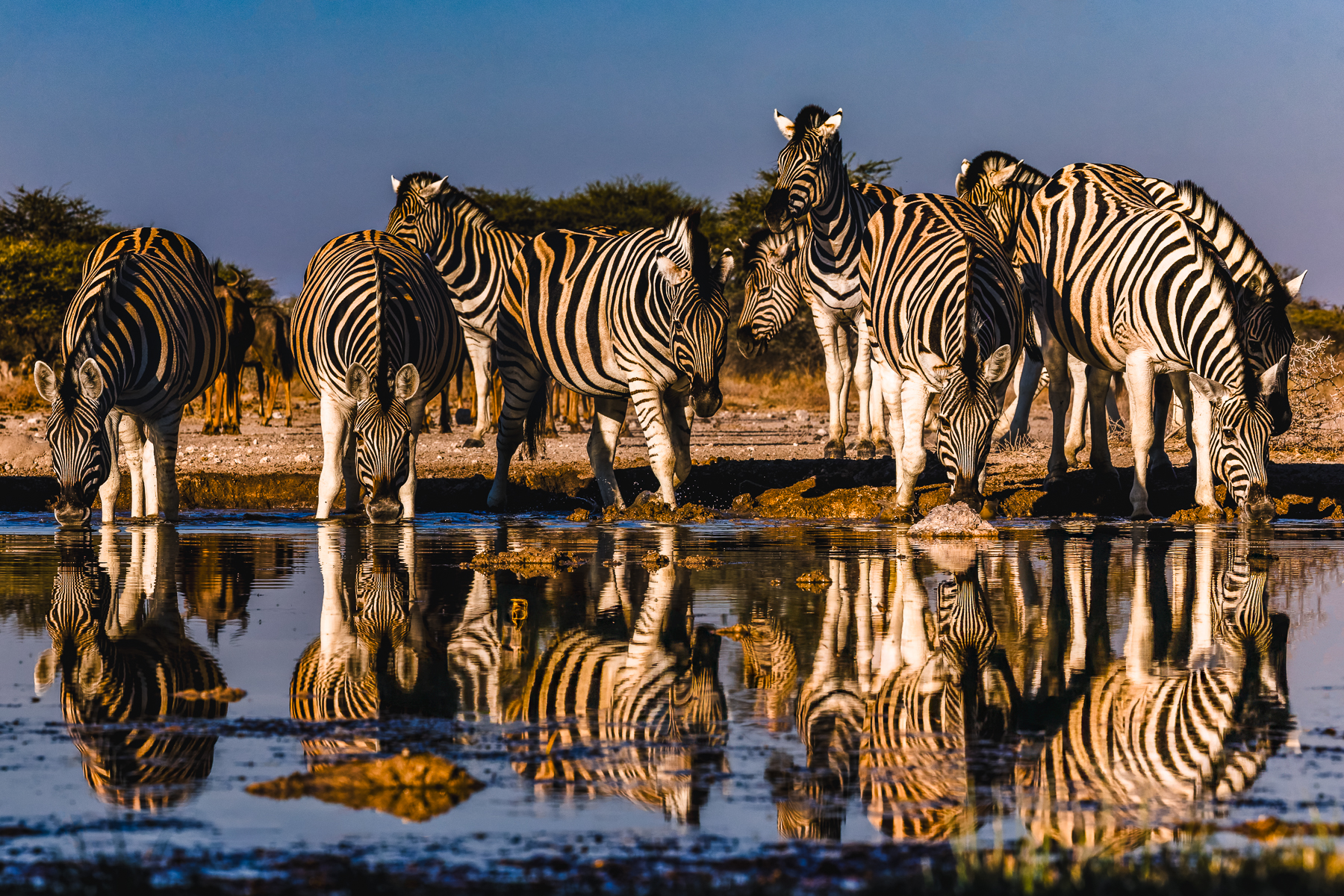
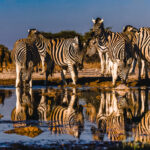
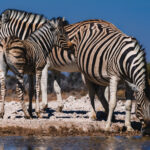
A herd of Burchell's Plains Zebra drink from the Onguma waterhole, their stripes making for some MC Escher-like optical illusions - with their reflections creating patterns that were difficult to separate from the animals (image by Virginia Wilde)
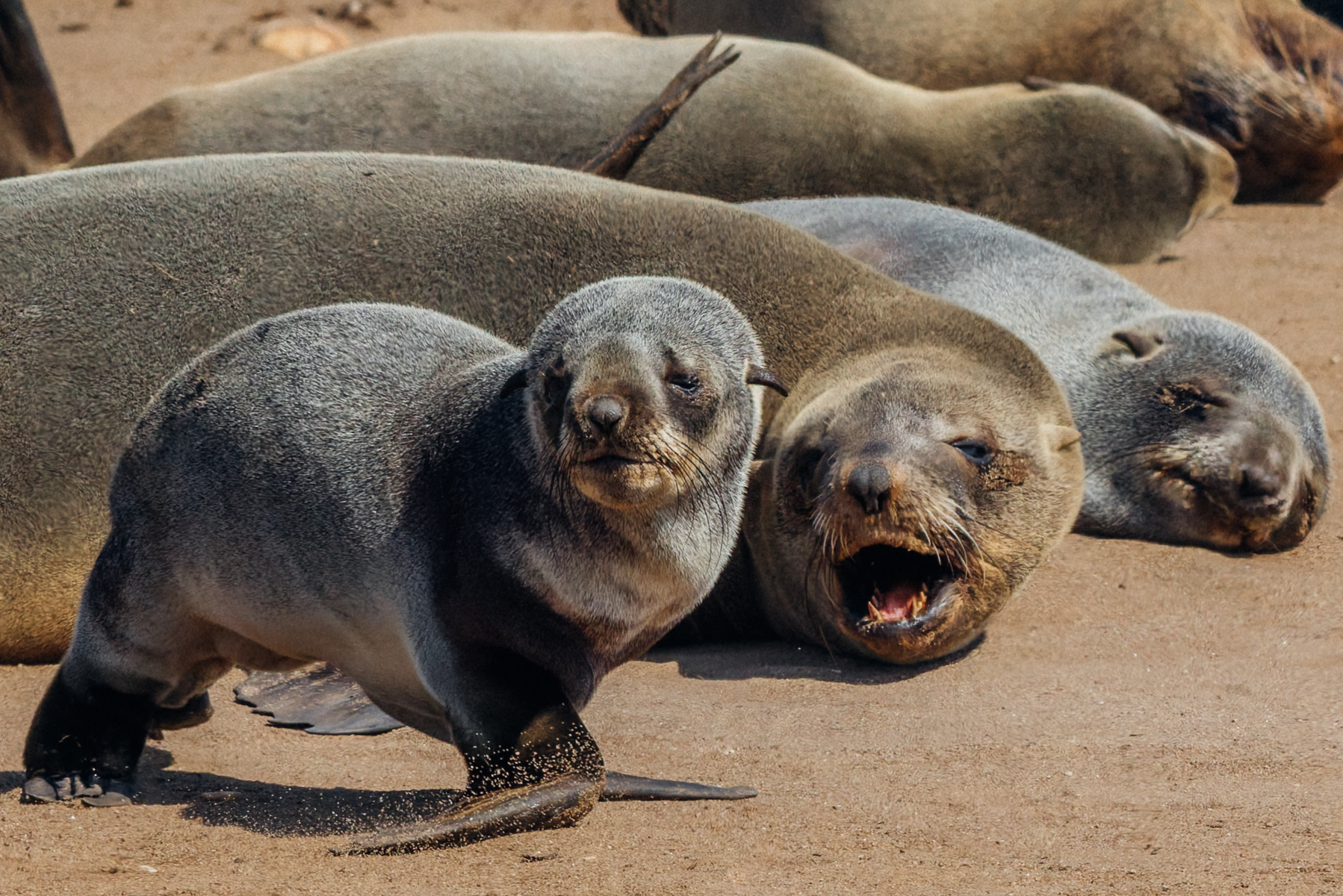
'No noisy pups, I'm sleeping!' A Cape Fur Seal appears to bellow at a passing pup after being woken from its slumber in Namibia's Cape Cross Seal colony (image by Virginia Wilde)
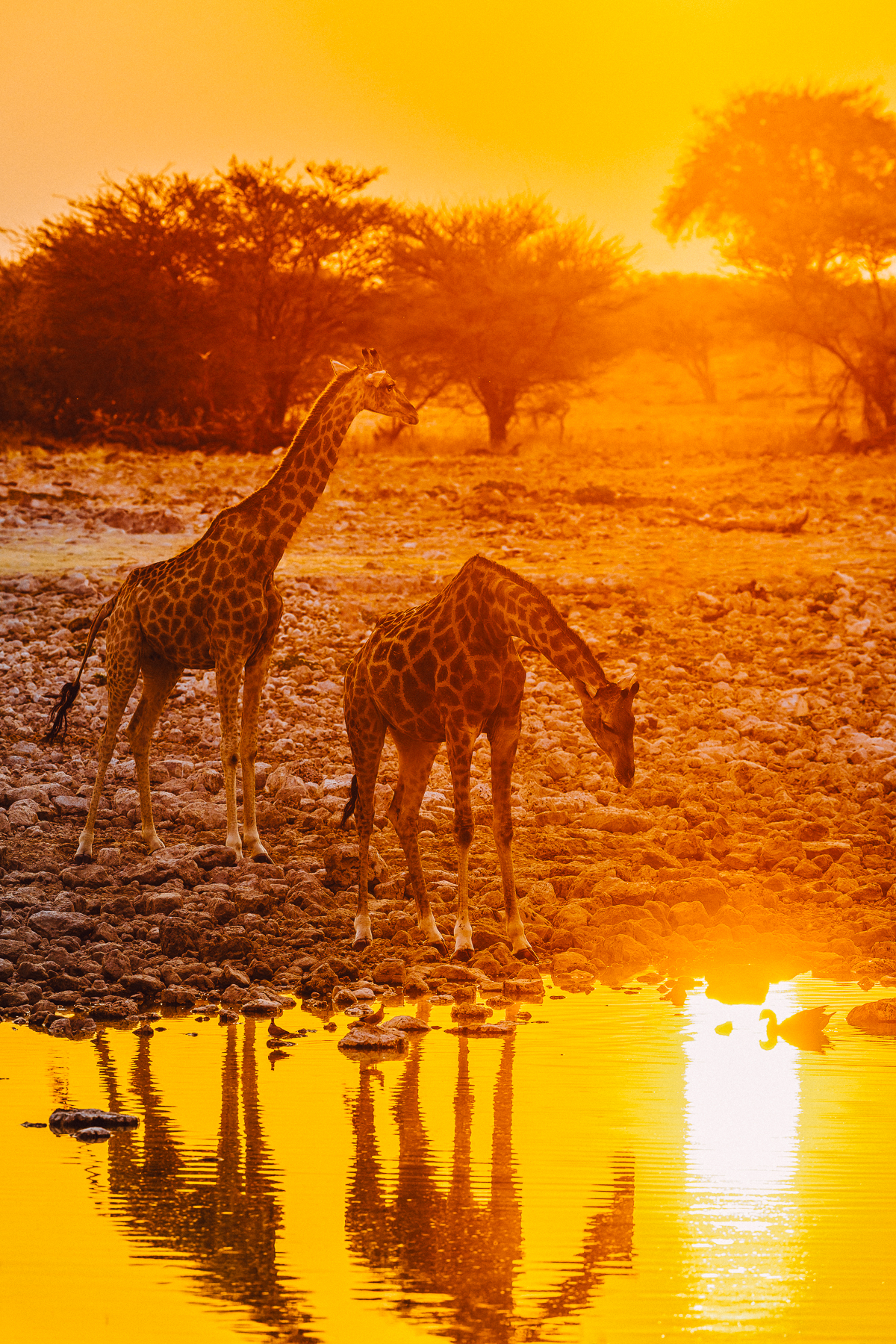
Two Angolan Giraffe appear cast in yellow light - in an image taken directly into the setting sun. Namibia gave us so many sun-set wildlife moments, it was hard to pick just a few for this report (image by Virginia Wilde)
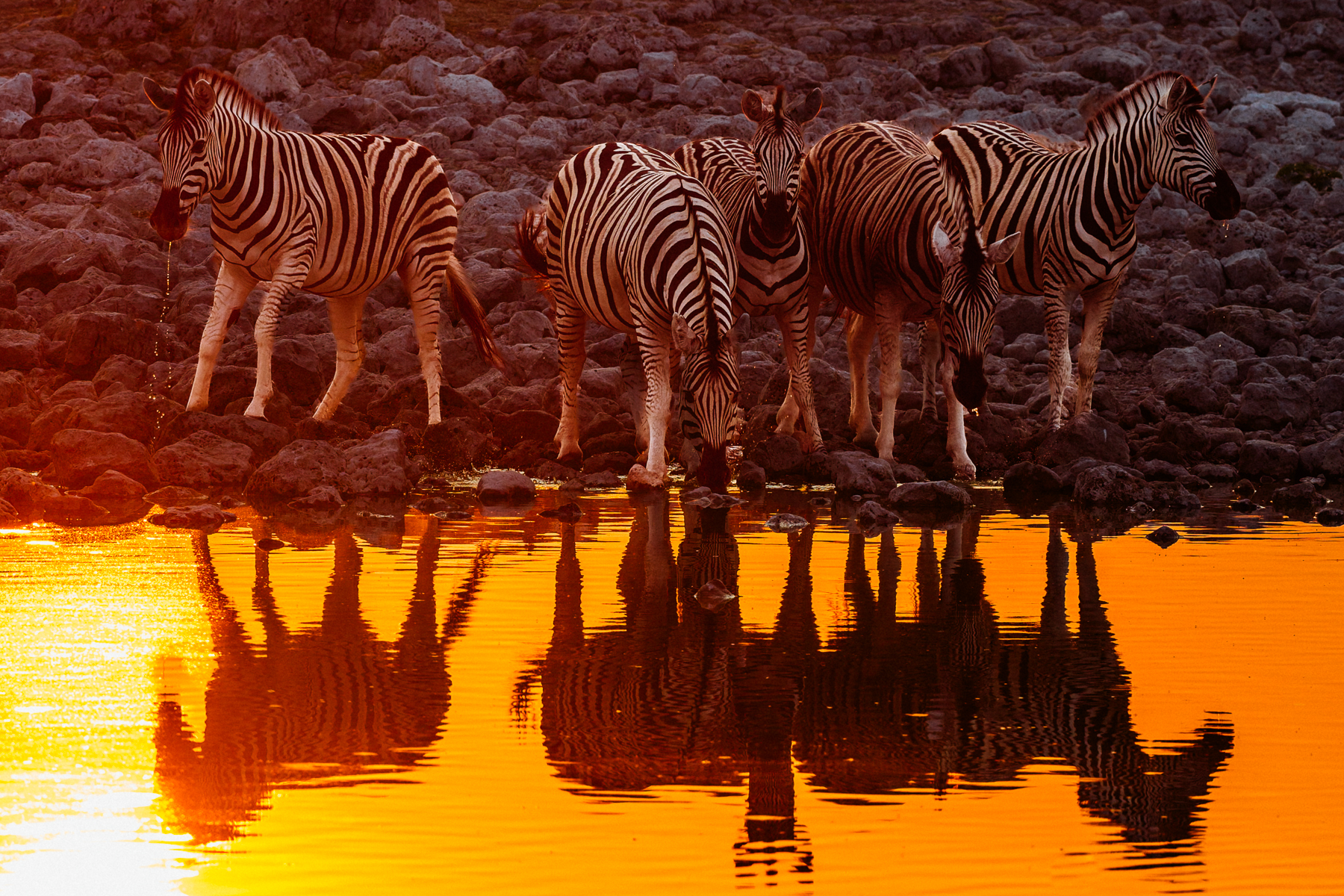
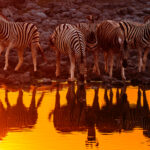
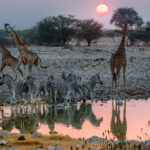
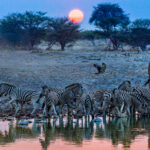
A deepening sunset turns the Okaukeujo waterhole orange in Namibia's Etosha National Park. A small herd of Burchell's Plains Zebra - distinctive with their faint brownish 'shadow stripe' on the hindquarters - gather to drink before night falls (image by Virginia Wilde)
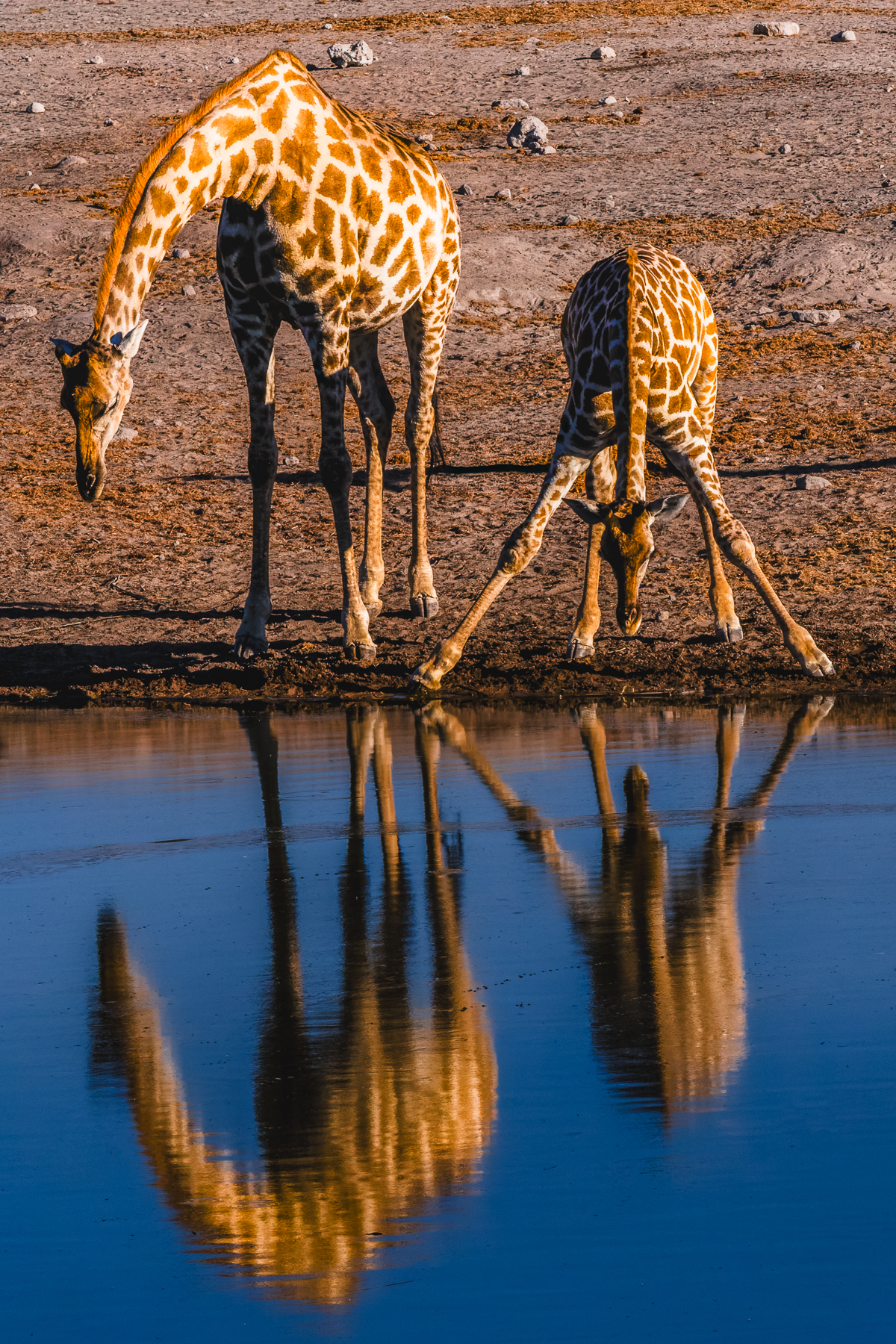
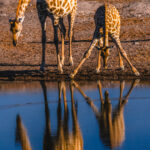
'Mirror, mirror in the waterhole wall, Who is the fairest Angolan Giraffe of them all?' A juvenile Giraffe and its mum bend to drink in Namibia's Etosha National Park, creating some beautiful reflections (image by Virginia Wilde)
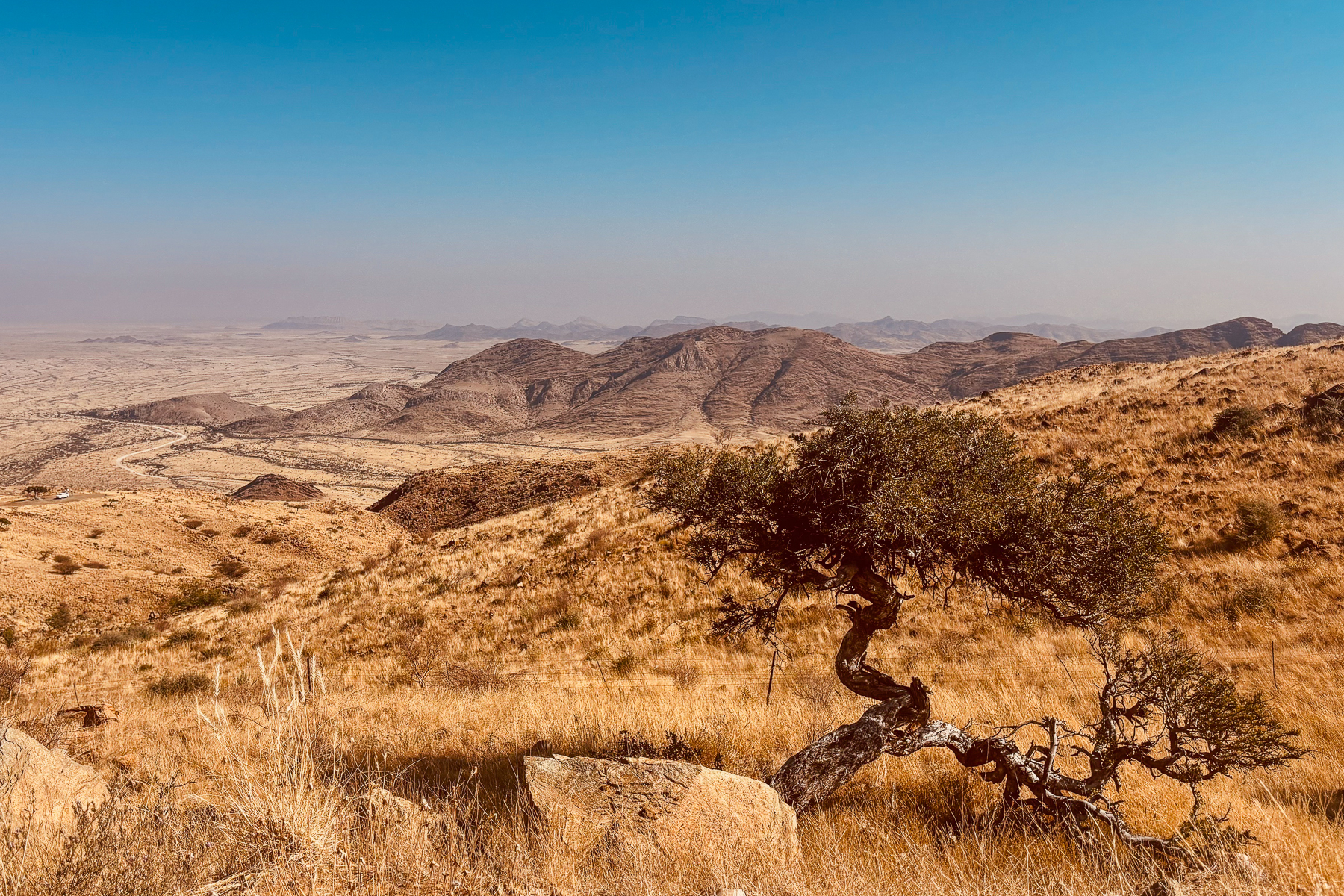
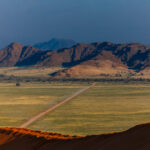
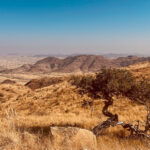
Some of the scenery during our road trip drives was stark and breathtaking. This view is just one of thousands we saw during our 2,000km trek (image by Virginia Wilde)
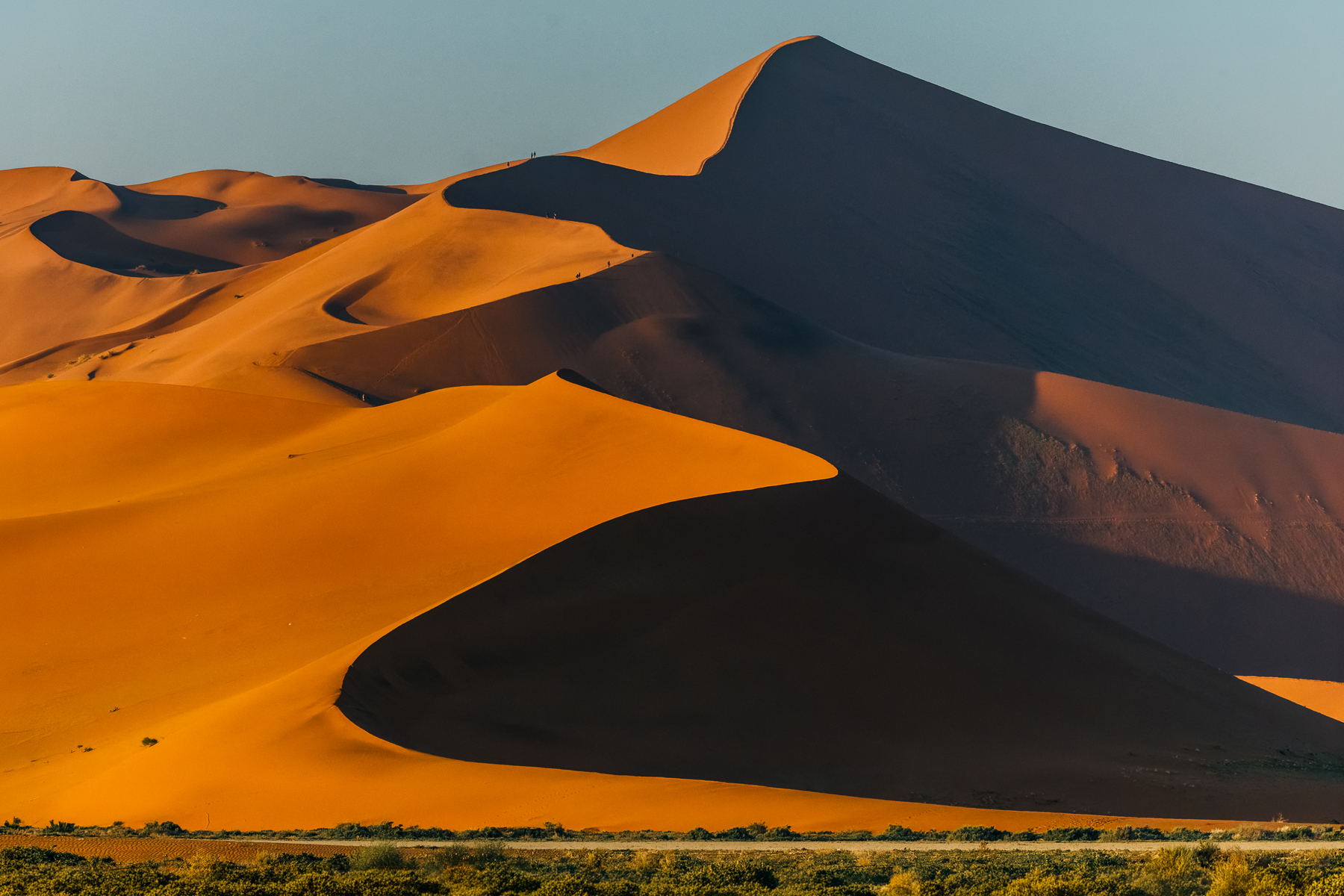
'Big Daddy', the highest dune at Sossusvlei, with its enormous, shadowed face contrasting with the orange ridges as they hit the morning light. The sand in Sossusvlei is so red in tone due to the iron oxide - essentially rust - coating the individual quartz sand grains. Older sand tends to be redder as it's had longer for the iron coating to develop (image by Virginia Wilde)
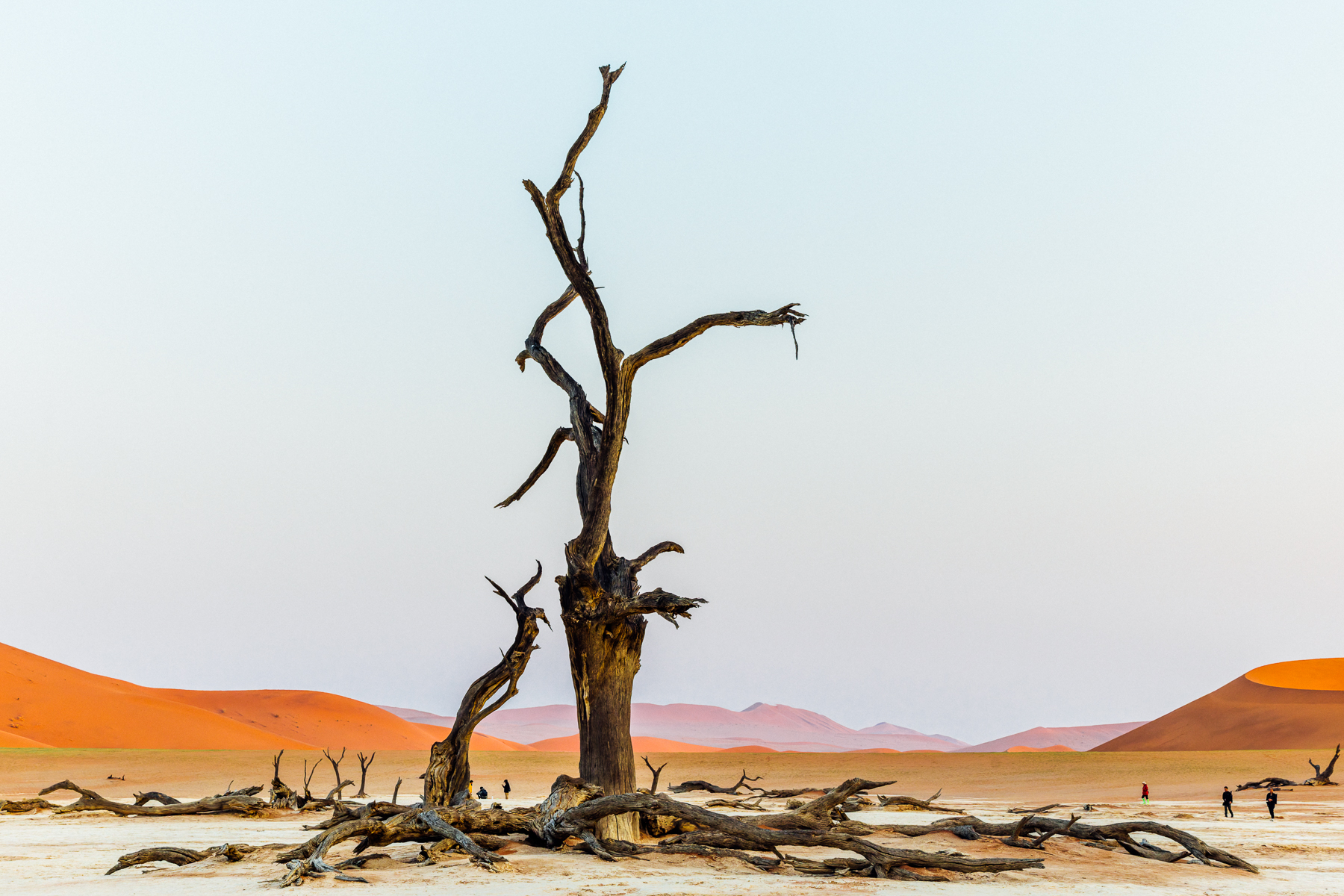
One of Deadvlei's great Camel Thorn trees towers above the ghostly remains of the forest around it, its weathered trunk rising high above the white clay pan. Around 600-700 years ago, these trees were cut off from the Tsauchab River and died, but the extreme aridity preserved their blackened remains (image by Mike Watson)
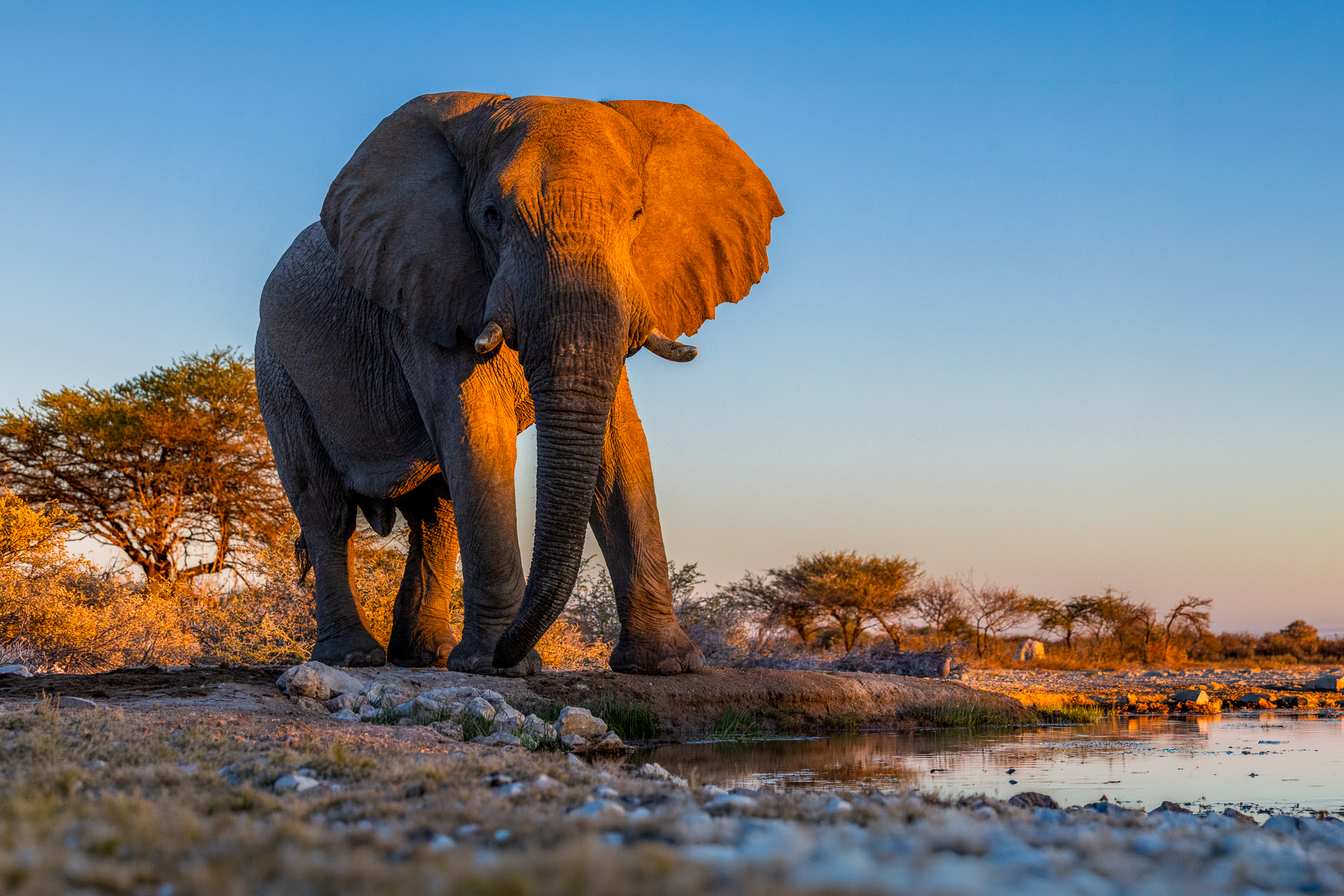
The setting sun turns the head of this African Elephant bull a fiery orange, as he approaches the waterhole, in Namibia's Onguma Reserve, for an evening drink. Namibia's sunsets - with colours scattered by desert dust and sand - were among some of the most spectacular I've ever seen (image by Virginia Wilde)
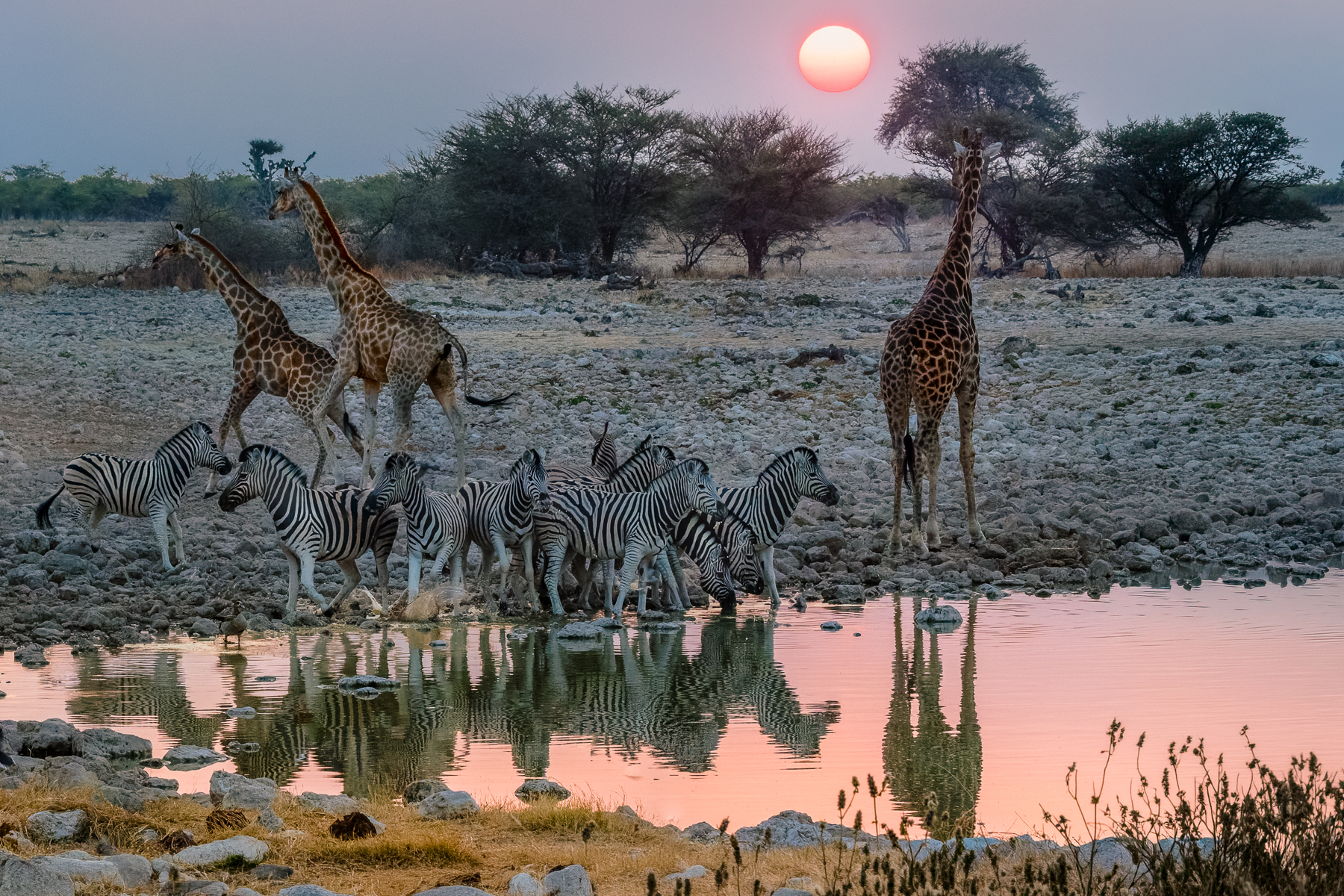
Sunset at Namibia's Okaukuejo waterhole can be a crowded affair. Here, Burchell's Plains Zebra jostle near Angolan Giraffe for some much-needed hydration in the salt pan of Etosha (image by Virginia Wilde)
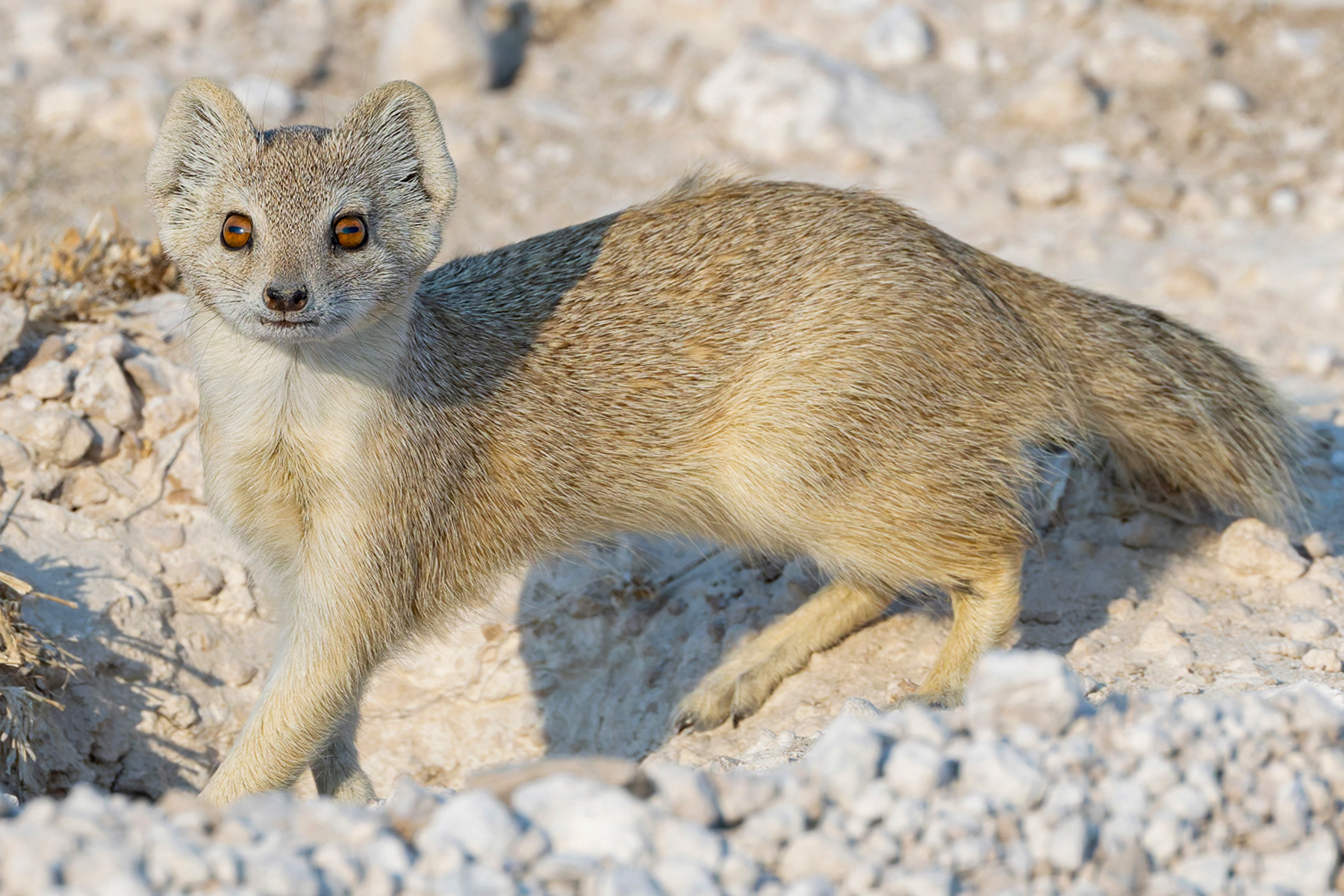
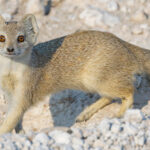
Hey Yellow Mongoose, what wonderfully orange eyes you have! Yellow Mongoose are excellent diggers and unlike many mongooses, they are largely solitary - with adults typically living and foraging alone (image by Virginia Wilde)
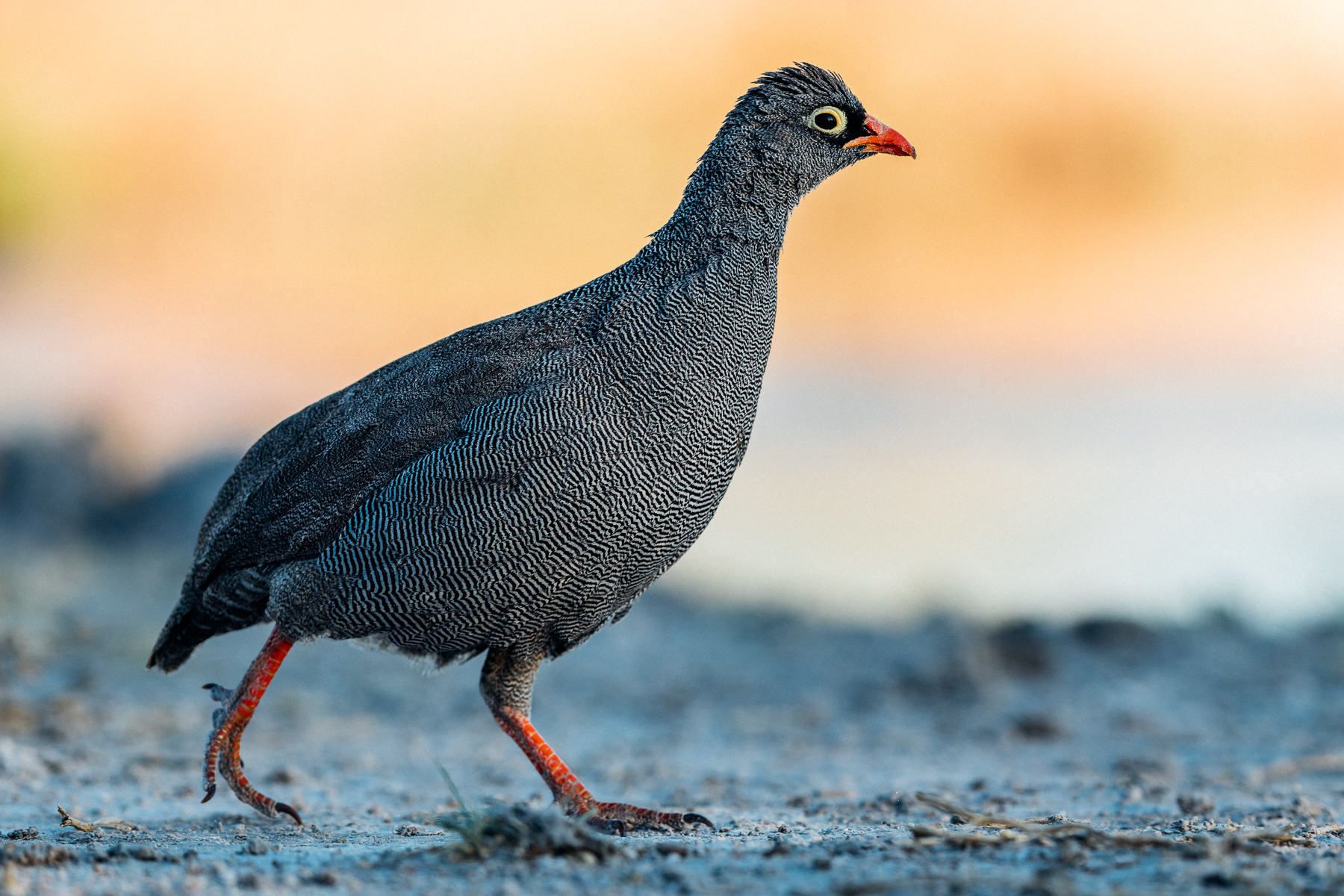
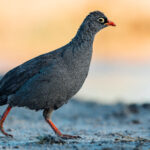
Red-billed Spurfowls are common visitors to Namibia's waterholes with their loud repeated calls conspicuous in the early mornings and evening. Like other spurfowl, they have powerful legs and spurs, used in territorial disputes between males (image by Virginia Wilde)
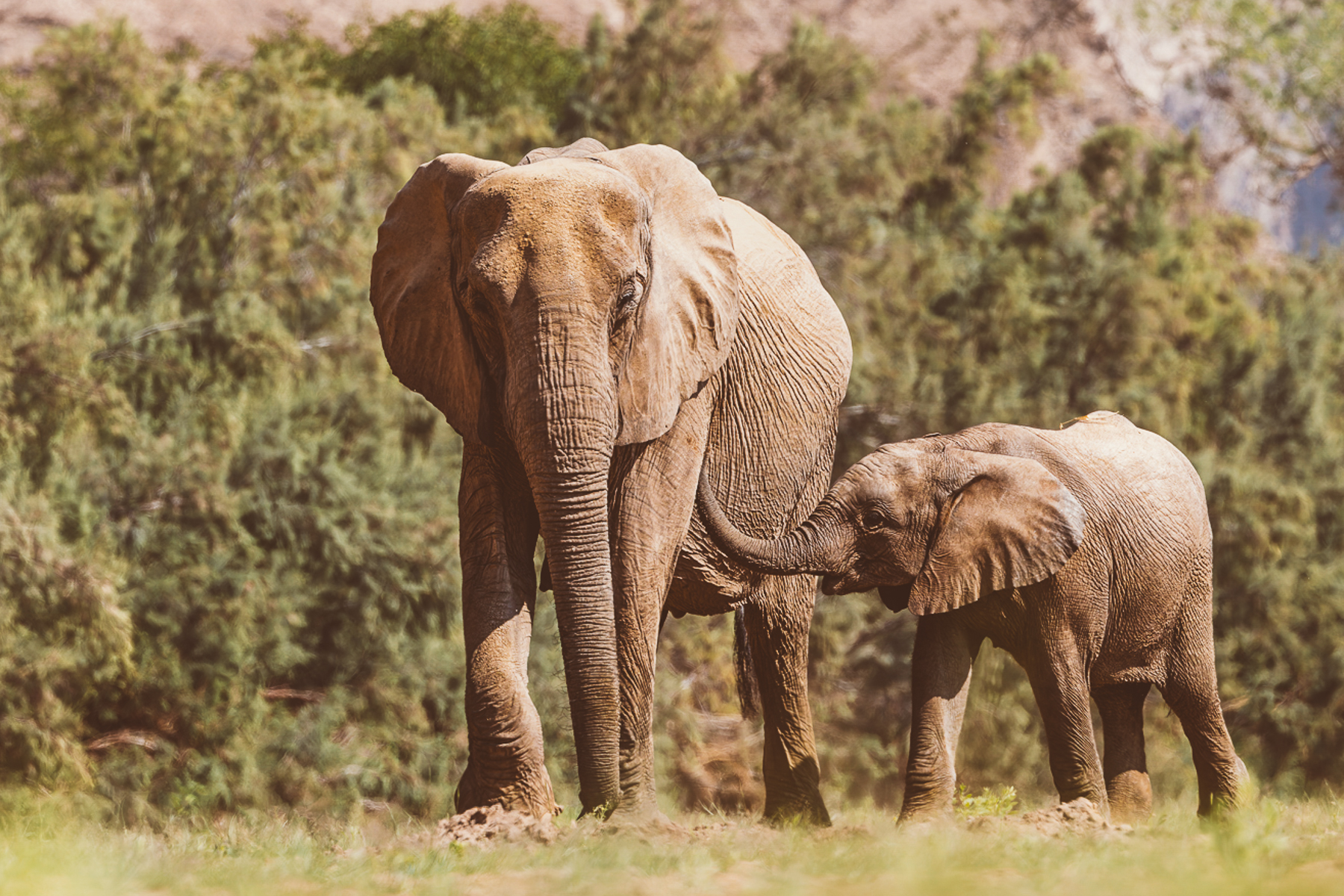
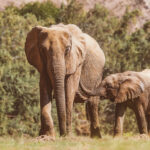
A juvenile African Savanna Elephant lifts its trunk to its mum's body for comfort - in a tender moment in Namibia's Hoanib River Valley (image by Mike Watson)
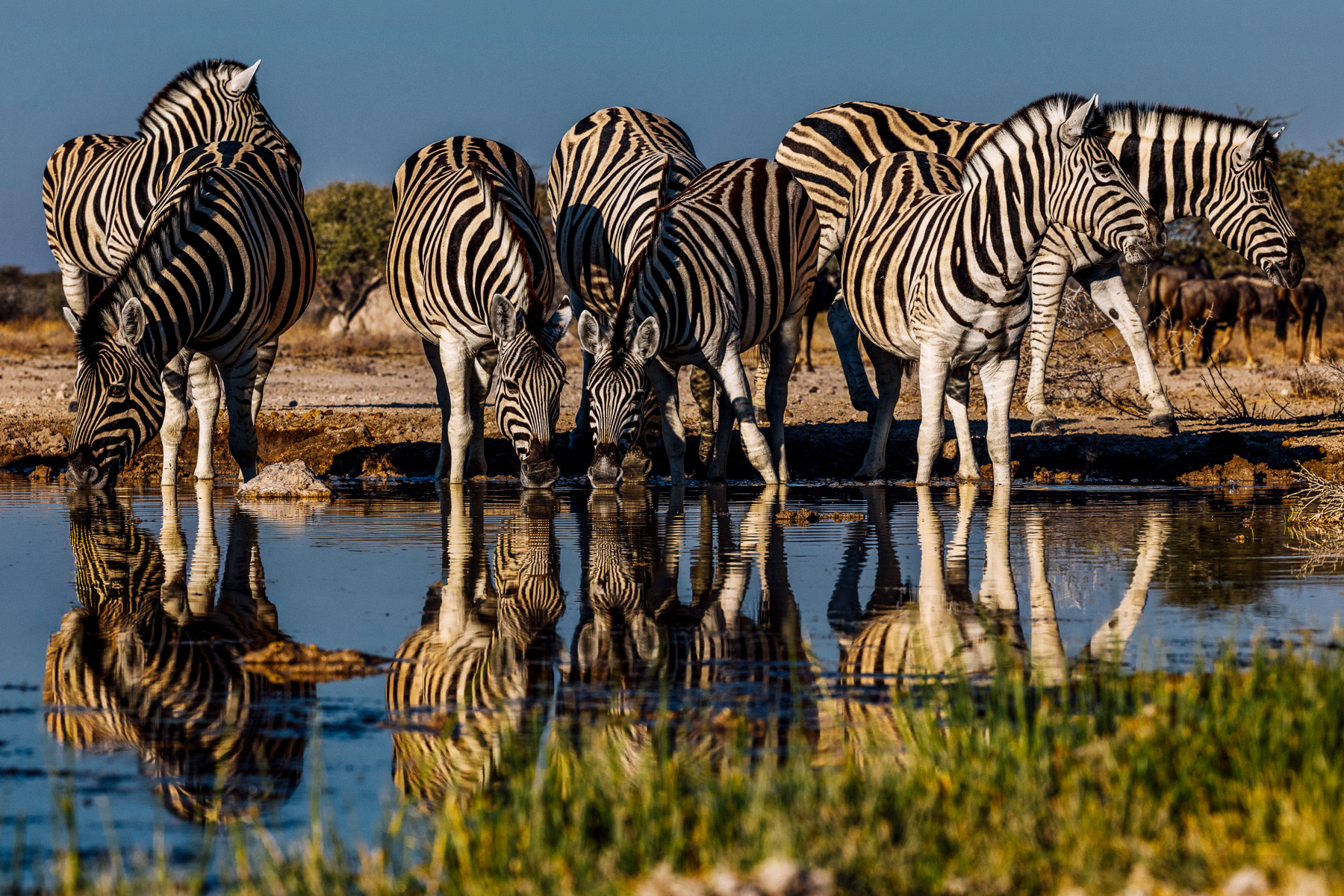
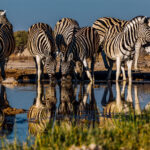
A dazzle of Burchell's Plains Zebra are reflected in the still waters of the Onguma Reserve waterhole. Zebra were one of our most frequent wildlife visitors during our time in the exceptional Onguma hide (image by Virginia Wilde)
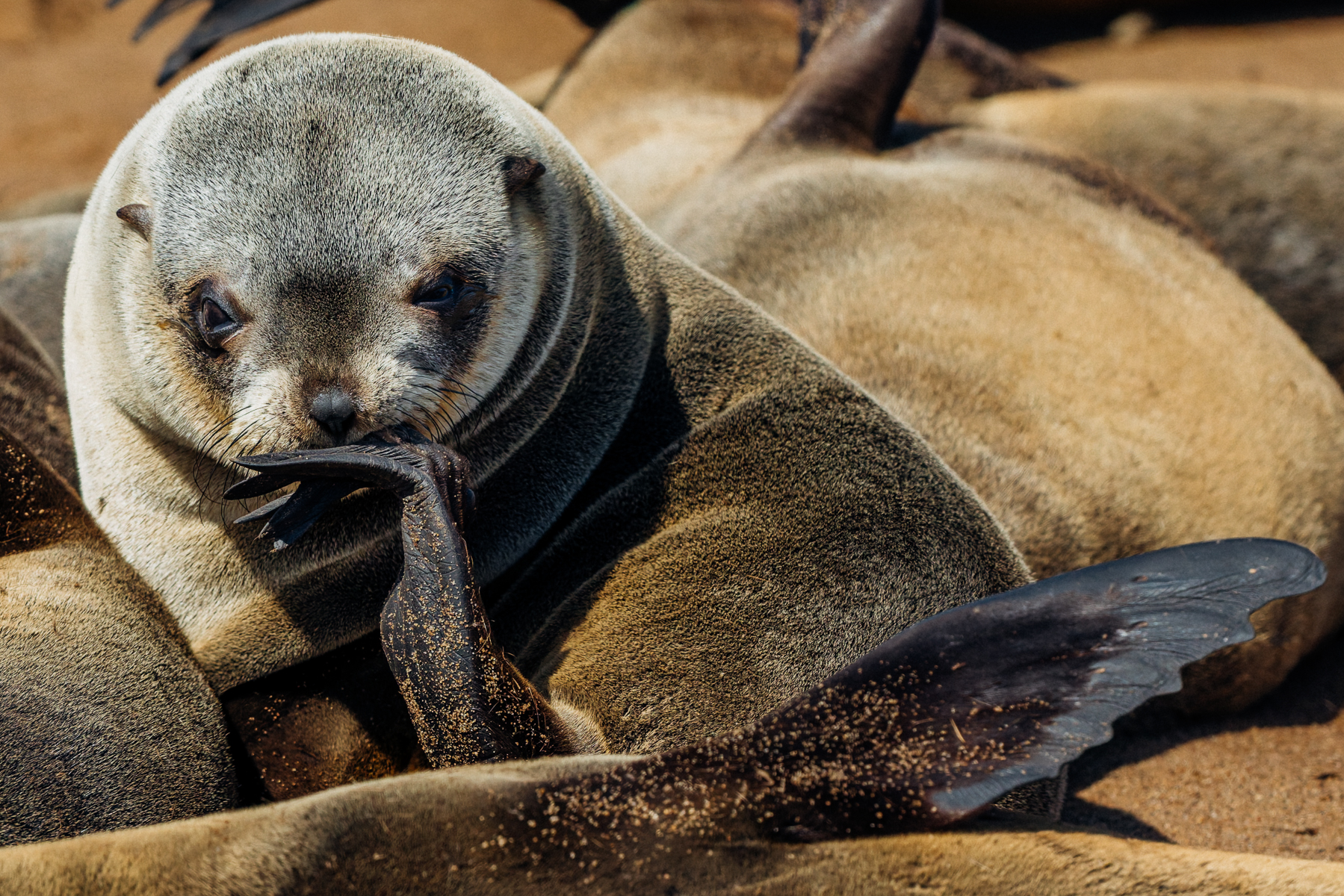
If a Cape Fur Seal could adopt a ponderous look, it would be this. It's a Pinniped version of Rodin's 'The Thinker' sculpture, if ever there was one (image by Virginia Wilde)
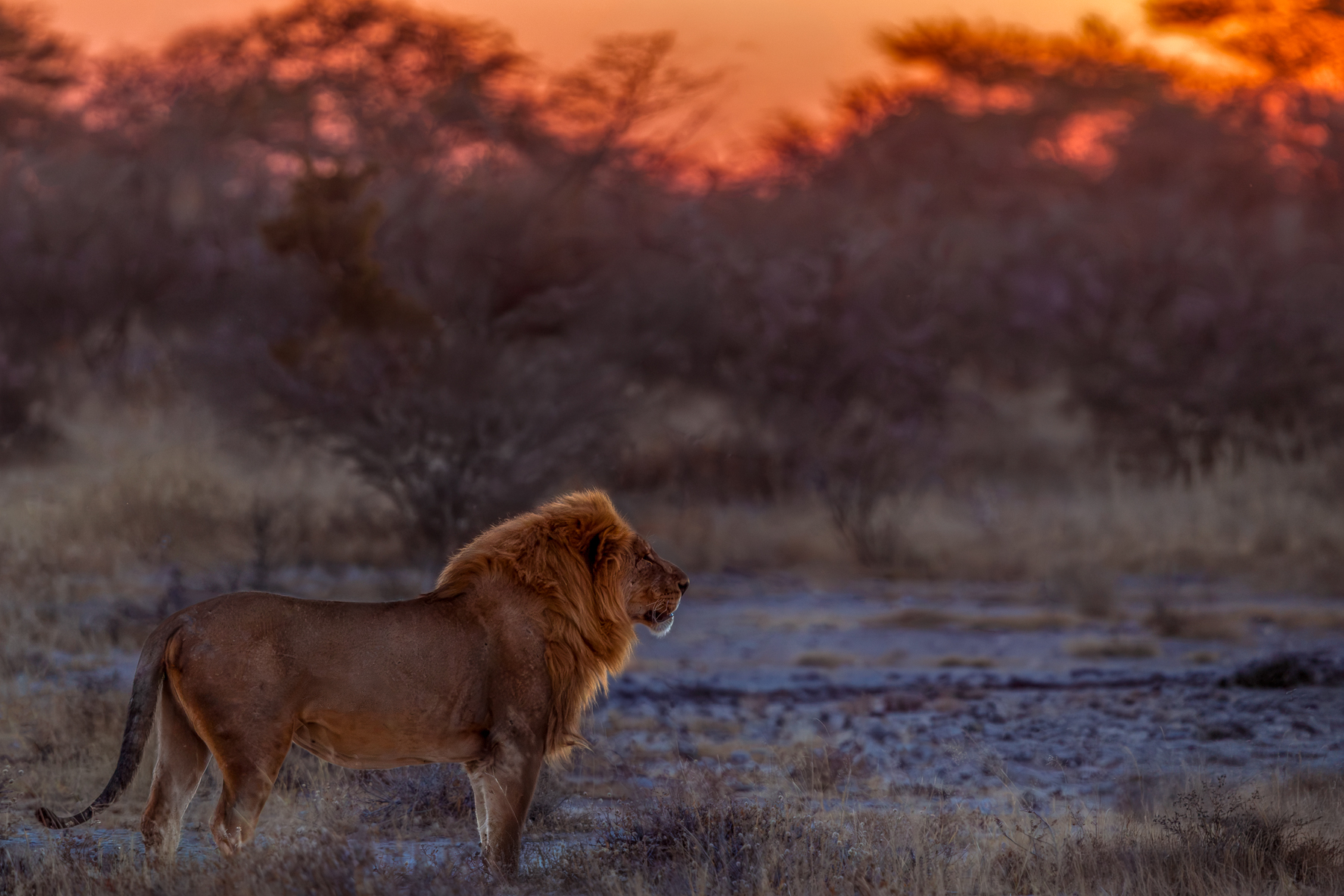
The last colours of sunset light up the mane of this wandering African Lion. Taken in Onguma Reserve, which borders Etosha National Park, Namibia (image by Virginia Wilde)
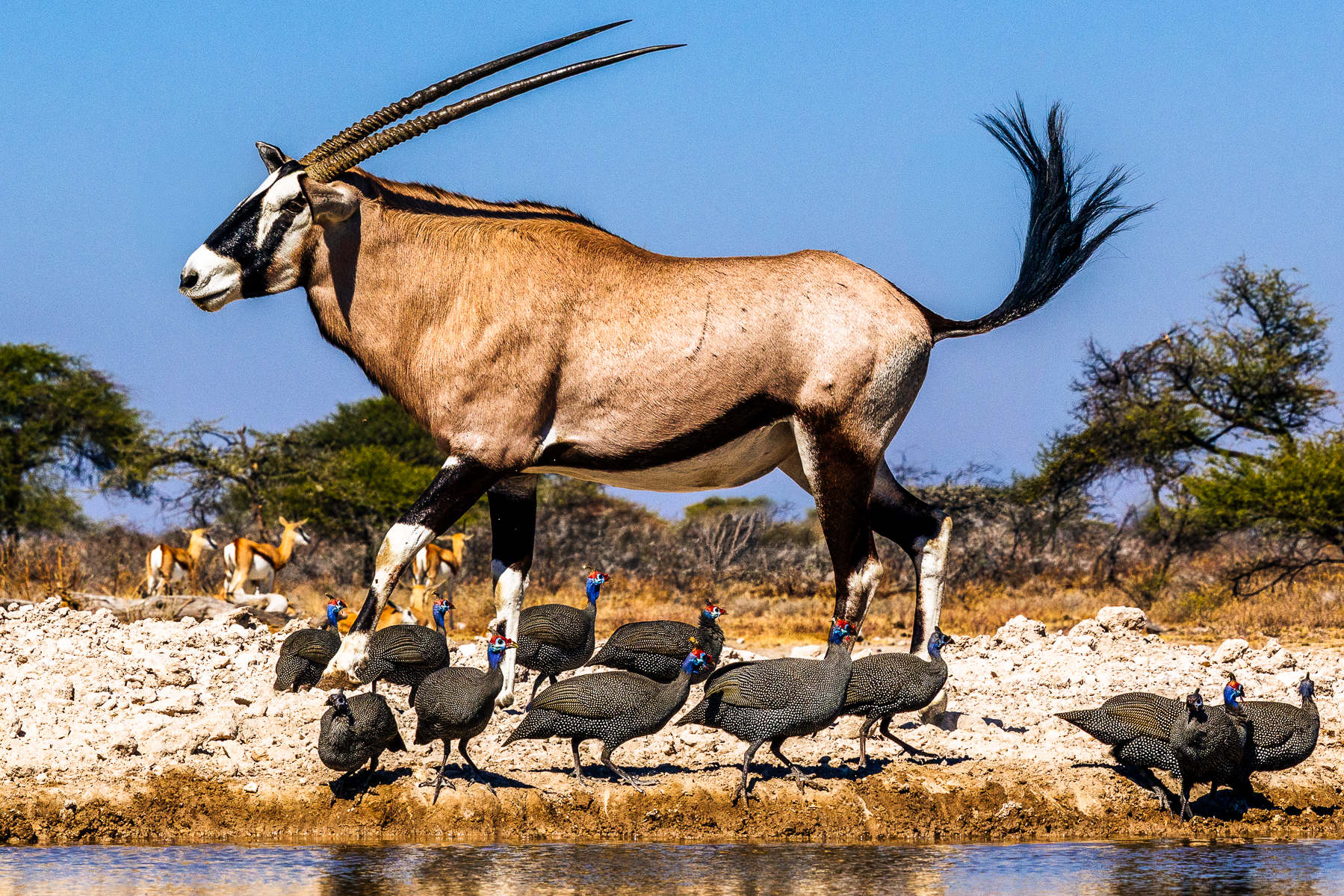
An animated-looking Gemsbok swishes her tail as she moves to take her turn at the Onguma waterhole - as a flock of Helmeted Guineafowl stroll past. Both sexes of Gemsbok have horns, although females' tend to be shorter and more slender (image by Virginia Wilde)
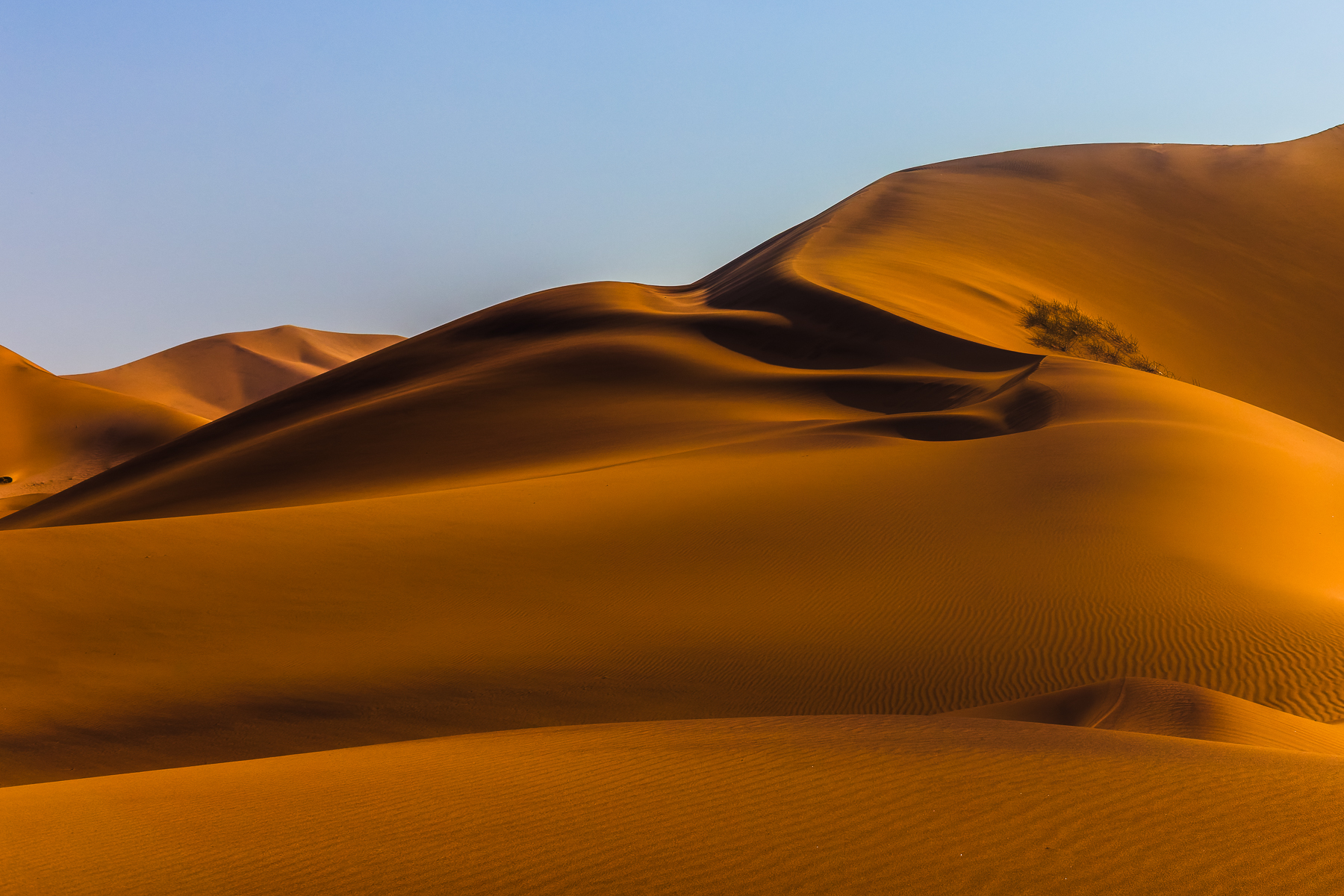
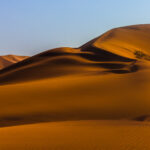
The sweeping sand dunes of the Namib Desert, on the outskirts of Swakopmund. When light hits these curves of sand, the colours can change from copper to burnt orange, depending on the interplay of light and shadow (image by Virginia Wilde)
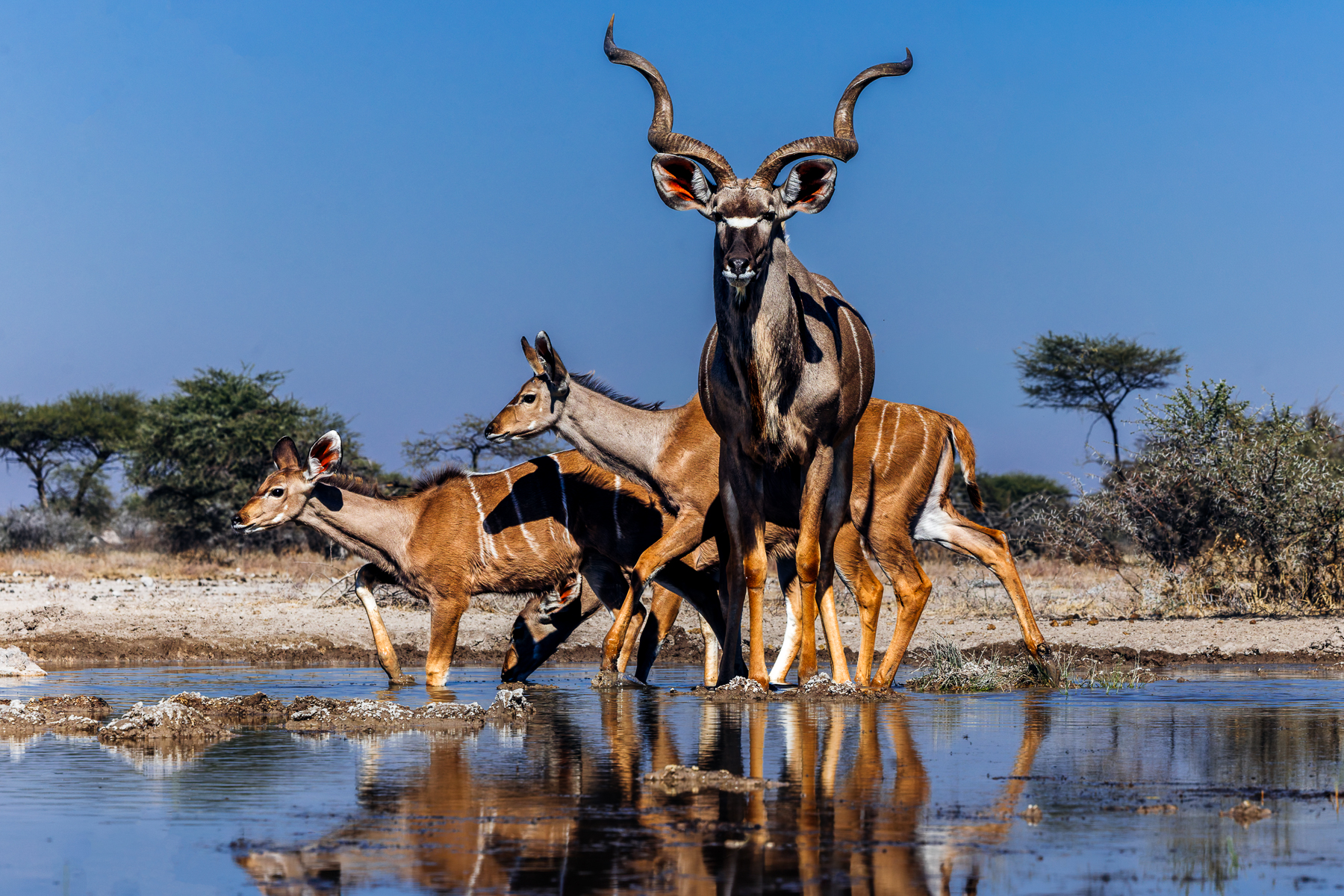
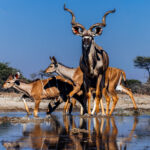
A small herd of Greater Kudu drink from the waterhole in Namibia's Onguma Reserve, with the male displaying his breed's distinctive horns, famed for their corkscrew-like twists. These massive horns can reach up to 1.8 metres (6ft) long, if stretched straight out (image by Virginia Wilde)
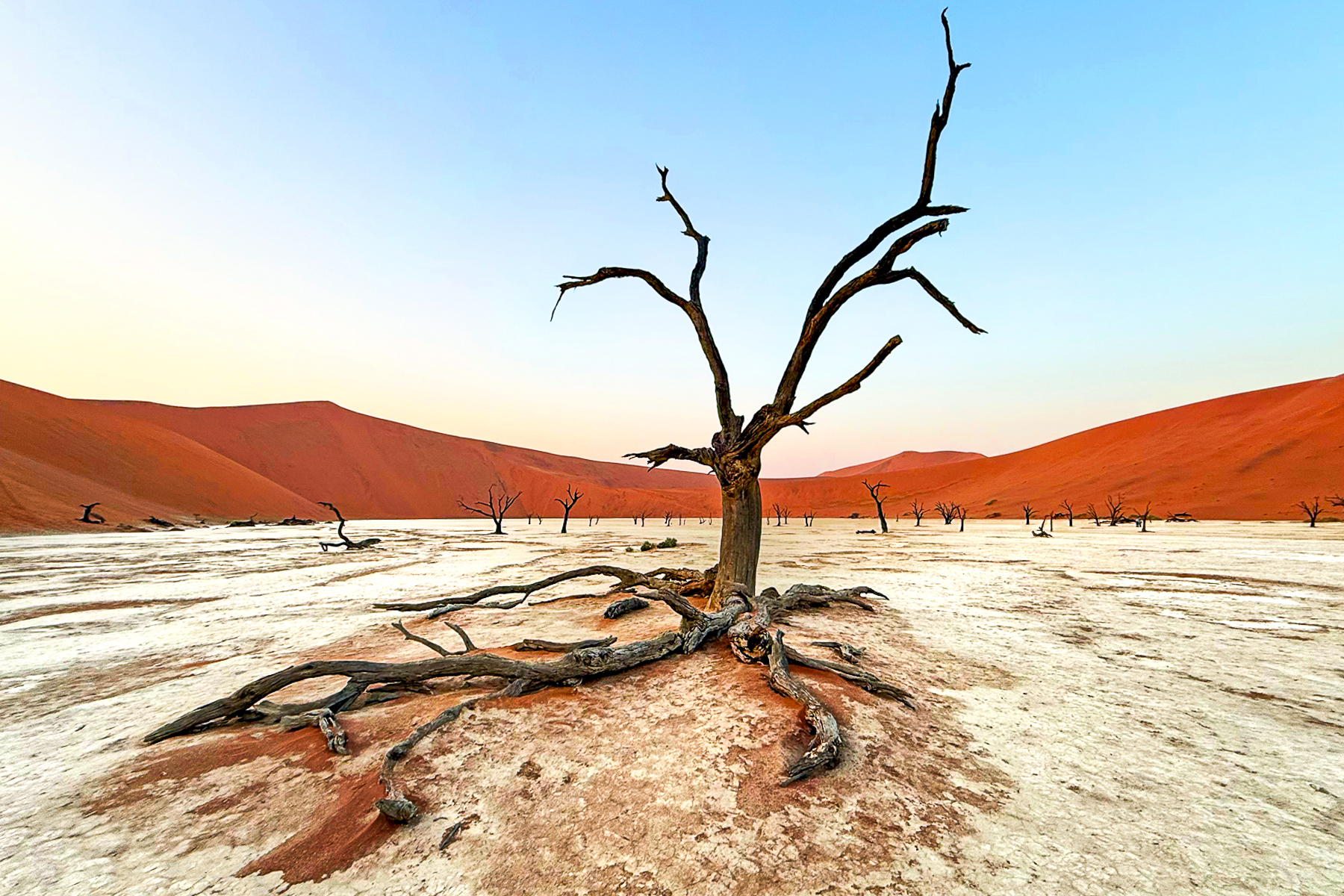
Wide-angle view of Deadvlei, complete with cracked salt pan ground and a scattering of Camel Thorn trees (image by Mike Watson)
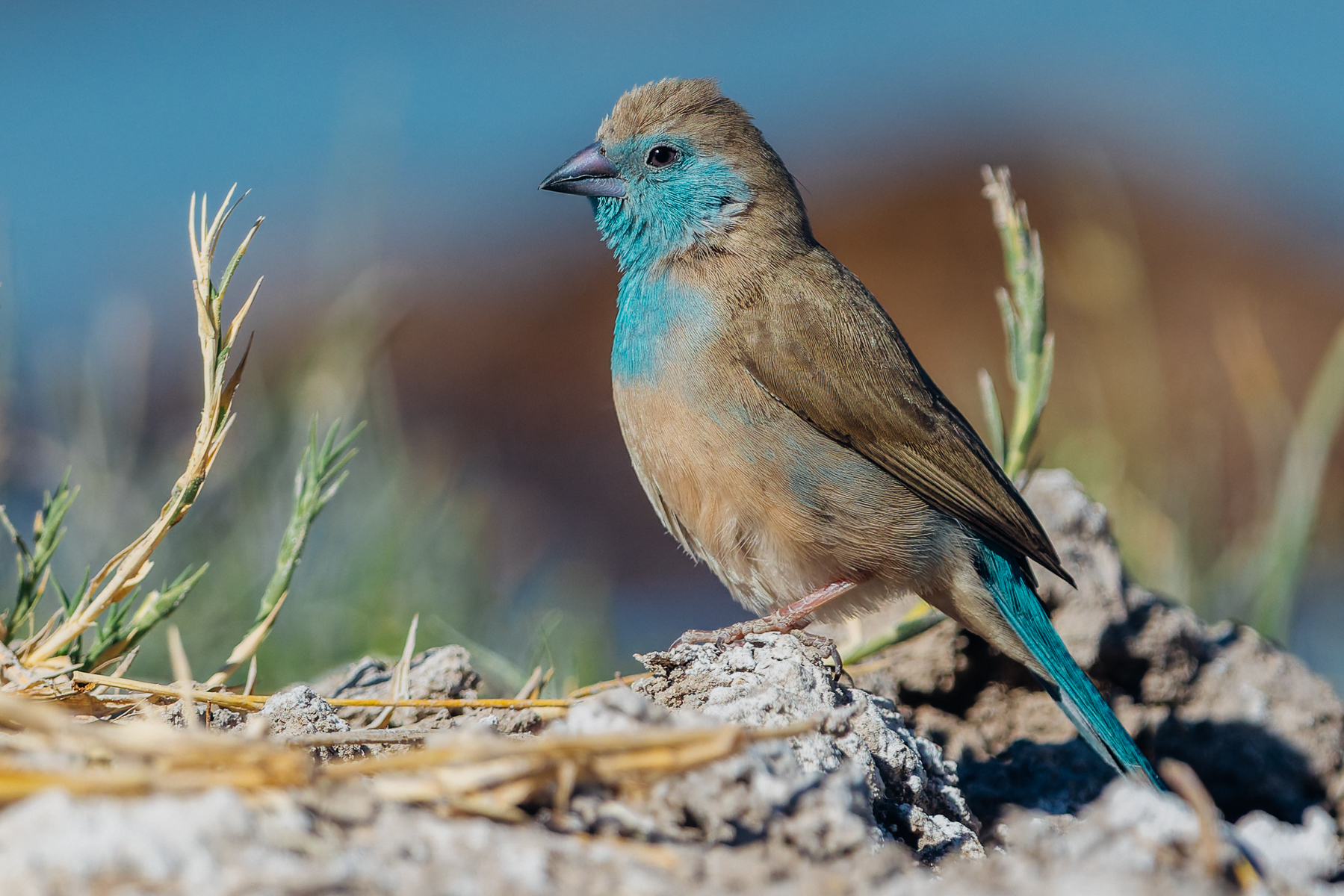
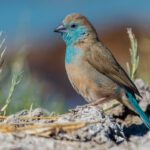
Portrait of a Southern Cordonbleu, resting by the waterhole in Namibia's Onguma Reserve. These waxbills are incredibly hard to photograph in flight due to sudden directional changes. So I finally had to settle on a portrait taken in a moment of calm (image by Virginia Wilde)
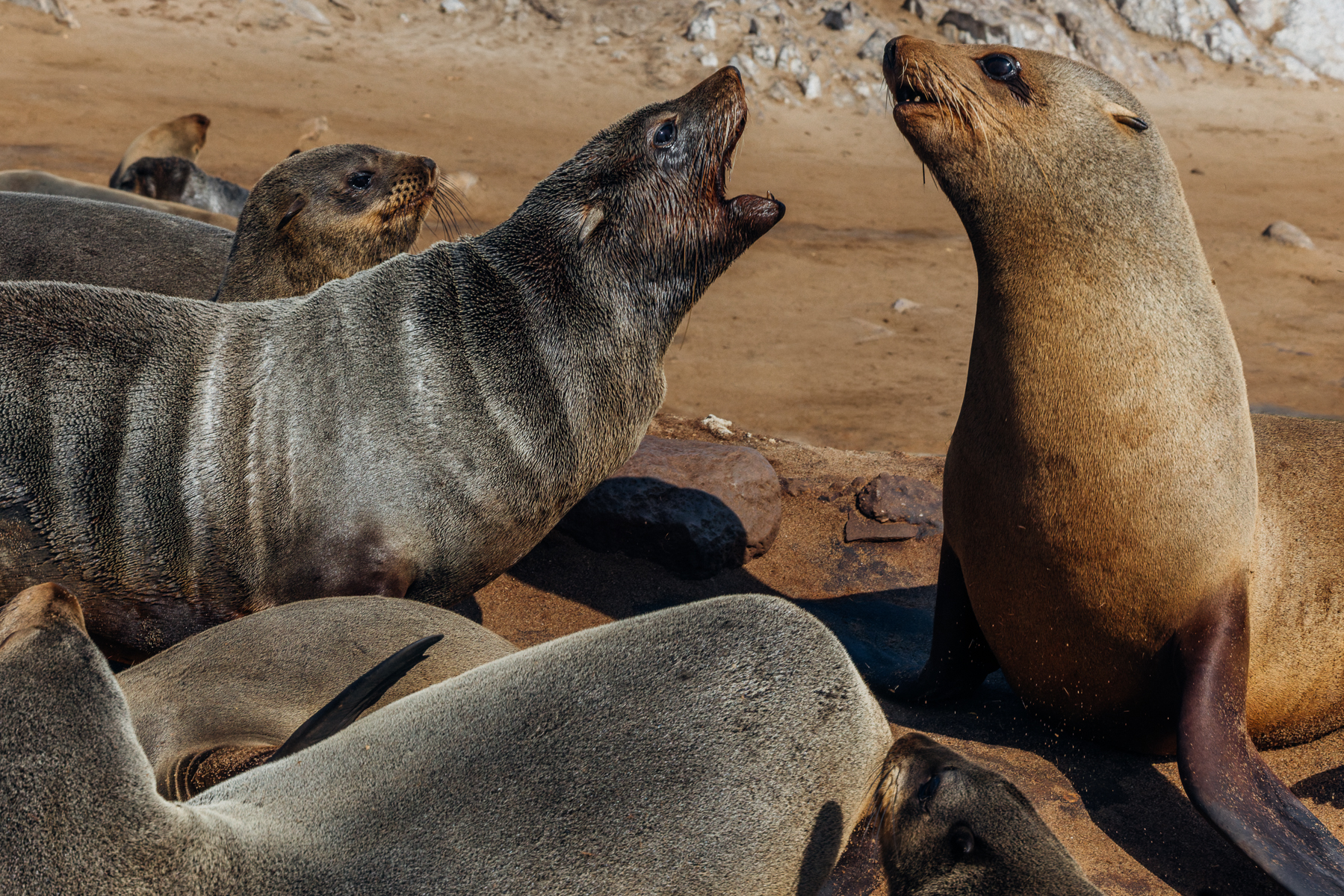
Seal drama is constant in Namibia's Cape Cross seal colony. Cape Fur Seals continuously square up in brief moments of social tension, before, out of nowhere these confrontations tend to defuse. Cape Fur Seals live in dense, noisy colonies where adults must continuously jostle for space, mates and access to the shore (image by Virginia Wilde)
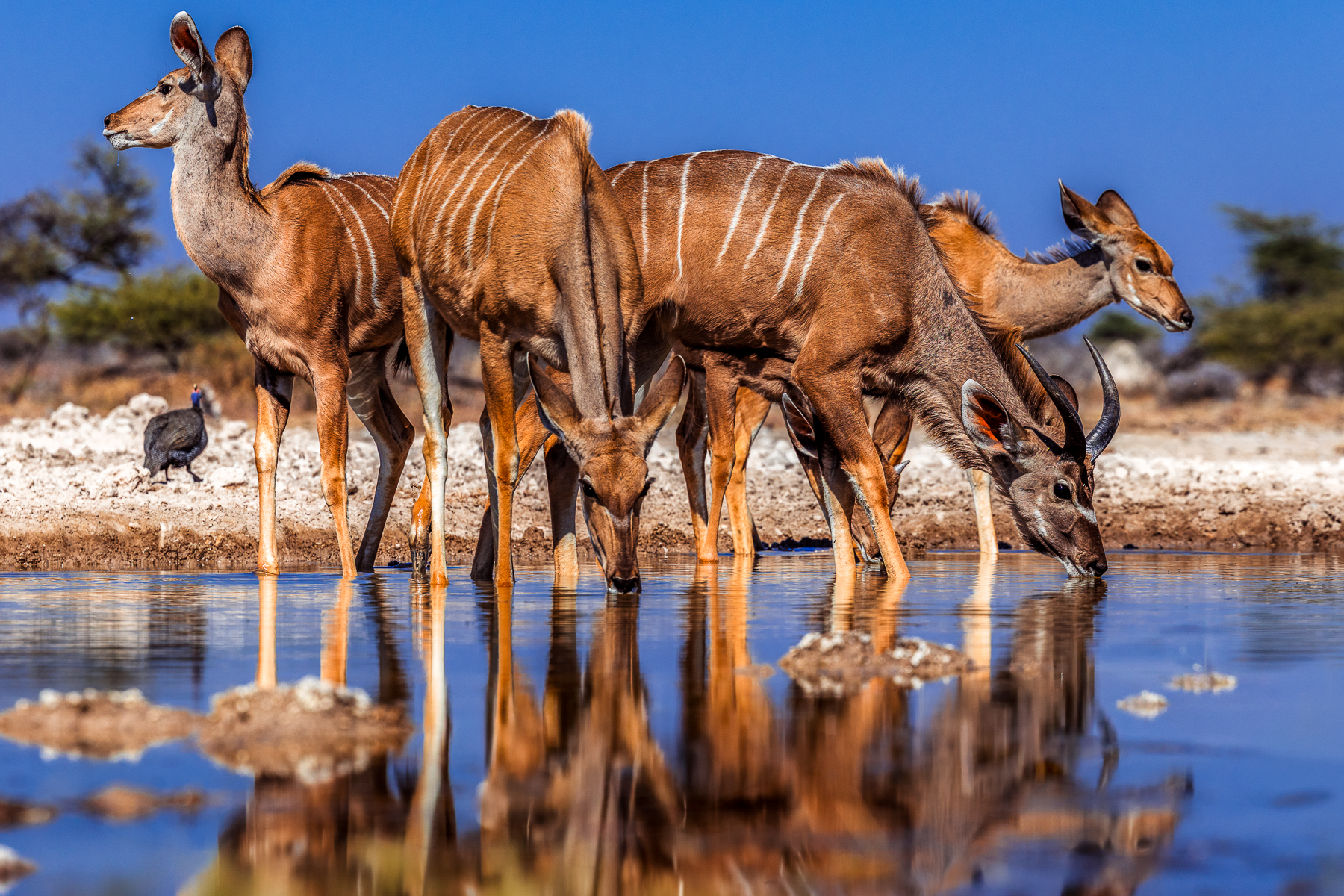
A young herd of Greater Kudu cluster together at a waterhole in the Onguma Reserve, with their heads and bodies reflected back at them like a mirror (image by Virginia Wilde)
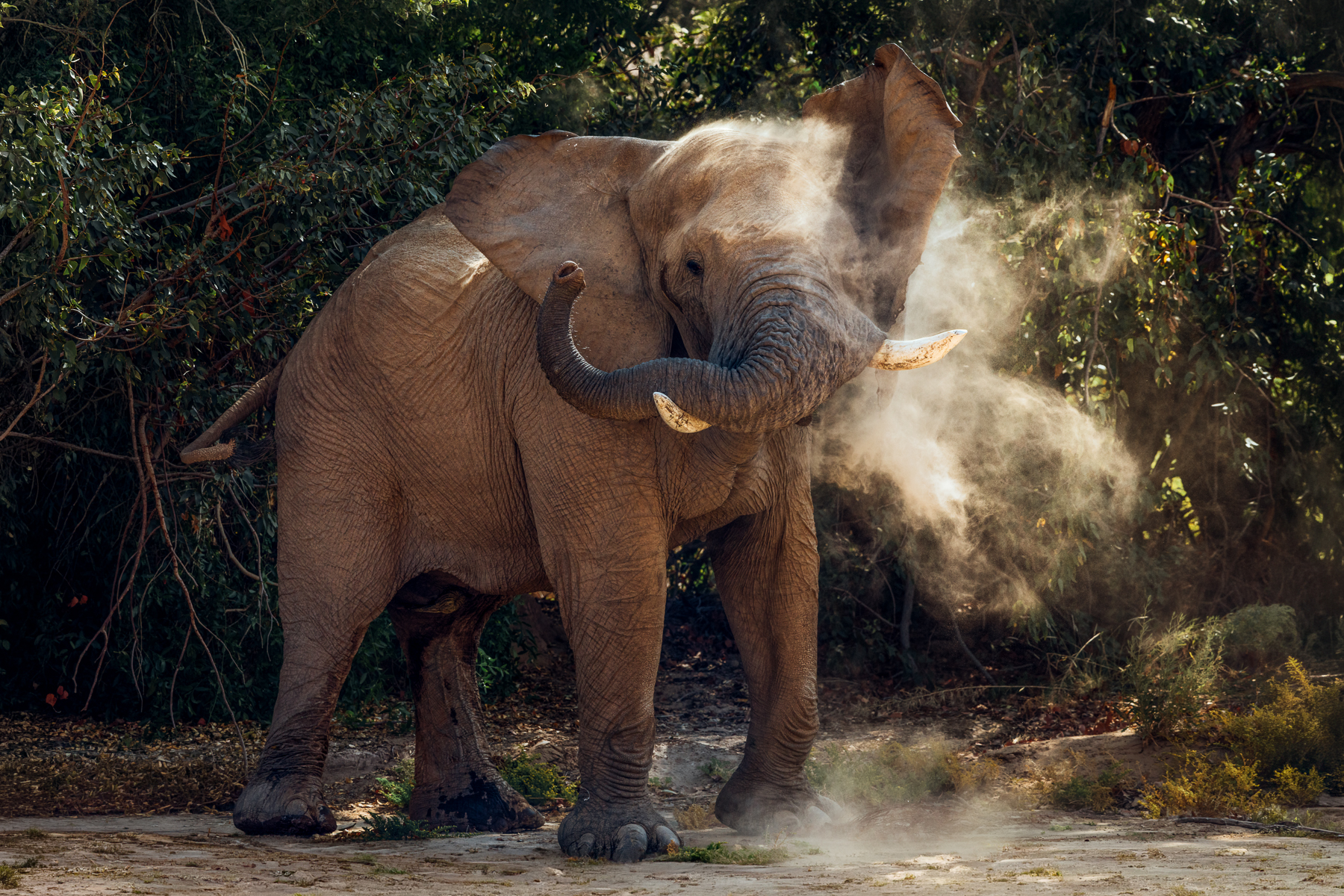
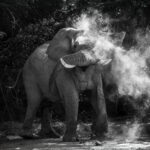
A swirl of dust surrounds a desert-adapted African Savanna Elephant bull in Namibia's Hoanib River Valley. An elephant hurling dust is more than a spectacle - it acts as sunscreen, insect repellent and skin protection in the harsh sun (image by Virginia Wilde)
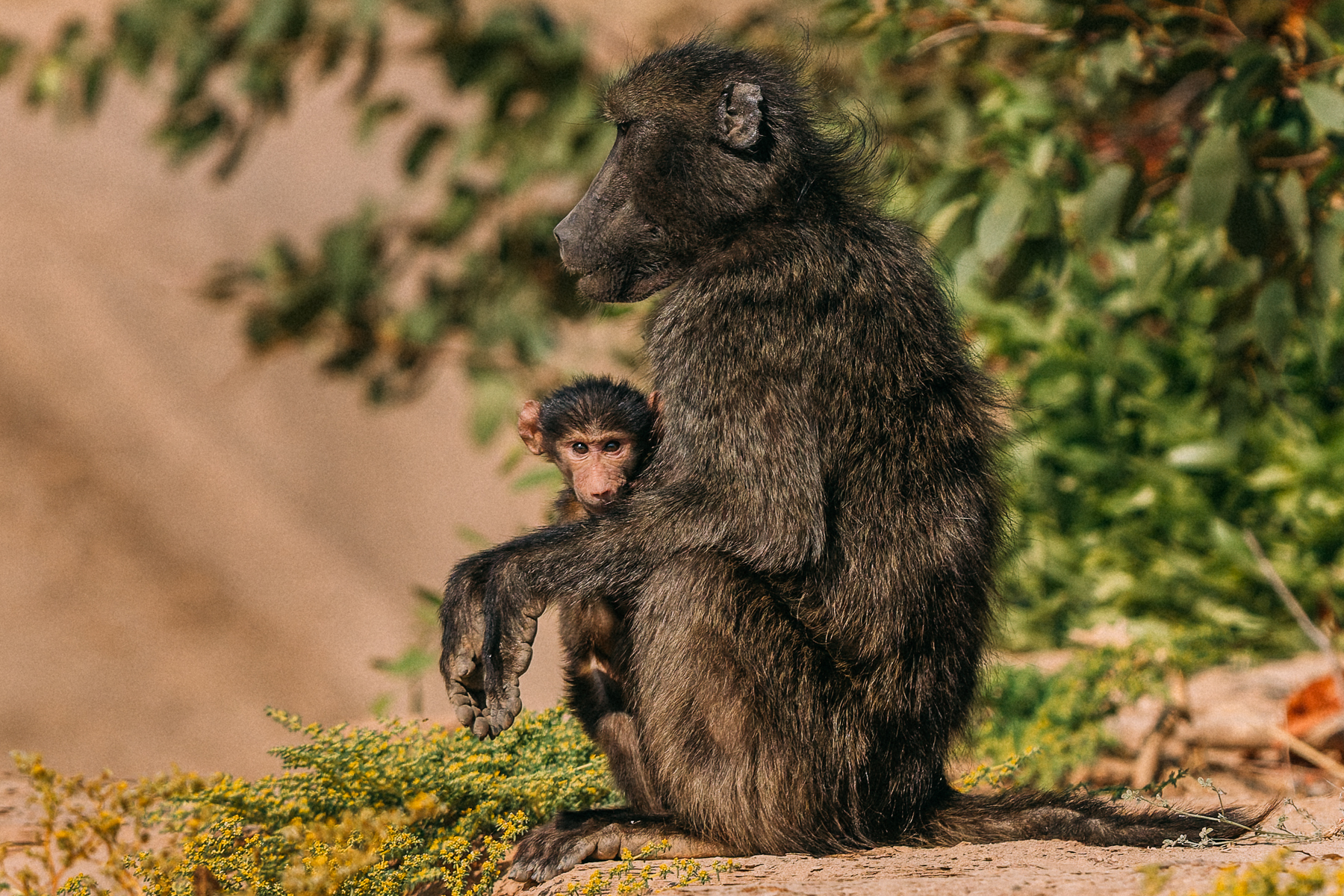
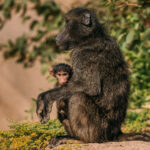
This infant Chacma Baboon has a distinctly suspicious look in its eye, as it peers out from the safety of its mother's knees. Taken in Namibia's Hoanib River Valley (image by Virginia Wilde)
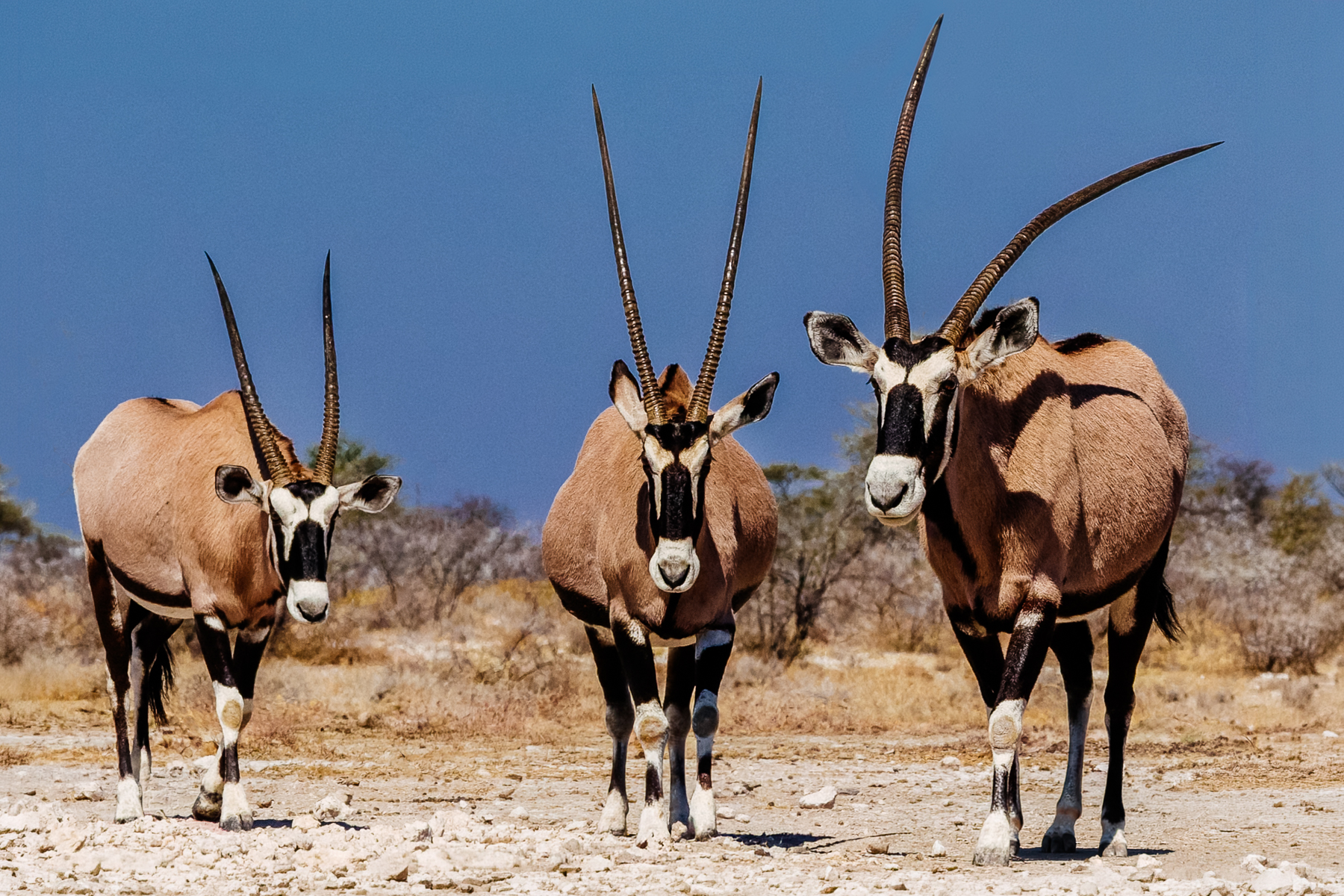
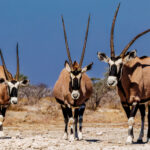
A trio of Gemsbok approach the waterhole in Onguma Reserve, Namibia, displaying their distinctive long spear-like horns. Gemsbok are the largest species of Oryx, found in southern African deserts like the Kalahari and Namib (image by Virginia Wilde)
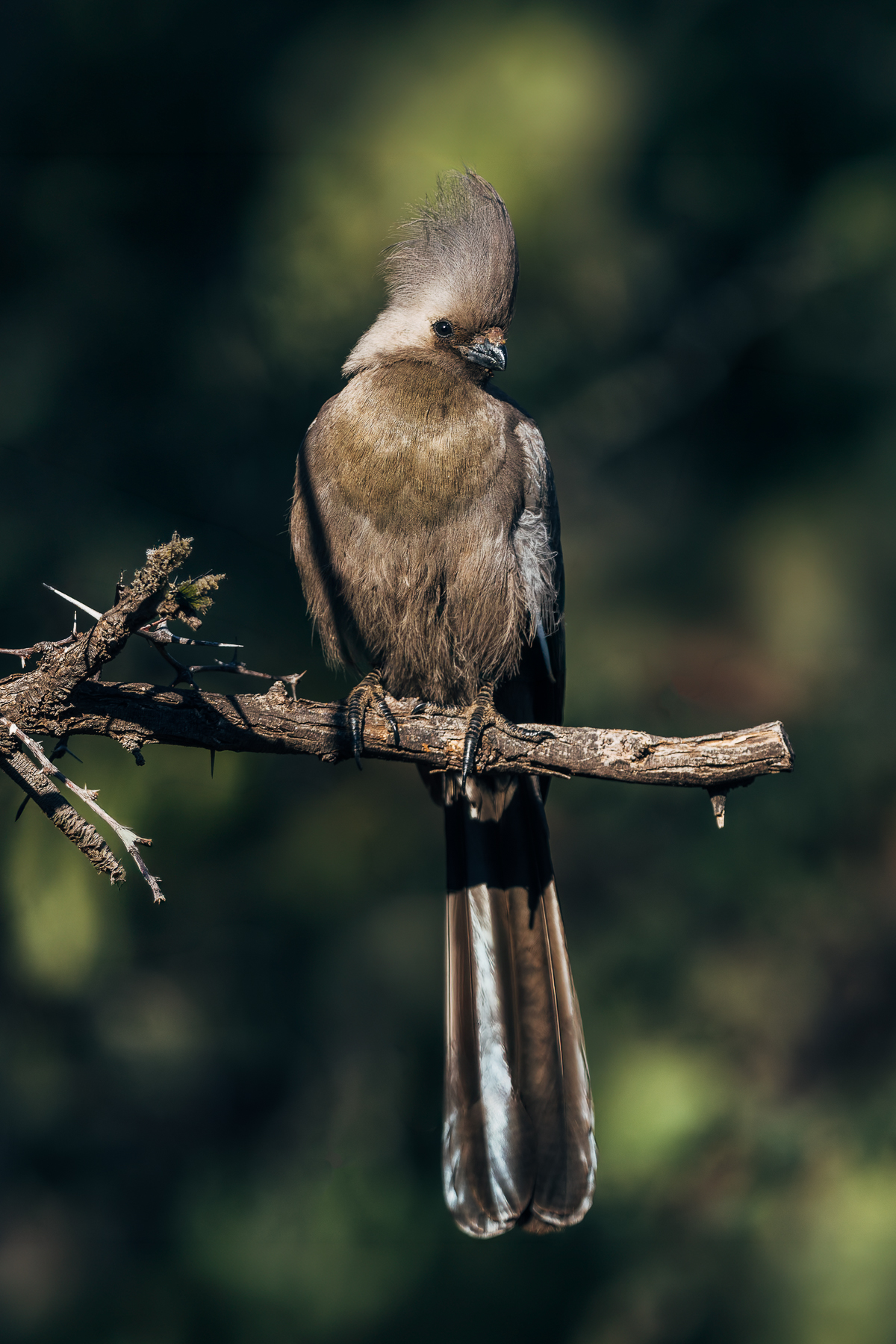
Portrait of a Grey Go-Away bird in Namibia's Onguma Reserve. Grey Go-Away birds get their name from their loud, nasal call, which sounds remarkably like 'Go-away!'- a sound that can carry a long way across the bush (image by Virginia Wilde)
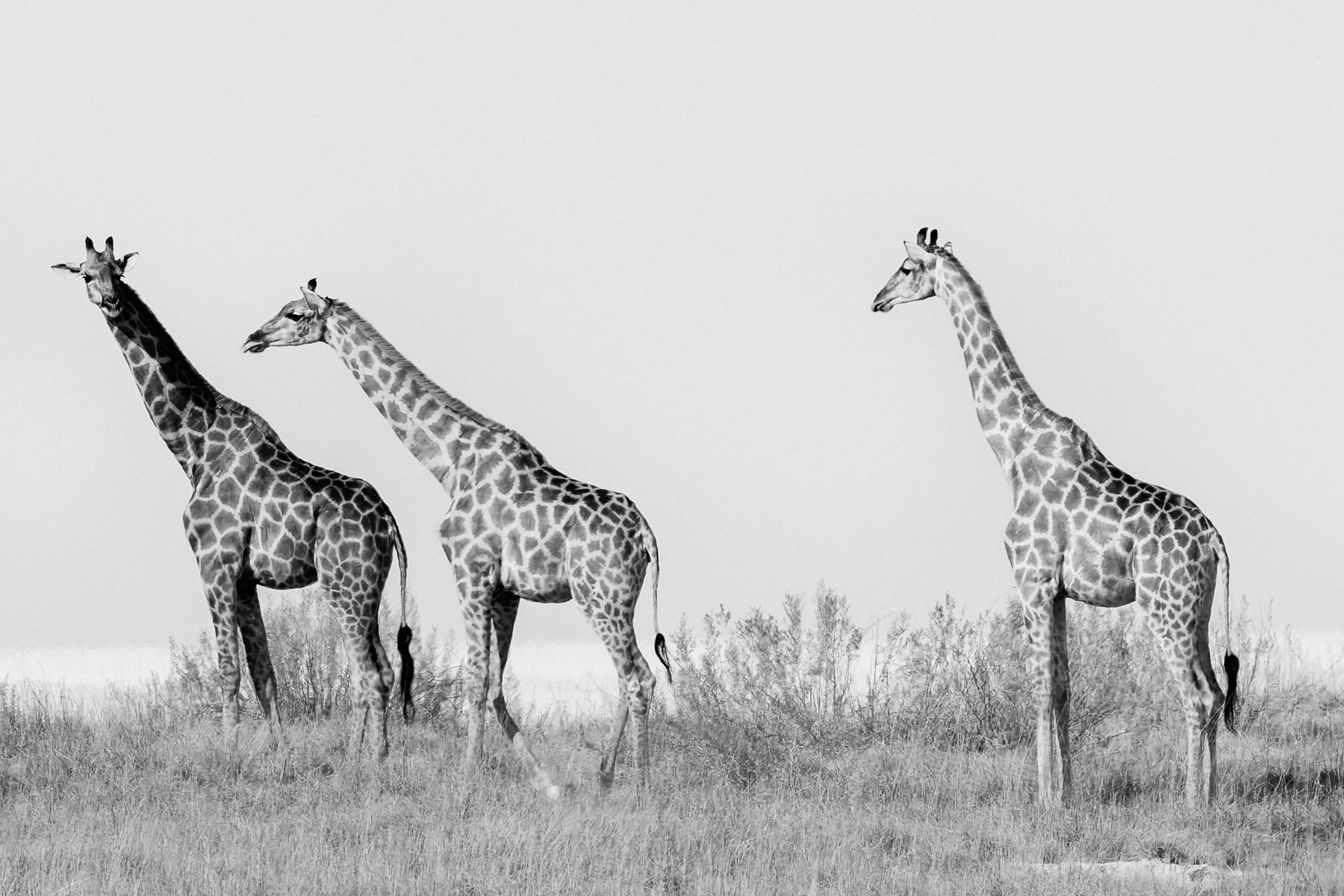
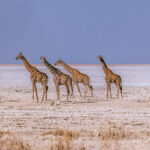
A small herd of Angolan Giraffes make their way towards a dry section of the Etosha Pan - a vast ancient lakebed that is 130km long and 55km wide. Namibia contains almost 90% of this beautiful subspecies (image by Virginia Wilde)
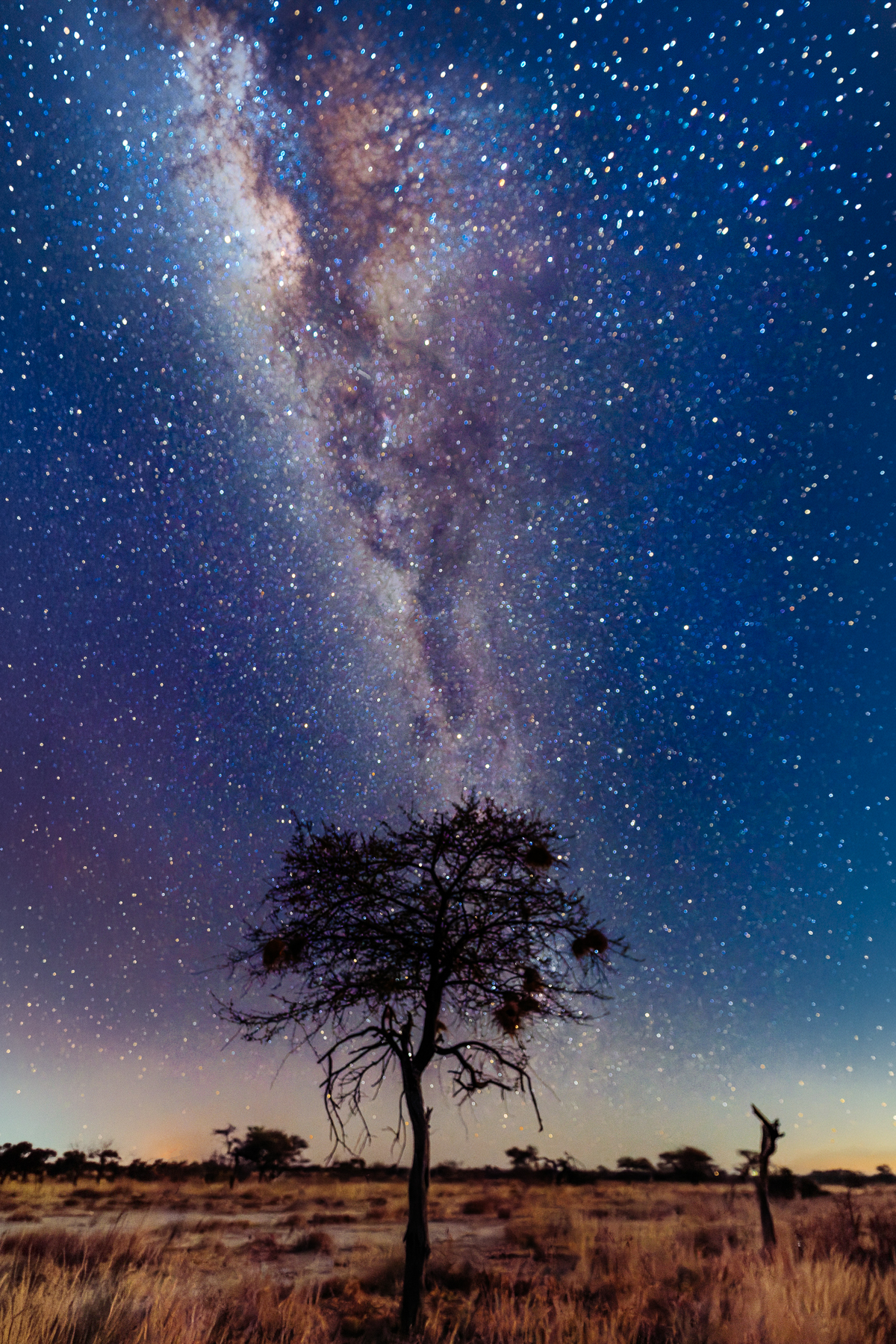
The Milky Way above a tree in Namibia's Onguma Reserve. We didn't have the perfect conditions for astrophotography this night, but we gave it a try anyway (image by Virginia Wilde)
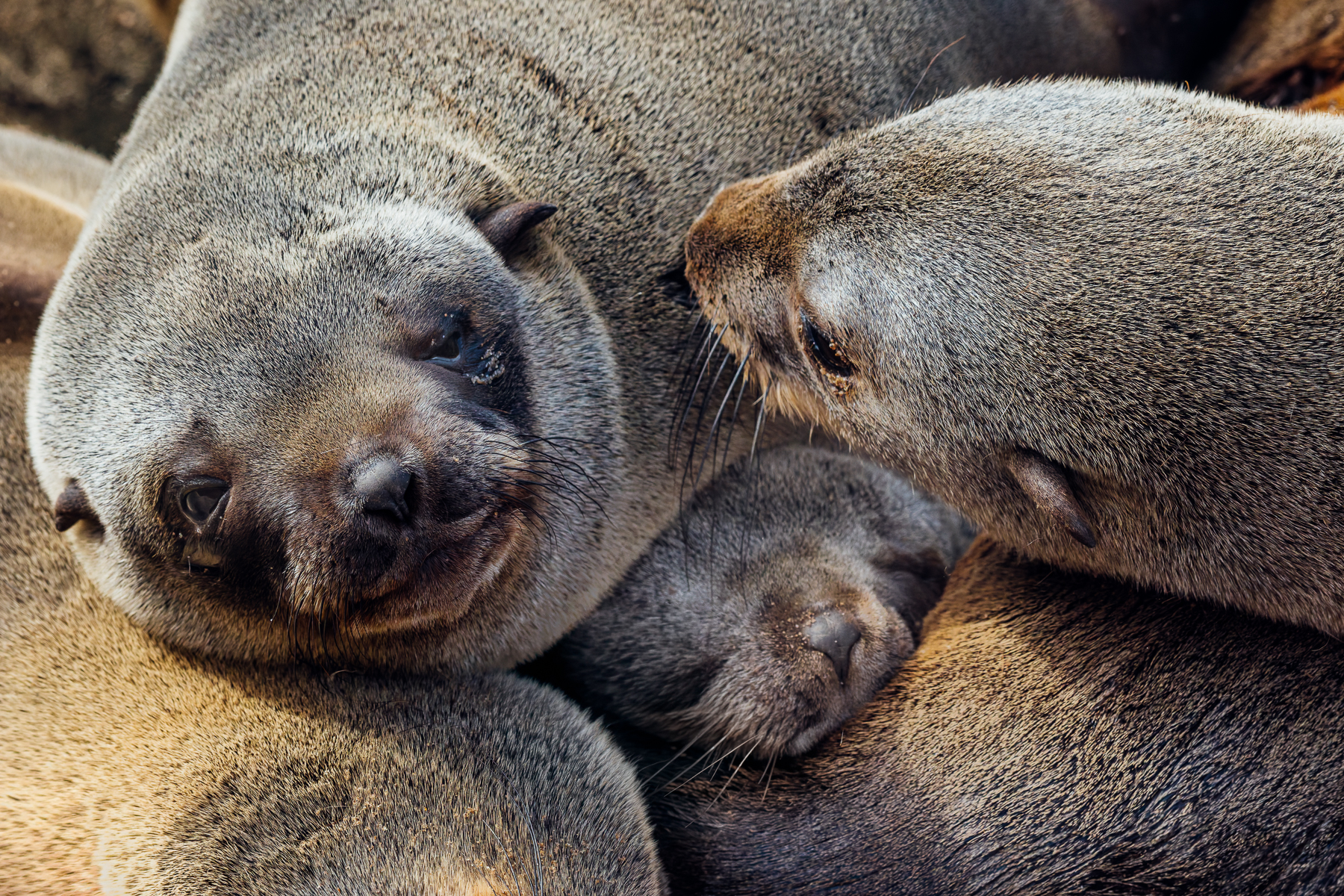
Aww! A juvenile Cape Fur Seal sleeps amid a pile of other fur seals - in a position that could be viewed as either cosy, or somewhat squashed! (image by Virginia Wilde)
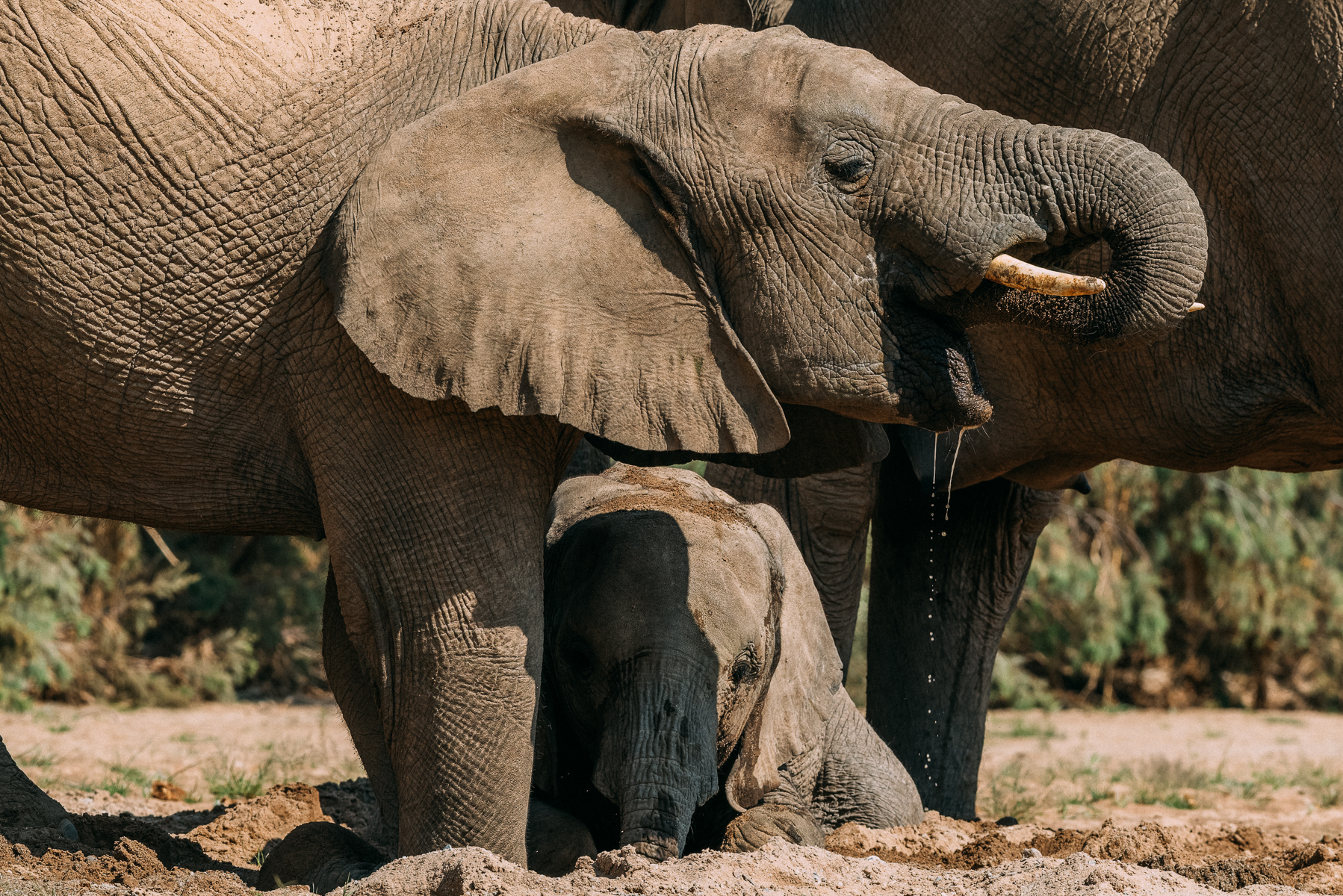
A juvenile desert-adapted African Savanna Elephant lies in shadow beneath an older troop-member, both sucking groundwater through their trunks from a hole they dug in the ground of the ephemeral Hoanib River (image by Virginia Wilde)
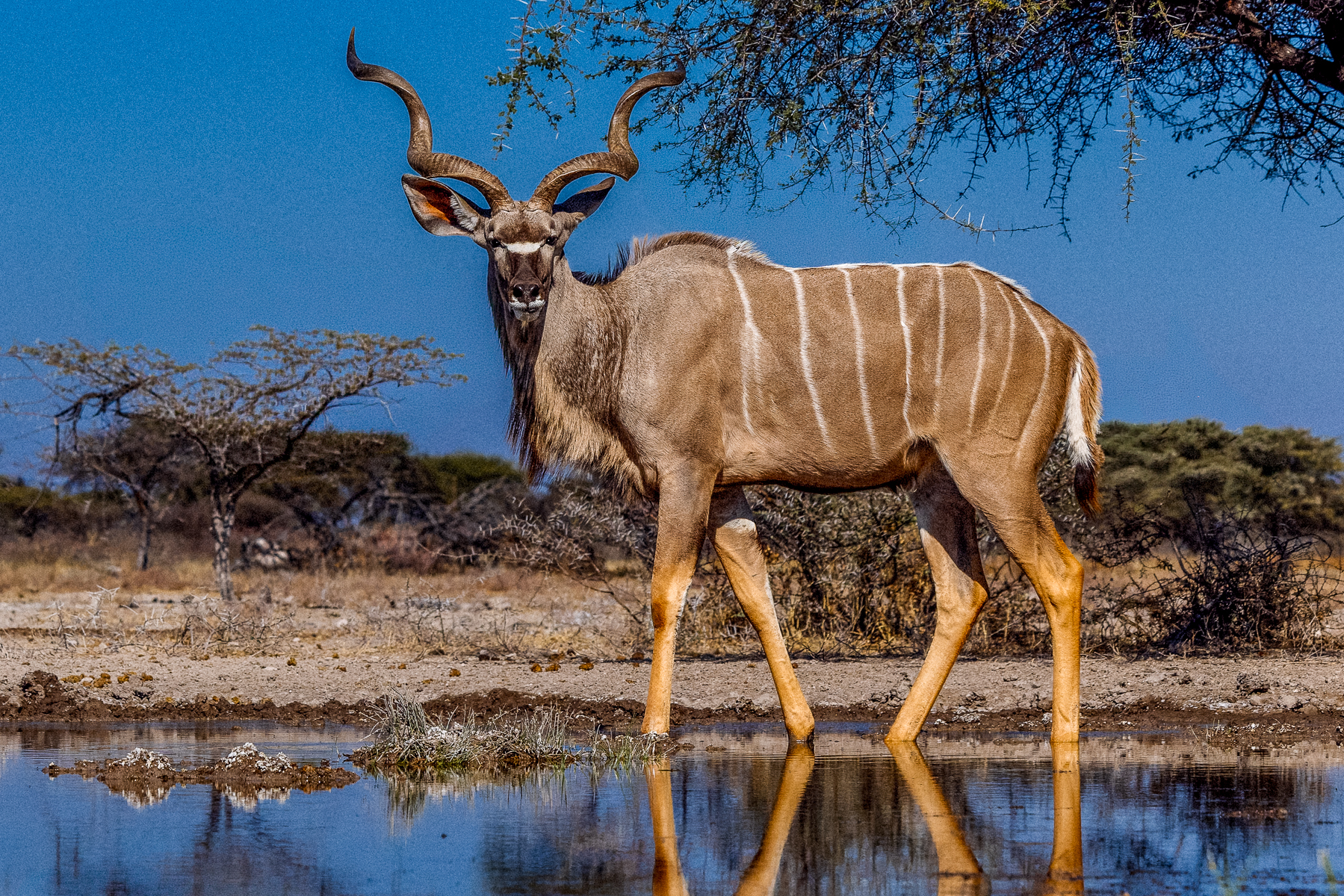
A handsome male Kudu pauses by the waterhole in Namibia's Onguma Reserve. Male Kudu can weigh up to 300kg - making them one of Africa's largest antelopes (image by Virginia Wilde)
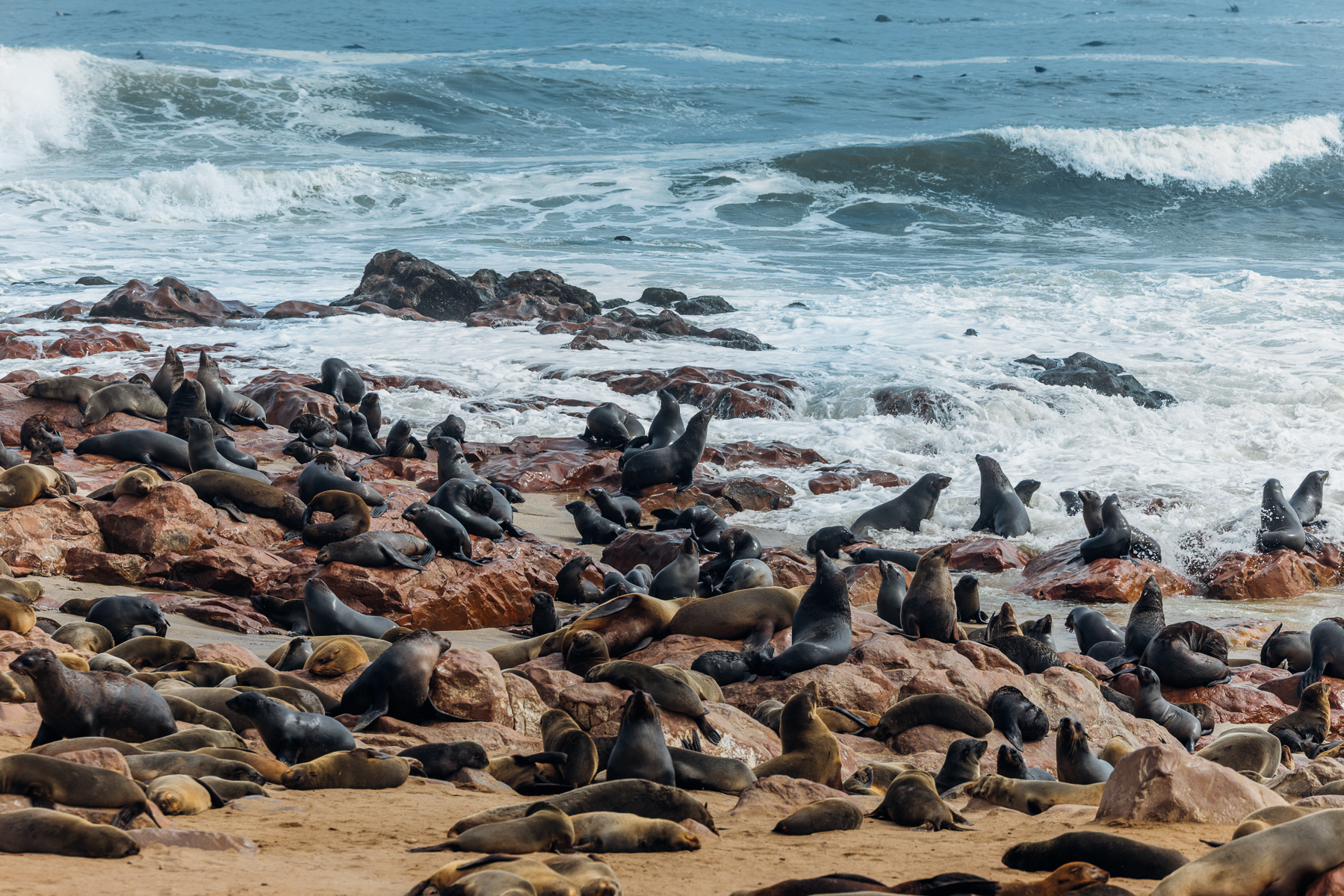
Atlantic waves crash over just a few of the estimated 100,000 Cape Fur Seals that make up Namibia's Cape Cross Seal colony. Visiting the colony is an experience due to the awesome sound and smell of all these seals (image by Virginia Wilde)
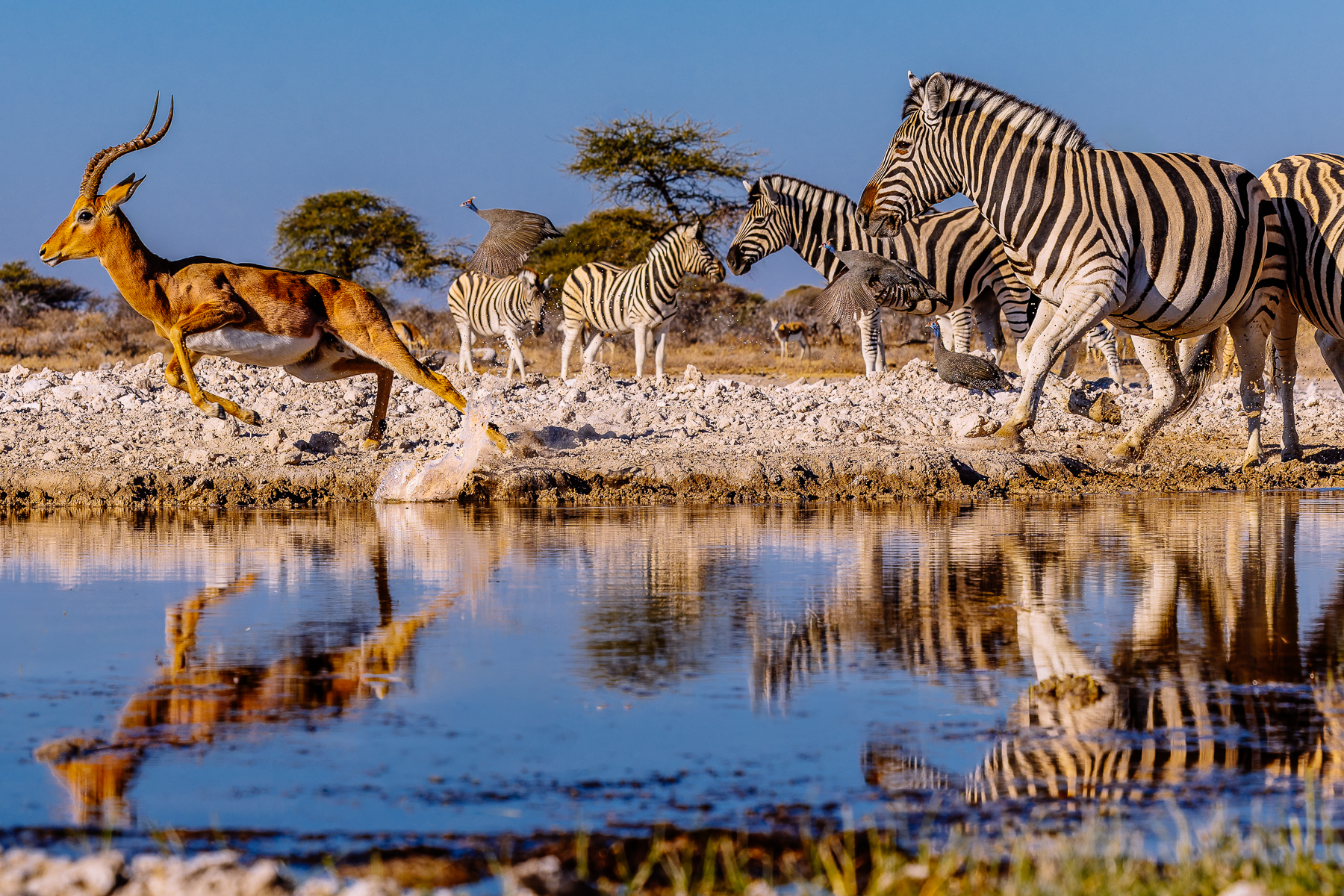
A male Black-faced Impala suddenly takes fright as a large herd of Zebra approach the Onguma waterhole, creating splashes with his skittishness. Black-faced Impala are a subspecies of the Common Impala, larger and darker and with a range that is extremely restricted to north-western Namibia and south-western Angola (image by Virginia Wilde)
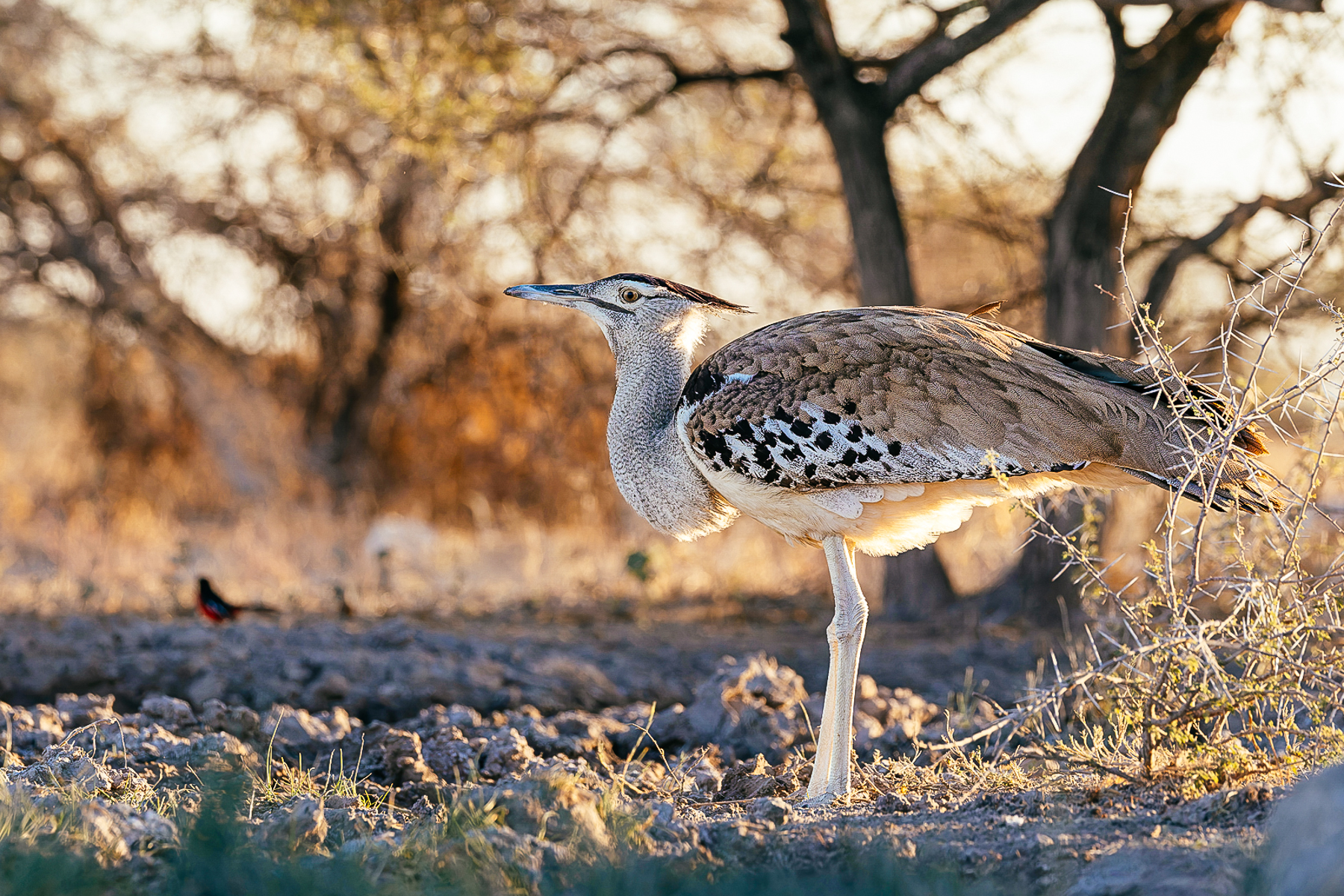
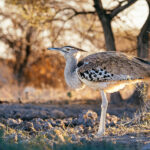
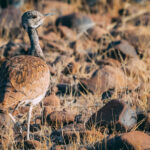
A Southern Kori Bustard waits patiently to drink at the waterhole by our Onguma Reserve hide. These bustards are one of the world's heaviest flying birds, with large males weighing more than 15kg. Yet they can still take to the air when necessary (image by Mike Watson)
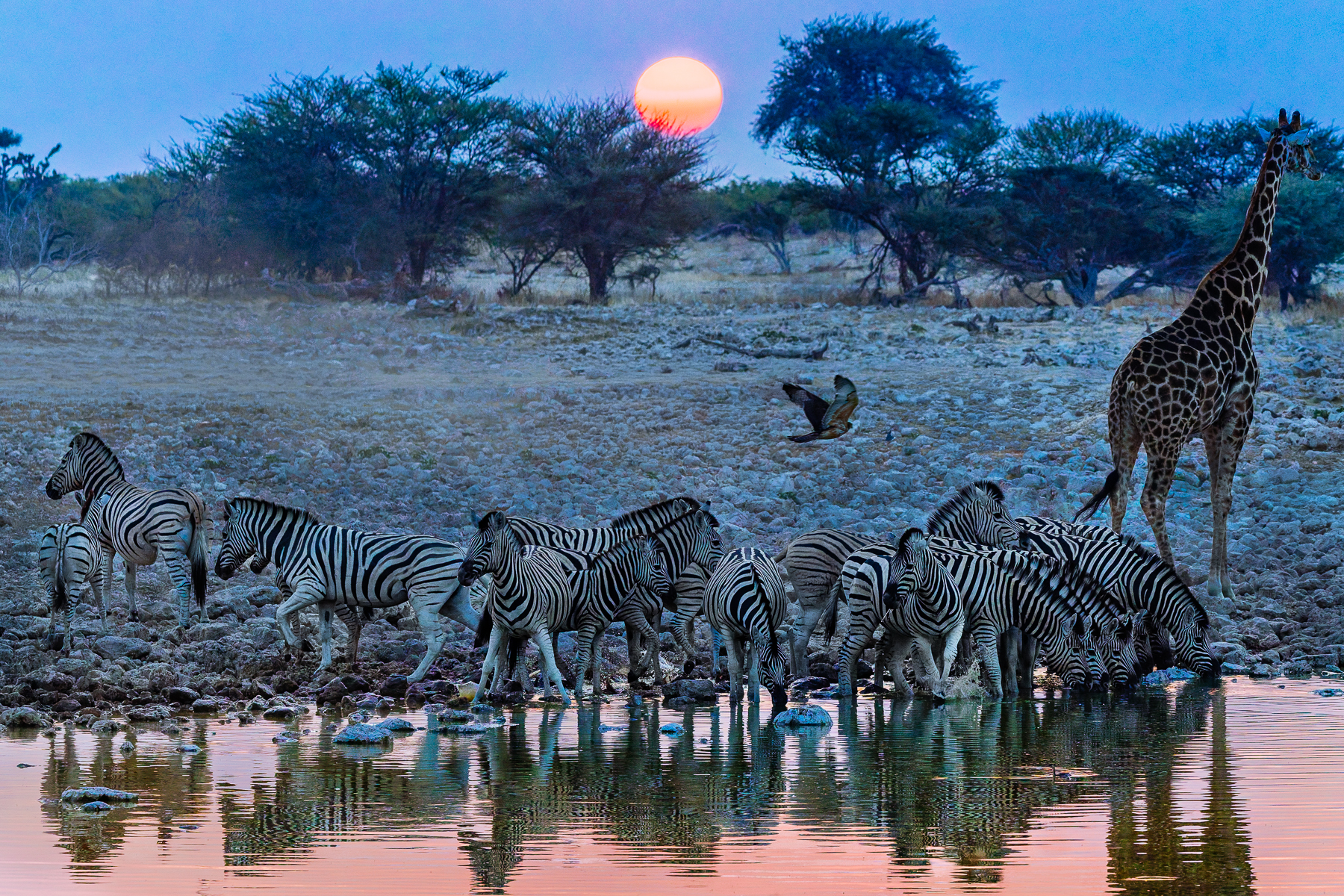
'Scenes at the Waterhole.' Evening and night-time at Etosha waterholes area as awash with life as the day. Here, a herd of Burchell's Plains Zebra share the rocky banks with an Angolan Giraffe and a passing raptor (image by Virginia Wilde)
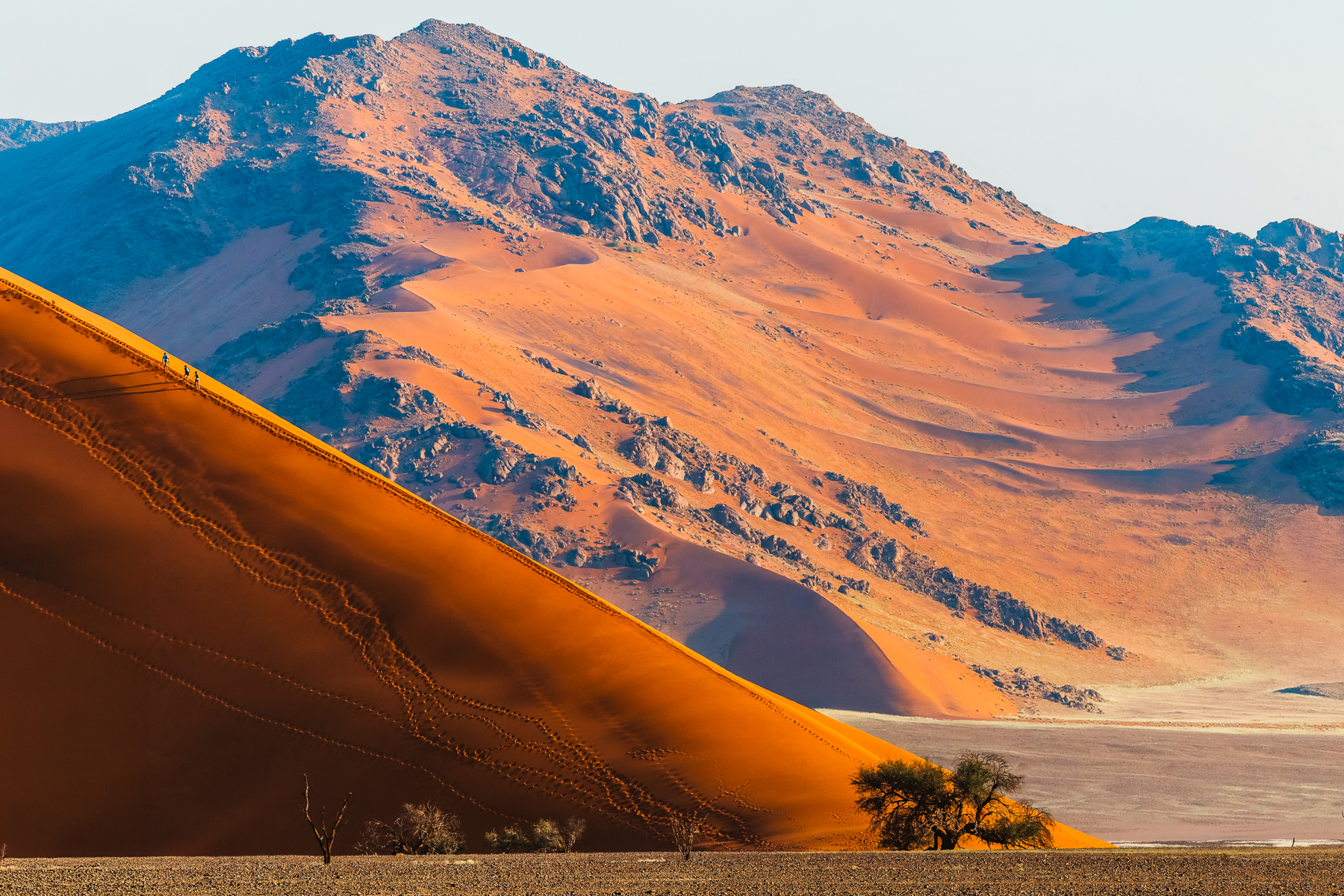
Hikers appear like tiny ants as they start to climb Dune 45, one of the most distinctive red sand dunes in the Sossusvlei area of Namibia's Namib-Naukluft National Park (image by Virginia Wilde)
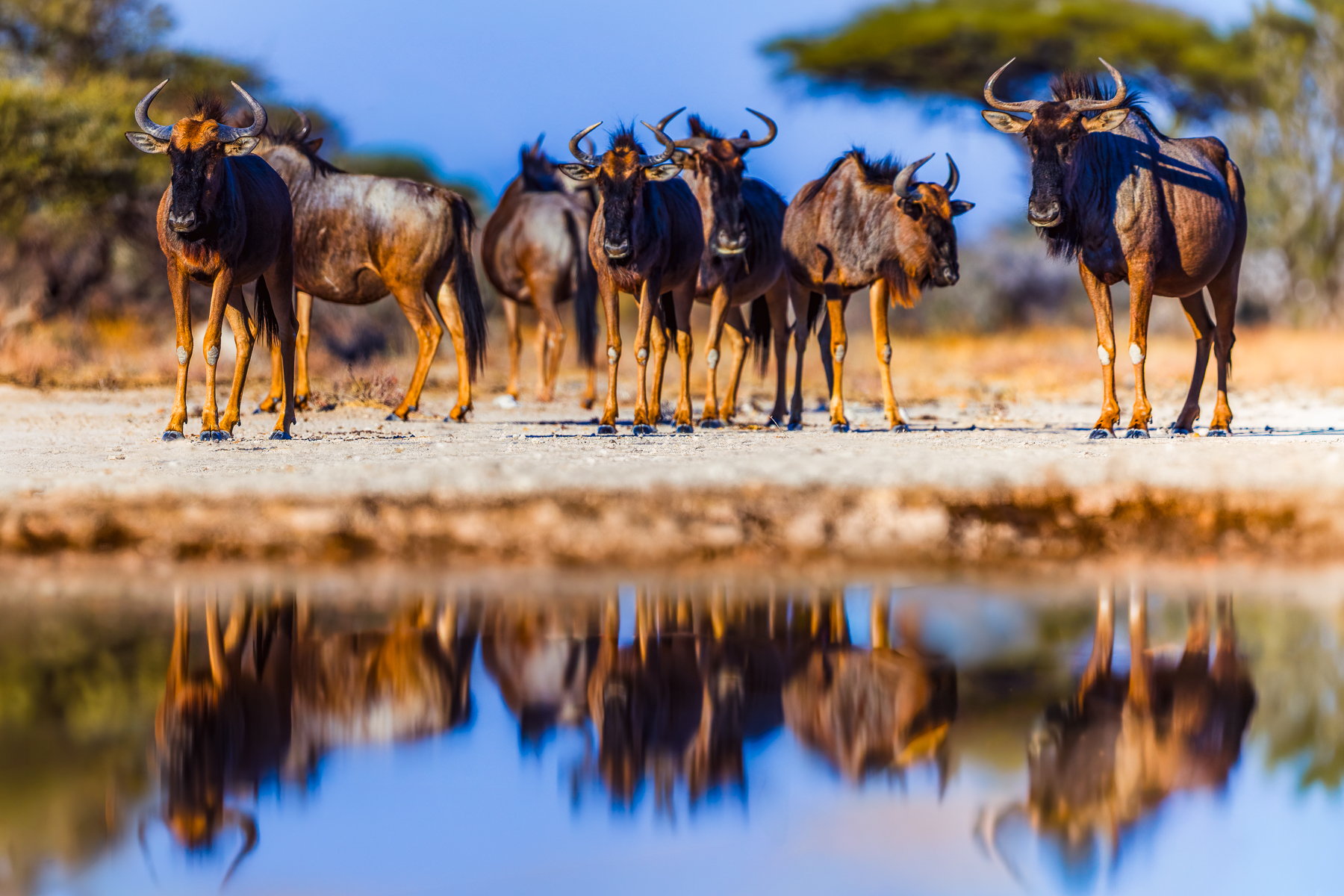
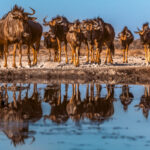
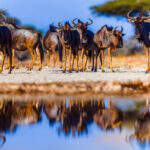
A small herd of Blue Wildebeest approach the waterhole in Namibia's Onguma Reserve, mirrored by the reflection in the shallow pool (image by Virginia Wilde)
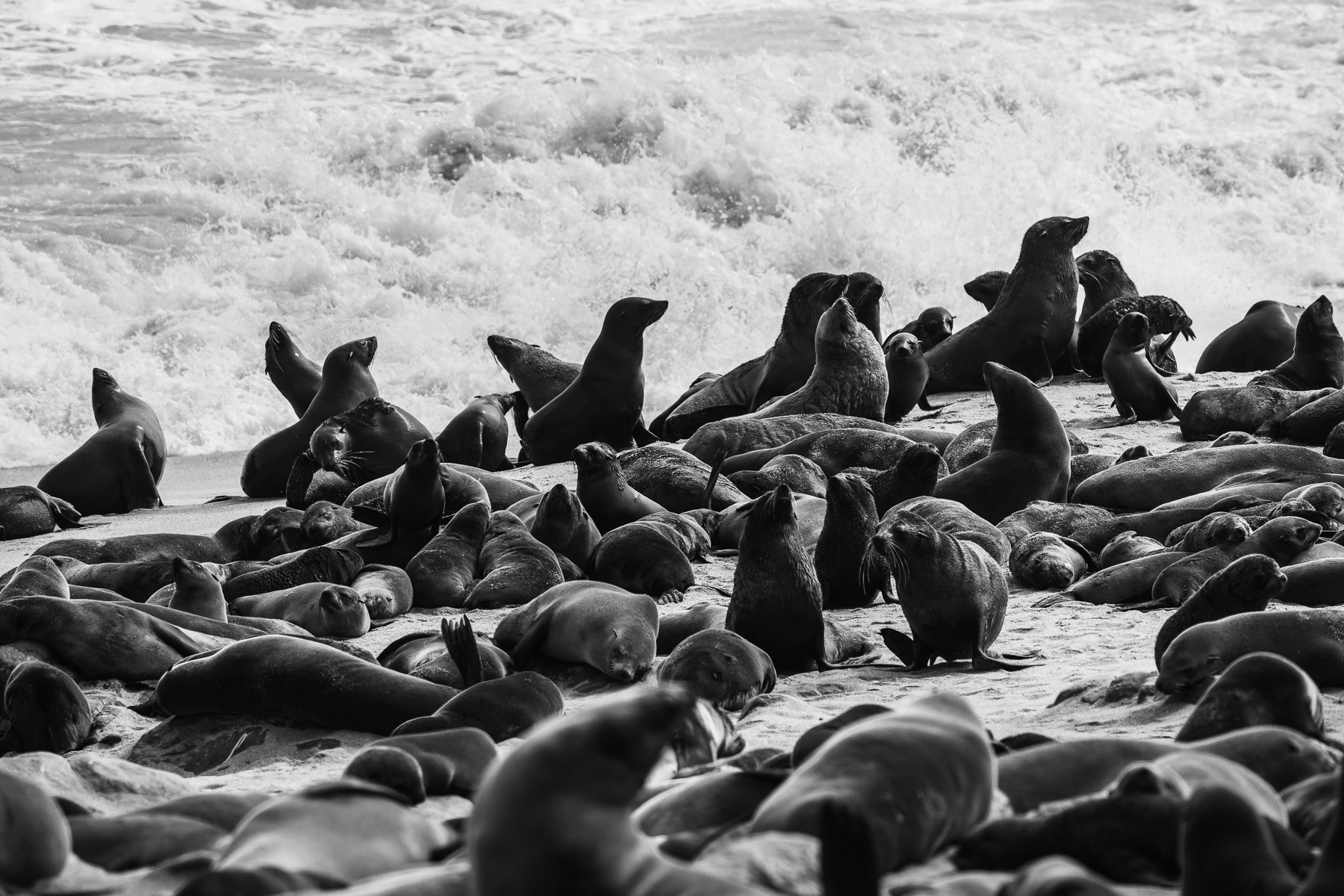
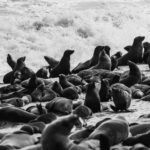
Black-and-white image of the thronging seals of Namibia's Cape Cross Fur Seal colony. As many as 100,000 Cape Fur Seals (image by Virginia Wilde)congregate on this unforgiving section of the Skeleton Coast, making for an overwhelming photographic experience (image by Virginia Wilde)
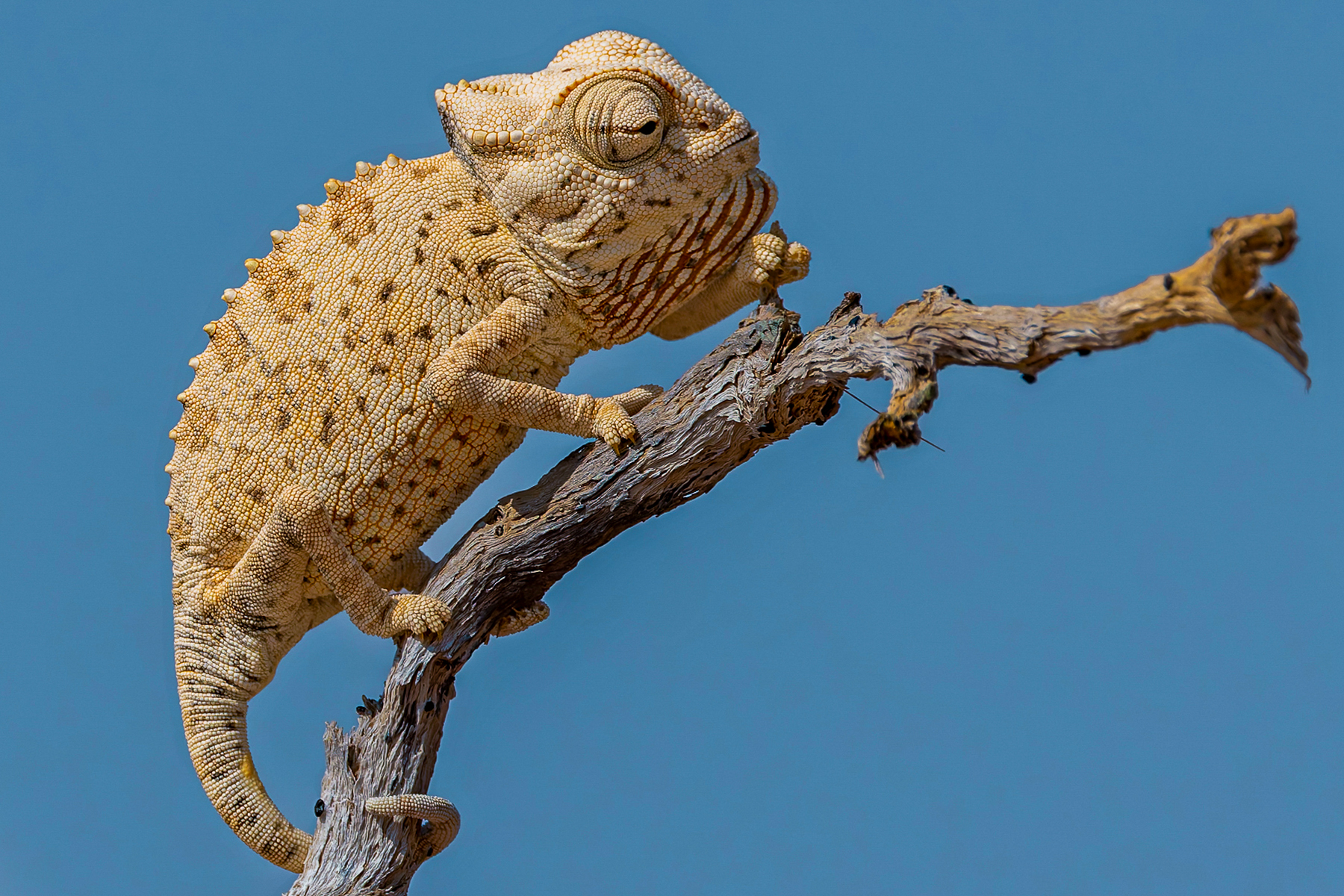
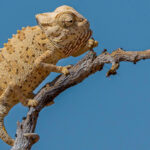
The Namaqua Chameleon is a decidedly unconventional chameleon that spends most of its life walking across the desert. It hunts largely on foot, taking beetles and grasshoppers with its long tongue and occasionally pursuing prey across the sand (image by Mike Watson)
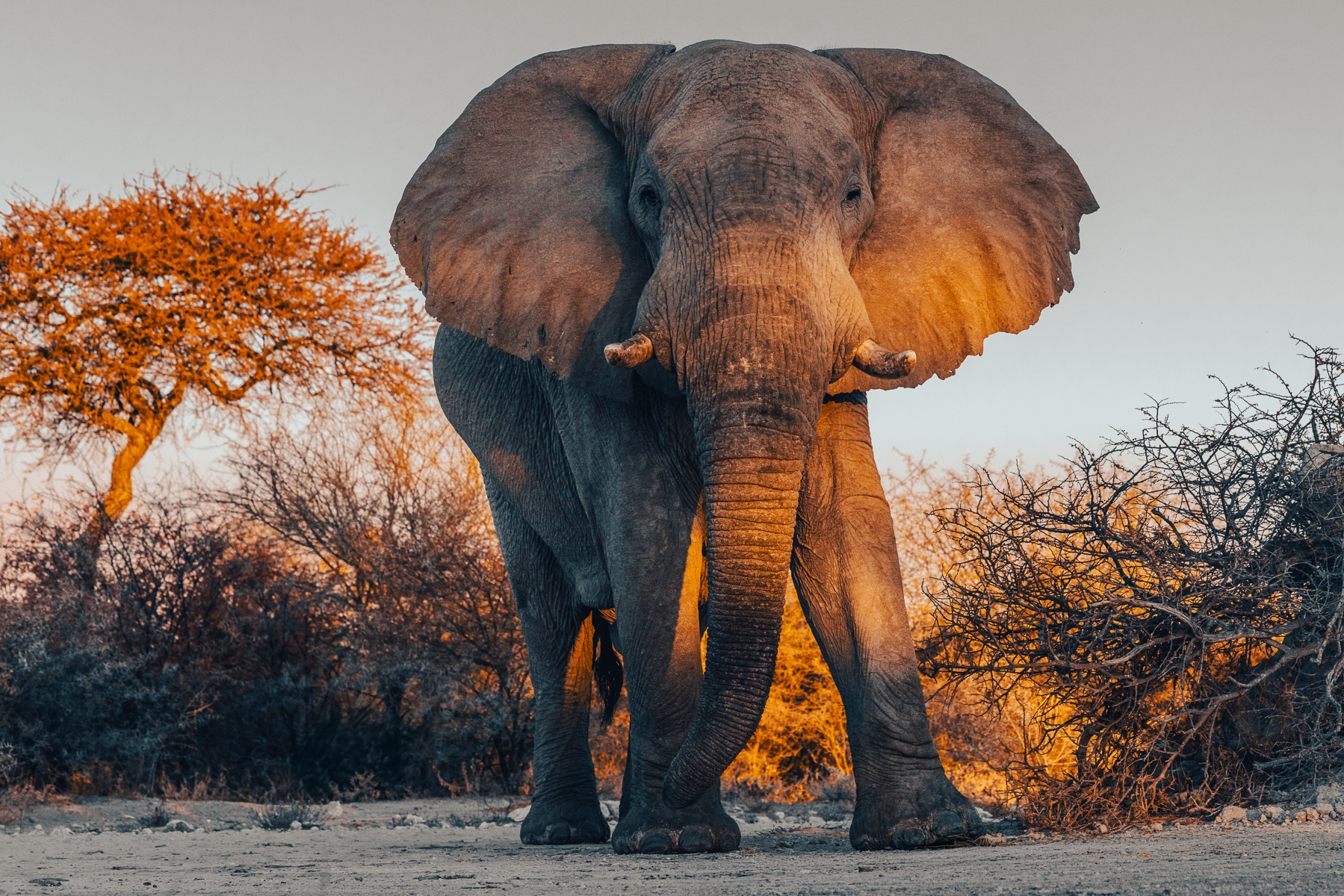
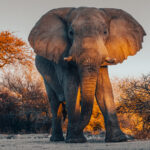
The last rays of golden sun spread across an African Savanna Elephant bull, just before it drops below the horizon. African Savanna Elephants can live for up to 70 years in the wild, although few will reach this age, Some of the bulls here can be older than 50 years old, meaning they were alive when Namibia gained independence in 1990 (image by Virginia Wilde)
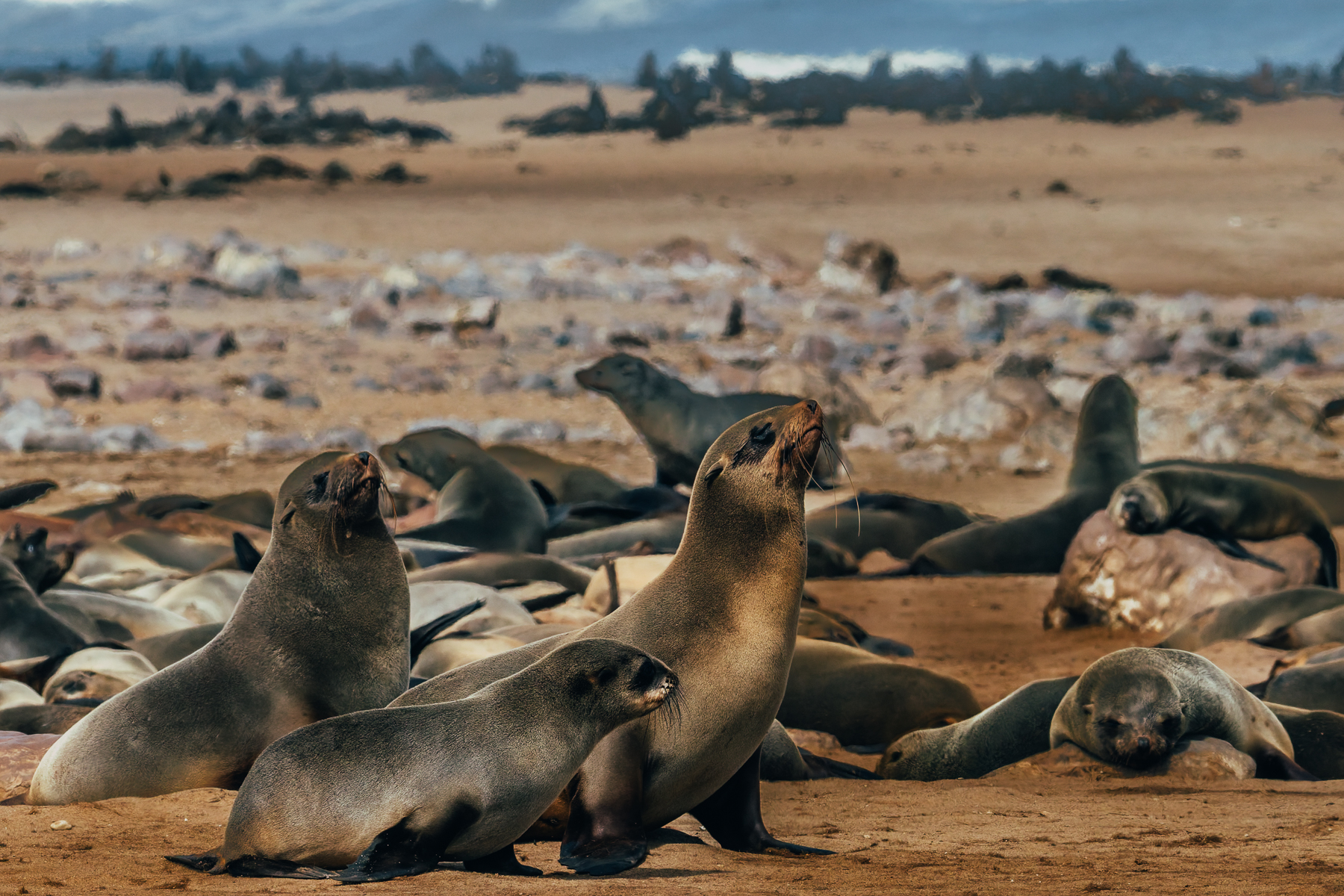
'This way, son, our patch is up here.' A Cape Fur Seal mother and her pup try to find their place among the 100,000 gathered seals in Namibia's Cape Cross Seal colony (image by Virginia Wilde)
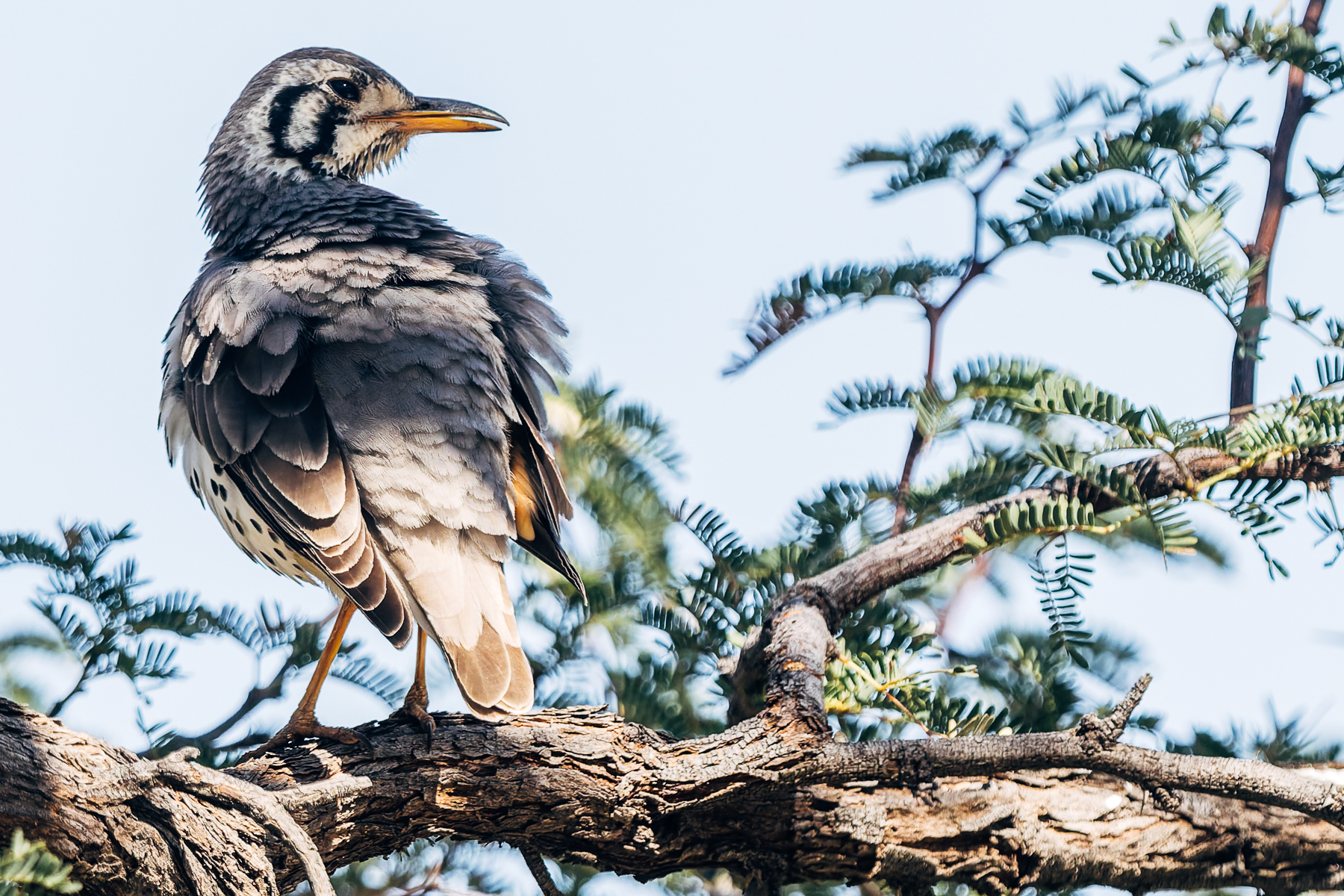
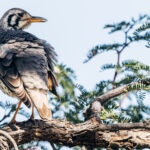
Groundscraper Thrushes are found widely across Namibia, with its bold white eyebrow and throat markings making it particularly distinctive (image by Virginia Wilde)
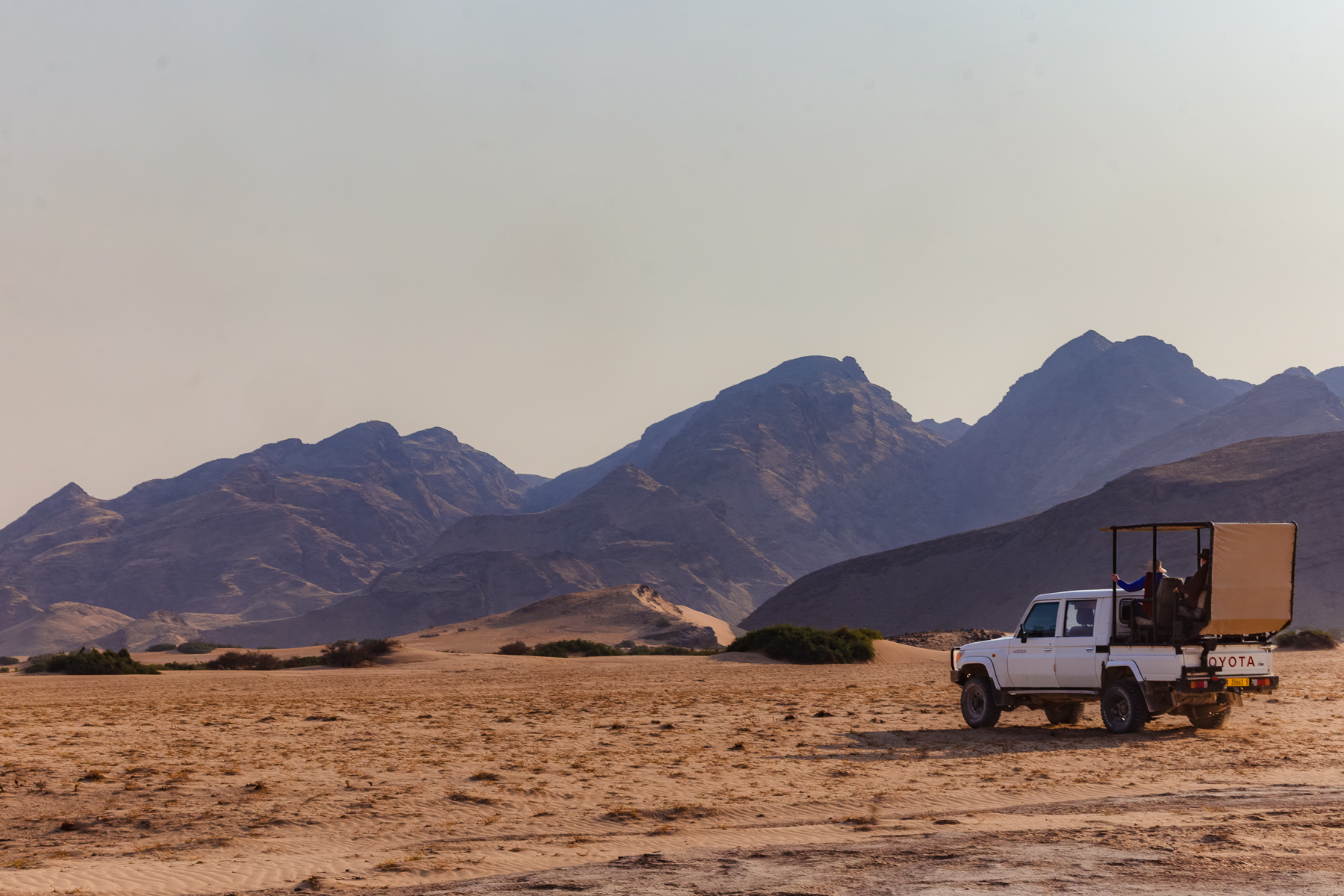
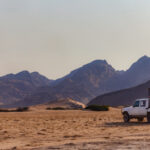
For me, the Hoanib River Valley was my favourite Namibia location. Here, one of our vehicles enjoys the craggy, desolate landscape (image by Virginia Wilde)
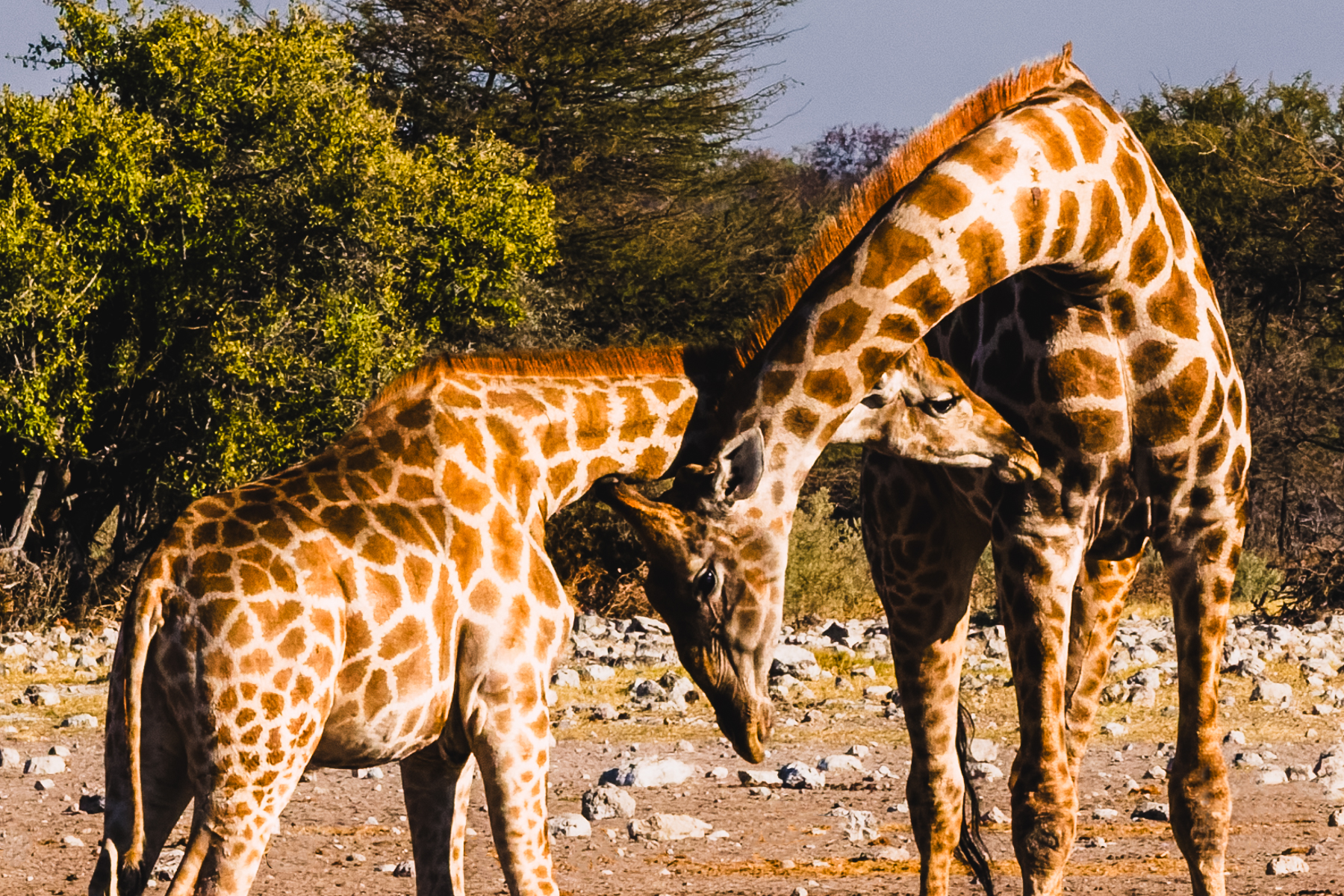
A tender moment between a juvenile Angolan Giraffe and its mother in Namibia's Etosha National Park (image by Virginia Wilde)
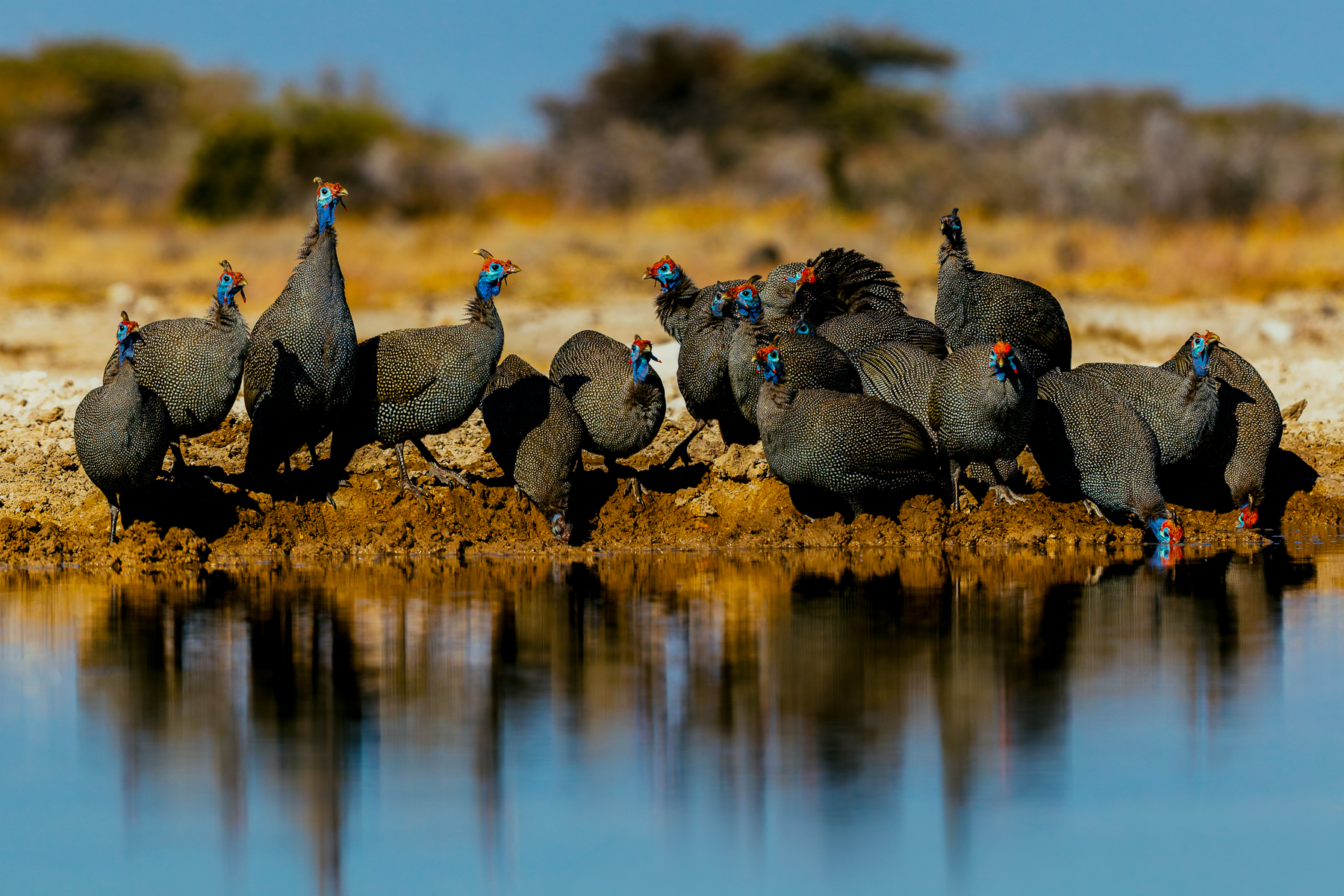
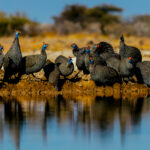
Helmeted Guineafowl gather at the Onguma Reserve waterhole, looking like armoured chickens. These Guineafowl have an entertaining-looking bobbing gait due to the way their legs and body are built for life on the ground. Particularly in areas where water is concentrated, flocks can reach numbers of 100+ birds (image by Virginia Wilde)
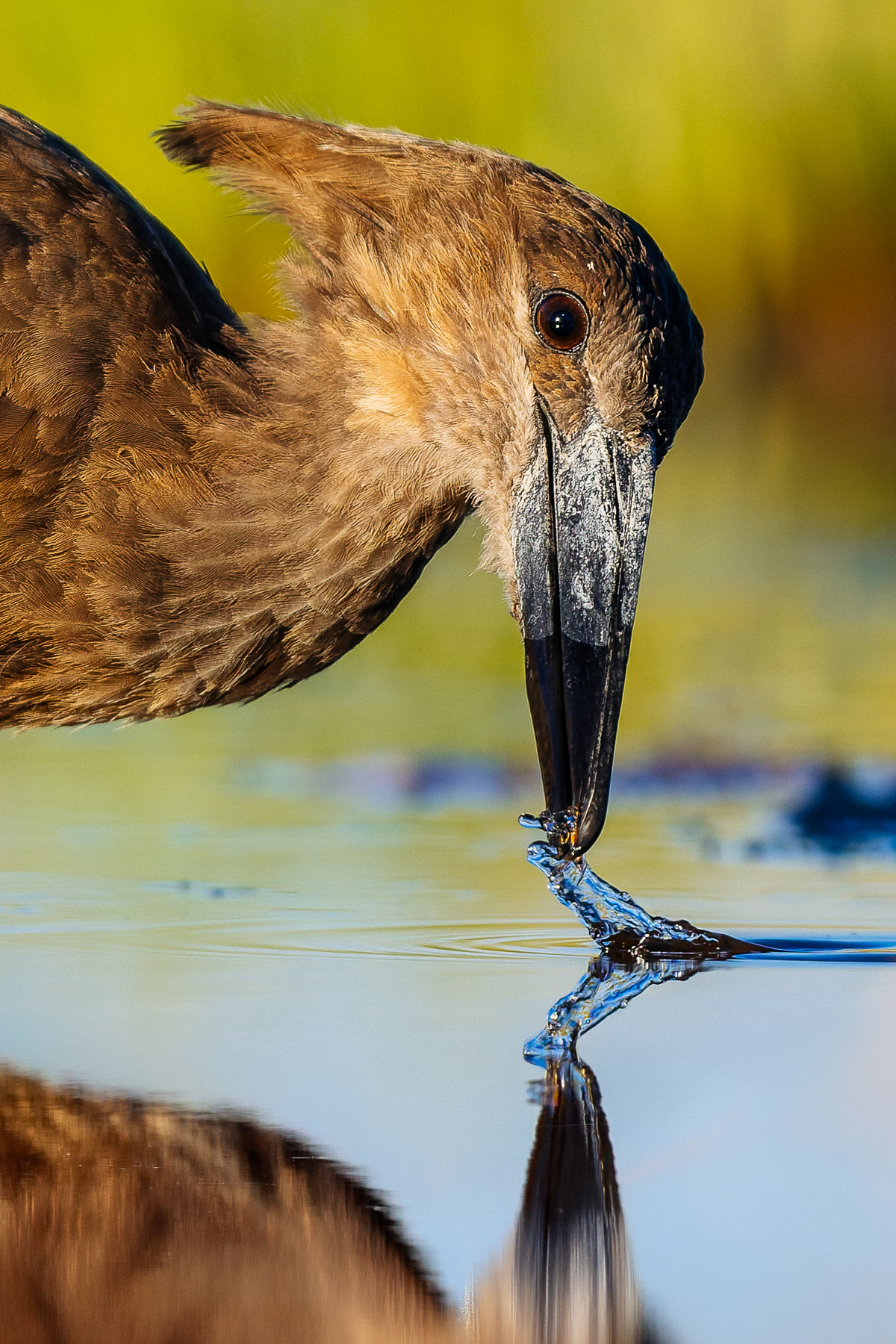
A Hamerkop fishes at lightning speed, with its bill scooping up prey from the shallow waterhole in Namibia's Onguma Reserve (image by Virginia Wilde)
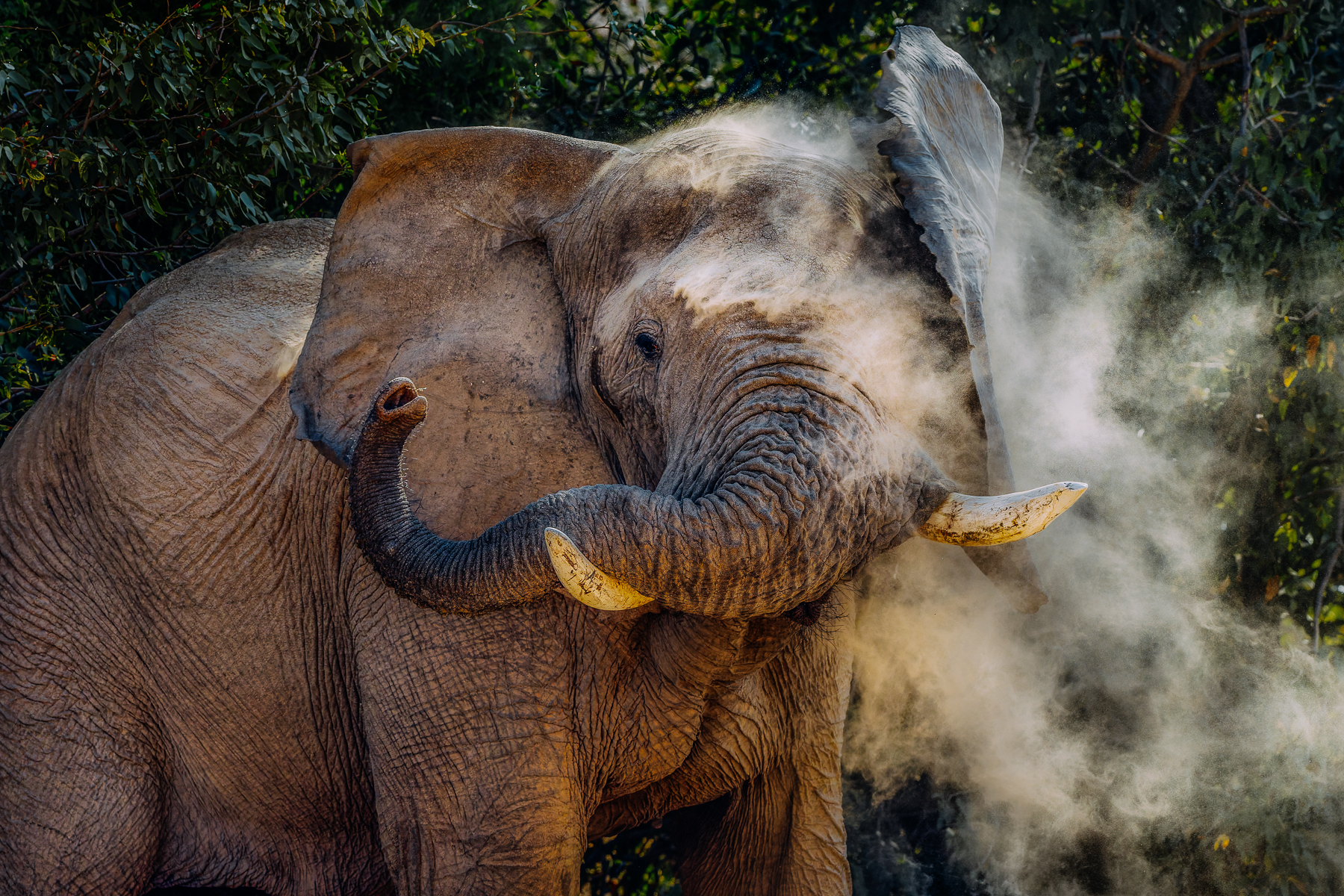
Dust swirls around the forehead of a desert-adapted Elephant bull, with the cloud enveloping his ear and head. The latest survey found only 28 desert-dwelling elephants in the Hoanib River Valley - the biggest troop of just 150 total desert-dwelling elephants, spread across five ephemeral rivers in Namibia (image by Virginia Wilde)
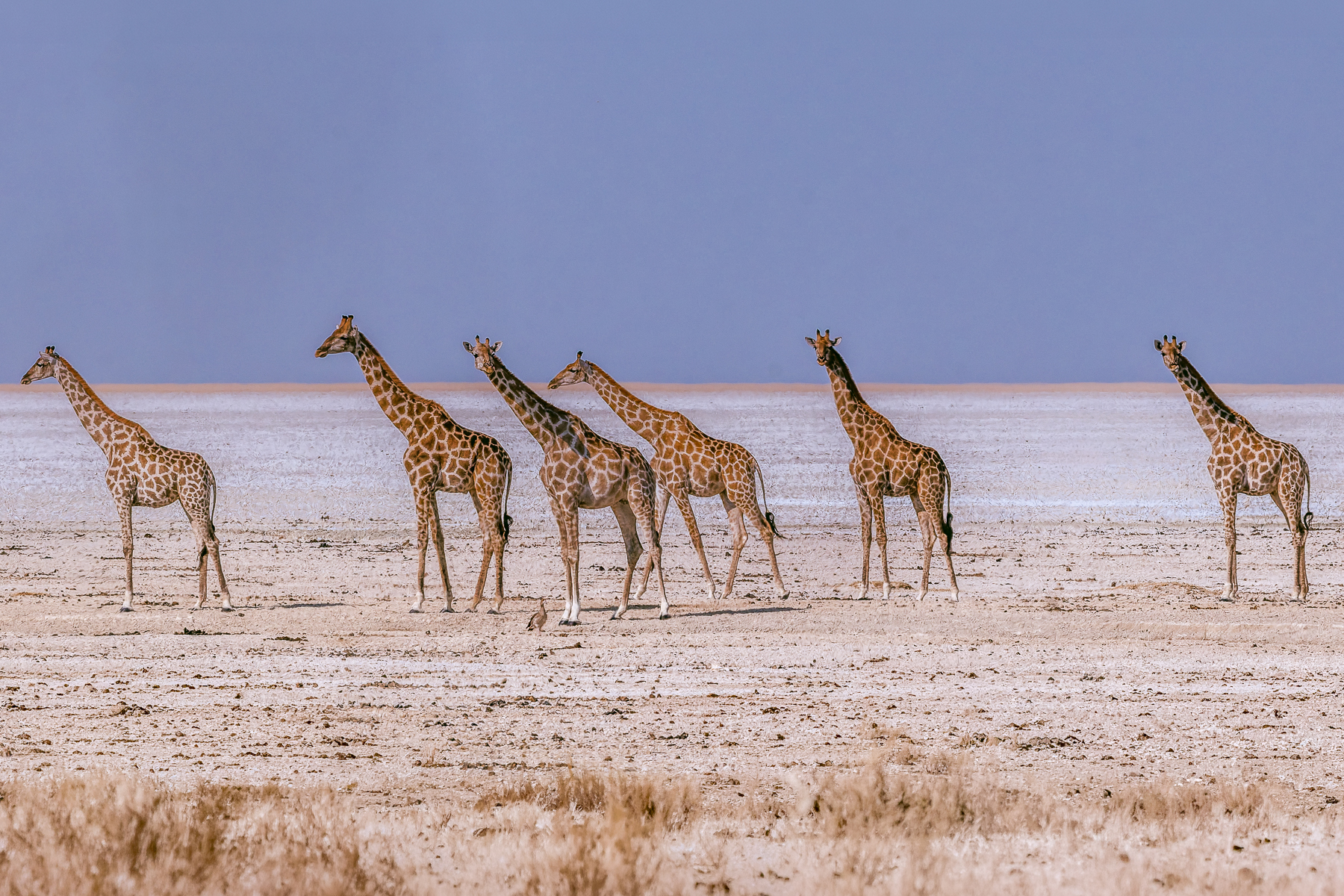
A tower of Angolan Giraffe briefly rest as they trek across the salt pan of Namibia's Etosha National Park. The pan itself covers about 25% of the 22,270-square-km park, and is notable for its silvery-white colour that is visible from space (image by Virginia Wilde)
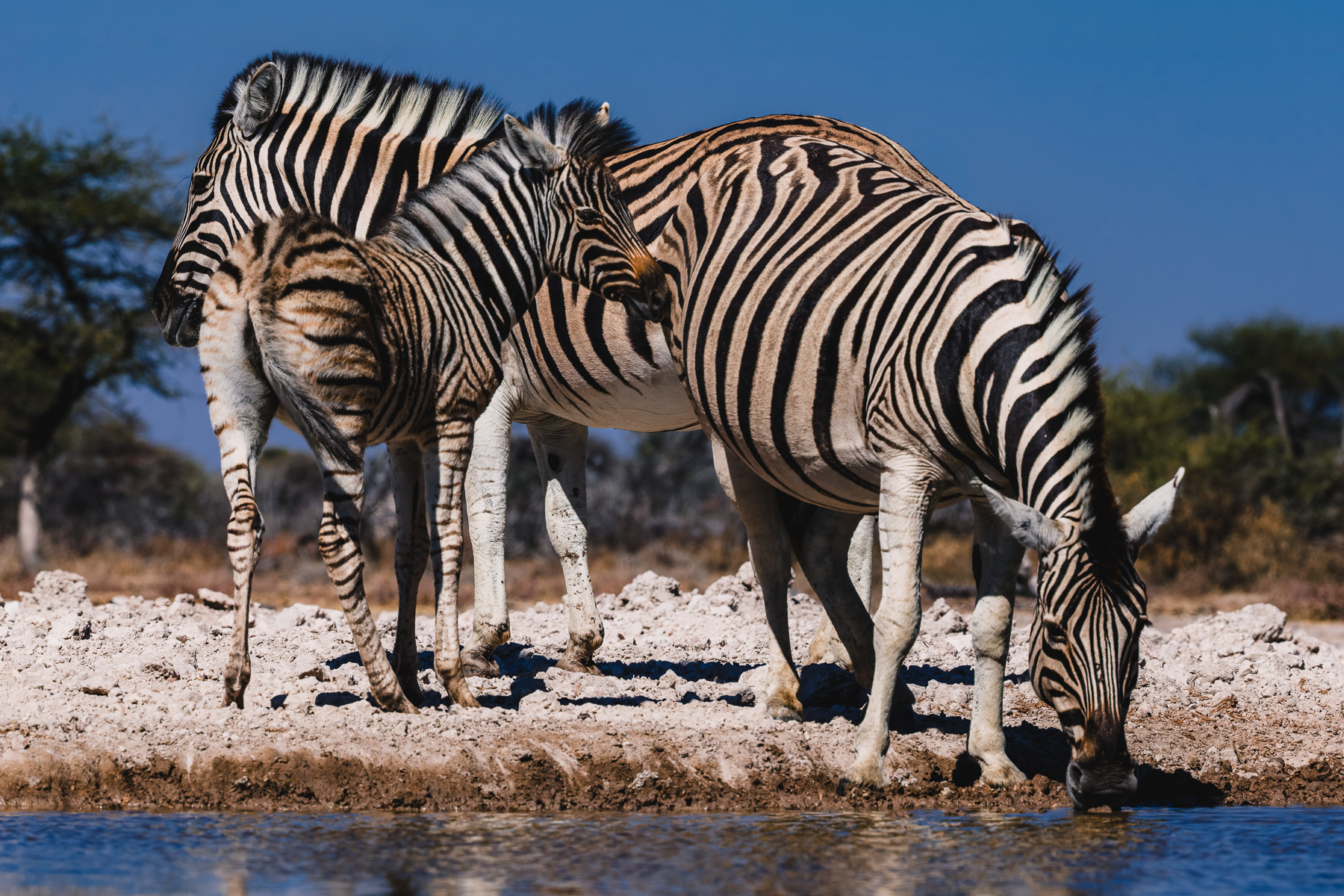
A young Burchell's Zebra foal stays close to its mother as they drink from the waterhole in Namibia's Onguma Reserve. These foals are born with brownish rather than black stripes, which darken as it matures, The mum recognises her young through its individual stripe pattern, smell and call (image by Virginia Wilde)
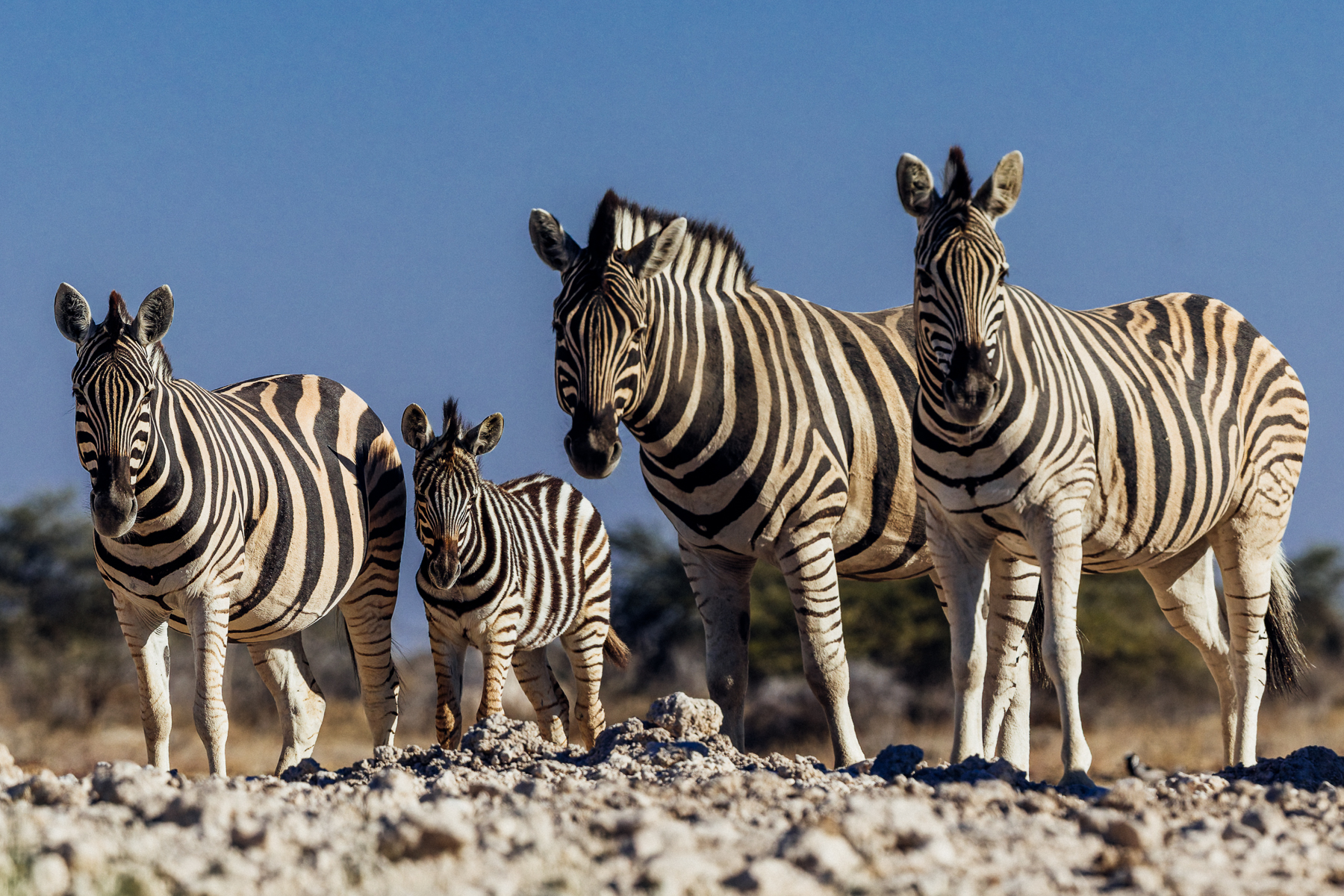
Four Burchell's Zebra stand alert on a rocky rise above a waterhole in Namibia's Onguma Reserve, the bold strips standing out against the deep blue sky (image by Virginia Wilde)
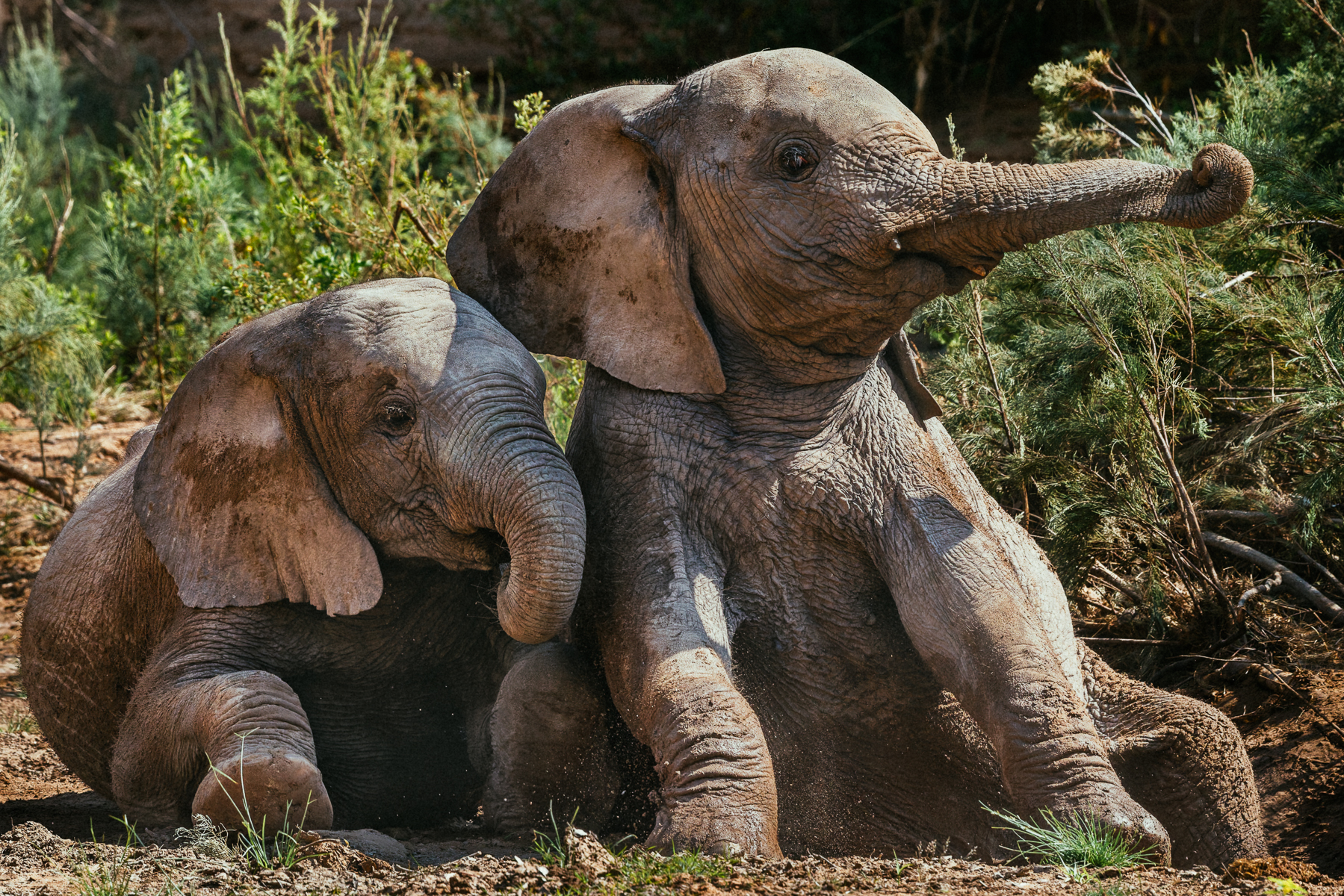
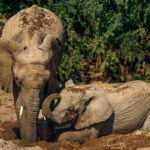
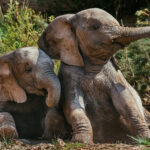
There are few things more compelling than watching two young Elephants lark about and play. With trunks that take years to learn how to use, this pair wielded theirs like toy swords before collapsing next to each other in a tender moment (image by Virginia Wilde)
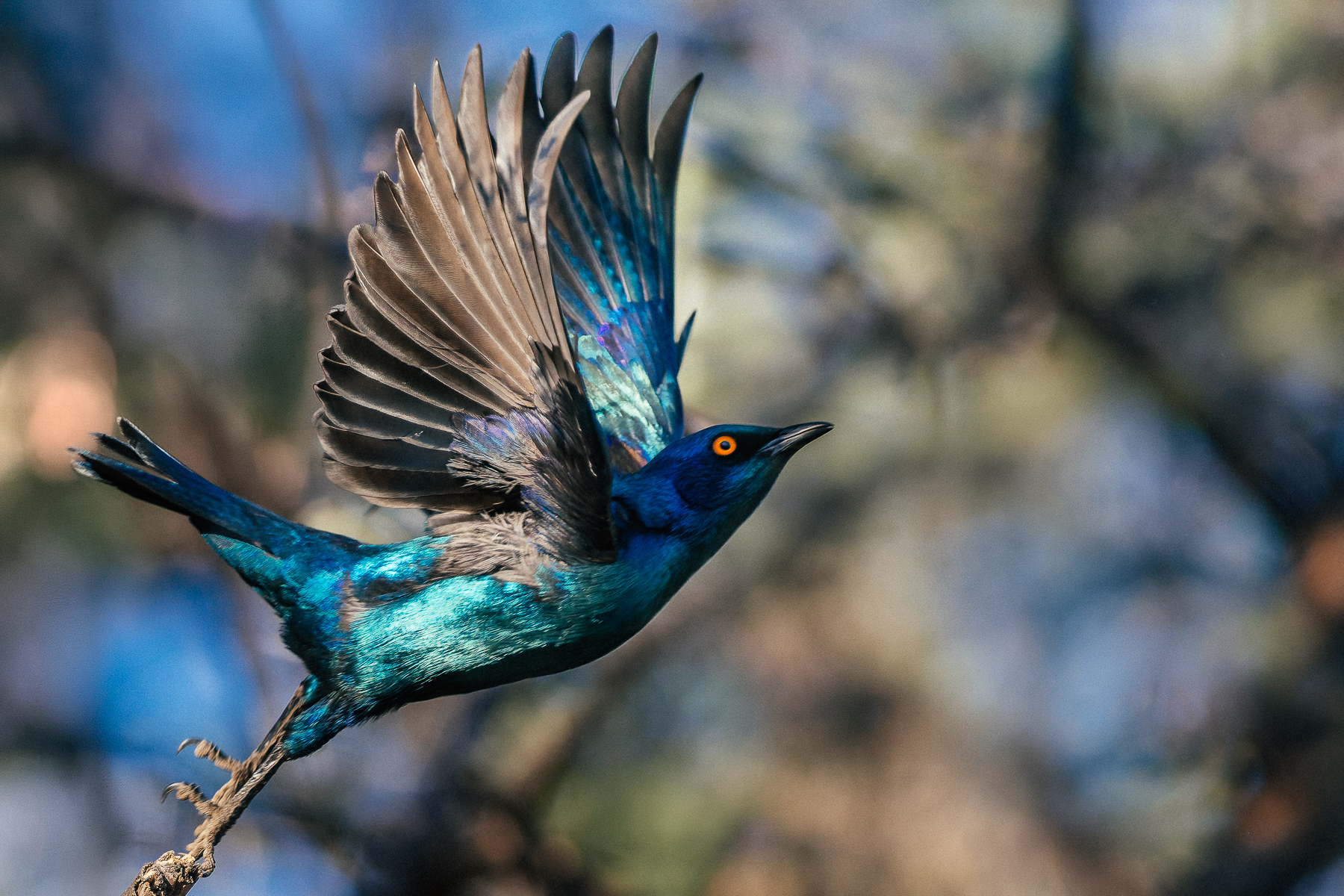
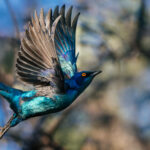
The brilliant blue-green plumage of a Cape Starling is structural rather than simply pigmented. Microscopic structures in the feathers scatter light to create its intense metallic sheen (image by Virginia Wilde)
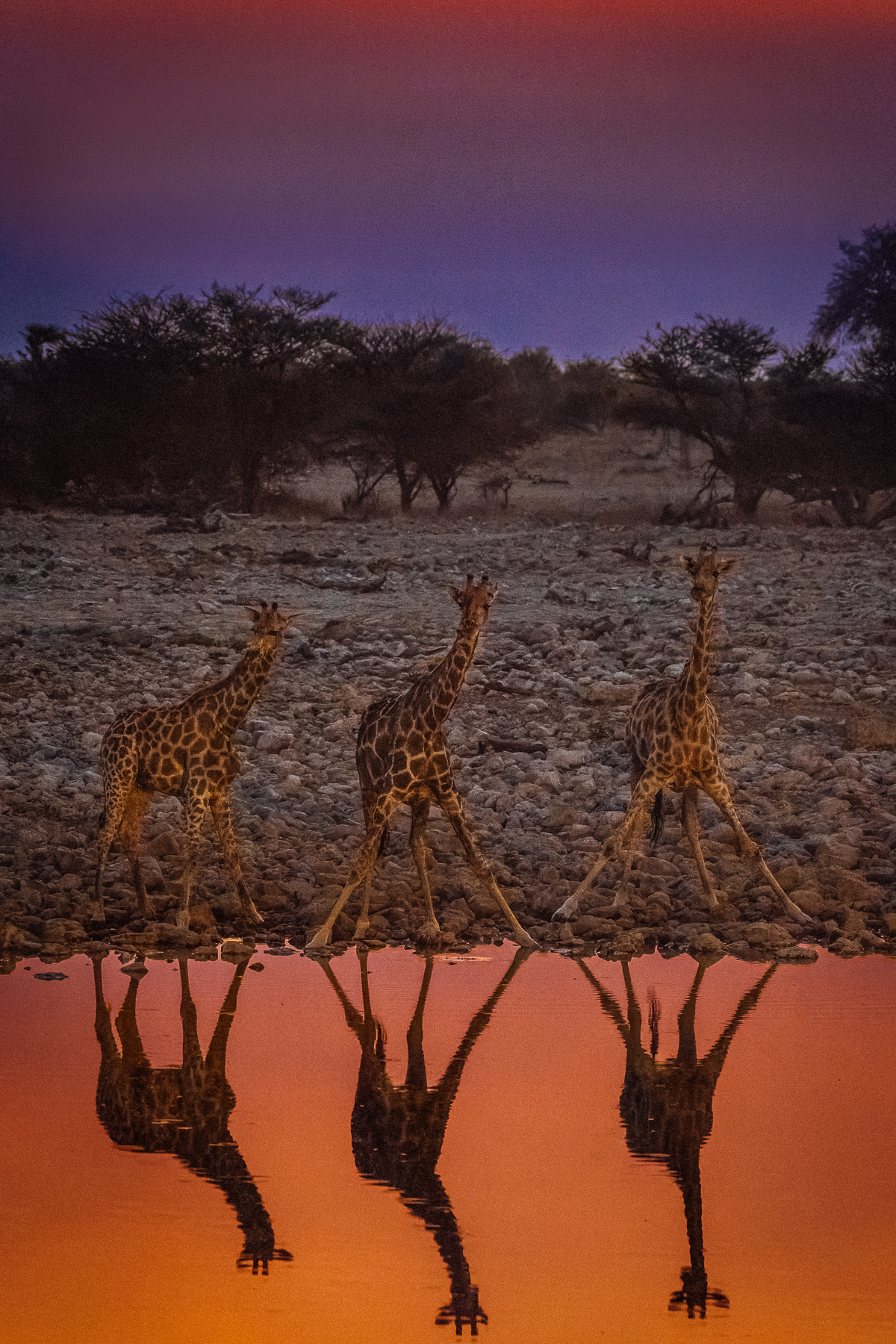
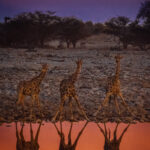
Namibia never fails to deliver incredible colours and light. We watched these three Angolan Giraffe drink from the Okaukeujo waterhole as the twilight hour produced some incredibly deep purple and pink skies (image by Virginia Wilde)
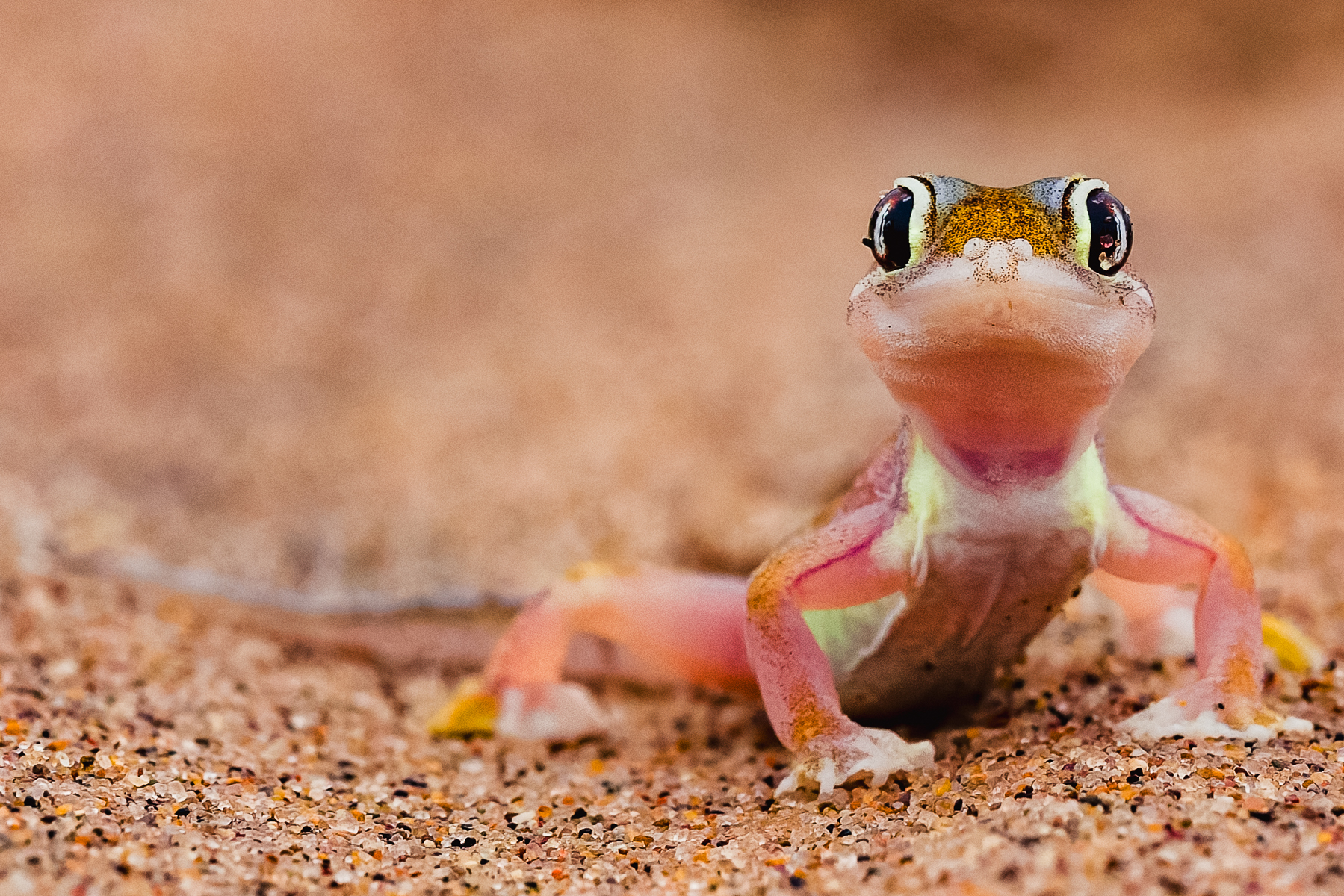
The striking pink colouration - and semi-transparent skin - of a Namib Sand Gecko. This desert specialist has fully webbed feet that allow it to 'swim' across loose desert sand and burrow into dunes (image by Virginia Wilde)
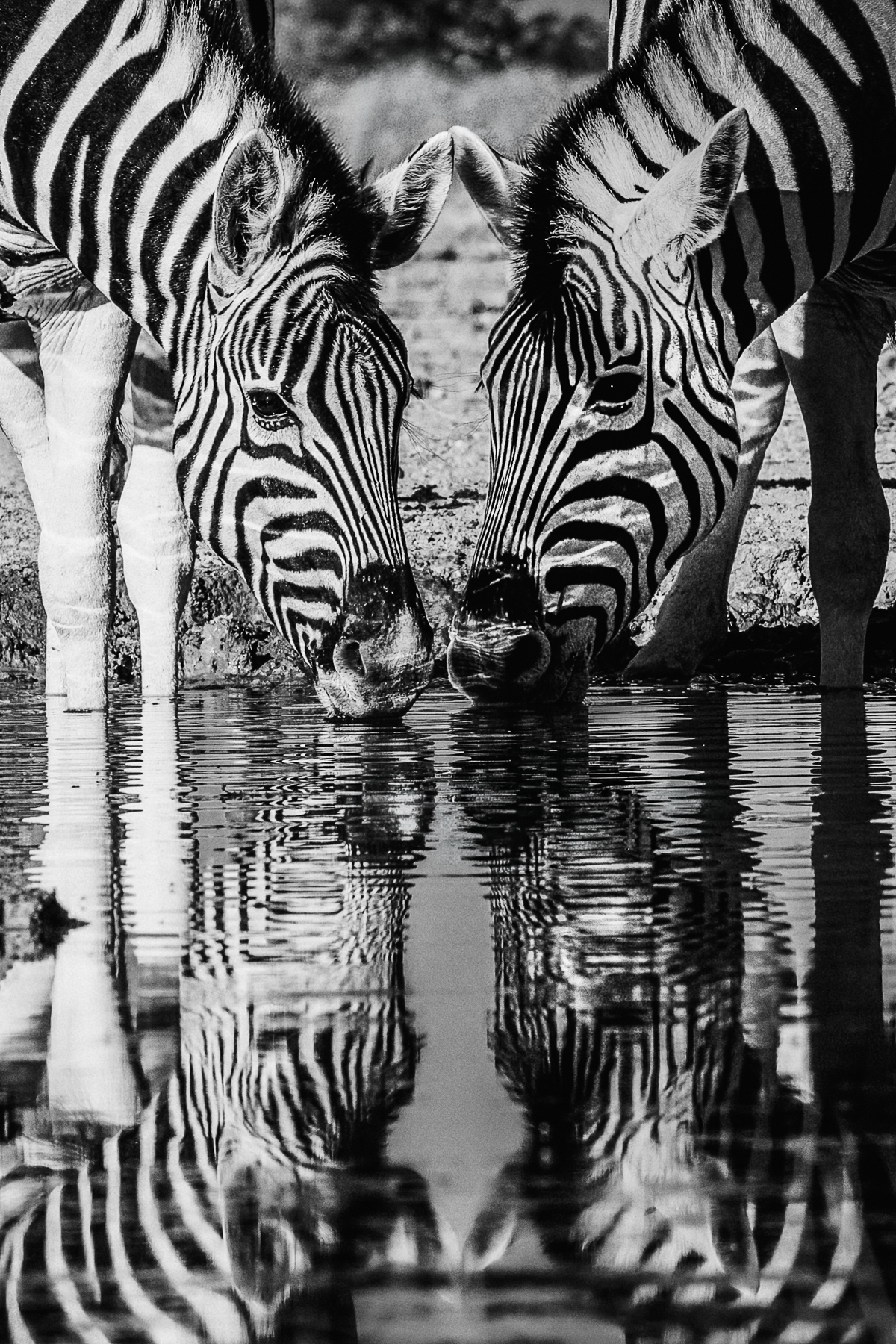
The black-and-white stripes of these Burchell's Zebra create a pattern of lines and reflections, blurring the boundary between animal and landscape (image by Virginia Wilde)
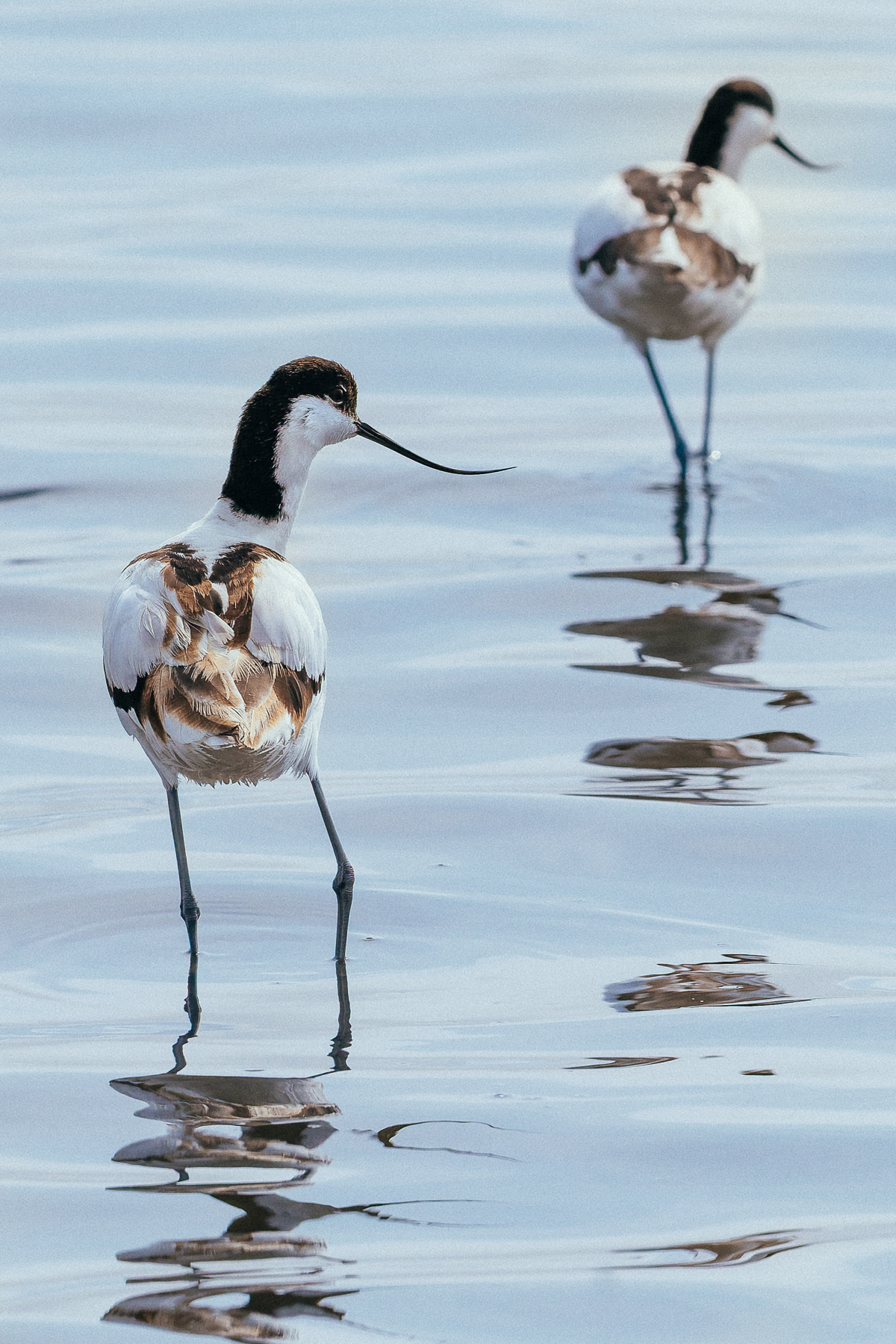
A pair of Pied Avocets wade through the shallow harbour waters of Namibia's Walvis Bay Lagoon. The lagoon sits right on the edge of the Namib Desert, with the Atlantic and dunes around it (image by Virginia Wilde)
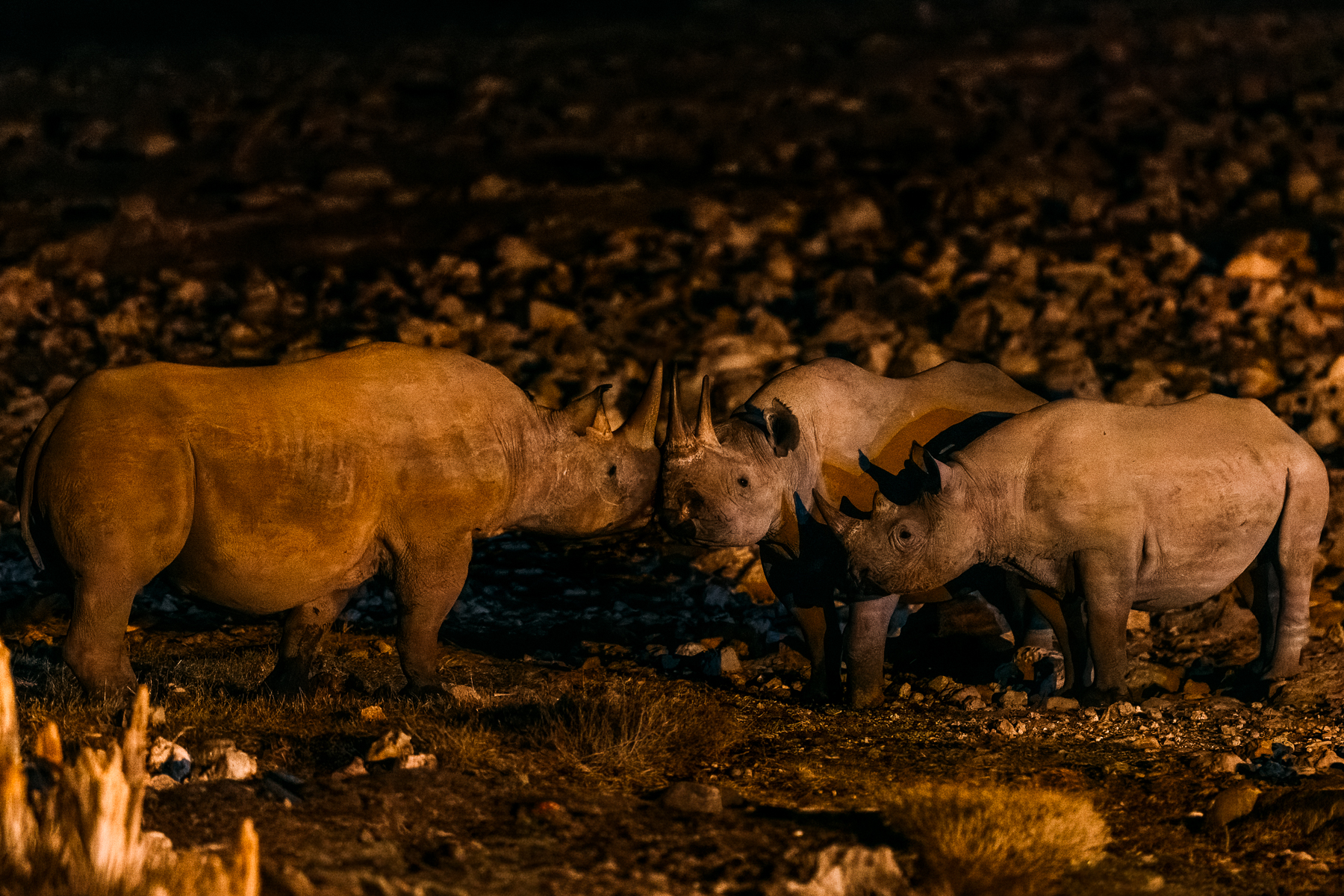
Three Black Rhinos gather by the Okaukuejo waterhole at night, their horns touching as they pause together in an interaction that appears as if they are old friends. Black Rhinos are generally solitary, so seeing several individuals approach each other peacefully makes for a rare encounter (image by Virginia Wilde)
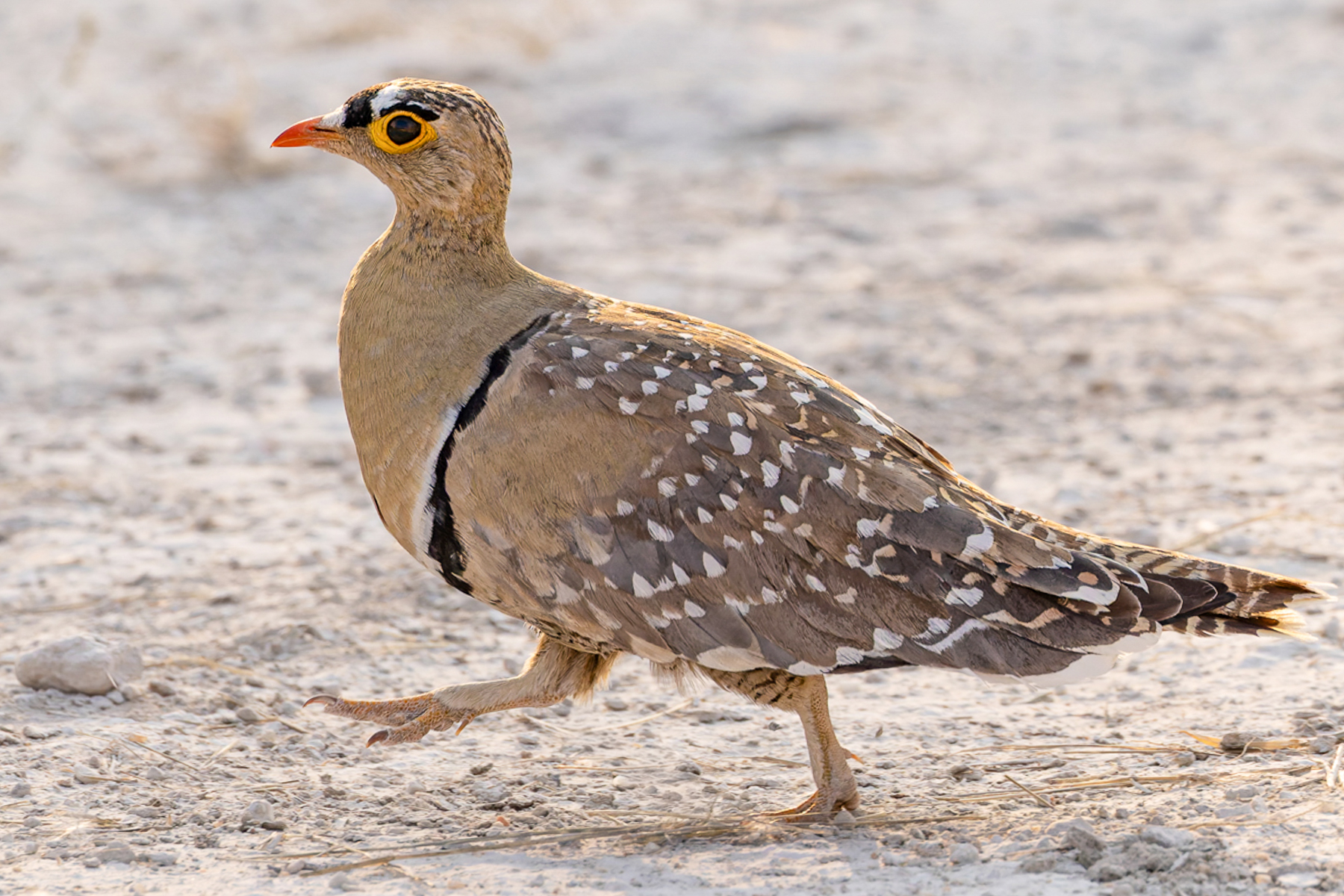
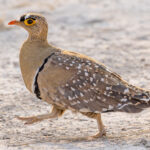
A Double-banded Sandgrouse struts across the salt pan in Namibia's Etosha National Park. Male sandgrouse wets his belly feathers at a waterhole before flying back to the nest where the chicks drink directly from his plumage (image by Mike Watson)
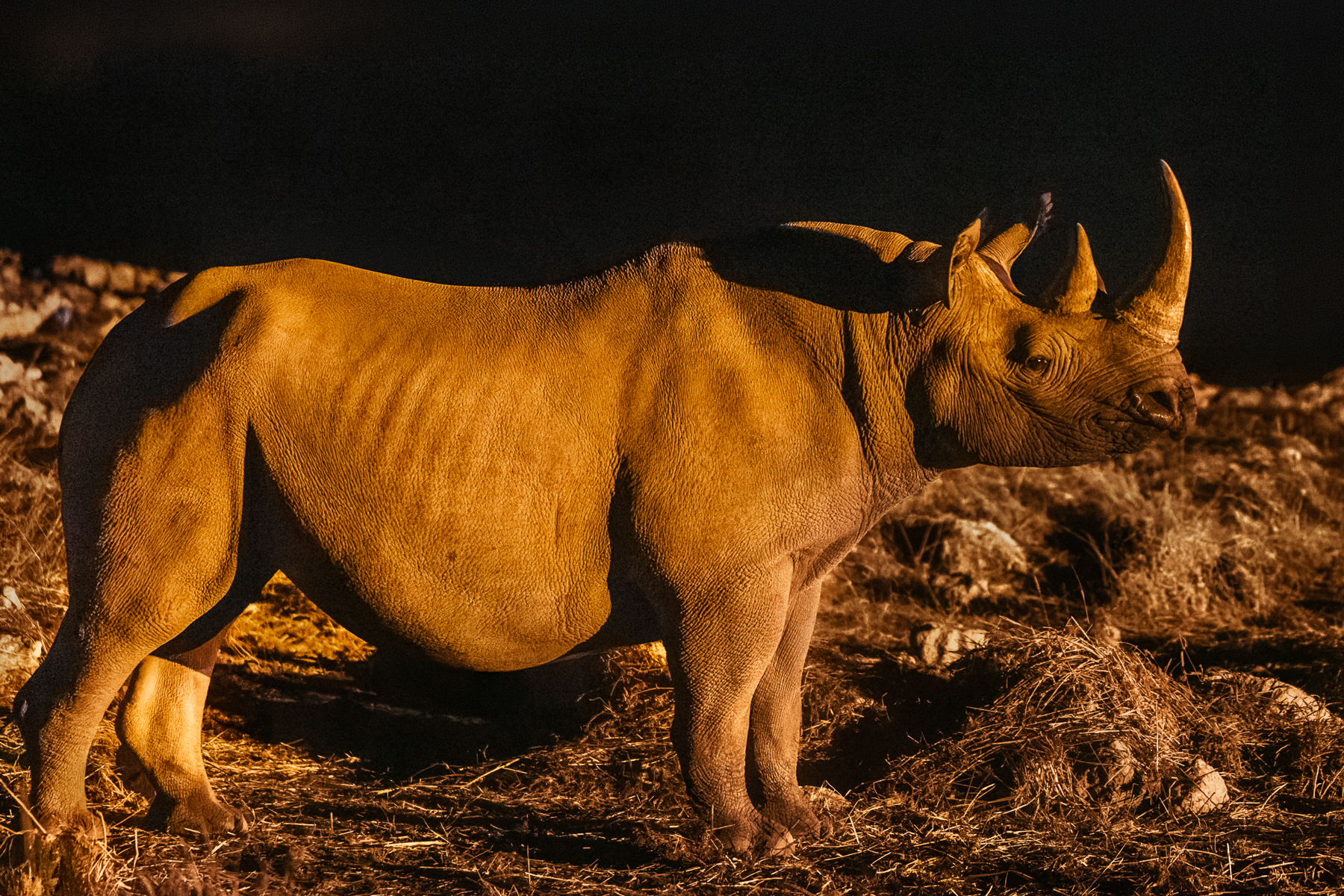
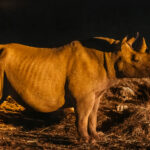
A Black Rhino stands upright and alert during a night-time visit to Namibia's Okaukuejo waterhole. Black Rhinos (and the Namibian south-western subspecies) are critically endangered and usually solitary, except when females are accompanied by calves (image by Virginia Wilde)
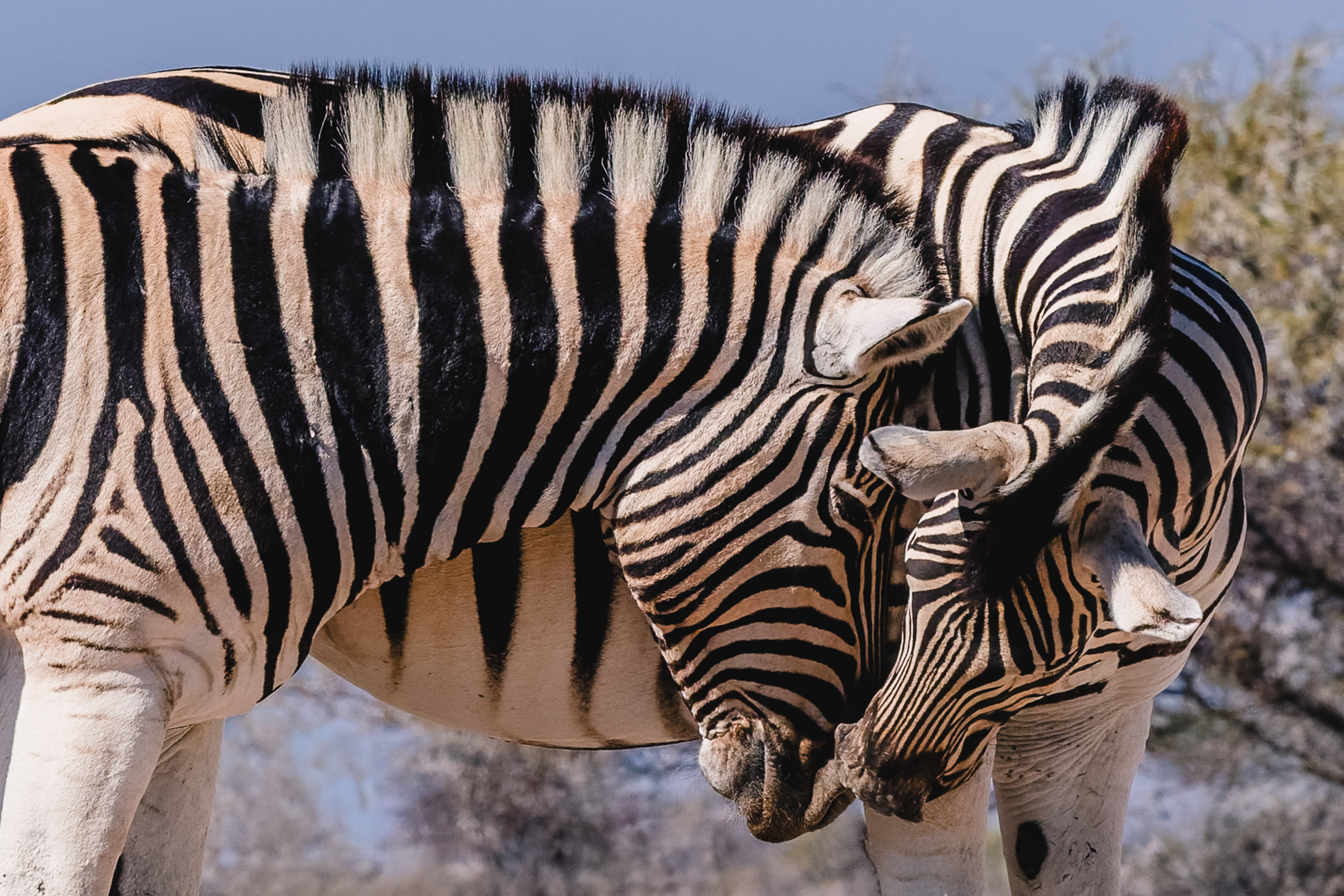
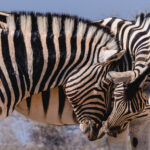
'It's all going to be okay, you know.' Zebras are highly social animals and close physical contact helps to reinforce the bonds between individuals. In the harsh Namibian landscape, this small display of affection makes for a particularly lovely glimpse of their world (image by Virginia Wilde)
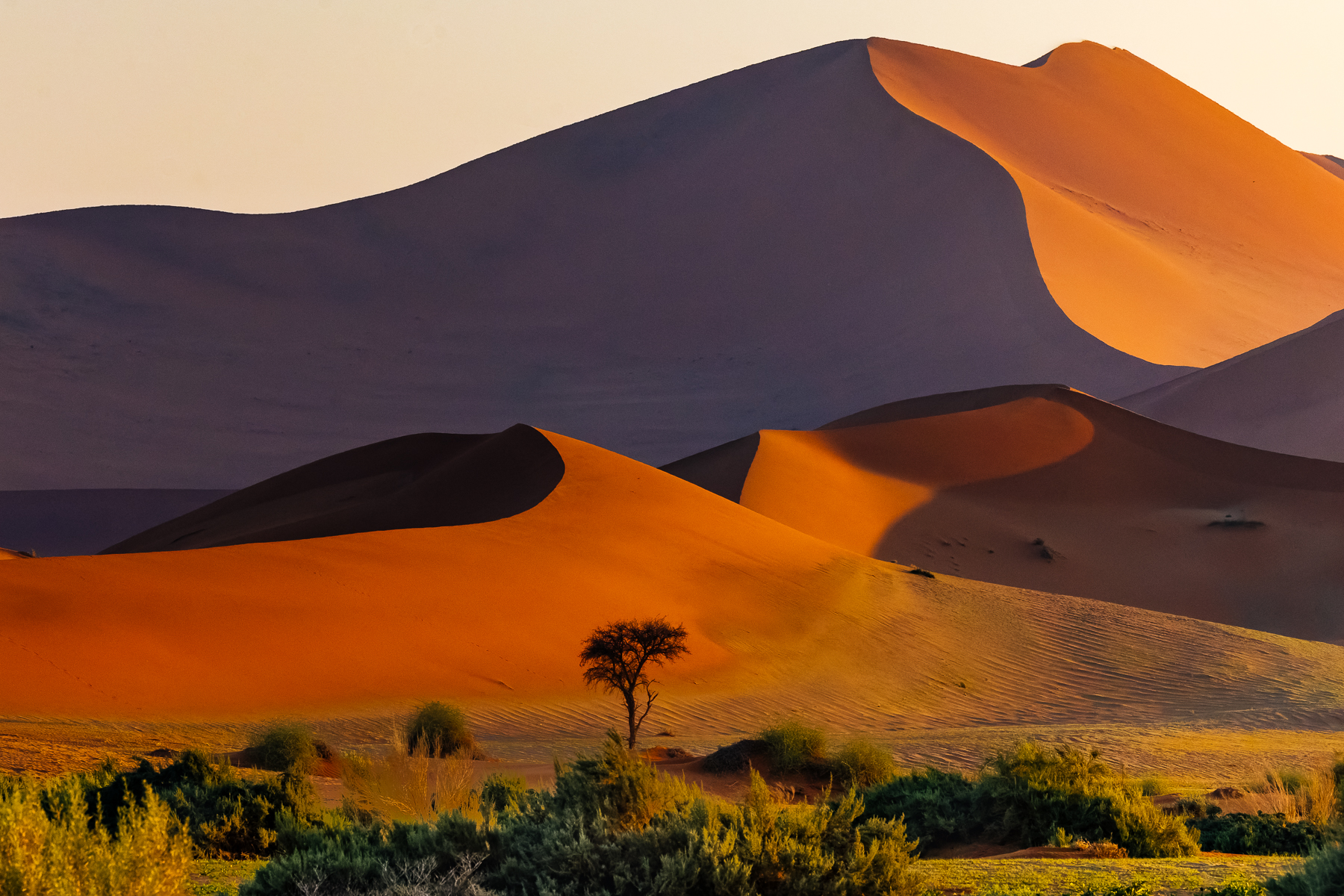
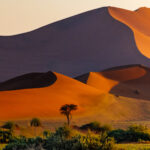
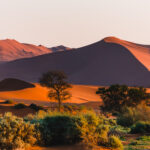
The sculpted ridges of the Sossusvlei dunes reveal the constant influence of wind, which has shaped this vast sea of sand over thousands of years. Against the dunes, a lone healthy Camel Thorn tree adds a sense of scale to one of Namibia's most iconic landscapes (image by Virginia Wilde)
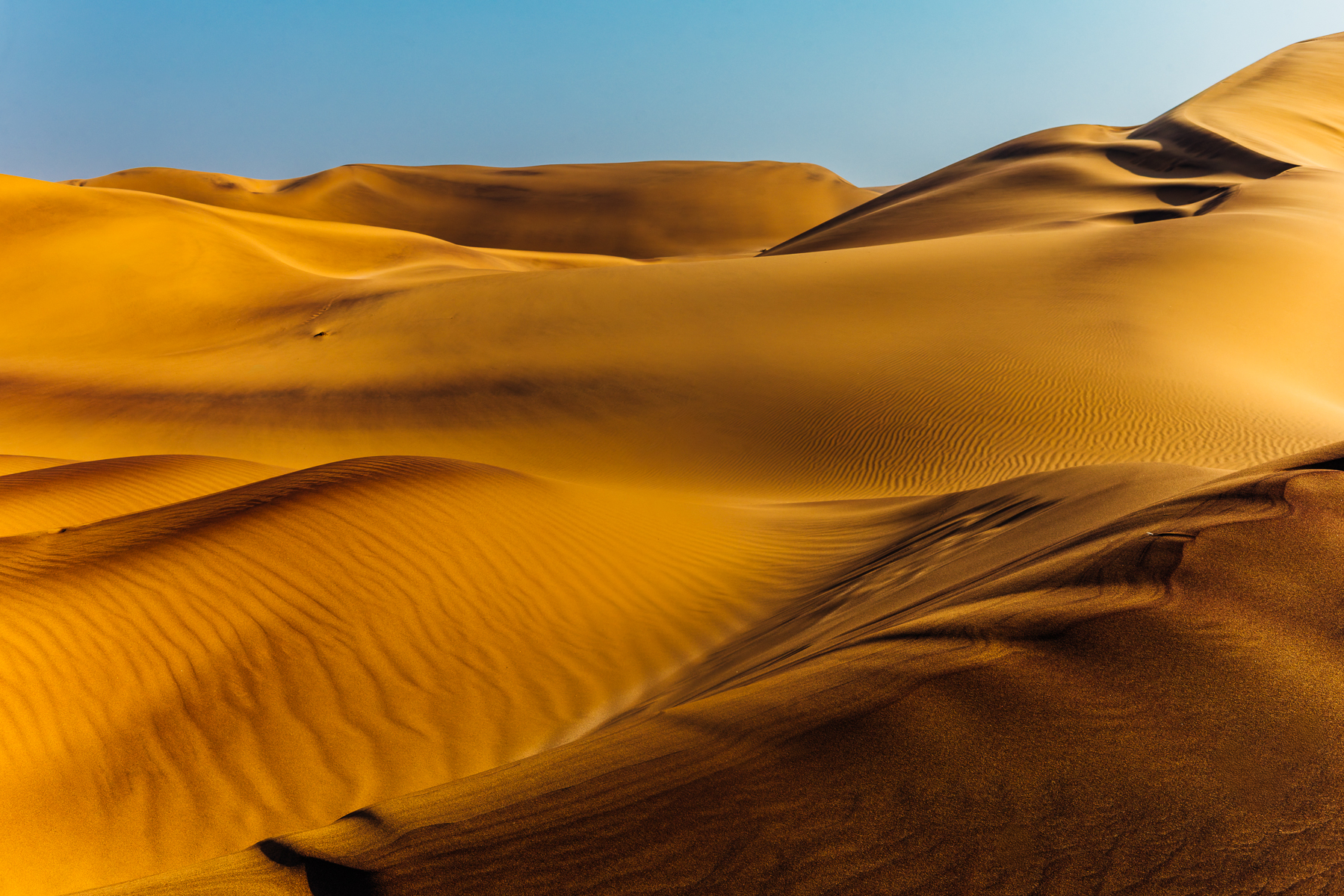
Ripples and folds in the sand - when combined with dawn or evening light - reveal the constantly shifting textures of the Namib Desert. The simplicity of these desert scenes make the landscape feel almost abstract (image by Virginia Wilde)
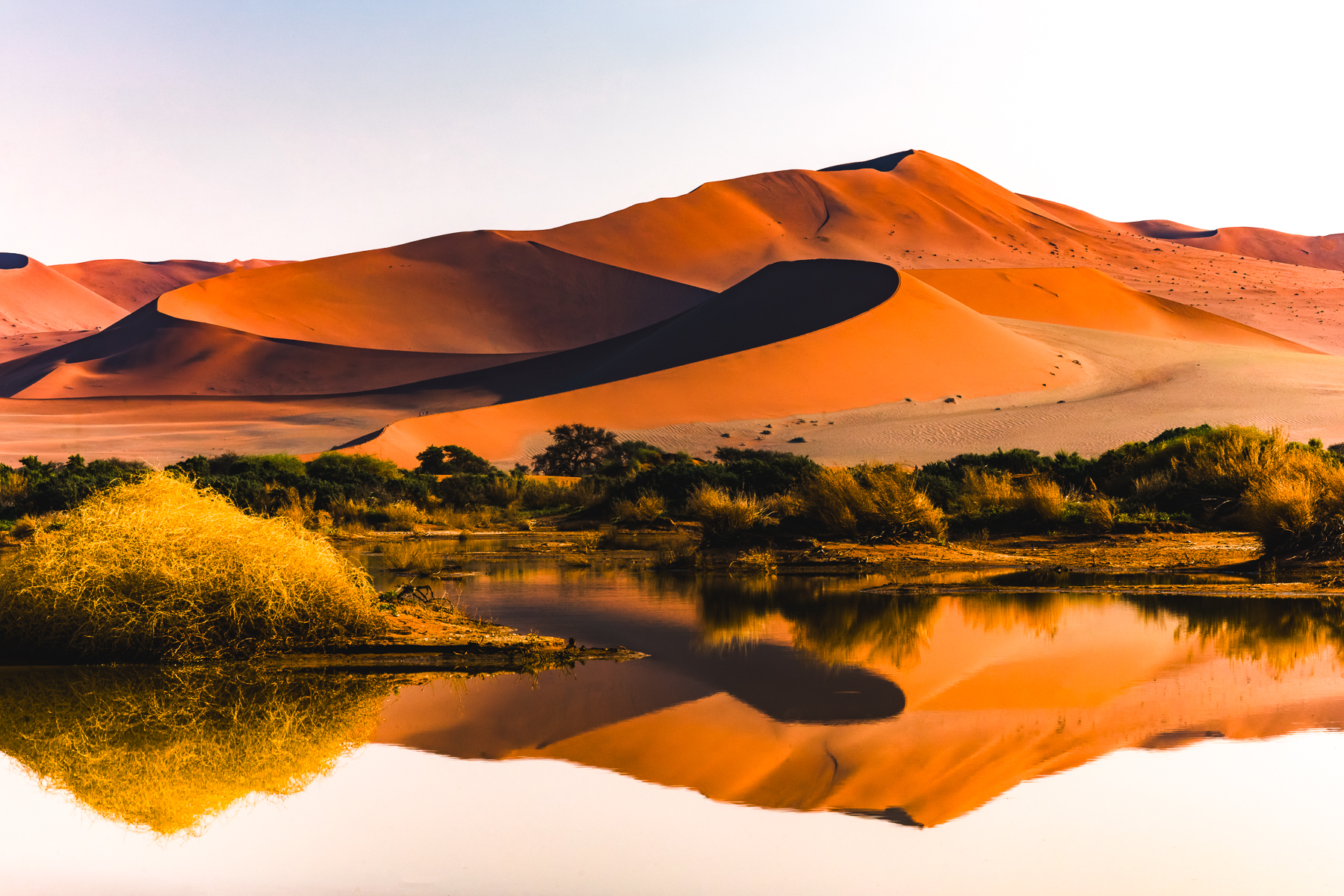
Sossusvlei's iconic curving dunes reflected in a rare pool of water. The main Sossusvlei pan only fills when the Tsauchab River gets enough water from heavy rainfall to make it all the way through the desert to the pan - which only happens around once a decade. When flooding does happen, the pan becomes a shallow lake, reflecting the dunes (image by Virginia Wilde)
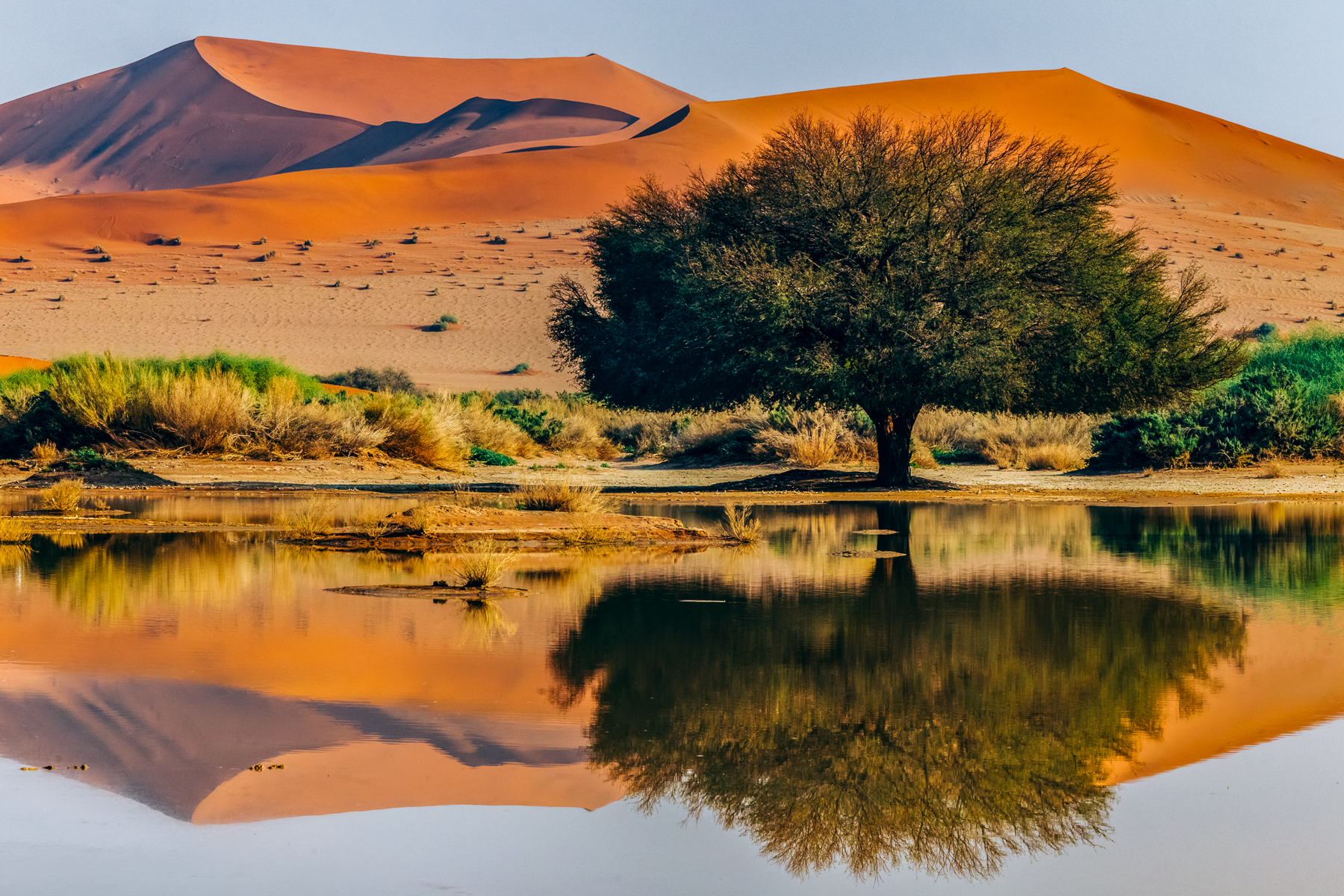
These reflective pools only develop by the Sossusvlei dunes about once every decade - brought on by heavy rainfall into the Tsauchab River. So we were incredibly lucky to have these wonderful conditions during our tour (image by Virginia Wilde)
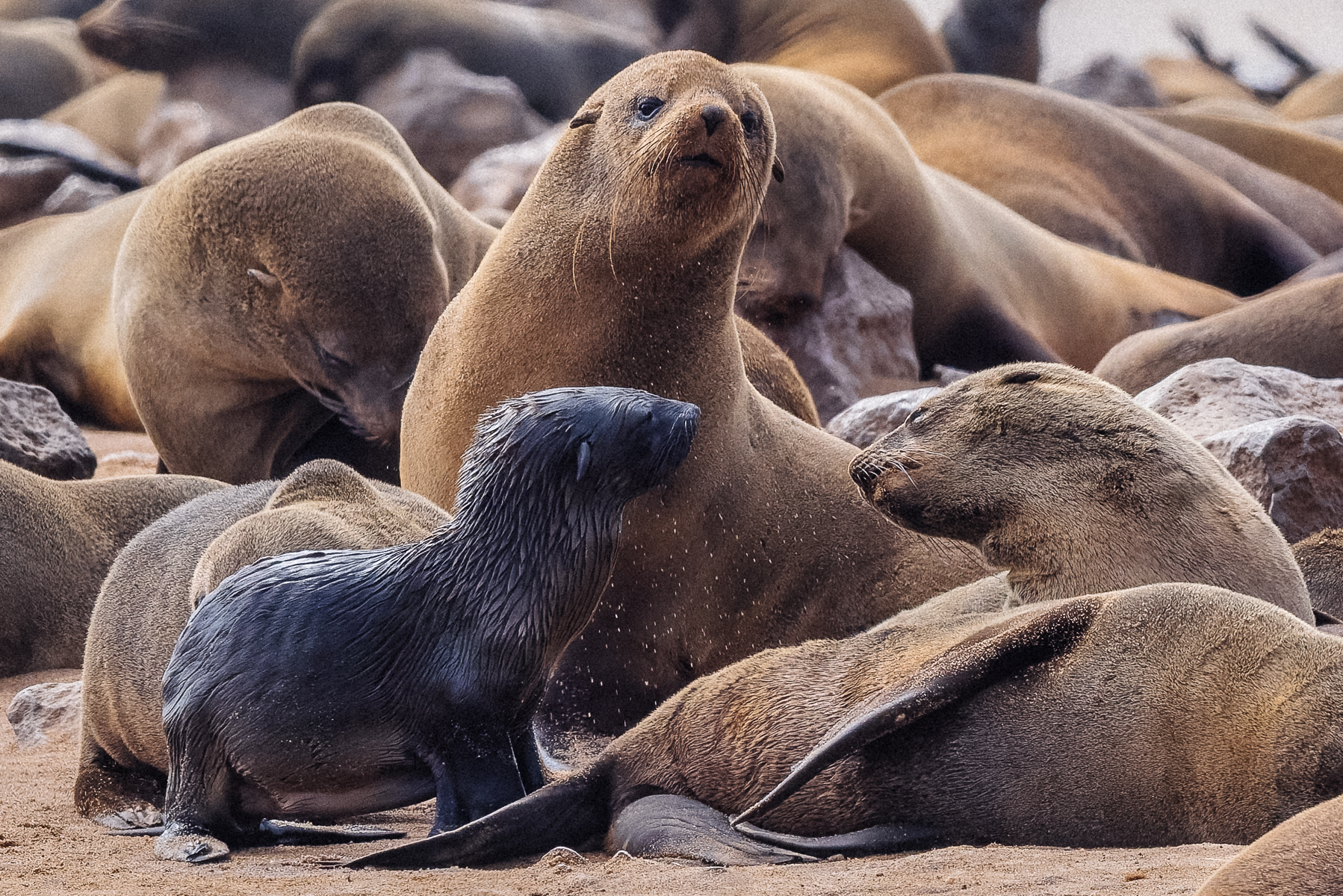
'But please can I go off to play?!' A Cape Fur Seal pup appears to implore with a seal we believed to be its mum. But Namibia's great Cape Cross colony is so sprawling with seals it's almost impossible to work out whose pup belongs to who (image by Virginia Wilde)
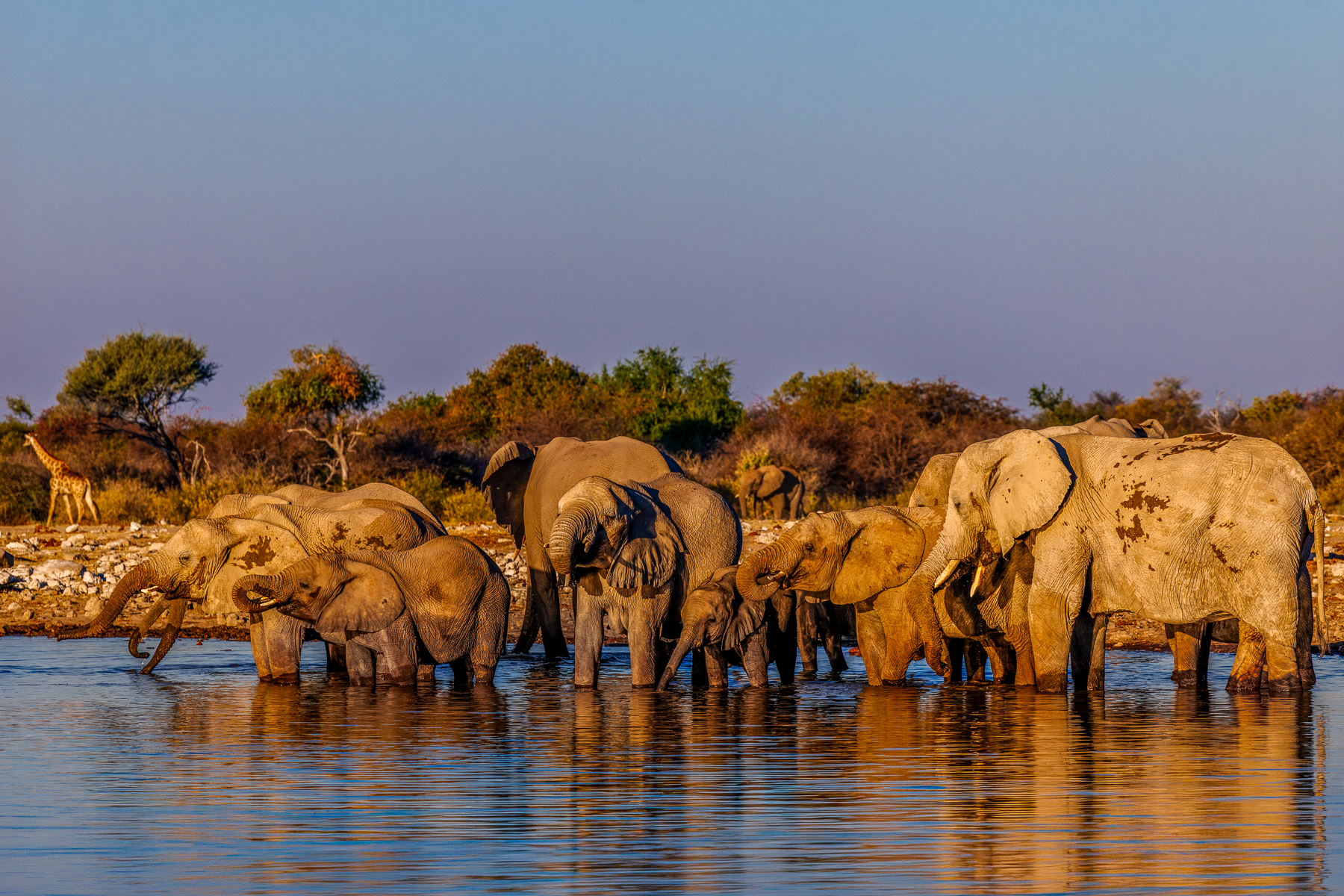
A large herd of African Savanna Elephants enjoy the cool waters of the Klein Namutoni waterhole in Namibia's Etosha National Park (image by Virginia Wilde)
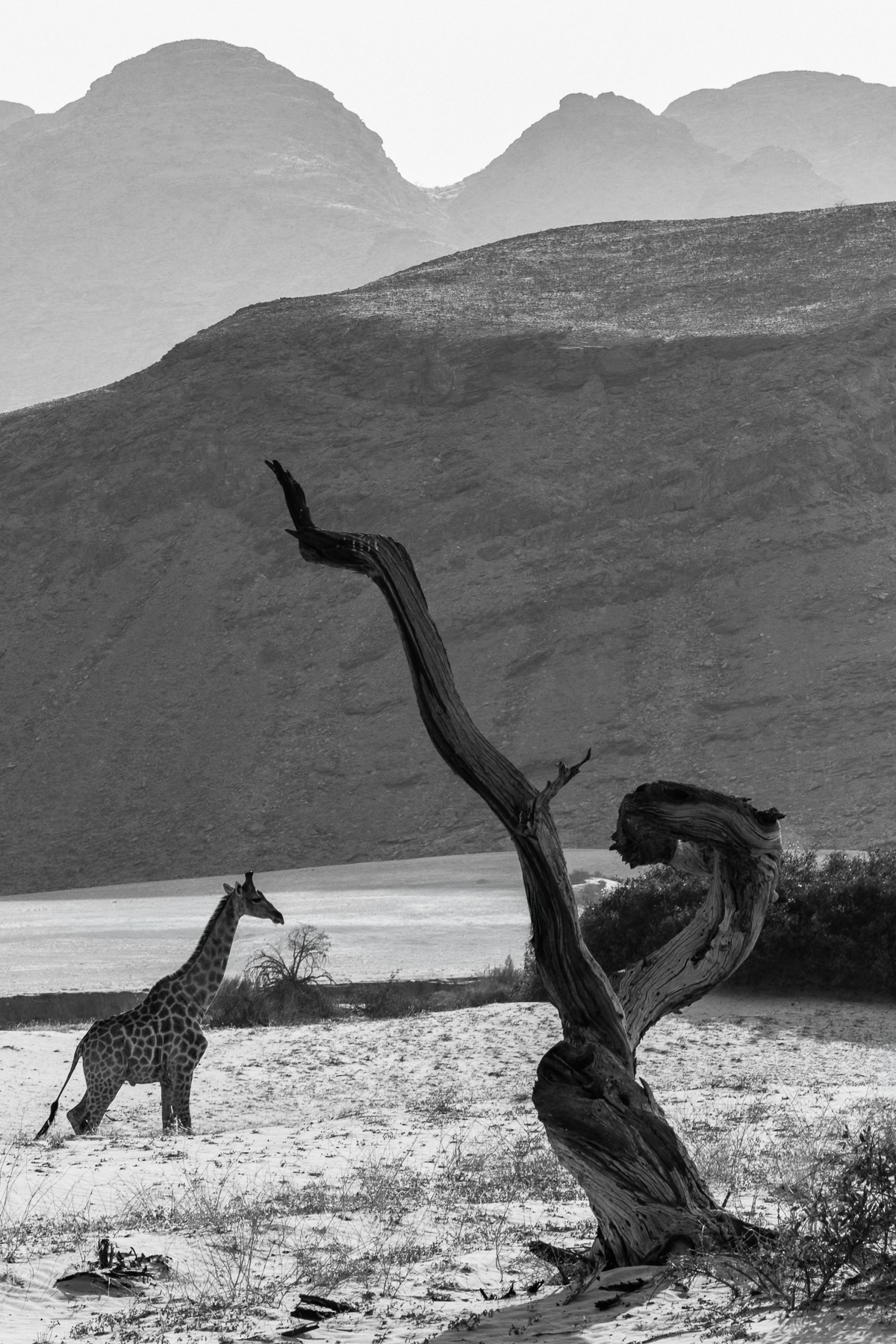
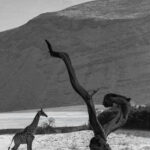
A desert-adapted Angolan Giraffe wanders by the remains of a twisted tree, in Namibia's Hoanib River Valley. Angolan Giraffe here live in an exceptionally arid environment of dry riverbeds, gravel plains and dunes. Research in this region found giraffes meet much of their water requirement from vegetation and dew (image by Virginia Wilde)
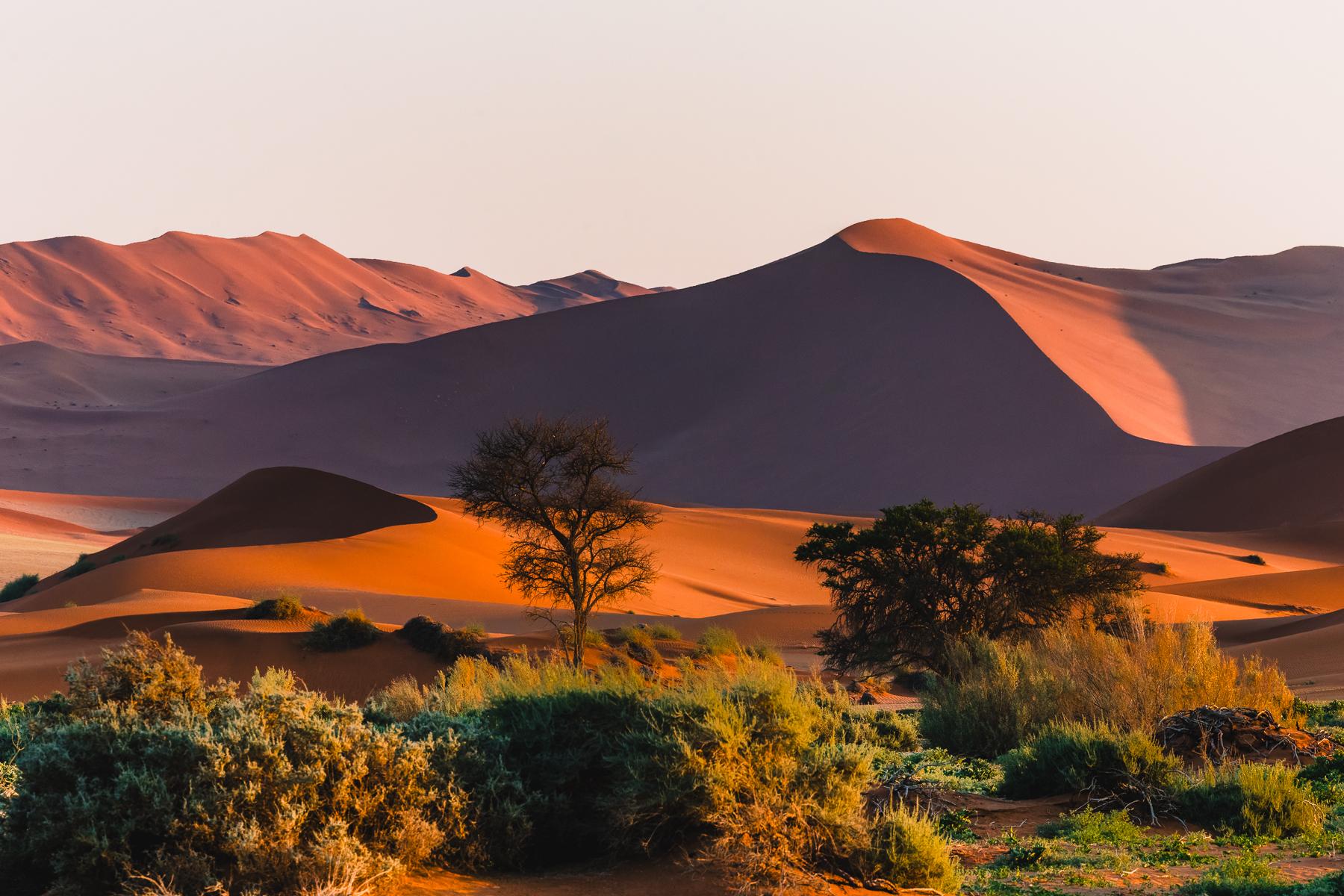
This year's Namibia tour group had a wonderful morning photographing the dunes of Sossusvlei, one-by-one, as the sun slowly rose and deepened the shadows, before it climbed high enough in the sky for contrast to decrease (image by Virginia Wilde)
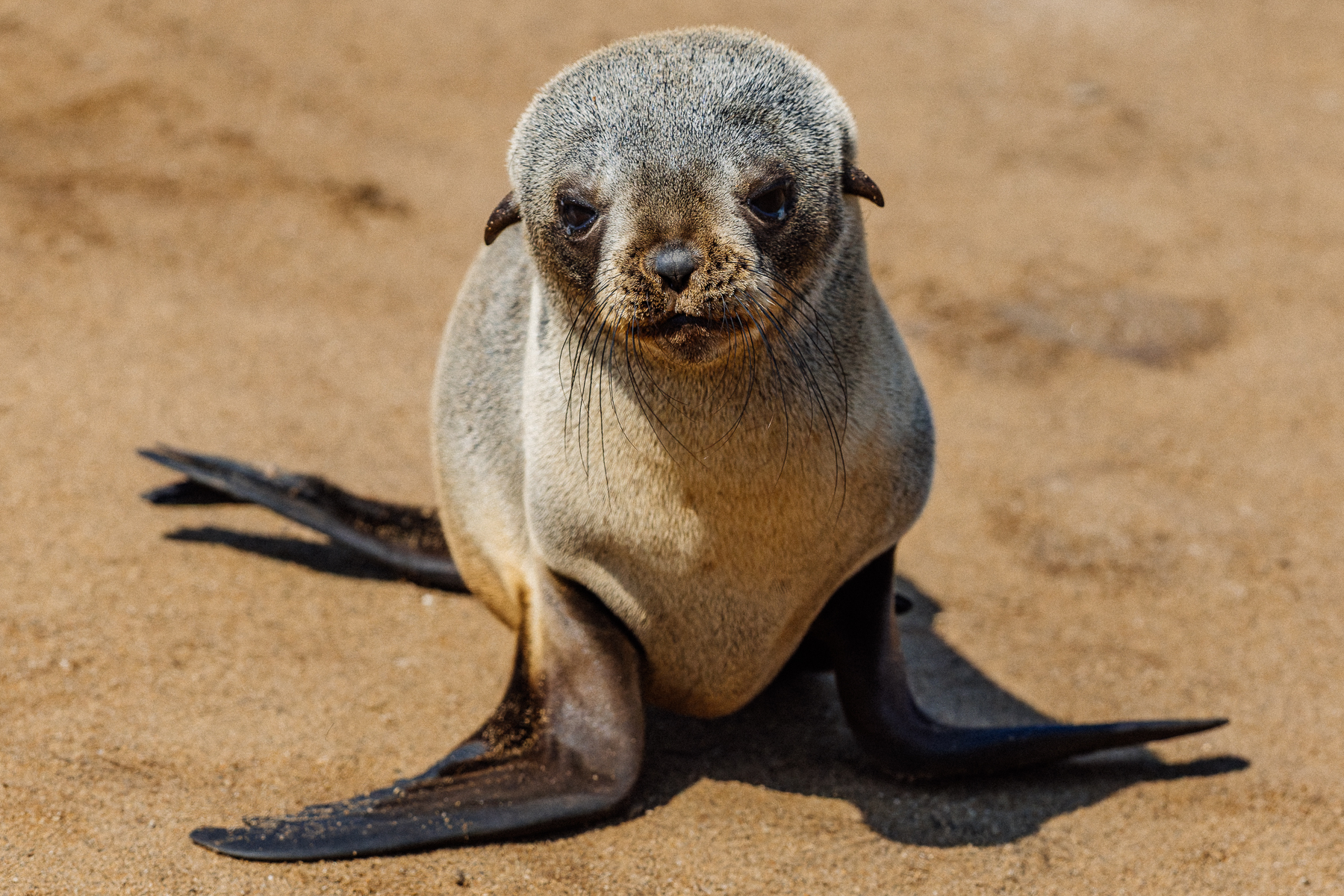
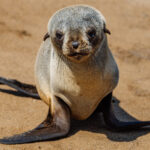
Juvenile Cape Fur Seals are adorable to watch - all enormous flippers, dark eyes and extravagant whiskers. At this age, they still have the awkward proportions of a pup - part marine predator, part ungainly bundle of fur and flippers (image by Virginia Wilde)
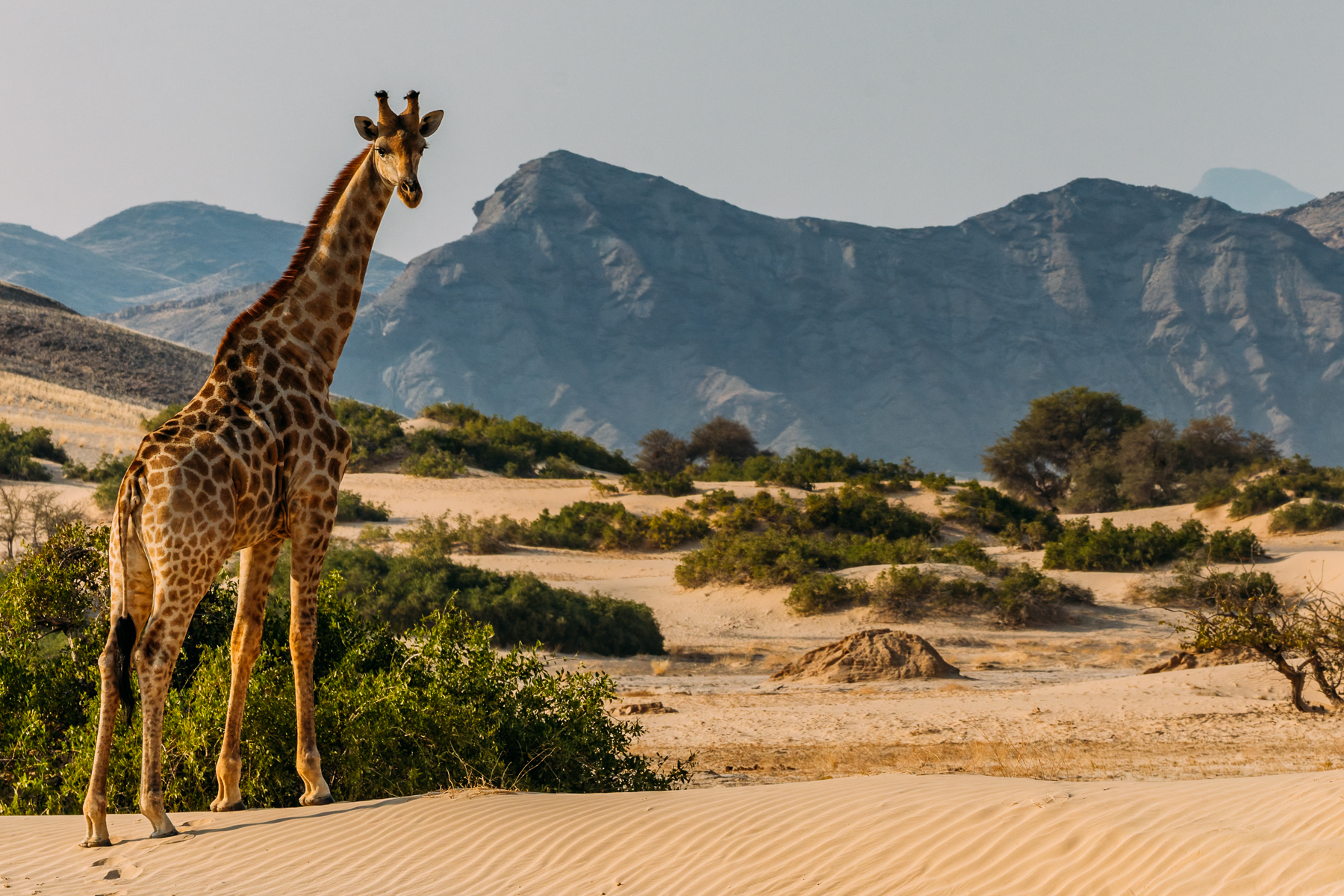
An Angolan Giraffe stands tall and elegant, backdropped by the rocky hills and escarpments of Namibia's Hoanib River Valley. These giraffes can survive in some of Namibia's driest habitats, feeding on thorny trees and shrubs and obtaining much of their water from food and dew (image by Virginia Wilde)
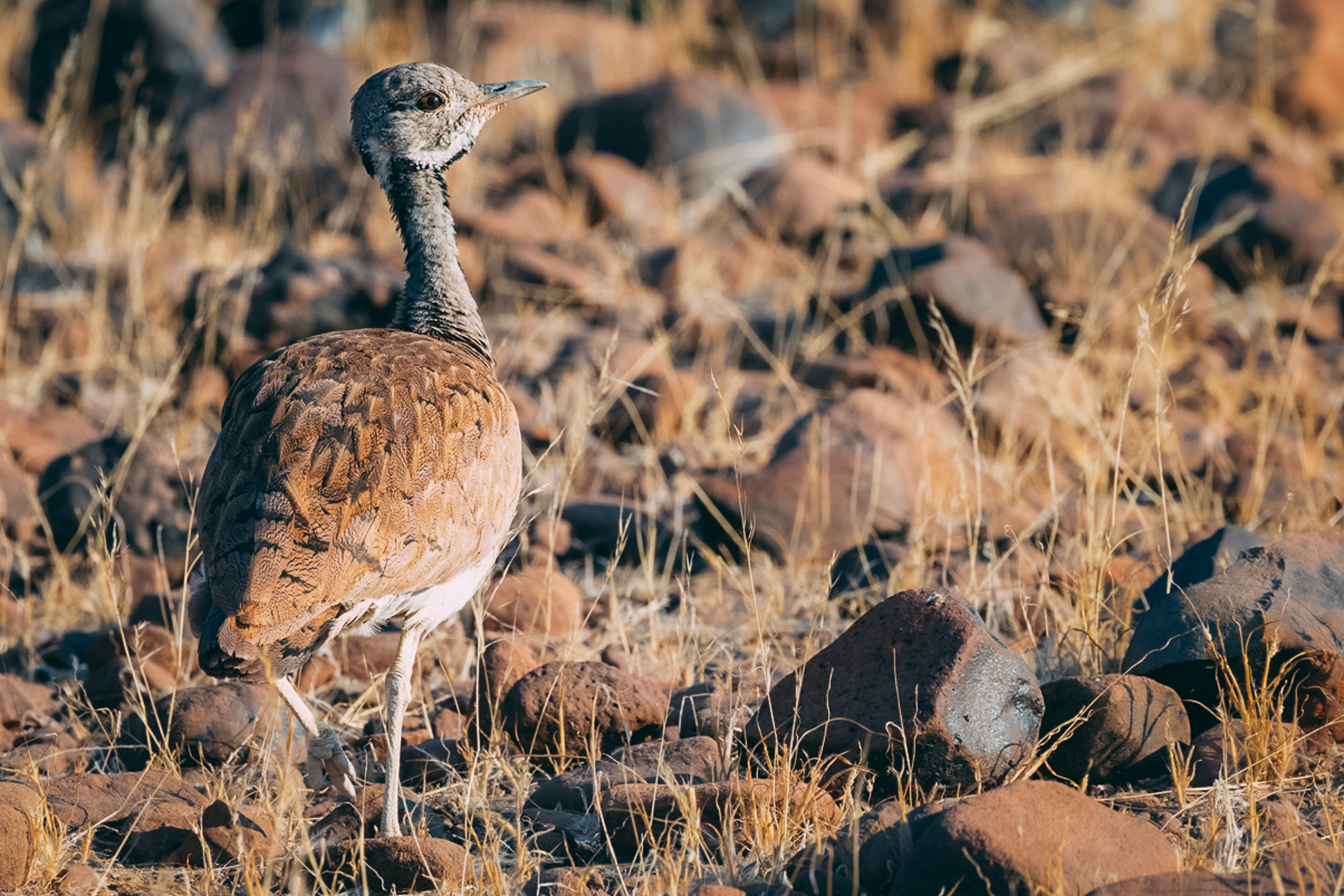
A male Rüppell’s Korhaan, one of the birds that thrives in Namibia's dry country, displays its intricately patterned plumage that echoes the rocks and grasses around it. Endemic to the arid landscapes of Namibia and southern Angola, it is usually encountered alone or in pairs across the desert plains (image by Mike Watson)
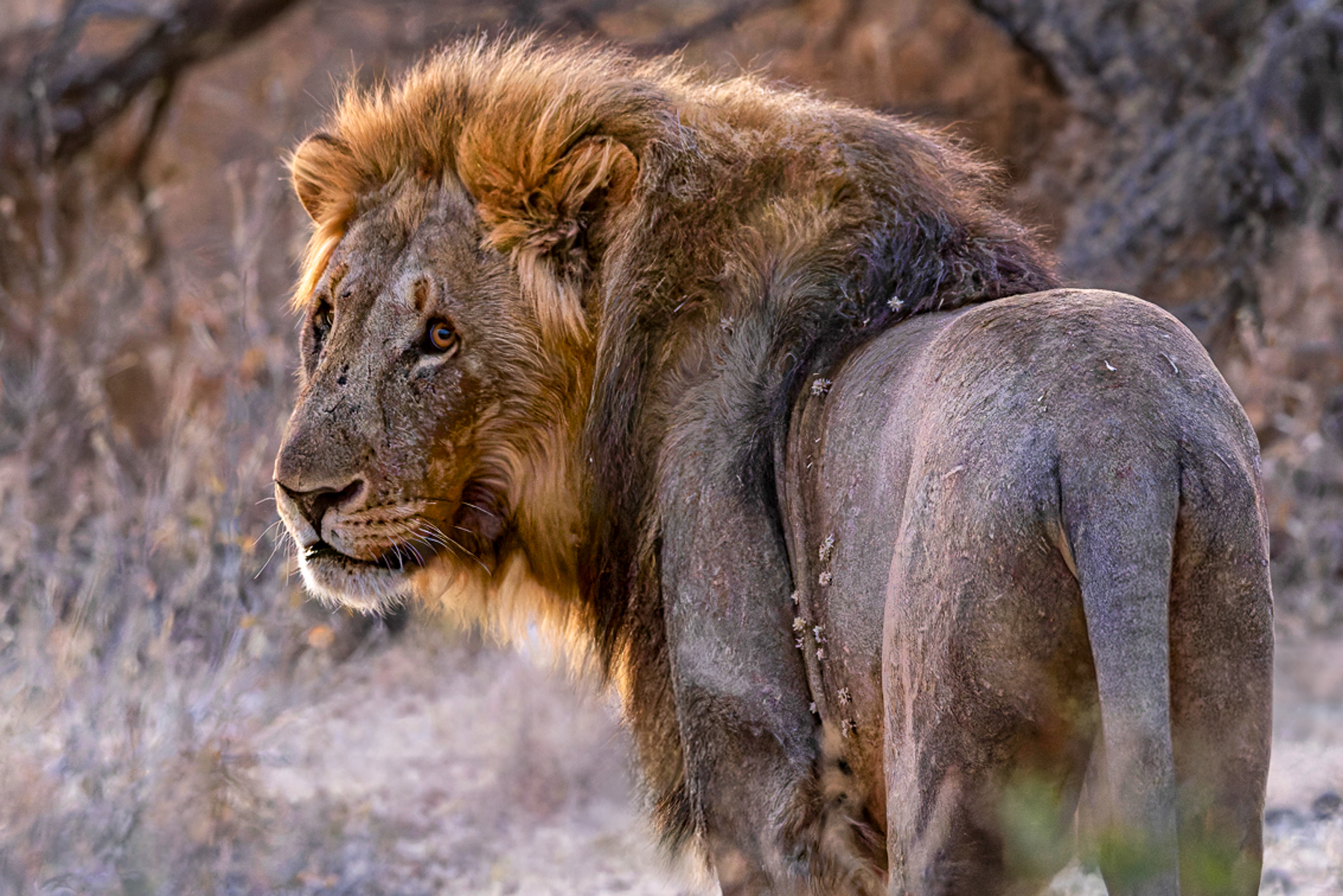
What thoughts and depths lie behind an African Lion's stare? Maybe the accumulated experience of a life: of territory won or lost, rivals faced, wounds survived and the constant demands of staying alive. The scars and battered coat hint at a life shaped by territorial battles (image by Mike Watson)
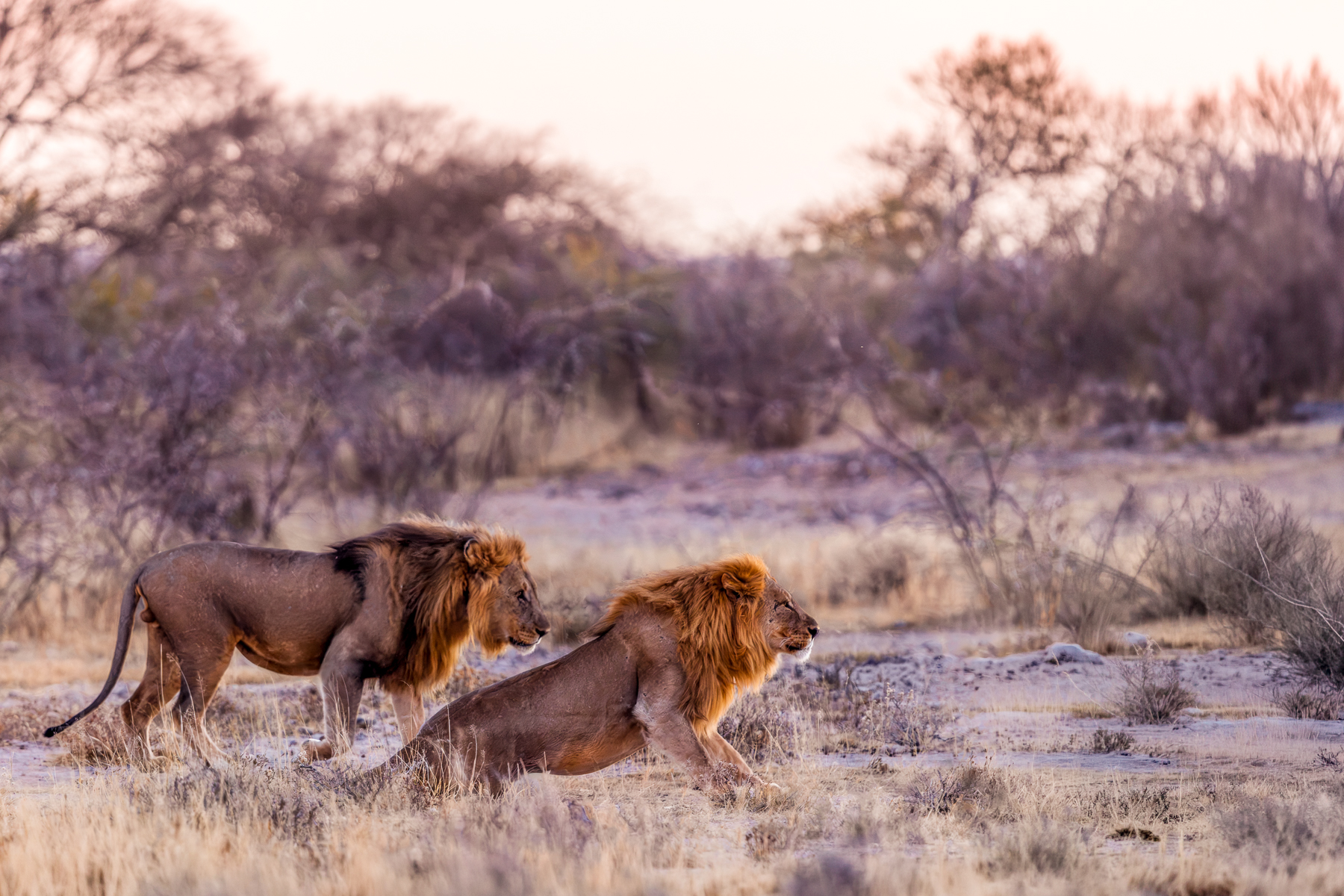
A pair of wandering African Lions - reputed to be brothers - stand out against the white sand and vegetation of the Onguma salt pan (image by Virginia Wilde)
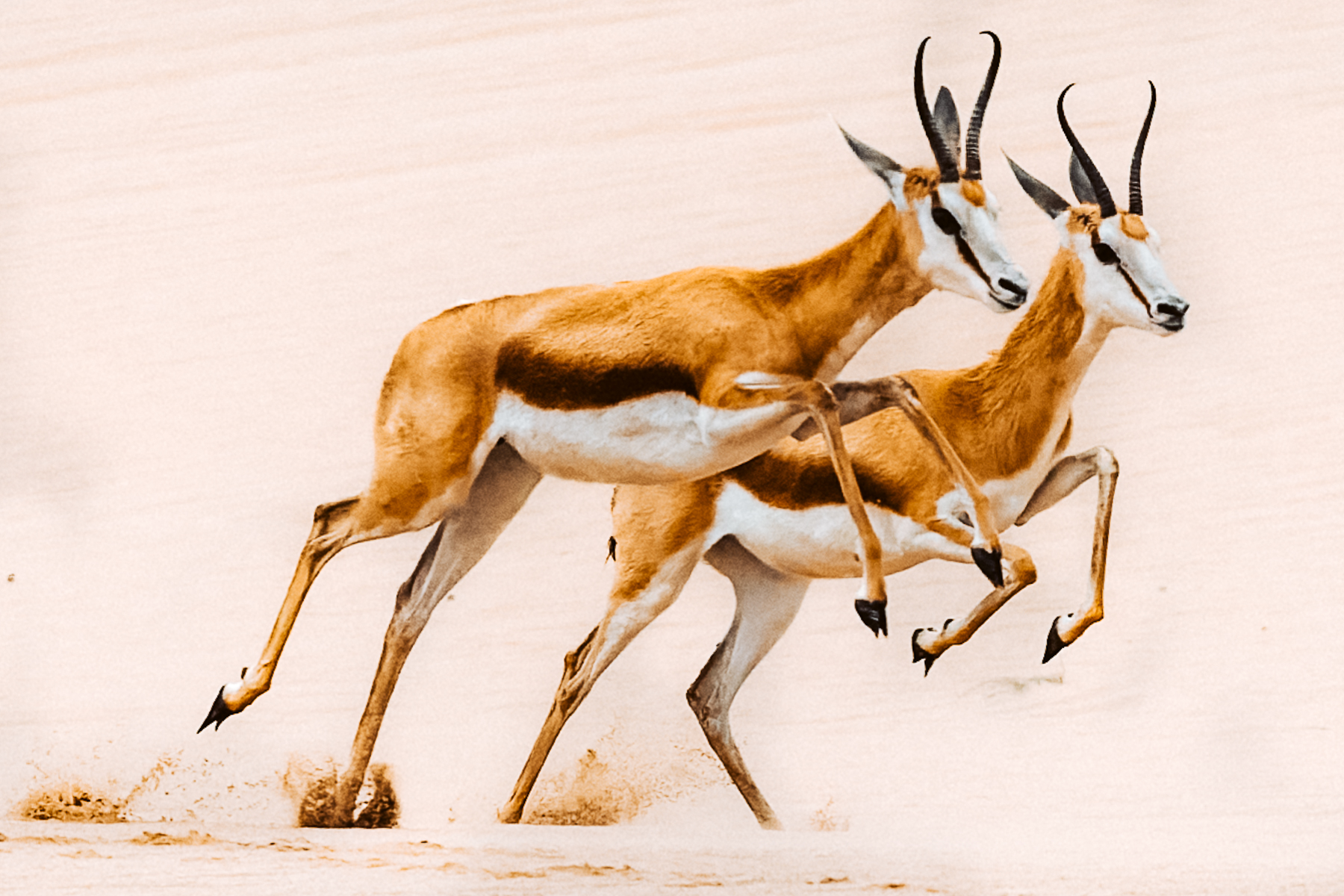
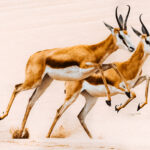
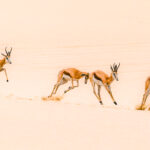
A pair of Springbok leap together, hooves raised, as they cross the Sandwich Harbour region of the sandy Namib-Naukluft National Park (image by Virginia Wilde)
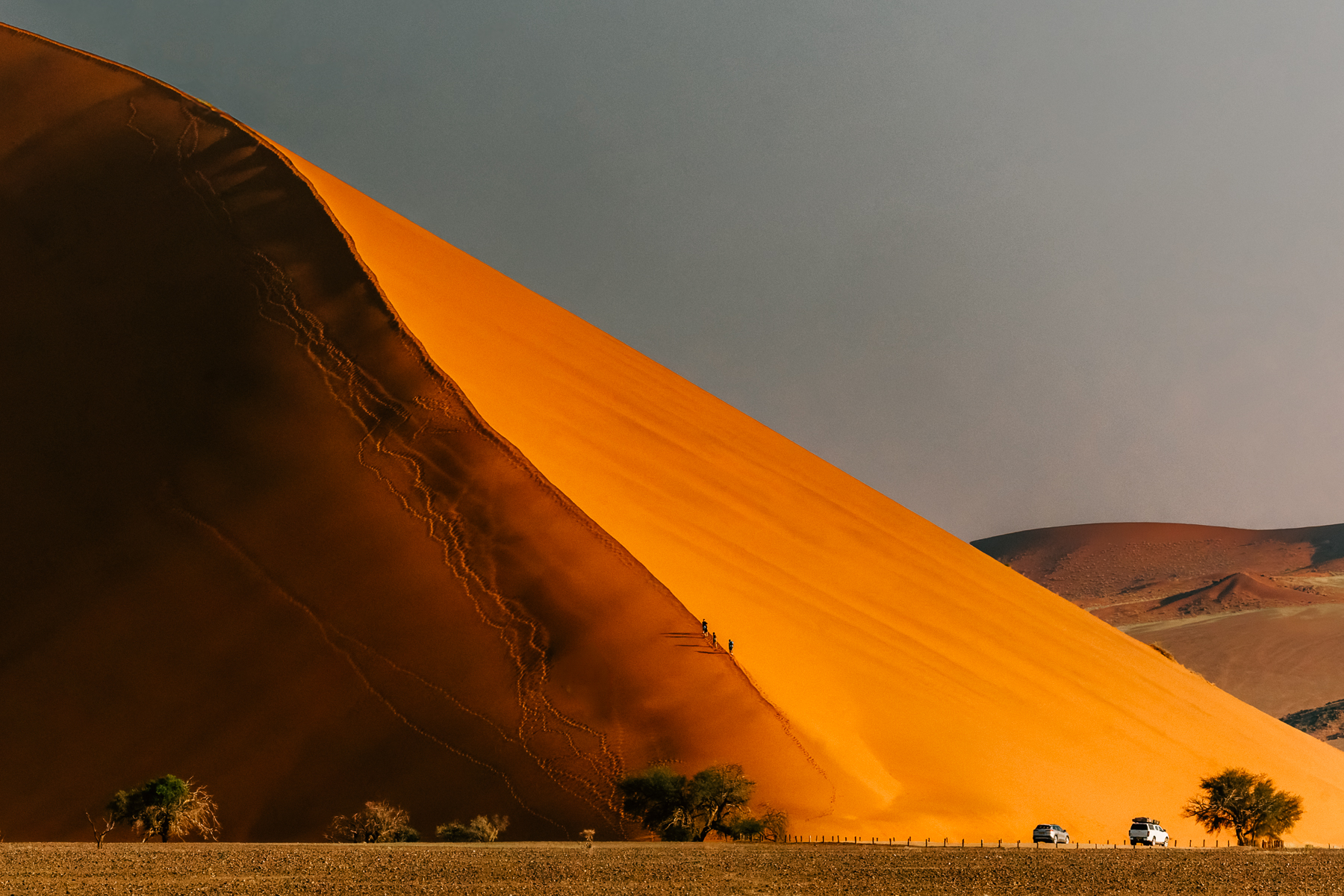
Three hikers are just visible - as small as tiny ants - as they start their climb of 'Big Daddy', the largest dune overlooking Deadvlei in the Sossusvlei area. At around 325 metres (1066ft) above the surrounding landscape, it is one of the most recognisable dunes in Namibia (image by Virginia Wilde)
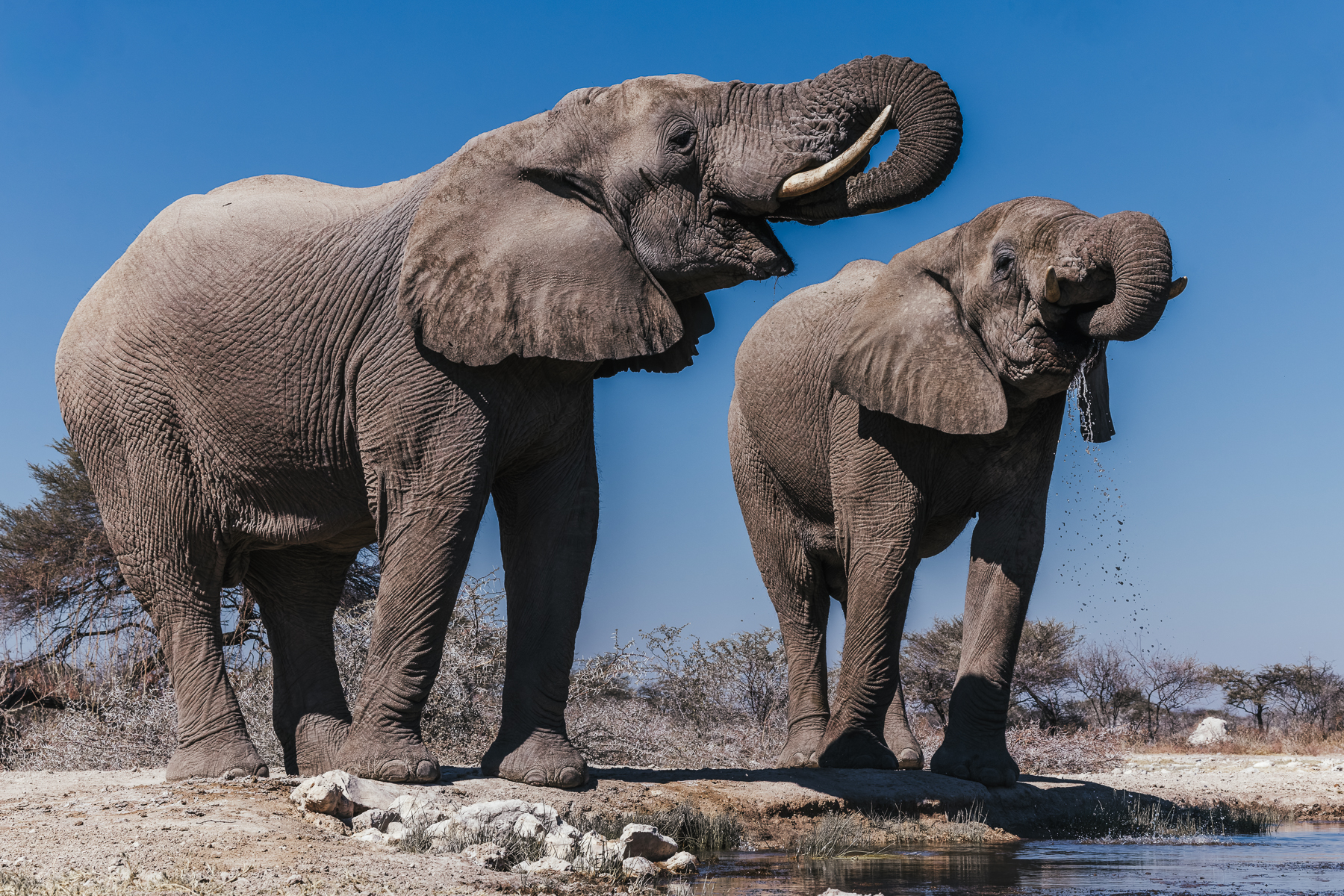
What's better than one African Savanna Elephant bull outside your waterhole hide? Two African Savanna Elephant bulls drinking outside your waterhole hide (image by Virginia Wilde)
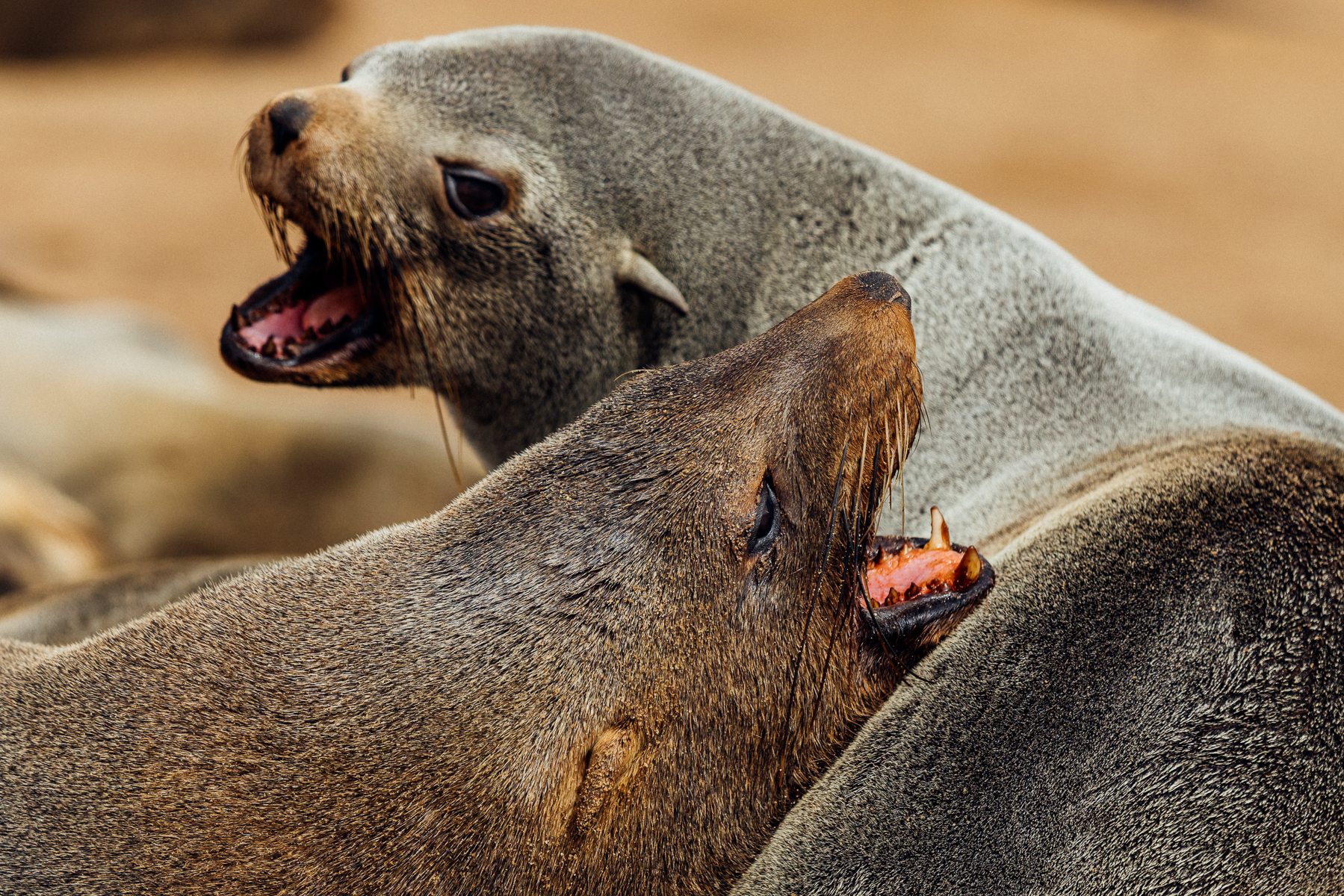
A pair of Cape Fur Seals briefly spar as they jostle for space in Namibia's Cape Cross Seal Colony. Cape seals are the largest fur seal species and are highly social, with Namibia's colonies among the most sprawling concentrations of these seals in the world (image by Virginia Wilde)
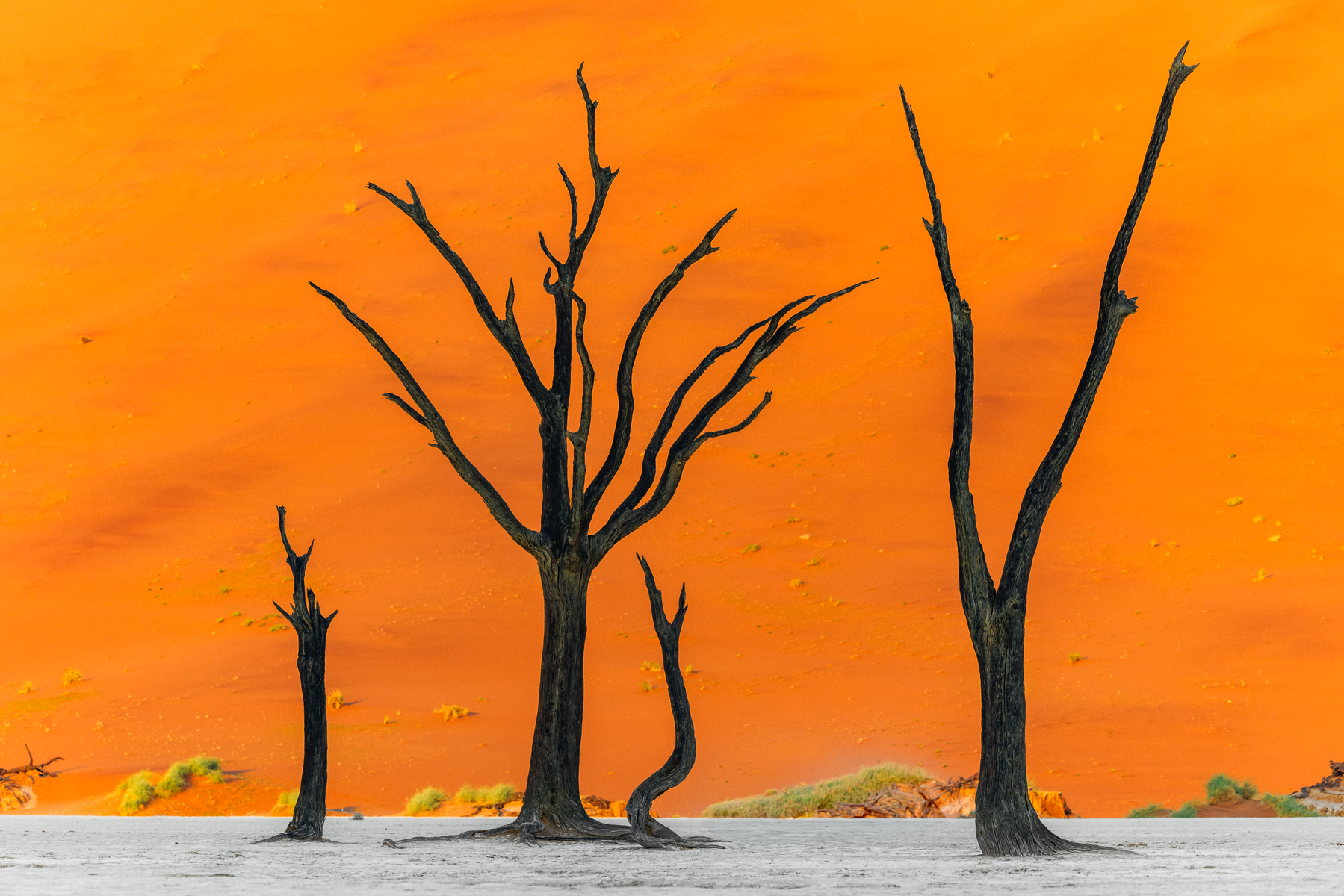
A cluster of long-dead Camel Thorn trees against the dunes in Namibia's iconic Deadvlei pan. Watching the sun rise here is one a landscape photographer's bucket list item (image by Virginia Wilde)
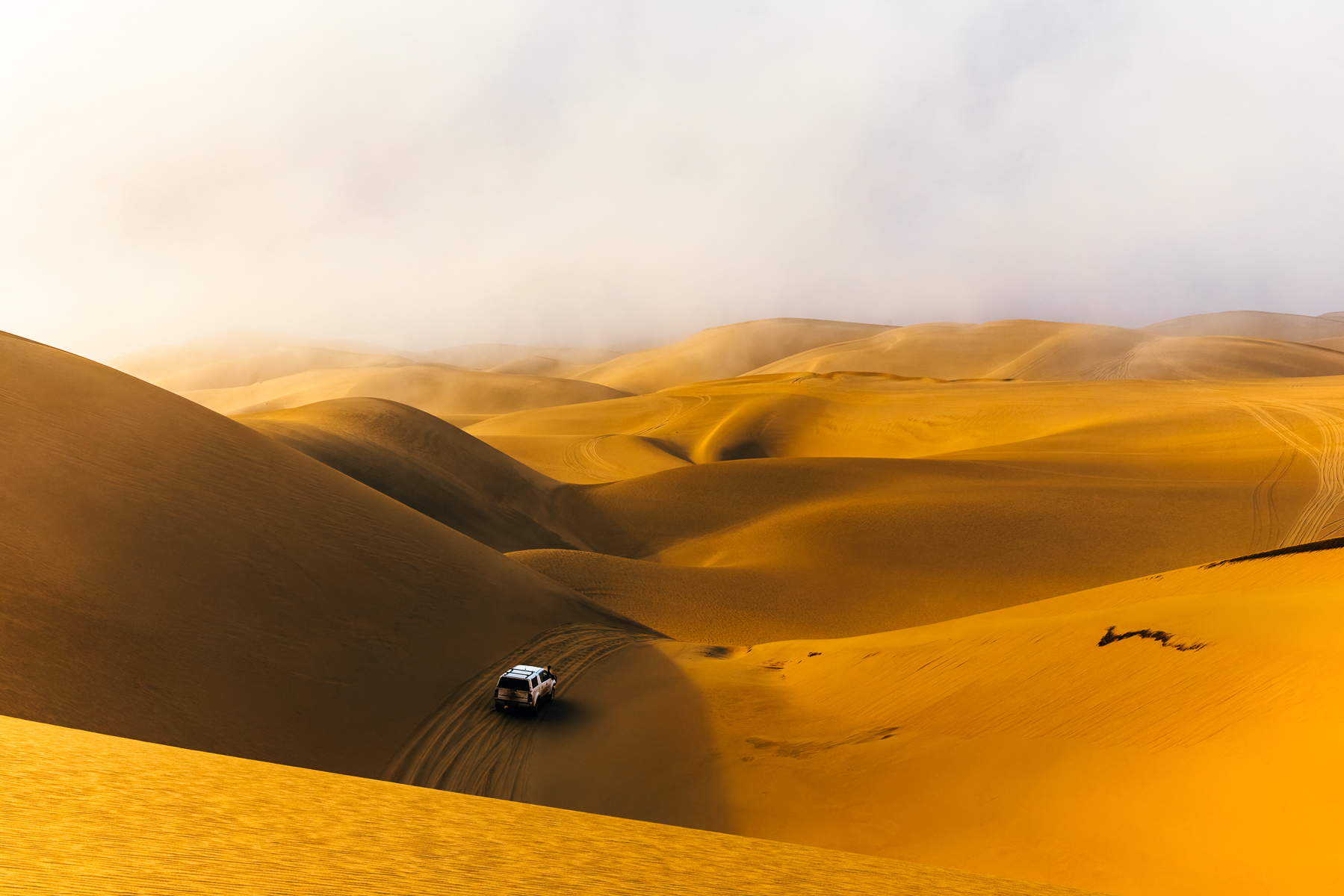
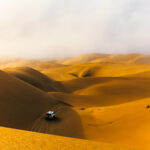
One of our 4x4 vehicles sweeps over dunes during an adventure drive day to Namibia's Sandwich Harbour, part of the Namib-Naukluft National Park. Some of the dunes rise to more than 100 metres in places, before running directly down towards the Atlantic Ocean (image by Virginia Wilde)
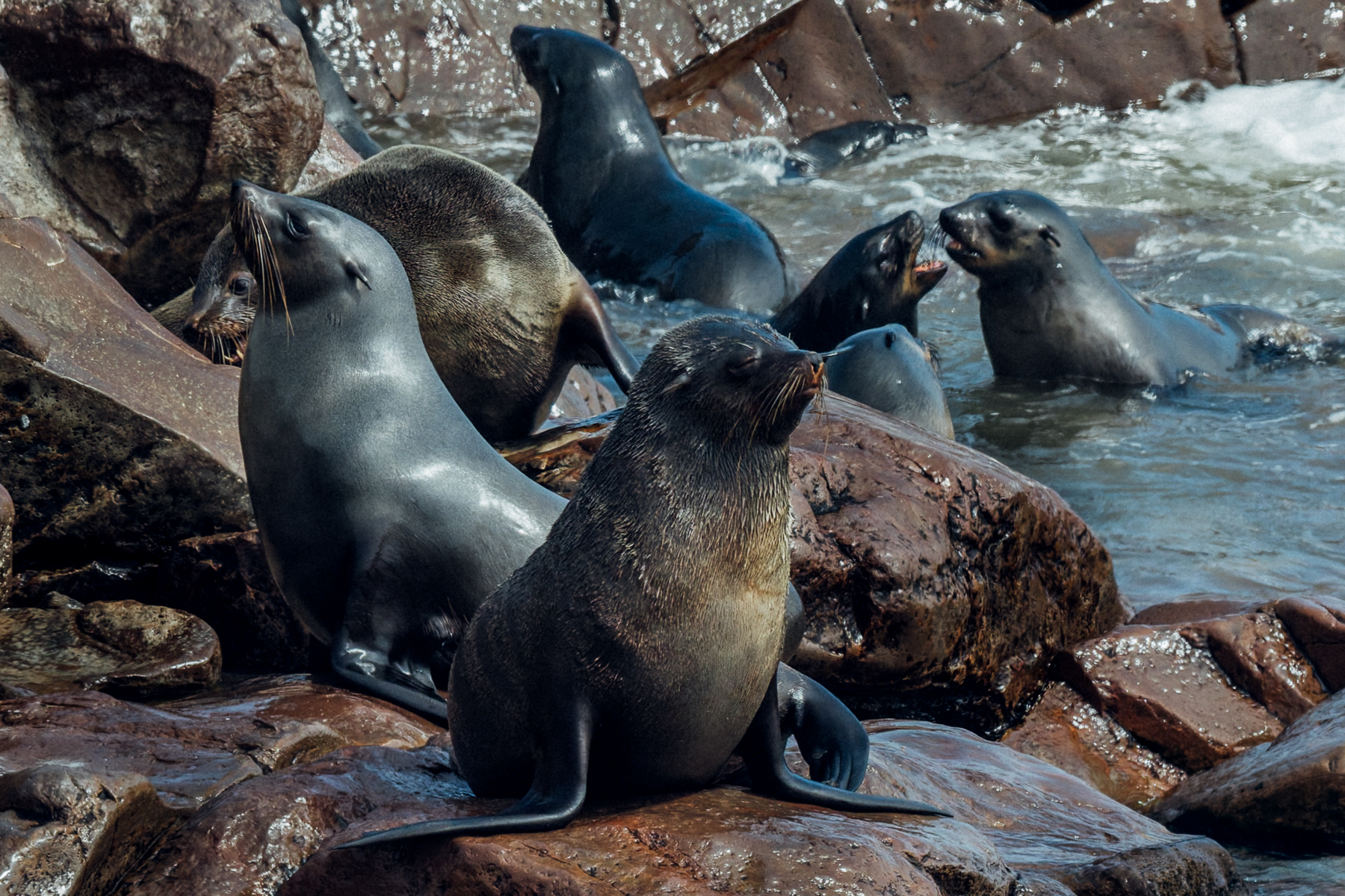
A small grouping of Cape Fur Seals rest on rocks at the edge of the Atlantic Ocean, part of the 100,000 estimated seals at the Cape Cross Cape Fur Seal Colony on Namibia's Skeleton Coast. There is a surprisingly high mortality of pups in this colony, with coastal scavengers such as Brown Hyena and Black-backed Jackals launching night-time raids on the young (image by Virginia Wilde)
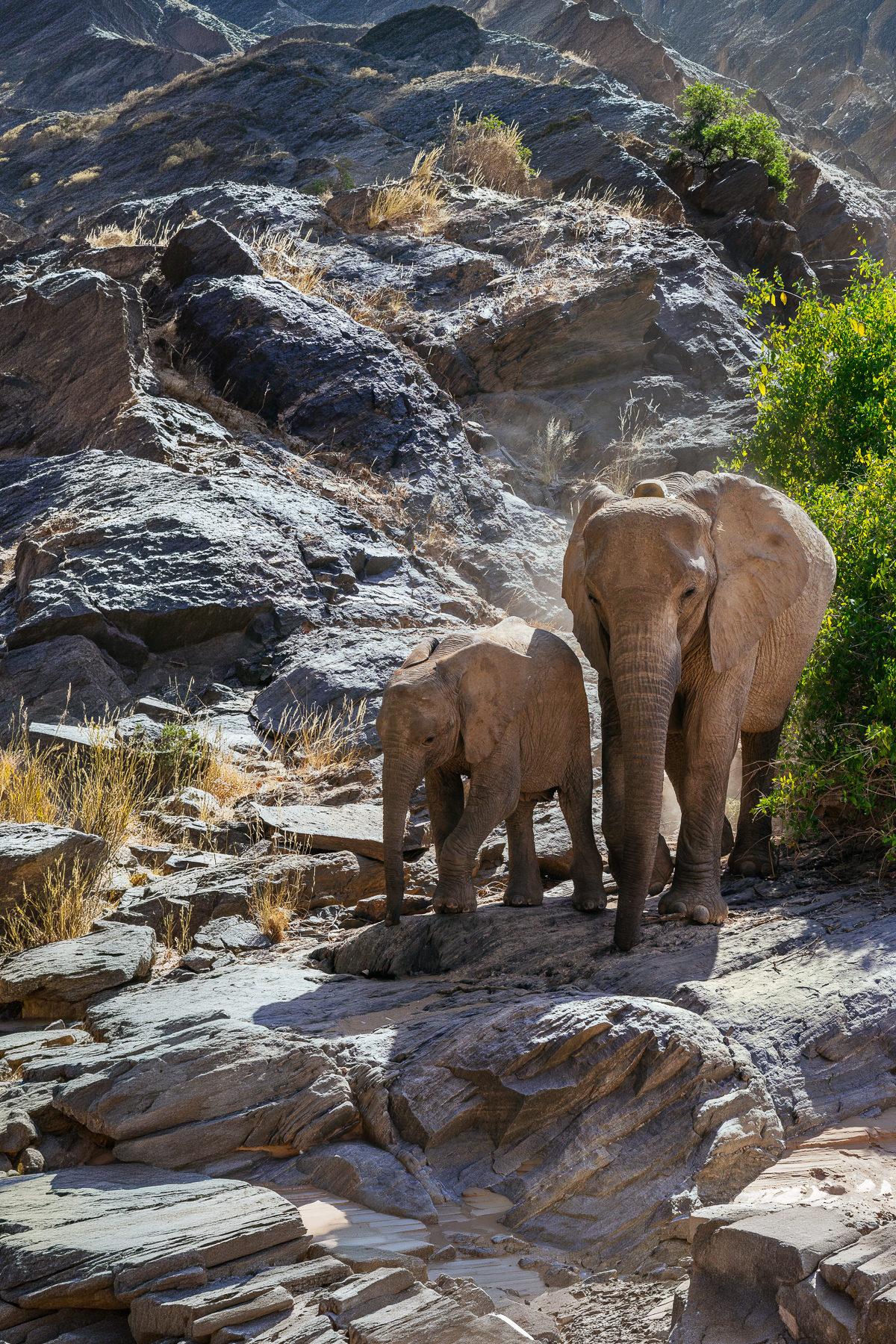
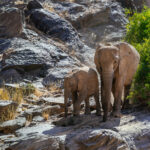
A pair of desert-adapted African Savanna Elephants navigate the rocky outcrops of the Hoanib River Valley in Namibia. The Hoanib is an ephemeral river - mostly dry on the surface but with water beneath the sand. These elephants use their trunks and feet to dig down until they reach groundwater (image by Virginia Wilde)
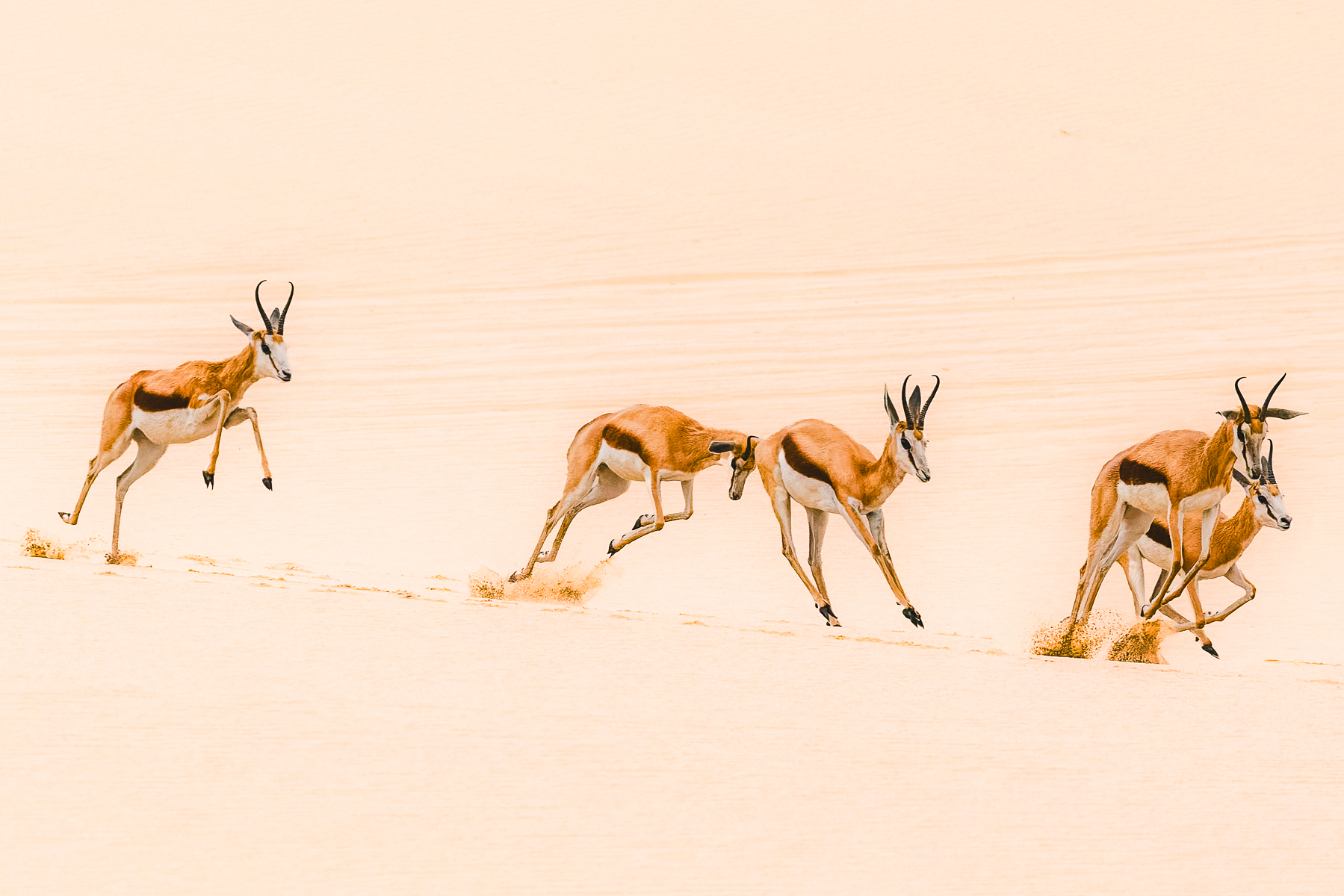
In the Namib-Naukluft National Park, a small herd of Springbok leap over the sand. Springbok can leap about 2 metres (6-7 feet) in the air during pronking behaviour (image by Virginia Wilde)
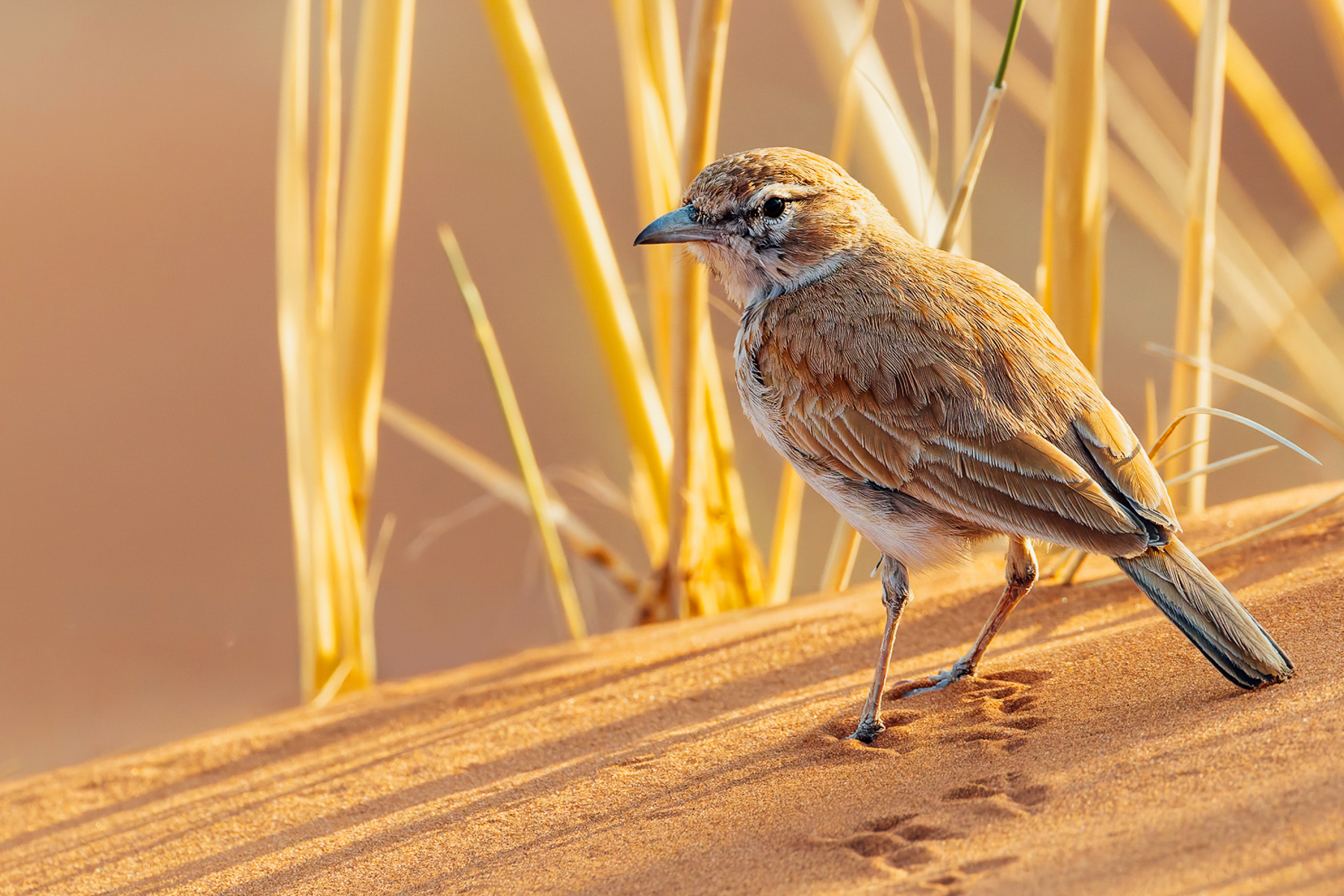
A Dune Lark - Namibia's only endemic bird - seen among the dunes in Sossusvlei. This lark lives in the hyper-arid Namib, making a living in one of the world's most inhospitable deserts (image by Mike Watson)
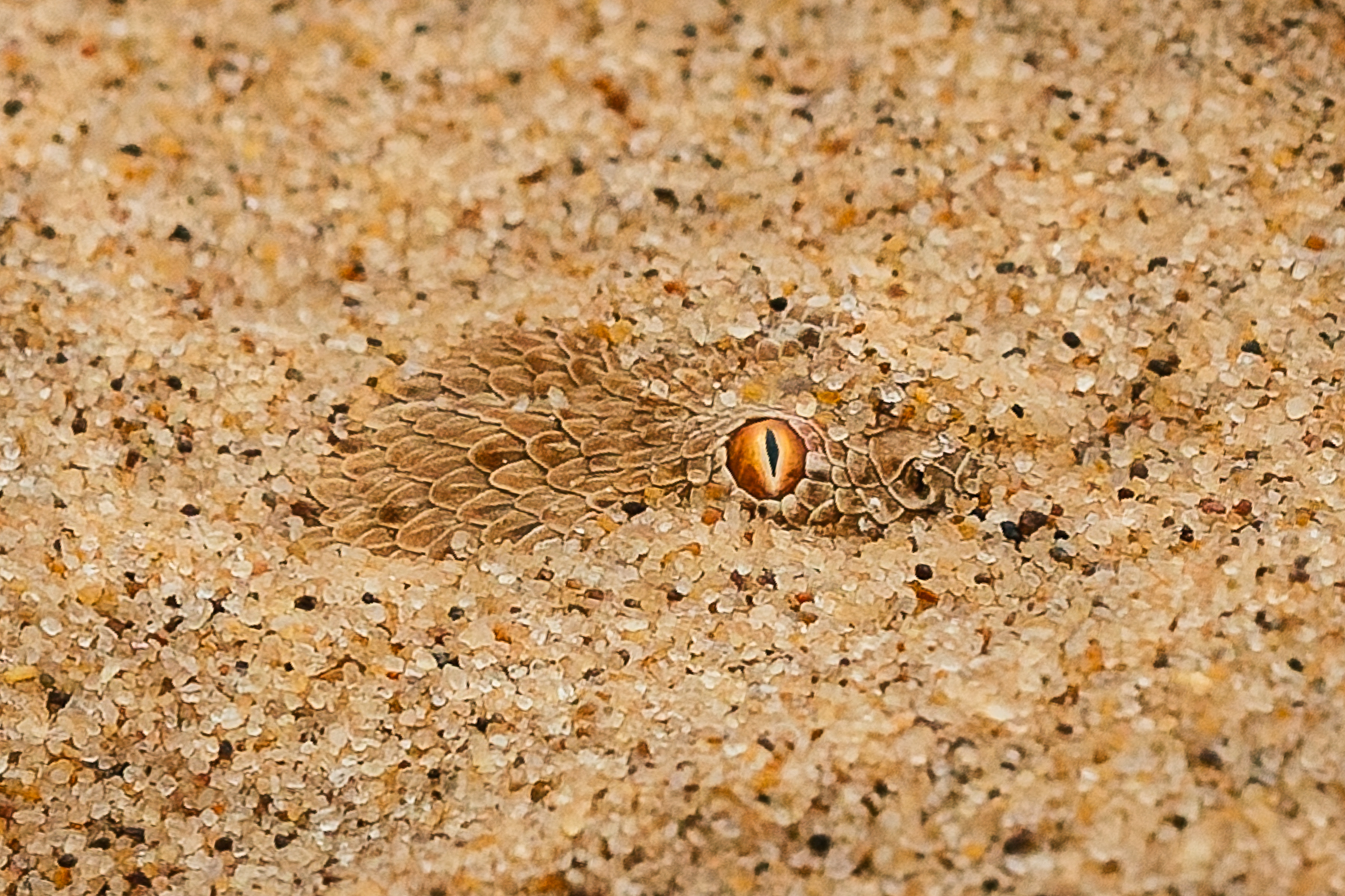
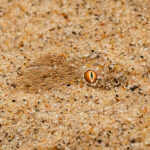
'Eye see you, snake in the sand!' Buried almost entirely beneath the Namib Desert's sand, a Peringuey's Adder leaves little more than its eyes exposed. This small venomous snake is an ambush predator, using its extraordinary camouflage to surprise passing prey (image by Virginia Wilde)
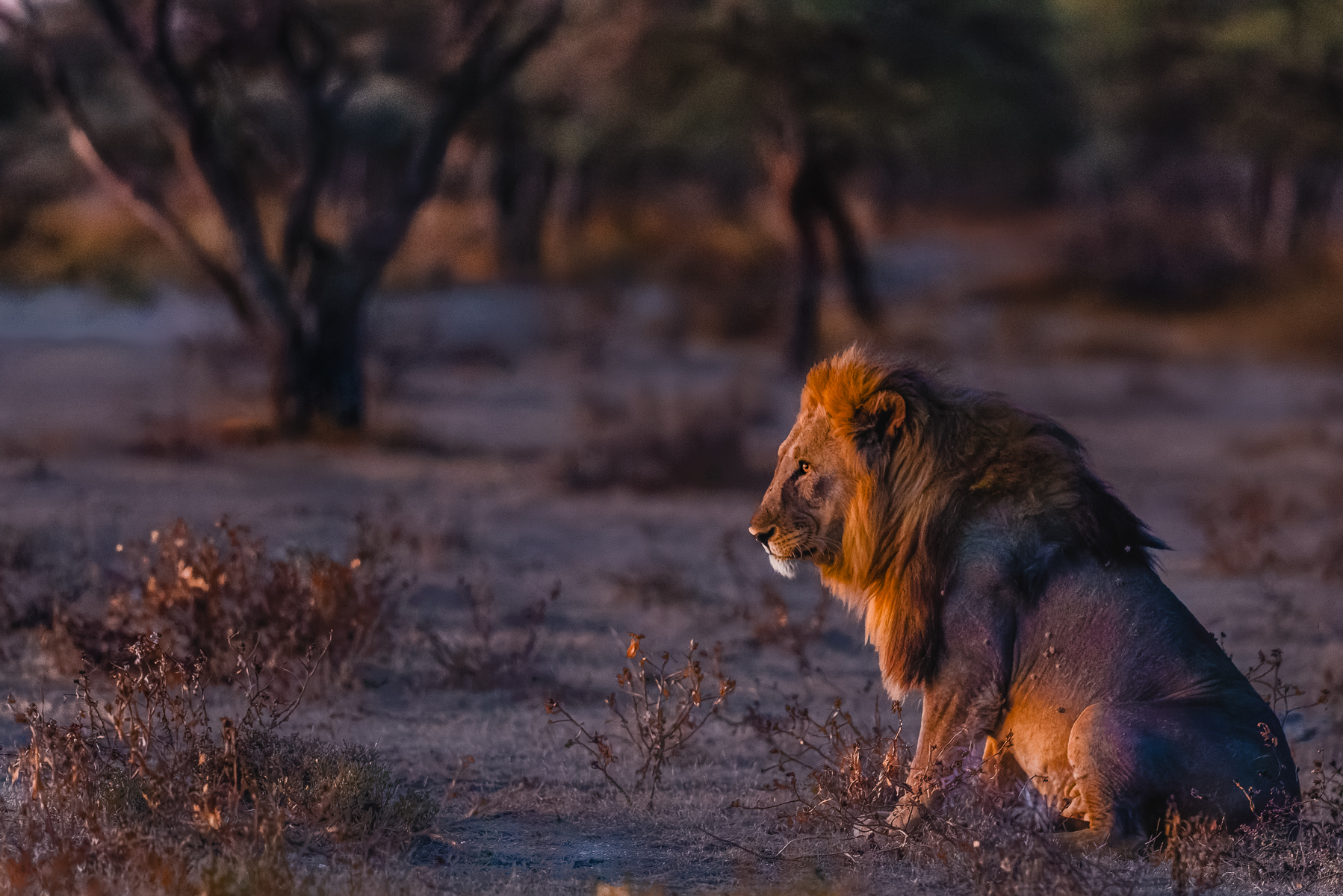
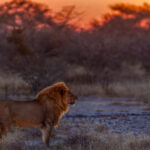
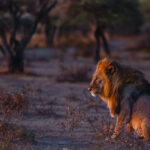
The last light of the day falls on the mane of this handsome male Lion in Namibia's Onguma Reserve. We watched two males slowly follow a lioness as they moved through trees in this arid region (image by Virginia Wilde)


A Black-faced Impala spreads its front limbs wide so it can drink from a waterhole in Namibia's Onguma Reserve. Life in Namibia is dictated by where wildlife can find much needed hydration in arid environments (image by Virginia Wilde)
A juvenile African Savanna Elephant hurls dust over itself at Etosha National Park's Okaukuejo waterhole, after enjoying a deep drink. In Etosha, elephants walk 20km a day between reliable water sources, but travel 50 km or more during times of drought (image by Virginia Wilde)
A juvenile desert-adapted African Savanna Elephant looks almost shy as it eats grass by the dried riverbank in Namibia's Hoanib River Valley. Young Elephants here have a steep learning curve if they are to survive in this harsh environment (image by Virginia Wilde)
A mother and juvenile Black Rhinoceros cautiously approach the water's edge at Etosha National Park's Okaukeujo waterhole. This park is famous as a stronghold for the South-western subspecies of Black Rhino, holding 85% of the world's population (image by Virginia Wilde)
A small herd of African Savanna Elephants gather to drink at one of the largest waterholes in Namibia's Onguma Reserve - a sprawling wildlife sanctuary bordering the vast Etosha National Park (image by Virginia Wilde)
A Lioness pads her way through vegetation on the Onguma salt pan, while 100 metres behind her, two Lion brothers follow. The most likely explanation is that she was coming into oestrus - with the pair following her for several days while competing for mating opportunities (image by Virginia Wilde)
The sunken hide in Onguma Reserve, Namibia, allows for beautiful encounters with animals like this magnificent male African Elephant. To see an animal this large, this close, was breathtaking (image by Virginia Wilde)
The Namib after rain is a desert transformed, with tiny shoots pushing through the rust-red sand beneath the great dunes of Sossusvlei (image by Virginia Wilde)
A herd of thirsty Blue Wildebeest walk towards the waterhole in Namibia's Onguma Reserve, stopping to drink before leaving as swiftly as they arrived (image by Virginia Wilde)
A wide-angle 'classic' view of the Sossusvlei dunes, but made all the more special thanks to the once-in-a-decade event where the ephemeral pans fill up with water, creating striking reflections. Here, the mirrored landscape doubles the sculptural forms of the Namib, bringing together the desert's renowned colour, light and geometry (image by Virginia Wilde)
One of my favourite wildlife encounters of our 2026 Namibia tour was watching this juvenile Black Rhino caper about at the Okaukeujo waterhole - and its mum's endeavours to protect her young: charging at any male rhino that came too close (image by Virginia Wilde)
Beautiful sunset light falls on an African Savanna Elephant bull as he drinks from the waterhole in Namibia's Onguma Reserve - sending water droplets spraying (image by Virginia Wilde)
We were overjoyed to find this small herd of Hartmann's Mountain Zebra as we drove towards Namibia's Hoanib River Valley. Namibia is a major stronghold of this zebra subspecies, with smaller populations extending into southwestern Angola. They are exceptionally well adapted to steep, rocky and arid mountain country, able to negotiate terrain that is difficult for many other large herbivores (image by Mike Watson)
Soft light falls on a pale of wandering African Lions in the faded coloured vegetation of the Onguma Reserve. Like the neighbouring Etosha National Park, Onguma has a large salt pan system, left by the ancient Lake Etosha (image by Virginia Wilde)
A Tractrac Chat soars upwards from the dunes of the Namib Desert, on the outskirts of the Namibian town of Swakopmund. Tractrac Chats are perfectly adapted to blend into their desert environment (image by Mike Watson)
A Martial Eagle grips tightly to a branch in Namibia's Etosha National Park. These raptors are Africa's largest eagle, capable of taking down prey many times its own size (image by Virginia Wilde)
We kept our distance from this desert-adapted Elephant bull in Namibia's Hoanib River Valley. As he sprayed dust all around him, we spotted his temporin secretion - a liquid from the temporal glands that the males secrete during musth: a natural periodic condition marked by a spike in testosterone and accompanied by restless and highly dominant behaviour (image by Virginia Wilde)
A Blacksmith Lapwing is mirrored almost perfectly in the still waters of a pool in Namibia's Onguma Reserve. Although commonly found, they are strikingly patterned and charismatic birds (image by Virginia Wilde)
First light warms a pair of juvenile Angolan Giraffe, making their coats pop against the shadowed bushes in Namibia's Etosha National Park (image by Virginia Wilde)
Dappled golden light from the setting sun makes the backdrop to this Southern Ostrich look as if it's on fire, in a portrait taken at Etango Ranch, Windhoek (image by Mike Watson)
The impressive red flank of Sossusvlei's 'Dune 40' rises above a surprisingly green winter plain in the Namib Desert. Although our tour visit - in July - is in the driest part of the year at Sossusvlei, the region experienced heavy rainfall in the summer season, with higher-than-average vegetation growth this year (image by Virginia Wilde)
A cluster of four young Greater Kudu gather to drink at the Onguma Reserve waterhole, barely metres away from the sunken hide that enabled us to see so many beautiful wildlife scenes close up (image by Virginia Wilde)
The wreck of the Zelia lies stranded on Namibia's Skeleton Coast, its rusting hull battered by the Atlantic surf. Hundreds of Cape cormorants have claimed the remains of the vessel as a perch, covering its masts and hull (image by Virginia Wilde)
One of the highlights of our time in the Onguma hide was watching this Hamerkop's incredible fishing technique. He tirelessly worked the shallows of the waterhole, flushing prey upwards by shuffling his feet to disturb the sediment before raking his bill along the mud (image by Virginia Wilde)
A mother and juvenile Black Rhinoceros spend time at the water's edge in Namibia's Etosha National Park. This pair were among eight Rhinos who assembled at the Okaukeujo waterhole - a real treat for those of us watching (image by Virginia Wilde)
Few wildlife experiences have been so fascinating for me as watching desert-adapted African Savanna Elephants dig down through a dry riverbed with their feet and trunks to find groundwater. Namibia is home to 150 true desert-adapted elephants, in five ephemeral river systems (image by Virginia Wilde)
Life in the Cape Fur Seal colony is a continual drama of skirmishes over the best resting spots. Living in such large numbers has survival benefits - but trade-offs in terms of noise and interrupted sleep! (image by Virginia Wilde)
A Common Scimitarbill rests briefly on a leaf, before continuing to dart so quickly around the bushes in Namibia's Etango Ranch - that all my other images were blurry! (image by Virginia Wilde)
A mother and calf Black Rhino drink from a waterhole in Namibia's Onguma Reserve. Namibia has around 35% of the world's remaining Black Rhinos, with the vast majority the South-western Black Rhino (image by Virginia Wilde)
Some of the incredible reptile and invertebrate life to be found in Namibia's deserts. From top left and clockwise - Wedge-snouted Skink; Western Rock Skink; Namib Sand Gecko; Dappled Namib Darkling Beetle (image by Mike Watson)
A tiny fish is caught mid-air between a Hamerkop's massive beak - testament to this wader's incredible hunting technique. Hamerkops' name means 'hammerhead' in Afrikaans - referring to its distinctive shaped head and bill (image by Virginia Wilde)
A pair of Angolan Giraffe drink from the waterhole at night, at Okaukuejo in Namibia's Etosha National Park. Angolan Giraffe (also known as the Namibian or Smokey Giraffe) have coat markings and patches that speckle all the way down to their hooves, unlike many other giraffe species whose markings stop at their knees (image by Virginia Wilde)
Smaller Mammals of Namibia, clockwise from top left: Angolan Slender Mongoose; Namaqua Rock Mouse; Cape Ground Squirrel and Black-backed Jackal (image by Virginia Wilde)
'Follow the Impala!' A Black-faced Impala appears to lead a mini procession of Zebra down to the waterhole in Namibia's Onguma Reserve (image by Virginia Wilde)
A beautiful Peringuey's Adder snakes through the sand in the Namib-Naukluft National Park. These stunning adders are endemic to the Namib Desert region, occurring only in coastal Namibia and southern Angola (image by Virginia Wilde)
One of a pair of African Lion brothers that we saw in Namibia's Onguma Reserve just as night began to fall - and both of them as handsome as any lion I've ever seen (image by Virginia Wilde)
A Black-faced Impala is mirrored as it drinks from the waterhole in Namibia's Onguma Reserve. Black-faced Impala are the largest and darkest-coated of all Impala subspecies (image by Virginia Wilde)
The view from Sossusvlei's 'Elim Dune', with the broad Tsauchab Valley and the mountains behind. The mountains mark the distant source of the ephemeral Tsauchab, which eventually disappears into the sands at Sossusvlei (image by Virginia Wilde)
Portrait of a Common Warthog in Namibia's Onguma Reserve. Our sunken hide allowed us to get wonderful close-ups of animals that normally would run away (image by Virginia Wilde)
A tower of sea spray erupts behind a Cape Fur Seal, who appears oblivious as he attends to the more important task of scratching his ear with a flipper (image by Mike Watson)
A Southern Rock Monitor lizard uses its tongue to sample the air for chemical information - vital for helping it detect prey, trails and potential mates. Taken in Namibia's Etosha National Park (image by Virginia Wilde)
Grooming is a hugely important part of Chacma Baboon society, helping to strengthen social bonds as well as keeping fur free of parasites and debris (image by Virginia Wilde)
A desert-adapted African Savanna Elephant calf careers down a rocky outcrop in Namibia's Hoanib River Valley. These incredibly smart animals have learned to survive in this arid and harsh desert environment (image by Virginia Wilde)
Charging Black Rhinos trade off against each other, as dust clouds billow around them. We watched this fiercely protective mother charge a male that had ventured too close to her calf, her protective instincts erupting in a sudden show of aggression (image by Virginia Wilde)
A Greater Kestrel starts to devour its rodent prey - having caught the surprisingly long mammal and carried it to a nearby tree, in Namibia's Etosha National Park (image by Virginia Wilde)
A female Southern Ostrich struts through a meadow at Namibia's Etango Ranch, with the setting sun turning the grass golden (image by Virginia Wilde)
Five Angolan Giraffe drink from the Okaukuejo waterhole in the Etosha National Park as night falls. Giraffes are remarkably well suited to Etosha's dry landscape because they can browse vegetation that is far above the reach of most other herbivores, allowing them to exploit food even when grass and low-level vegetation become scarce (image by Virginia Wilde)
The Sossusvlei dune known as 'Big Mama' rises 200 metres (656ft) over the pan, showing a sweeping dark shadow across its face. 'Big Mama' lies north of 'Big Daddy' in the Namib Sand Sea UNESCO site (image by Virginia Wilde)
Unlike the more familiar Burchell's Plains Zebra, Hartmann's Mountain Zebra spend much of their lives in rugged mountain country, navigating steep slopes, rocky escarpments and sparse vegetation. This group has the unmistakable air of a family on the move (image by Virginia Wilde)
A pair of juvenile African Savanna Elephants joust with their trunks, playing together in the Hoanib River Valley. The birth rate for these desert-adapted elephants is low due to the demanding environment (image by Virginia Wilde)
A striking pair of Gemsbok - with characteristic long speared horns - approach the Onguma waterhole to drink, leaving the slightly rattled-looking bunch of Helmeted Guineafowl unsure whether to hold their ground or make a swift sideways exit from their coveted waterside spot (image by Virginia Wilde)
First light falls on an ancient Camel Thorn tree in Namibia's Deadvlei. The trees here died roughly 600-700 years ago, when water from the Tsauchab River was cut off by sand dunes. They are not petrified trees, but remarkably well-preserved dead wood (image by Virginia Wilde)
A herd of Burchell's Plains Zebra drink from the Onguma waterhole, their stripes making for some MC Escher-like optical illusions - with their reflections creating patterns that were difficult to separate from the animals (image by Virginia Wilde)
'No noisy pups, I'm sleeping!' A Cape Fur Seal appears to bellow at a passing pup after being woken from its slumber in Namibia's Cape Cross Seal colony (image by Virginia Wilde)
Two Angolan Giraffe appear cast in yellow light - in an image taken directly into the setting sun. Namibia gave us so many sun-set wildlife moments, it was hard to pick just a few for this report (image by Virginia Wilde)
A deepening sunset turns the Okaukeujo waterhole orange in Namibia's Etosha National Park. A small herd of Burchell's Plains Zebra - distinctive with their faint brownish 'shadow stripe' on the hindquarters - gather to drink before night falls (image by Virginia Wilde)
'Mirror, mirror in the waterhole wall, Who is the fairest Angolan Giraffe of them all?' A juvenile Giraffe and its mum bend to drink in Namibia's Etosha National Park, creating some beautiful reflections (image by Virginia Wilde)
Some of the scenery during our road trip drives was stark and breathtaking. This view is just one of thousands we saw during our 2,000km trek (image by Virginia Wilde)
'Big Daddy', the highest dune at Sossusvlei, with its enormous, shadowed face contrasting with the orange ridges as they hit the morning light. The sand in Sossusvlei is so red in tone due to the iron oxide - essentially rust - coating the individual quartz sand grains. Older sand tends to be redder as it's had longer for the iron coating to develop (image by Virginia Wilde)
One of Deadvlei's great Camel Thorn trees towers above the ghostly remains of the forest around it, its weathered trunk rising high above the white clay pan. Around 600-700 years ago, these trees were cut off from the Tsauchab River and died, but the extreme aridity preserved their blackened remains (image by Mike Watson)
The setting sun turns the head of this African Elephant bull a fiery orange, as he approaches the waterhole, in Namibia's Onguma Reserve, for an evening drink. Namibia's sunsets - with colours scattered by desert dust and sand - were among some of the most spectacular I've ever seen (image by Virginia Wilde)
Sunset at Namibia's Okaukuejo waterhole can be a crowded affair. Here, Burchell's Plains Zebra jostle near Angolan Giraffe for some much-needed hydration in the salt pan of Etosha (image by Virginia Wilde)
Hey Yellow Mongoose, what wonderfully orange eyes you have! Yellow Mongoose are excellent diggers and unlike many mongooses, they are largely solitary - with adults typically living and foraging alone (image by Virginia Wilde)
Red-billed Spurfowls are common visitors to Namibia's waterholes with their loud repeated calls conspicuous in the early mornings and evening. Like other spurfowl, they have powerful legs and spurs, used in territorial disputes between males (image by Virginia Wilde)
A juvenile African Savanna Elephant lifts its trunk to its mum's body for comfort - in a tender moment in Namibia's Hoanib River Valley (image by Mike Watson)
A dazzle of Burchell's Plains Zebra are reflected in the still waters of the Onguma Reserve waterhole. Zebra were one of our most frequent wildlife visitors during our time in the exceptional Onguma hide (image by Virginia Wilde)
If a Cape Fur Seal could adopt a ponderous look, it would be this. It's a Pinniped version of Rodin's 'The Thinker' sculpture, if ever there was one (image by Virginia Wilde)
The last colours of sunset light up the mane of this wandering African Lion. Taken in Onguma Reserve, which borders Etosha National Park, Namibia (image by Virginia Wilde)
An animated-looking Gemsbok swishes her tail as she moves to take her turn at the Onguma waterhole - as a flock of Helmeted Guineafowl stroll past. Both sexes of Gemsbok have horns, although females' tend to be shorter and more slender (image by Virginia Wilde)
The sweeping sand dunes of the Namib Desert, on the outskirts of Swakopmund. When light hits these curves of sand, the colours can change from copper to burnt orange, depending on the interplay of light and shadow (image by Virginia Wilde)
A small herd of Greater Kudu drink from the waterhole in Namibia's Onguma Reserve, with the male displaying his breed's distinctive horns, famed for their corkscrew-like twists. These massive horns can reach up to 1.8 metres (6ft) long, if stretched straight out (image by Virginia Wilde)
Wide-angle view of Deadvlei, complete with cracked salt pan ground and a scattering of Camel Thorn trees (image by Mike Watson)
Portrait of a Southern Cordonbleu, resting by the waterhole in Namibia's Onguma Reserve. These waxbills are incredibly hard to photograph in flight due to sudden directional changes. So I finally had to settle on a portrait taken in a moment of calm (image by Virginia Wilde)
Seal drama is constant in Namibia's Cape Cross seal colony. Cape Fur Seals continuously square up in brief moments of social tension, before, out of nowhere these confrontations tend to defuse. Cape Fur Seals live in dense, noisy colonies where adults must continuously jostle for space, mates and access to the shore (image by Virginia Wilde)
A young herd of Greater Kudu cluster together at a waterhole in the Onguma Reserve, with their heads and bodies reflected back at them like a mirror (image by Virginia Wilde)
A swirl of dust surrounds a desert-adapted African Savanna Elephant bull in Namibia's Hoanib River Valley. An elephant hurling dust is more than a spectacle - it acts as sunscreen, insect repellent and skin protection in the harsh sun (image by Virginia Wilde)
This infant Chacma Baboon has a distinctly suspicious look in its eye, as it peers out from the safety of its mother's knees. Taken in Namibia's Hoanib River Valley (image by Virginia Wilde)
A trio of Gemsbok approach the waterhole in Onguma Reserve, Namibia, displaying their distinctive long spear-like horns. Gemsbok are the largest species of Oryx, found in southern African deserts like the Kalahari and Namib (image by Virginia Wilde)
Portrait of a Grey Go-Away bird in Namibia's Onguma Reserve. Grey Go-Away birds get their name from their loud, nasal call, which sounds remarkably like 'Go-away!'- a sound that can carry a long way across the bush (image by Virginia Wilde)
A small herd of Angolan Giraffes make their way towards a dry section of the Etosha Pan - a vast ancient lakebed that is 130km long and 55km wide. Namibia contains almost 90% of this beautiful subspecies (image by Virginia Wilde)
The Milky Way above a tree in Namibia's Onguma Reserve. We didn't have the perfect conditions for astrophotography this night, but we gave it a try anyway (image by Virginia Wilde)
Aww! A juvenile Cape Fur Seal sleeps amid a pile of other fur seals - in a position that could be viewed as either cosy, or somewhat squashed! (image by Virginia Wilde)
A juvenile desert-adapted African Savanna Elephant lies in shadow beneath an older troop-member, both sucking groundwater through their trunks from a hole they dug in the ground of the ephemeral Hoanib River (image by Virginia Wilde)
A handsome male Kudu pauses by the waterhole in Namibia's Onguma Reserve. Male Kudu can weigh up to 300kg - making them one of Africa's largest antelopes (image by Virginia Wilde)
Atlantic waves crash over just a few of the estimated 100,000 Cape Fur Seals that make up Namibia's Cape Cross Seal colony. Visiting the colony is an experience due to the awesome sound and smell of all these seals (image by Virginia Wilde)
A male Black-faced Impala suddenly takes fright as a large herd of Zebra approach the Onguma waterhole, creating splashes with his skittishness. Black-faced Impala are a subspecies of the Common Impala, larger and darker and with a range that is extremely restricted to north-western Namibia and south-western Angola (image by Virginia Wilde)
A Southern Kori Bustard waits patiently to drink at the waterhole by our Onguma Reserve hide. These bustards are one of the world's heaviest flying birds, with large males weighing more than 15kg. Yet they can still take to the air when necessary (image by Mike Watson)
'Scenes at the Waterhole.' Evening and night-time at Etosha waterholes area as awash with life as the day. Here, a herd of Burchell's Plains Zebra share the rocky banks with an Angolan Giraffe and a passing raptor (image by Virginia Wilde)
Hikers appear like tiny ants as they start to climb Dune 45, one of the most distinctive red sand dunes in the Sossusvlei area of Namibia's Namib-Naukluft National Park (image by Virginia Wilde)
A small herd of Blue Wildebeest approach the waterhole in Namibia's Onguma Reserve, mirrored by the reflection in the shallow pool (image by Virginia Wilde)
Black-and-white image of the thronging seals of Namibia's Cape Cross Fur Seal colony. As many as 100,000 Cape Fur Seals (image by Virginia Wilde)congregate on this unforgiving section of the Skeleton Coast, making for an overwhelming photographic experience (image by Virginia Wilde)
The Namaqua Chameleon is a decidedly unconventional chameleon that spends most of its life walking across the desert. It hunts largely on foot, taking beetles and grasshoppers with its long tongue and occasionally pursuing prey across the sand (image by Mike Watson)
The last rays of golden sun spread across an African Savanna Elephant bull, just before it drops below the horizon. African Savanna Elephants can live for up to 70 years in the wild, although few will reach this age, Some of the bulls here can be older than 50 years old, meaning they were alive when Namibia gained independence in 1990 (image by Virginia Wilde)
'This way, son, our patch is up here.' A Cape Fur Seal mother and her pup try to find their place among the 100,000 gathered seals in Namibia's Cape Cross Seal colony (image by Virginia Wilde)
Groundscraper Thrushes are found widely across Namibia, with its bold white eyebrow and throat markings making it particularly distinctive (image by Virginia Wilde)
For me, the Hoanib River Valley was my favourite Namibia location. Here, one of our vehicles enjoys the craggy, desolate landscape (image by Virginia Wilde)
A tender moment between a juvenile Angolan Giraffe and its mother in Namibia's Etosha National Park (image by Virginia Wilde)
Helmeted Guineafowl gather at the Onguma Reserve waterhole, looking like armoured chickens. These Guineafowl have an entertaining-looking bobbing gait due to the way their legs and body are built for life on the ground. Particularly in areas where water is concentrated, flocks can reach numbers of 100+ birds (image by Virginia Wilde)
A Hamerkop fishes at lightning speed, with its bill scooping up prey from the shallow waterhole in Namibia's Onguma Reserve (image by Virginia Wilde)
Dust swirls around the forehead of a desert-adapted Elephant bull, with the cloud enveloping his ear and head. The latest survey found only 28 desert-dwelling elephants in the Hoanib River Valley - the biggest troop of just 150 total desert-dwelling elephants, spread across five ephemeral rivers in Namibia (image by Virginia Wilde)
A tower of Angolan Giraffe briefly rest as they trek across the salt pan of Namibia's Etosha National Park. The pan itself covers about 25% of the 22,270-square-km park, and is notable for its silvery-white colour that is visible from space (image by Virginia Wilde)
A young Burchell's Zebra foal stays close to its mother as they drink from the waterhole in Namibia's Onguma Reserve. These foals are born with brownish rather than black stripes, which darken as it matures, The mum recognises her young through its individual stripe pattern, smell and call (image by Virginia Wilde)
Four Burchell's Zebra stand alert on a rocky rise above a waterhole in Namibia's Onguma Reserve, the bold strips standing out against the deep blue sky (image by Virginia Wilde)
There are few things more compelling than watching two young Elephants lark about and play. With trunks that take years to learn how to use, this pair wielded theirs like toy swords before collapsing next to each other in a tender moment (image by Virginia Wilde)
The brilliant blue-green plumage of a Cape Starling is structural rather than simply pigmented. Microscopic structures in the feathers scatter light to create its intense metallic sheen (image by Virginia Wilde)
Namibia never fails to deliver incredible colours and light. We watched these three Angolan Giraffe drink from the Okaukeujo waterhole as the twilight hour produced some incredibly deep purple and pink skies (image by Virginia Wilde)
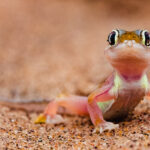
The striking pink colouration - and semi-transparent skin - of a Namib Sand Gecko. This desert specialist has fully webbed feet that allow it to 'swim' across loose desert sand and burrow into dunes (image by Virginia Wilde)
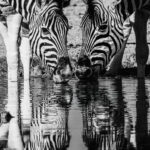
The black-and-white stripes of these Burchell's Zebra create a pattern of lines and reflections, blurring the boundary between animal and landscape (image by Virginia Wilde)
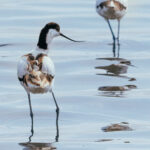
A pair of Pied Avocets wade through the shallow harbour waters of Namibia's Walvis Bay Lagoon. The lagoon sits right on the edge of the Namib Desert, with the Atlantic and dunes around it (image by Virginia Wilde)
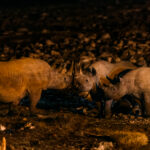
Three Black Rhinos gather by the Okaukuejo waterhole at night, their horns touching as they pause together in an interaction that appears as if they are old friends. Black Rhinos are generally solitary, so seeing several individuals approach each other peacefully makes for a rare encounter (image by Virginia Wilde)
A Double-banded Sandgrouse struts across the salt pan in Namibia's Etosha National Park. Male sandgrouse wets his belly feathers at a waterhole before flying back to the nest where the chicks drink directly from his plumage (image by Mike Watson)
A Black Rhino stands upright and alert during a night-time visit to Namibia's Okaukuejo waterhole. Black Rhinos (and the Namibian south-western subspecies) are critically endangered and usually solitary, except when females are accompanied by calves (image by Virginia Wilde)
'It's all going to be okay, you know.' Zebras are highly social animals and close physical contact helps to reinforce the bonds between individuals. In the harsh Namibian landscape, this small display of affection makes for a particularly lovely glimpse of their world (image by Virginia Wilde)
The sculpted ridges of the Sossusvlei dunes reveal the constant influence of wind, which has shaped this vast sea of sand over thousands of years. Against the dunes, a lone healthy Camel Thorn tree adds a sense of scale to one of Namibia's most iconic landscapes (image by Virginia Wilde)
Ripples and folds in the sand - when combined with dawn or evening light - reveal the constantly shifting textures of the Namib Desert. The simplicity of these desert scenes make the landscape feel almost abstract (image by Virginia Wilde)
Sossusvlei's iconic curving dunes reflected in a rare pool of water. The main Sossusvlei pan only fills when the Tsauchab River gets enough water from heavy rainfall to make it all the way through the desert to the pan - which only happens around once a decade. When flooding does happen, the pan becomes a shallow lake, reflecting the dunes (image by Virginia Wilde)
These reflective pools only develop by the Sossusvlei dunes about once every decade - brought on by heavy rainfall into the Tsauchab River. So we were incredibly lucky to have these wonderful conditions during our tour (image by Virginia Wilde)
'But please can I go off to play?!' A Cape Fur Seal pup appears to implore with a seal we believed to be its mum. But Namibia's great Cape Cross colony is so sprawling with seals it's almost impossible to work out whose pup belongs to who (image by Virginia Wilde)
A large herd of African Savanna Elephants enjoy the cool waters of the Klein Namutoni waterhole in Namibia's Etosha National Park (image by Virginia Wilde)
A desert-adapted Angolan Giraffe wanders by the remains of a twisted tree, in Namibia's Hoanib River Valley. Angolan Giraffe here live in an exceptionally arid environment of dry riverbeds, gravel plains and dunes. Research in this region found giraffes meet much of their water requirement from vegetation and dew (image by Virginia Wilde)
This year's Namibia tour group had a wonderful morning photographing the dunes of Sossusvlei, one-by-one, as the sun slowly rose and deepened the shadows, before it climbed high enough in the sky for contrast to decrease (image by Virginia Wilde)
Juvenile Cape Fur Seals are adorable to watch - all enormous flippers, dark eyes and extravagant whiskers. At this age, they still have the awkward proportions of a pup - part marine predator, part ungainly bundle of fur and flippers (image by Virginia Wilde)
An Angolan Giraffe stands tall and elegant, backdropped by the rocky hills and escarpments of Namibia's Hoanib River Valley. These giraffes can survive in some of Namibia's driest habitats, feeding on thorny trees and shrubs and obtaining much of their water from food and dew (image by Virginia Wilde)
A male Rüppell’s Korhaan, one of the birds that thrives in Namibia's dry country, displays its intricately patterned plumage that echoes the rocks and grasses around it. Endemic to the arid landscapes of Namibia and southern Angola, it is usually encountered alone or in pairs across the desert plains (image by Mike Watson)
What thoughts and depths lie behind an African Lion's stare? Maybe the accumulated experience of a life: of territory won or lost, rivals faced, wounds survived and the constant demands of staying alive. The scars and battered coat hint at a life shaped by territorial battles (image by Mike Watson)
A pair of wandering African Lions - reputed to be brothers - stand out against the white sand and vegetation of the Onguma salt pan (image by Virginia Wilde)
A pair of Springbok leap together, hooves raised, as they cross the Sandwich Harbour region of the sandy Namib-Naukluft National Park (image by Virginia Wilde)
Three hikers are just visible - as small as tiny ants - as they start their climb of 'Big Daddy', the largest dune overlooking Deadvlei in the Sossusvlei area. At around 325 metres (1066ft) above the surrounding landscape, it is one of the most recognisable dunes in Namibia (image by Virginia Wilde)
What's better than one African Savanna Elephant bull outside your waterhole hide? Two African Savanna Elephant bulls drinking outside your waterhole hide (image by Virginia Wilde)
A pair of Cape Fur Seals briefly spar as they jostle for space in Namibia's Cape Cross Seal Colony. Cape seals are the largest fur seal species and are highly social, with Namibia's colonies among the most sprawling concentrations of these seals in the world (image by Virginia Wilde)
A cluster of long-dead Camel Thorn trees against the dunes in Namibia's iconic Deadvlei pan. Watching the sun rise here is one a landscape photographer's bucket list item (image by Virginia Wilde)
One of our 4x4 vehicles sweeps over dunes during an adventure drive day to Namibia's Sandwich Harbour, part of the Namib-Naukluft National Park. Some of the dunes rise to more than 100 metres in places, before running directly down towards the Atlantic Ocean (image by Virginia Wilde)
A small grouping of Cape Fur Seals rest on rocks at the edge of the Atlantic Ocean, part of the 100,000 estimated seals at the Cape Cross Cape Fur Seal Colony on Namibia's Skeleton Coast. There is a surprisingly high mortality of pups in this colony, with coastal scavengers such as Brown Hyena and Black-backed Jackals launching night-time raids on the young (image by Virginia Wilde)
A pair of desert-adapted African Savanna Elephants navigate the rocky outcrops of the Hoanib River Valley in Namibia. The Hoanib is an ephemeral river - mostly dry on the surface but with water beneath the sand. These elephants use their trunks and feet to dig down until they reach groundwater (image by Virginia Wilde)
In the Namib-Naukluft National Park, a small herd of Springbok leap over the sand. Springbok can leap about 2 metres (6-7 feet) in the air during pronking behaviour (image by Virginia Wilde)
A Dune Lark - Namibia's only endemic bird - seen among the dunes in Sossusvlei. This lark lives in the hyper-arid Namib, making a living in one of the world's most inhospitable deserts (image by Mike Watson)
'Eye see you, snake in the sand!' Buried almost entirely beneath the Namib Desert's sand, a Peringuey's Adder leaves little more than its eyes exposed. This small venomous snake is an ambush predator, using its extraordinary camouflage to surprise passing prey (image by Virginia Wilde)
The last light of the day falls on the mane of this handsome male Lion in Namibia's Onguma Reserve. We watched two males slowly follow a lioness as they moved through trees in this arid region (image by Virginia Wilde)


Namibia’s beguiling beauty exerts an enduring pull on photographers: Africa’s great wildlife amid a raft of unfamiliar worlds.
The animals are instantly recognisable: Elephant, Lion, Giraffe, Rhino. Yet place them against a silvery salt pan, a desert river or the great sweeping Atlantic dunes, and they acquire an entirely different character.
For me, the great pleasure of visiting this gorgeous country is that moment when an animal becomes something else entirely because of the landscape around it.
We had no shortage of these encounters on this year’s Namibia: ‘Wildlife Spectacular’ tour – a trip where stark landscapes gave way to intimate wildlife portraits, sometimes within a few metres of each other.
We saw wildlife at every conceivable scale: strikingly rare desert-adapted Elephants digging for water in a river that appeared dry and Hartmann’s Mountain Zebra beside a mountain pass. Giraffes striding across the white edge of Etosha and Cape Fur Seals smashing into Atlantic waves. Roaring salt pan Lions and elusive Black Rhinos jousting at night.
In the dunes, there were translucent sand geckos, chameleons, and an Adder with nothing but eyes above the sand. At Sossusvlei, rare heavy rains had created a large pool of water beneath the dunes, forming a reflective landscape that was utterly surreal. And left our group spellbound.
Not to mention our time at the much-celebrated waterhole hide in Onguma – a Wild Images first – which brought us almost absurdly close to African Savanna Elephants and the herds of Gemsbok and Kudu – and a host of other animals and birds – that came to drink.
What a tour it was! Fifteen days. More than 2,000 kilometres. One of the world’s great road trips, from the highlands of Windhoek to the pans of Etosha, the craggy Hoanib, fog-drenched Skeleton Coast and finally Deadvlei and the dunes of the Namib.
There were long, unbroken roads, bone-shaking corrugations, sudden wildlife and weather, and the occasional argument with the satnav. It was, in other words, a proper road trip across a young country forged upon an ancient landscape.
Our 2026 tour also had adventure in abundance: great fun and humour, excellent food, some spectacular lodges and wildlife that was alternately intimate and overwhelming, familiar and utterly ‘other’.
WINDHOEK AND THE KHOMAS HIGHLANDS: OUR JOURNEY BEGINS
Windhoek is often not what visitors expect of a Namibian capital. At around 1,650 metres above sea level – and one of the world’s highest capitals – it sits among the dry hills of the Khomas Highlands and has a distinctly German colonial imprint, visible in its old buildings and architecture.
The altitude gives the city an almost alpine feel, at least until you look more closely at the vegetation and remember where you are. It also bustles with people, rather more than you’d expect for a country that is the world’s second least densely populated, after Mongolia.
Fellow Wild Images leader Mike Watson and I joined a few clients, who had arrived in Windhoek early, at the charming Etango Ranch – a little out of the city – with even our first few hours yielding a respectable haul of birds.
Wandering the grounds, we recorded Groundscraper Thrush, Cape Sparrow, Ostrich, Common Scimitarbill, Red-billed Spurfowl, Rosy-faced Lovebird, Grey Go-away-birds, Crimson-breasted Gonolek, Spotted Thick-knee, Kalahari Scrub Robins and a lovely Pearl-spotted Owlet.
As we awaited the arrival of our tour vehicles – a pair of incredibly competent Toyota Fortuner 4x4s – we photographed a wonderful Bushveld Elephant Shrew. Then we headed into the city to load up with road trip snacks, water and spare tanks of fuel (just in case): all essentials for the kind of rugged road trip we were about to undertake.
Later, all our tour members assembled for dinner at the River Crossing Lodge, nestled above the city with views towards the Auas and Moltkeblick Mountains. A herd of Gemsbok (otherwise known as Southern Oryx) grazed on these slopes; their wonderfully distinctive spear-shaped horns glistening in the late evening sun.
As we enjoyed a first-night drink, Mike excitedly spotted the distant forms of some Hartmann’s Mountain Zebra. Although only visible through a long lens or binoculars, it was a lovely glimpse of what was to come.
ONGUMA: EYE-TO-EYE WITH SOME OF NAMIBIA’S MOST CHARISMATIC ANIMALS
After breakfast the next morning, we headed north-east towards our first destination: Onguma Reserve. Leaving the city lights behind, we journeyed into increasingly widescreen country, with roadsides peppered with Steenbok, Black-faced Impala, Springbok and a lone Klipspringer.
We stopped at a crocodile reserve for coffee and cake, but pressed on, keen to reach our lodge after a 670-km drive.
By the time we reached Onguma, we were on the eastern boundary of the mighty Etosha National Park, famed for its vast salt pan, extraordinary wildlife and waterholes that draw animals from across this immense wilderness.
Onguma itself is a 36,000-hectare private reserve of open savanna, dry riverbeds, ancient leadwood trees and waterholes – and for the next three nights it would be our base.
This time, we had the good fortune of staying in the luxury Tented Camp, where the spacious tents have their own private decks with outdoor baths overlooking the lodge’s waterhole. During our stay, we spotted many Black-backed Jackals, Black-faced Impala, Burchell’s Zebra, and Warthogs, along with frequent Kori Bustards and Black-fronted Herons.
At night, over five-star restaurant-quality meals, we frequently heard elephants crashing and lions and jackals calling.
But the real reason for being at Onguma was Onkolo Hide.
Some hides make you spend hours waiting for something to happen; others quickly make you realise the real challenge is deciding what to photograph. Onkolo was very much the latter.
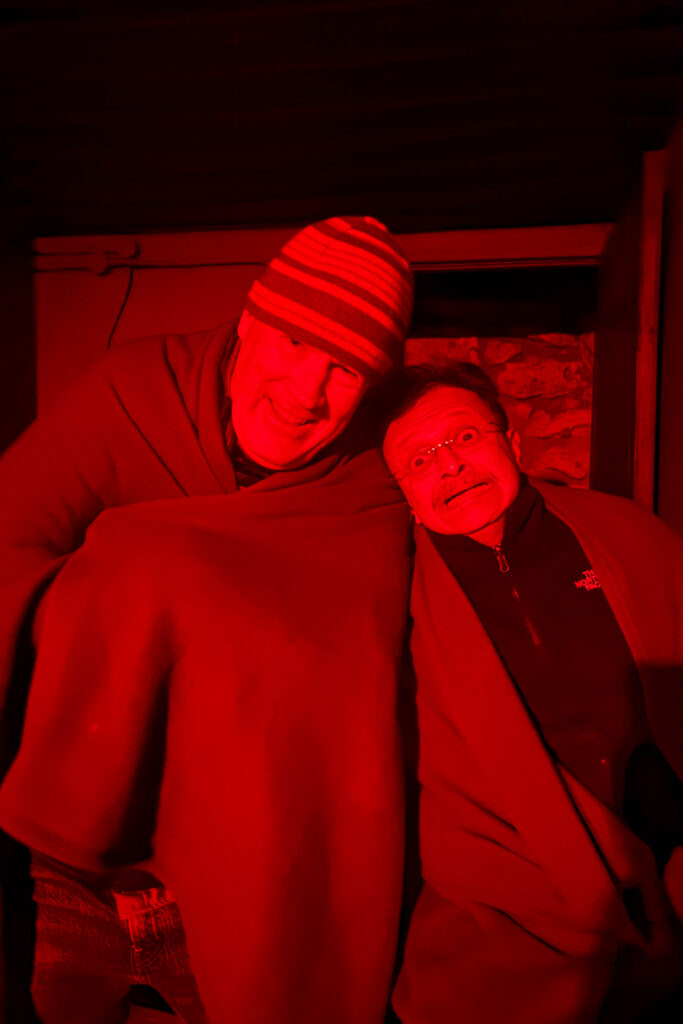
Larking about in the red nightlights of the wonderful Onkolo Hide – where co-leader Mike looks increasingly like TV star Jeremy Clarkson and tour-member KC looks frankly terrified (image by Virginia Wilde)
The celebrated hide – the site of several international award-winning images – is sunk below ground level beside a waterhole (around a 30-minute drive from the camp, in the heart of the Onguma pan), putting you almost at eye level with the animals.
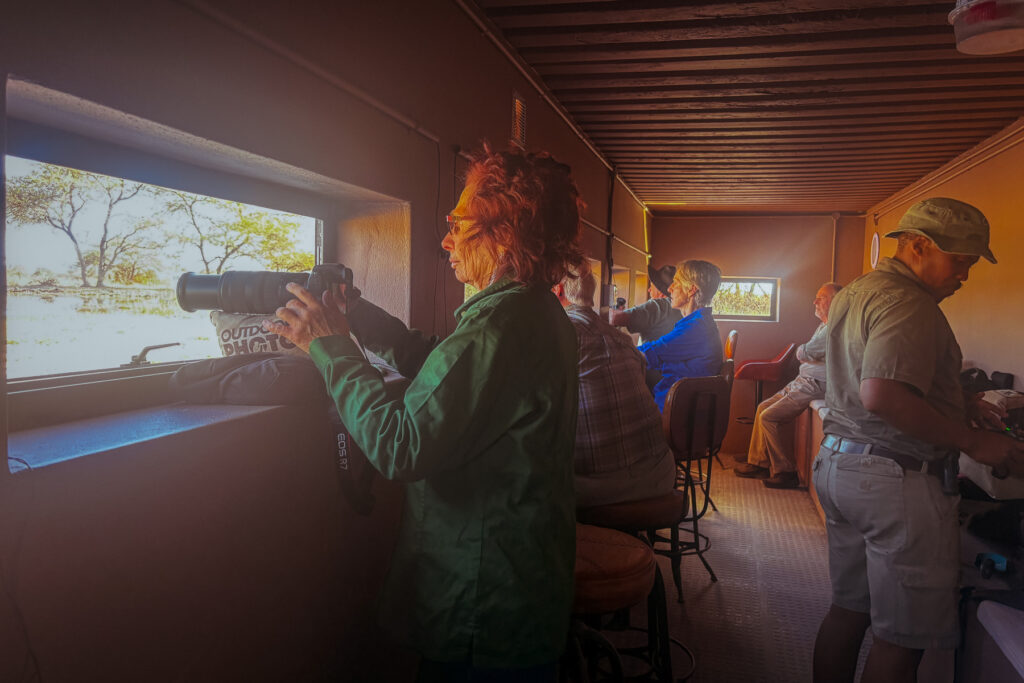
We loved our sessions in Onguma Reserve’s Onkolo Hide. It was comfortable and incredibly near any wandering wildlife. And Onguma guide Salomon had a hamper of food and drink treats on hand at all times! (image by Virginia Wilde)
There is no elevated viewpoint and very little sense of distance; when something walks down to drink, it can feel astonishingly close, with almost nothing between you and it.
The hide was also extremely comfortable, with soft seats at the back and plenty of space to settle in for several hours. To make it even more enjoyable, Salomon, our warm-natured Onguma guide, arrived with a food hamper and a reliable supply of beer, soft drinks, fruit and cake throughout the day.
In total, we spent around 18 hours in the Onkolo hide over three days, trying out different time slots from dawn to nightfall. Each had a completely different character, with the wildlife changing markedly as the day progressed. But for many in our group, the male African Savanna Elephants were the obvious stars.
I found myself holding my breath each time they came in, silent at first and then suddenly audible in the stillness as they breathed and sprayed water. They were so close yet seemed utterly unconcerned by the group of photographers sitting just a few metres away.
When the last glow of the setting sun caught the head of one particularly impressive elephant bull – the colours more vivid than the most determinedly lustrous painting – many of us were deeply moved by such a privileged, intimate encounter.
One morning in the hide, Gemsbok (Southern Oryx) came down to drink, three females and a male. Their horns were extraordinary, long and almost ruler-straight, the females’ noticeably longer and more slender than the male’s thicker, heavier pair.
Against the waterhole, their black-and-white faces and sharply marked bodies made for particularly striking photographs.
Other favourites included the charismatic (and surprisingly large) Kudu, swathes of Burchell’s Plains Zebra with infants, Wildebeest, Black-faced Impala and Springbok.
Warthogs appeared with their usual complete lack of concern about whether they were photogenic.
Among our bird sightings, one Hamerkop was particularly entertaining. He worked the shallows, stabbing into the water and continuously emerging with something small and unfortunate between his bill.
I have a personal soft spot for Emerald-spotted Wood-Doves, which hopped frequently outside, while a pair of Blacksmith Lapwings arrived with a scruffy youngster.
Most sessions, Kori Bustards wandered around the edge of the waterhole. Other bird regulars included Violet-eared Waxbills, Southern Cordonbleus, Namaqua and Double-banded Sandgrouse, Crimson-breasted Gonoleks, Meyer’s Parrot, and Black-faced Waxbills.
And Helmeted Terrapins, Slender Mongoose and Black-backed Jackals provided plenty to look at when the larger animals weren’t drinking.
The best thing about the Onkolo hide was that nothing seemed to follow a timetable. Every session had a different cast. Early one morning, before reaching the hide, we saw our only primate species of the tour – a Southern Lesser Galago (bushbaby) in a tree.
After dark one night, a Black Rhino mother and calf appeared – absolutely one of our target species – while a Spotted Hyena moved furtively around the edge of the water.
One evening, we headed out into the bush to photograph the Milky Way, looking for foreground interest to anchor the sky’s vastness, and settled on a lone tree.
Namibia’s night skies are famous for good reason, with a clarity that makes the stars seem almost within reach. Put binoculars to your eyes and an entirely different sky appears, revealing stars you simply hadn’t noticed before.
Someone mentioned that our galaxy could have hundreds of billions of stars. Although the session was fun – and a few clients got some remarkably sharp images – being out in the bush at night (even with a watchful night guard like Salomon) is generally not advisable. Mike and I later decided it was probably best just to look up and enjoy them.
MAGNIFICENT LIONS ON THE SILVERY SALT PAN OF ONGUMA
When we finally tore ourselves away from the hide, Salomon took us on several short game drives around the Onguma Reserve. We had some worthy encounters with African Savanna Elephants, Angolan Giraffes, a Martial Eagle and Damara Dik-diks – who have a tendency to look as though someone has taken a normal-sized antelope and reduced it in a photocopier.
On our second afternoon in Onkolo, we heard a report that a coalition of Lions had been seen in the Onguma Reserve, having crossed over from Etosha.
Our initial search yielded two very distant lionesses before we joined several vehicles watching another female moving through the silvery pan, with two strikingly handsome males following behind her.
When the other vehicles left, the three Lions continued along our homeward road towards camp, leaving us with the slightly surreal task of following them, very slowly and at a respectful distance.
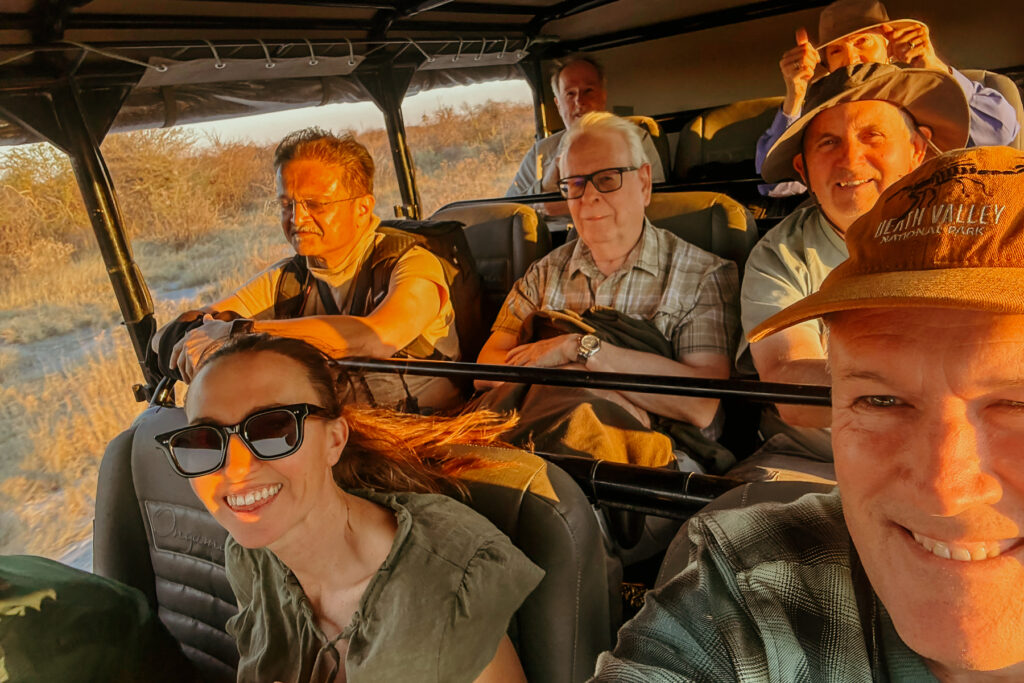
In between our Onkolo hide sessions, we embarked on some short safari drives in Onguma Reserve, with our wonderful guide Salomon (image by Virginia Wilde)
The males would stop from time to time, their pale coats catching the light against the silver pan and dry vegetation – and they were, quite simply, the most magnificent male Lions I had seen in a long while.
Then one of them roared. At fifteen metres, the sound was extraordinary. Deep and resonant enough to feel through the vehicle, and when the second male joined in, the whole encounter took on another dimension.
At this point, trying to get an image was pointless. The roar left an imprint on us that evening.
ETOSHA: WILDLIFE ACROSS THE SALT PAN AND THE ENDLESS DRY HORIZON
Before leaving Onguma and its undeniably luxurious tented camp behind, we made our first foray into Etosha itself, entering through Von Lindequist Gate and spending an afternoon exploring the waterholes of Klein Namutoni, Chudop, Groot Okevi and Klein Okevi.
Of these, Klein Namutoni was particularly good for Angolan Giraffes – giving us our much-desired sightings of towering Giraffes performing their extraordinary drinking manoeuvre – front legs splayed almost into the splits – as they bent down to drink.
Meanwhile, Chudob produced an impressively large herd of African Savanna Elephants, which we photographed as long as we could in the sunset light, before the inevitable last-dash rush towards the gate. It was a useful introduction to the very different style of wildlife viewing inside the park.
Other sightings included a sleeping lioness and an Agama Lizard that Mike spotted on some rocks.
Etosha means ‘Great White Place’, and few names describe somewhere quite so literally. The salt pan covers around 4,800 square kilometres and, in places, seems to stretch away without any obvious end.
Watching a Giraffe or Ostrich walk out against that whiteness is oddly disorientating; the animal can appear to be heading towards nowhere, just an alabaster abyss.
The national park itself covers almost 23,000 square kilometres – roughly the size of Wales – and during the dry season much of its wildlife becomes concentrated around the permanent waterholes.
The most recent aerial census figures give some idea of the scale: 2,911 African Savanna Elephants, 2,196 Black Rhinos, more than 14,000 Burchell’s Zebras, more than 10,000 Springbok and more than 3,000 Angolan Giraffes were recorded spread across this enormous landscape.
Leaving Onguma for good, we embarked on an early-morning game drive in eastern Etosha again, before continuing west across the park towards our next destination, Okaukuejo.
We clocked up the waterholes again, finding Secretary birds, Martial Eagles, Kori Bustards, Cape Shelducks, Egyptian Geese, Sandgrouse, Lilac-breasted Rollers, Sociable Weavers, and several species of Sparrow-Lark.
A brief Cheetah sighting at the Charitsaub depression on the road to Okaukuejo was so fleeting and distant that only Ruth and I, in my vehicle, saw it. Wildlife guiding occasionally means explaining to people who didn’t see the animal that, yes, it really was there.
And frustratingly, the long drive through Etosha National Park was tougher and less enjoyable than I’d hoped. There were extensive roadworks, several waterholes were inaccessible, and both Mike’s and my mapping apps appeared to develop a personal objection to the shortest route.
The road itself was dusty, corrugated, and vibrated enough to make you fear for any dental fillings.
We did find an incredibly milky white-dust elephant and two Black Rhinos, which promptly disappeared into the bush. Otherwise, the day’s principal achievement was getting to Okaukuejo.
OKAUKUEJO: MESMERISING RHINOS & ELEPHANTS AT THE WATERHOLE AFTER DARK
After the long drive across Etosha, we arrived at Okaukuejo Camp, the sprawling ‘village’ at the park’s western end.
Admittedly, it was the least swish accommodation and food of the tour. Fortunately, Okaukuejo has something far more important: its famous floodlit waterhole, where you can sit on bench seats for as long as you like and watch a wide array of wildlife come down to drink.
The viewing area has an almost amphitheatrical quality, and during the dry season it can be astonishingly busy as wildlife-lovers gather to see what emerges from the darkness.
Our first evening session began in the golden light, as small herds of Burchell’s Zebras and Angolan Giraffes appeared, their outlines softened by the dust hanging in the air. It was not ideal for photography, but it gave the scene a beautiful haziness, with the animals emerging and fading through the dust as the sun slipped lower.
Spotted Hyenas and Black-backed Jackals worked the edges of the waterhole, while hundreds of Double-banded Sandgrouse came down in small groups, drank rapidly and disappeared back into the night.
Several of us planned to stay up late, hoping the incredibly elusive Brown Hyena would make an appearance.
After dinner, we returned to the waterhole and were rewarded with our first five Black Rhinos, including a calf.
This is the great attraction of Okaukuejo: you don’t need to drive around looking for wildlife. You simply sit down and wait, and sooner or later something extraordinary – like some of Africa’s most endangered mammals – walks into the light. It’s a pretty special way to spend an evening.
Namibia is the last great stronghold of the South-western Black Rhino, with an estimated 2,113 of this subspecies (almost 85% of the world’s wild population) recorded here in 2023. Their recovery is a remarkable conservation story, built on protected areas, community conservancies, and serious anti-poaching work.
By day, we worked the western side of Etosha in search of Cheetah, driving many dusty kilometres to distant waterholes including Ozonjuiti M’Bari, Okondeka and Salvadora. The Cheetahs remained elusive, and Etosha’s distances proved every bit as formidable as its wildlife.
Yes, we took some arresting images of Ostrich, Gemsbok, and Angolan Giraffe moving across the pan, and of a sizable Rock Monitor Lizard. But our sightings were mostly birds, with a succession of Black-bellied and Red-crested Bustards, Double-banded Courser, and Northern black Korhaans keeping us busy.
The second evening at Okaukuejo produced two of my favourite encounters of the entire trip. Together with our tour members, we watched eight Black Rhinos moving around the water – when the atmosphere suddenly changed.
One male edged too close to a mother and her calf, and she charged him, sending him scrambling back in a cloud of dust. Once she had made her point, she returned to the calf, keeping herself between it and the male as he continued to move around the waterhole. Every time he edged closer, she was ready.
Later that night, the calf wandered right up to the waterhole fence, perhaps five metres from where Mike, I and most of our tour members were sitting. He stood there looking at us with enormous curiosity, completely unconcerned by our presence. I couldn’t tear my eyes away.
After the drama of the charge, this quiet encounter with such a young Rhino, standing just a few metres away and apparently as fascinated by us as we were by him, was even more captivating.
Later that same evening, a large herd of female African Savanna Elephants emerged almost silently from the pan to the left. There were so many of them that the waterhole’s whole dynamic changed.
The females kept the calves tightly protected, constantly shifting their positions and never allowing the younger animals too close to our side of the water. Watching them work together was fascinating: who was making the decisions, who was taking charge, and how did the others respond?
For me, it was one of the most absorbing wildlife encounters of the tour.
WEST INTO DAMARALAND: THE ROAD TO HARTMANN’S MOUNTAIN ZEBRA
All too soon, it was time to leave Okaukuejo and head west towards Damaraland. By this stage, we had driven hundreds of kilometres across Etosha, and the fuel gauge was now looking distinctly uncomfortable. My vehicle, in particular, was in danger of conking out with only 35 kilometres left in the tank.
Etosha itself has no gas station, so the first priority was to reach the fuel pumps just outside the park gates. My 4×4 almost sputtered onto the forecourt, and I was grateful not only for the fuel but also for a very welcome coffee before setting off again towards the Kunene region.
Before we left, however, Etosha had one final Lion for us. A small convoy of vehicles followed a young male, all trying to find somewhere to pull over and get a view. He was collared, which was disappointing from a photographic point of view, although this was barely visible when he turned side-on. It was not quite the Lion encounter we had been hoping for, but it made an appropriate final sighting as we left the park behind.
Just before the official gate, we stopped at a waterhole to see up to 100 Helmeted Guineafowl bobbing together in groups and sometimes in single file, seemingly everywhere around the vehicle. It’s as if they’d been attending a meeting and had now been dismissed. The sight was so comical it made tour members Ruth and Mike roar with laughter.
From Etosha, the road ran west towards Khowarib, roughly 320 kilometres away and a journey of around five and a half hours. We ate our packed lunch in a dusty town, reminiscent of an old American Western movie, and watched the landscape gradually change.
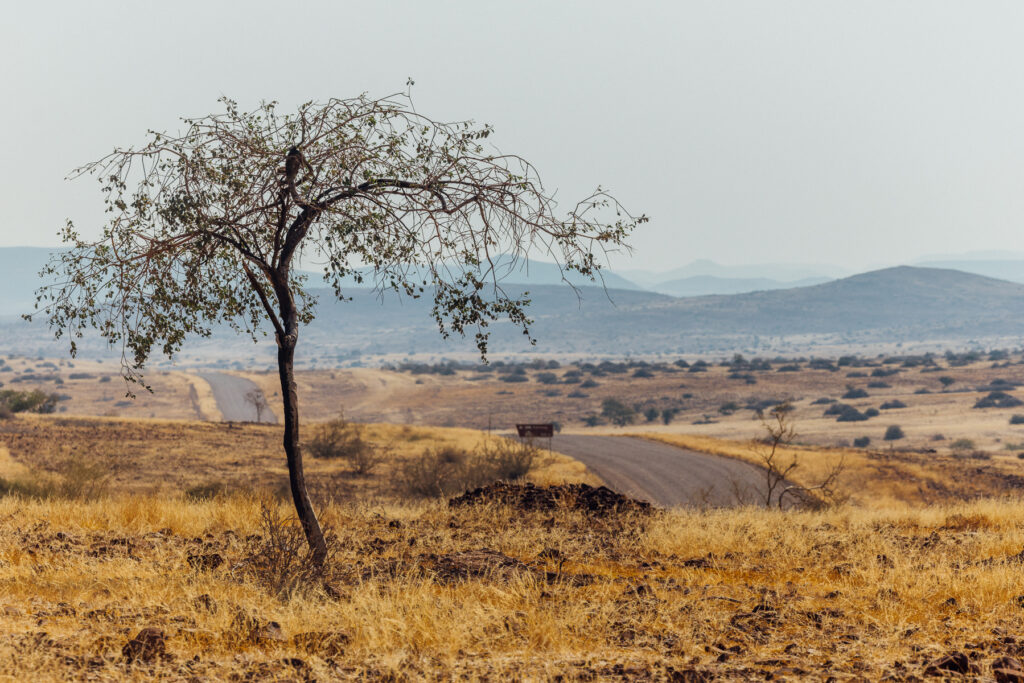
The road through Namibia’s Damaraland – en route to search for Hartmann’s Mountain Zebra – was stark and dry, as hazy mountains filled the horizon beyond (image by Virginia Wilde)
The open plains around Etosha gave way to increasingly rugged country, with rocky hills, dry valleys and flat-topped mountains stretching across the horizon. This was Damaraland, a landscape of extraordinary geological variety, where the road climbs through mountain passes and then drops into vast, seemingly empty valleys.
Grootberg Pass, at around 1,600 metres, is one of the route’s most dramatic sections, with the Etendeka Mountains and their layers of ancient volcanic rock creating stark, haunting scenery. After the flatness of Etosha, it felt like we had driven into another Namibia entirely.
There was plenty to admire along the way, but we were also looking for something very specific: Hartmann’s Mountain Zebra.
After leaving the small town of Palmwag – where there was a short opportunity to engage with and photograph some women from the semi-nomadic Himba tribal community – Mike and I continually scouted the hills and rocky terrain.
We had some luck about 20 km along the same road, when we found a herd at a reasonable distance. Pulling over, we started to slowly hike towards them, using every inch of fieldcraft in an endeavour to get close enough for a decent encounter – without spooking the herd.
Frustratingly, most of the Zebra were nervous and moved uphill towards an escarpment, while the stallion stayed behind, watching us carefully, until he too trotted over the ridge, out of reach.
A second herd appeared another seven kilometres or so further on. These were a little closer, although still not quite what we had been hoping for, so we carried on through another 40 kilometres of spectacular Damaraland scenery.
Then I spotted a third herd, partly obscured by bushes this time but more or less point-blank beside the gravel road. As they moved into a clearing, we could see their heavy build, striking black-and-white striping, and white bellies, with dark stripes running down their legs to their pointed hooves.
Hartmann’s Mountain Zebra are larger and more robust than Cape Mountain Zebra, and unlike Plains Zebra their striping continues down the legs. They also have a distinctive dewlap beneath the neck, although at this distance there was rather more interest in watching and photographing them than discussing their anatomy.
For Mike, in particular, this was the wildlife encounter he had been waiting sixteen years for – and we could hardly have wished for a better view. There was something particularly satisfying about finding them here, in this rugged country they are so perfectly adapted to, rather than simply ticking another Zebra off a list.
We continued to our new destination – the impressive Khowarib Lodge, set on the banks of the Hoanib in the dramatic Khowarib Gorge – very pleased with ourselves.
THE HOANIB: TRACKING THE REMARKABLE DESERT-ADAPTED ELEPHANTS
We journeyed deep into the remote, craggy country of the Hoanib to find one of Namibia’s most extraordinary wildlife spectacles: its desert-adapted Elephants.
Only two recognised populations of desert-adapted Elephants Exist in the world: one in north-western Namibia and the other in the Gourma region of Mali. The Namibian population numbers around 150, spread across five ephemeral river systems, while Mali has around 450.
The Hoanib is one such ephemeral river, which means that for much of the year there is no river in the conventional sense at all. Its sandy channel can look completely dry, yet water persists beneath the surface, supporting Ana and Camelthorn trees along its course.
That hidden water creates a narrow ribbon of life through an otherwise extraordinarily arid landscape, and here some of Namibia’s most remarkable wildlife has adapted to conditions that seem almost impossible.
These ‘desert Elephants’ are African Savanna Elephants, not a separate species or subspecies. What makes them special is how they have learned to survive here, where water is hidden beneath sand, and food can be scattered across enormous distances.
Older animals carry a remarkable store of knowledge: where to dig for water, which parts of the riverbed produce food and when conditions are favourable enough to remain. The Hoanib population is tiny, with fewer than 30 Elephants using this river system.
We’d arrived at Khowarib Lodge the previous evening, and the group all said they immediately loved the place. It felt wonderfully wild, the food was excellent, and that evening the lodge staff gave us some spirited songs and dances – including one about the perils of Amarula drunkenness, complete with increasingly enthusiastic mime actions.
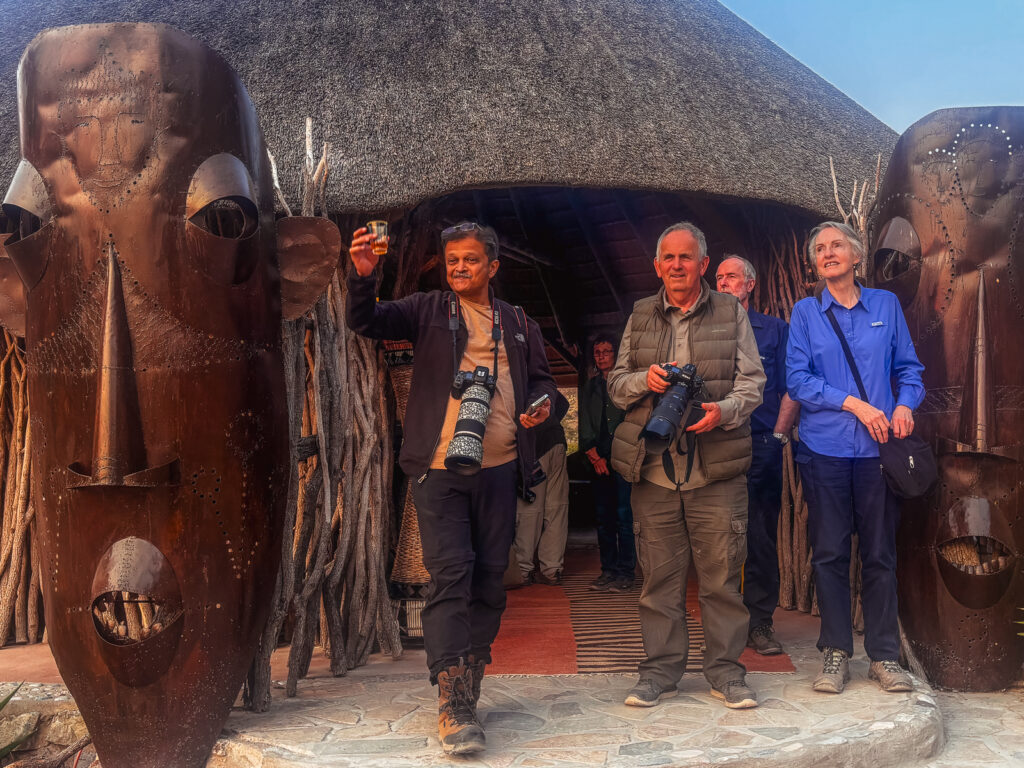
It’s a fair old drive through Damaraland and the Khowarib Gorge, so a drink at the lodge when we arrived was very welcome! (image by Virginia Wilde)
The following morning, we climbed into two spacious open-sided safari vehicles, one driven by Buck, the lodge manager, and the other by Ueera, an exceptionally knowledgeable guide who knows this part of Namibia intimately.
This early morning drive into the Hoanib was decidedly chilly, with several tour members rather underdressed for the occasion, as we shared hats and scarves. But as the sun climbed higher, we soon warmed up.
Buck handled the 4×4 superbly through the deep sand as we entered the river valley. Our first wildlife came in the form of two lone Angolan Giraffes, standing elegantly against the mountains and crags behind them.
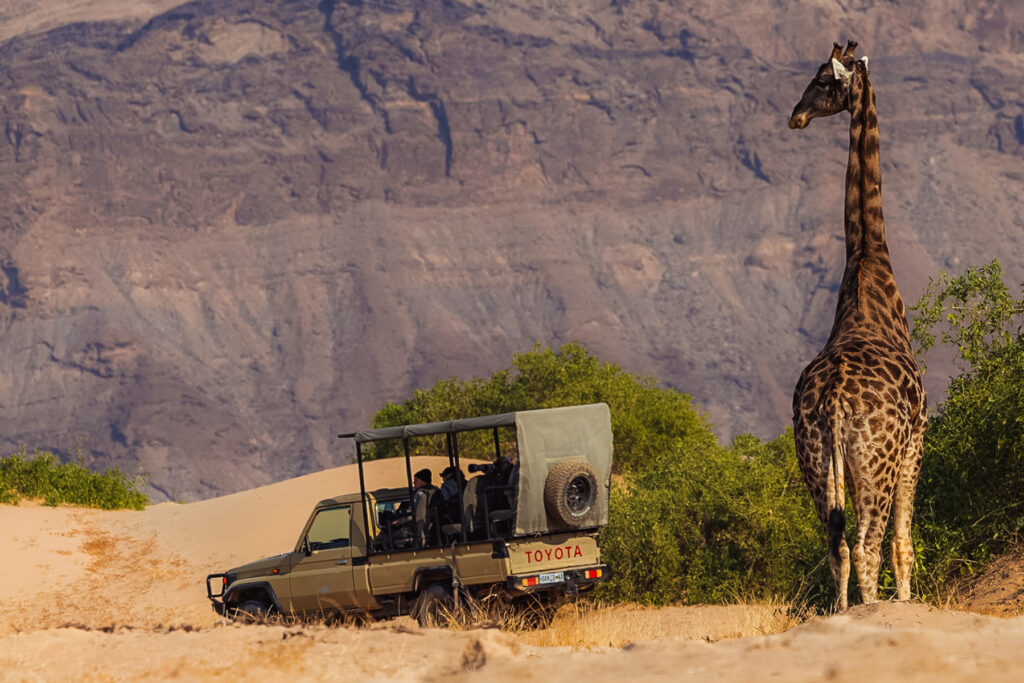
An Angolan Giraffe towers over one of our open-top safari vehicles during a mini expedition into the Hoanib River Valley – looking like a giant against the craggy mountains (image by Virginia Wilde)
The combination of Giraffes, enormous rock formations, dry riverbed and scattered trees made for some of the most atmospheric wildlife photography of the trip.
The talented Ueera soon had us onto the Elephants, finding a few individuals first among Camelthorn trees, and then more – including several six- and nine-month-old infants – along the dry riverbed.
He and Buck expertly positioned the vehicles for some extraordinary views. We watched them excavating the dry riverbed, digging a metre down into the apparently bone-dry sand with their trunks and feet until they reached water. The calves copied them, plunging their little trunks into the sand and enthusiastically digging, droplets splashing from their mouths.
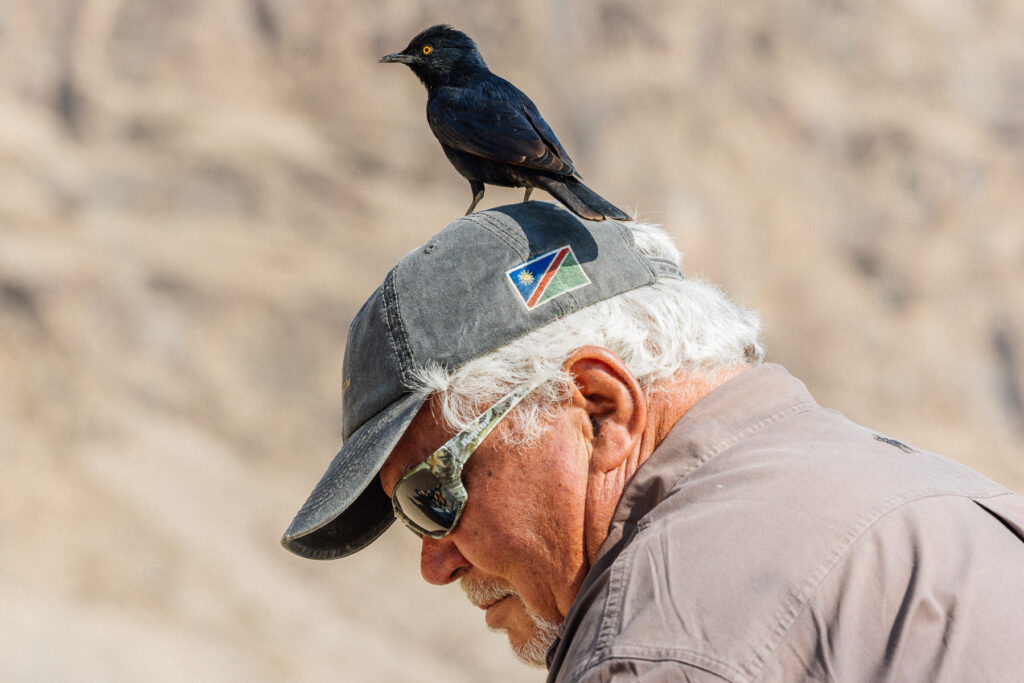
Life is tough in the arid Hoanib River Valley and friends need to stick together. One of our Hoanib guides – Buck – prepares coffee and biscuits for us, along with his Pale-winged Starling pal (image by Virginia Wilde)
Watching elephants make water appear from beneath a riverbed that looked completely parched was extraordinary. We even got out of the vehicles and photographed them from ground level, although the drivers remained sensibly alert. The Elephants simply carried on with their business, digging patiently into the sand while we watched.
After lunch we found more Elephants, including a tiny youngster following its mother down steep rocks in a way I’d never seen an Elephant do before. We also came across a troop of Chacma Baboons, including a tiny infant that looked barely a few days old.
Later we found three bull Elephants together, followed by a large male in musth. The temporal glands on either side of his head were visibly secreting, as he dust-bathed beside the river. A bull in musth is not an animal you want to surprise, so we gave him a very wide berth.
By the end of the day, we had encountered 25 Elephants in three herds, undoubtedly most of the animals using this stretch of river.
Other wildlife in this Hoanib River Valley included Springbok and Steenbok in the vegetation, Rock Hyrax, Mountain Chats, Crowned Lapwings and Pale-winged Starlings. The local Lions were absent, having apparently headed downstream towards the Skeleton Coast, around 50 kilometres away, to hunt Seals.
By the time we returned to Khowarib, we were cold, dusty and extremely happy. We took a hot shower, then spent the evening beside the campfire beneath the stars. For me, and several others, the Hoanib Elephants were my favourite encounter of the tour.
Watching these vast mammals excavate water from the dry riverbed was extraordinary enough, but hearing Ueera explain the latest science on how Elephants communicate made the experience even more fascinating.
Research has shown that Elephants create low-frequency vibrations that pass through the ground, potentially carrying information over considerable distances. Other Elephants can detect these seismic signals through their feet and inner ears, giving them another way of communicating across the vast, open landscape.
The combination of mind-blowing animal behaviour, the mountainous terrain, and the sheer wildness of the Hoanib made this section, for me, the most memorable of the tour.
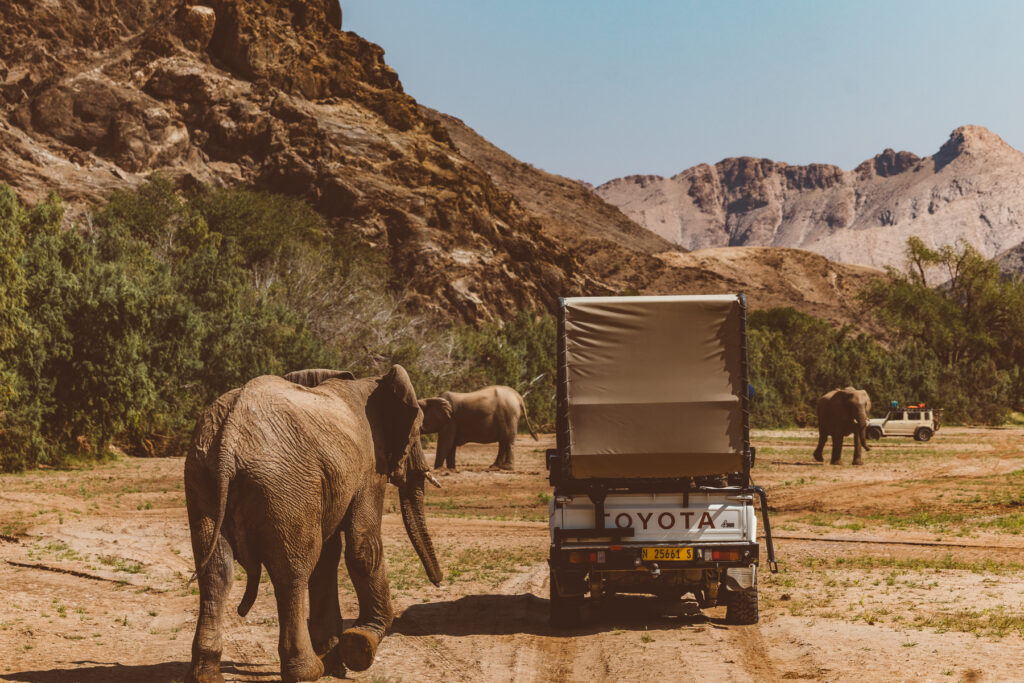
It’s not every day you get to drive among desert-adapted African Savanna elephants along an ephemeral riverbed (image by Virginia Wilde)
THE SKELETON COAST: WHERE THE DESERT MEETS THE ATLANTIC AND A HEAVING MASS OF SEALS
We left Khowarib before dawn, with roughly 450 kilometres between us and Swakopmund, and a dinner reservation at a fabulous restaurant waiting for us that evening.
This was one of Namibia’s great road journeys, but it was long, and by the time we reached the Skeleton Coast, we had already been driving for hours.
As we passed through various coastal checkpoints, we heard reports of a pair of desert-adapted Lions along the coast, one of the Hoanib animals that had travelled downstream in search of Seals. We kept an eye out, although the reports were far too unreliable to plan around.
At times, the road seemed to run on forever. The rugged country around Khowarib gradually flattened into an immense, almost featureless desert, with long stretches of gravel, sand and enormous sky.
A few Black-backed Jackals appeared along the way, providing brief flashes of life in a landscape that could otherwise seem almost completely empty.
At one point we stopped beside a small field of Welwitschia, one of the Namib’s most extraordinary plants. These ancient survivors can live for more than a thousand years, their enormous, strap-like leaves spreading across the desert floor.
Eventually, we reached the Skeleton Coast, where the desert meets the Atlantic in one of Africa’s most remote, notorious and evocative landscapes.
There is, undeniably, something eternally romantic about the Skeleton Coast, despite its rather ghostly name. Its ‘skeletons’ refer not only to the ships wrecked along this treacherous coast, but also to the bones of marine mammals that accumulated along its shores.
The cold Benguela Current keeps the coastline surprisingly cool, while fog rolls inland from the Atlantic, bringing precious moisture to one of the driest environments on earth.
Capitalising on its pirate reputation, flags bearing the ‘Skull and Crossbones’ insignia occasionally fly from flagpoles near the road.
We stopped at one of the coast’s famous shipwrecks, a wave-battered husk of a fishing trawler called the ‘Zeila’. Its rusting hull lay exposed by the low tide as Atlantic waves battered the remains. Cormorants crowded the wreck, perched along its rusted superstructure and nesting among the metalwork.
Keen to avoid clients getting caught out by the fast-encroaching tide, I ran down to warn them, myself getting my feet wet in the process, in what I can only describe as a rather unnecessary display of unhelpful helpfulness.
After such a long drive, we really should have been keen to press on, but the Skeleton Coast has a way of making you stop to stare at its contrasts.
Eventually we reached Cape Cross, home to the world’s largest breeding colony of Cape Fur Seals, where numbers can reach more than 200,000 during the breeding season.
After lunch on the beach, next to some Dolphin Gulls, we gathered our cameras to walk around the decking overlooking a small section of the colony. Thousands of Seals were packed along the shoreline, hauled out on the rocks and sand while others fought their way through the surf.
The Atlantic waves continually crashed into seals at the margins, repeatedly knocking animals sideways and sending pups disappearing beneath the adults before they popped up again moments later.
There was almost too much happening to know where to look. Seals squabbled, barked and shoved for space; others were tumbled around by the breakers; pups clambered over the adults and then vanished back into the crowd.
For photographers, it was a surprisingly difficult situation, with a host of backlit and dynamic range problems to attempt to remedy and potential pictures unfolding in every direction – and no obvious way to choose between them.
Just outside Swakopmund we stopped again when we came across fields of brilliantly coloured lichens spreading across the desert. By then, however, the long drive and the evening ahead finally won out. We decided to come back the following day and explore them properly.
We eventually reached our destination of Swakopmund, checked into our boutique hotel, and headed out for dinner at ‘The Tug’, a restaurant built around the wheelhouse of a decommissioned tugboat overlooking the Atlantic. After such a long day on the road, it was an atmospheric and utterly delicious end to the day.
THE LIVING DESERT: WHERE TINY WILDLIFE DISAPPEARS INTO THE SAND
Swakopmund is one of Namibia’s most distinctive towns, an oddly charming seaside outpost where German colonial buildings sit alongside cafés, bakeries and shops, all squeezed between the Namib Desert and the Atlantic.
We were due to head out early with Chantelle, our wonderfully charismatic but self-described ‘eccentric’ guide from ‘Living Desert Tours’, to look for some of the Namib’s smaller inhabitants, but we’d already heard reports of a desert storm coming in.
These winter East Winds, or Bergwinds, are hot, dry winds that descend from the interior towards the coast, carrying sand with them. They occur only intermittently, but when they arrive, they can transform the usually cool coast into something very different.
With the worst of the weather expected that morning, we moved our excursion to after lunch. By the time Chantelle arrived shortly after 11 am, the storm was already passing, and the air was beginning to clear.
But this change of plan gave us something we rarely get on a wildlife photography tour: a completely free morning. And after the long drive from Khowarib, it was a very welcome luxury.
All of us wandered around Swakopmund, browsing bookshops, maps and souvenir shops, then settled into a wonderful café for brunch, with smoothies, milkshakes and baskets of incredible homemade bread. It was rather nice to have nowhere we needed to be for a few hours.
Chantelle collected us shortly after 11 am, and we headed out into the desert. This stage of our journey provided a very different wildlife experience from Etosha and the Hoanib. Instead of scanning waterholes and the horizon for something large, we looked down into the sand for animals that have spent millions of years developing ways to become almost indistinguishable from their surroundings.
Although the storm had passed, the conditions were still challenging, with sand blowing across the surface and the desert looking particularly inhospitable. Finding anything small in all that open country would require a very good guide and more patience than usual.
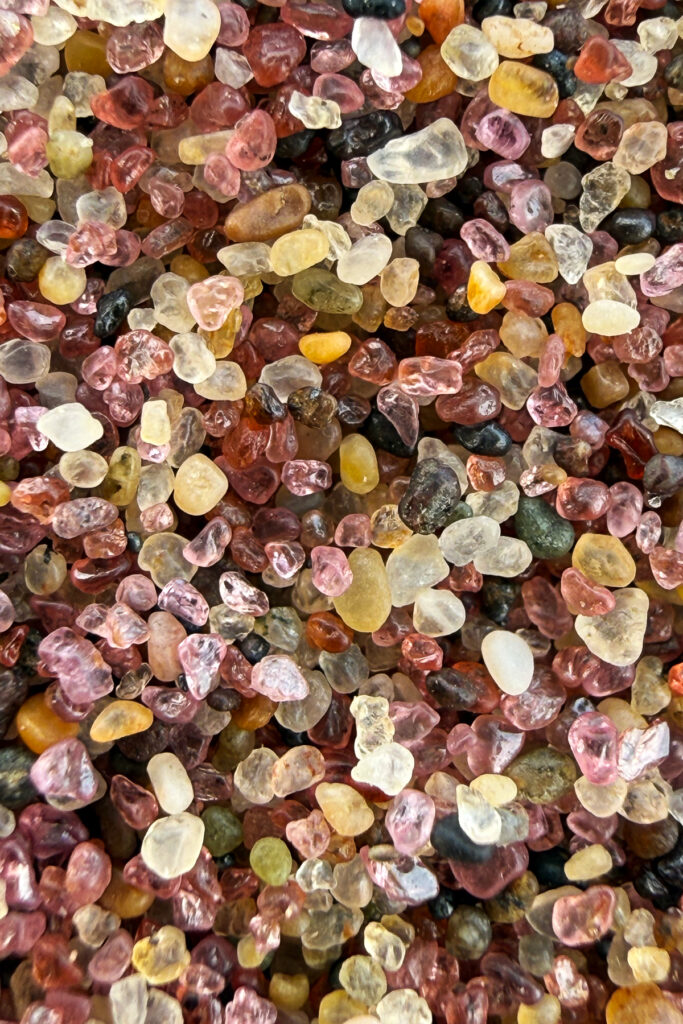
A close-up of the Namib: a mosaic of tiny, weather-worn grains in shades of rose, amber, cream and black – each one shaped the desert over countless years (image by Virginia Wilde)
Our first finds included a Namaqua Chameleon, a beautifully adapted desert specialist that can change colour to blend with the sand. We followed this with Shovel-snouted and Wedge-snouted Lizards. The Shovel-snouted Lizard can effectively ‘swim’ through loose sand, disappearing beneath the surface with remarkable speed, while the Wedge-snouted Lizard is equally adept at burrowing out of sight.
Other finds – as we searched (in vain, sadly, for our much-desired Peringuey’s Adder) included an Armoured Darkling Beetle, a Tractrac Chat, and a surprisingly relaxed Black-backed Jackal in a bush against the sweeping golden-hued dunes.
The Tractrac Chat was particularly obliging, approaching Chantelle’s vehicle for mealworms and eventually getting so close that our telephoto lenses became less useful than we’d hoped.
The reptiles were markedly less cooperative. The Namaqua Chameleon could blend surprisingly well into the desert, while the lizards had a frustrating habit of disappearing beneath the sand whenever they stopped moving.
In a landscape where almost everything is the same colour, finding them became a matter of watching very carefully for the slightest movement.
But after days of watching Elephants, Rhinos and Lions, it was oddly satisfying to become completely absorbed by animals that could disappear beneath a footprint.
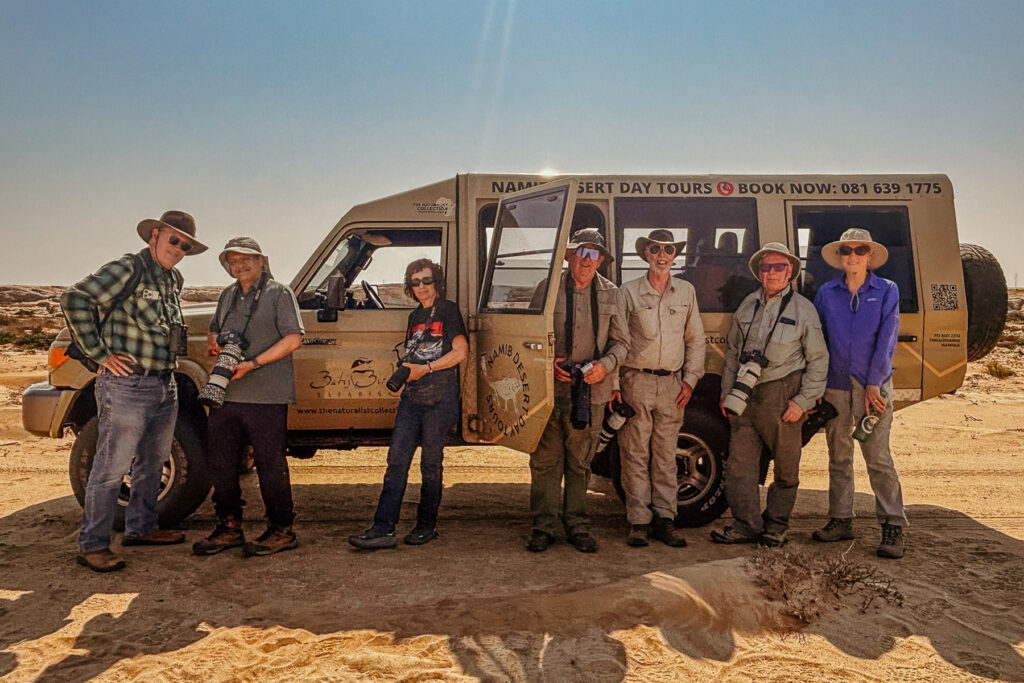
We’d had a morning desert storm, keeping us in Swakopmund. But that subsided enough for us to head out into the Namib Desert in search of reptiles! (image by Virginia Wilde)
SANDWICH HARBOUR: A SERIOUSLY ADVENTUROUS DAY IN THE DUNES
The following morning was our adventure day, and it duly turned out to be the most exhilarating of the tour.
At first light, we headed into Sandwich Harbour with three specialist dune drivers from ‘SandWave’. In this section of coast, the Namib dunes plunge towards the Atlantic, and the only sensible way of driving here is in a highly capable 4×4 with someone who knows exactly what they are doing.
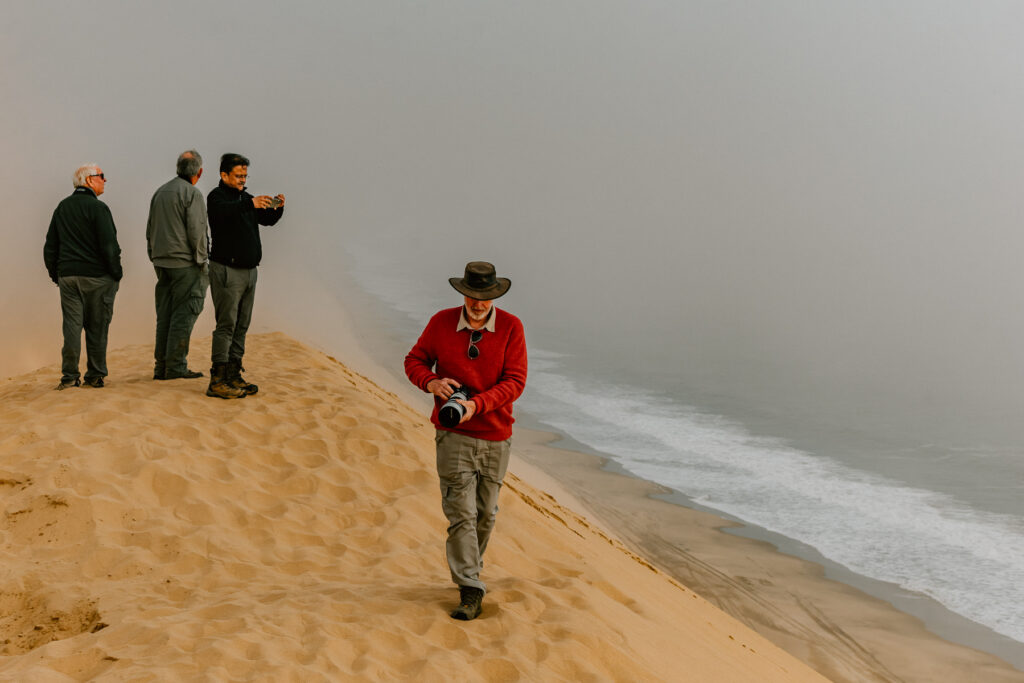
Our Namibia tour-members wait for the famous fog to clear from one of Sandwich Harbour’s classic viewpoints. In the end, it didn’t clear. But the sight of the Atlantic crashing into great sand dunes was beautiful regardless (image by Virginia Wilde)
Sandwich Harbour lies within the enormous Namib-Naukluft National Park and forms part of the Namib Sand Sea – the UNESCO World Heritage Site that protects more than three million hectares of shifting coastal dunes.
Some of the dunes around Sandwich Harbour rise to more than 100 metres, and the area is also a Ramsar wetland of international importance. It’s an extraordinary combination: enormous desert dunes on one side, the cold Atlantic on the other, and a surprisingly rich wetland tucked between them.
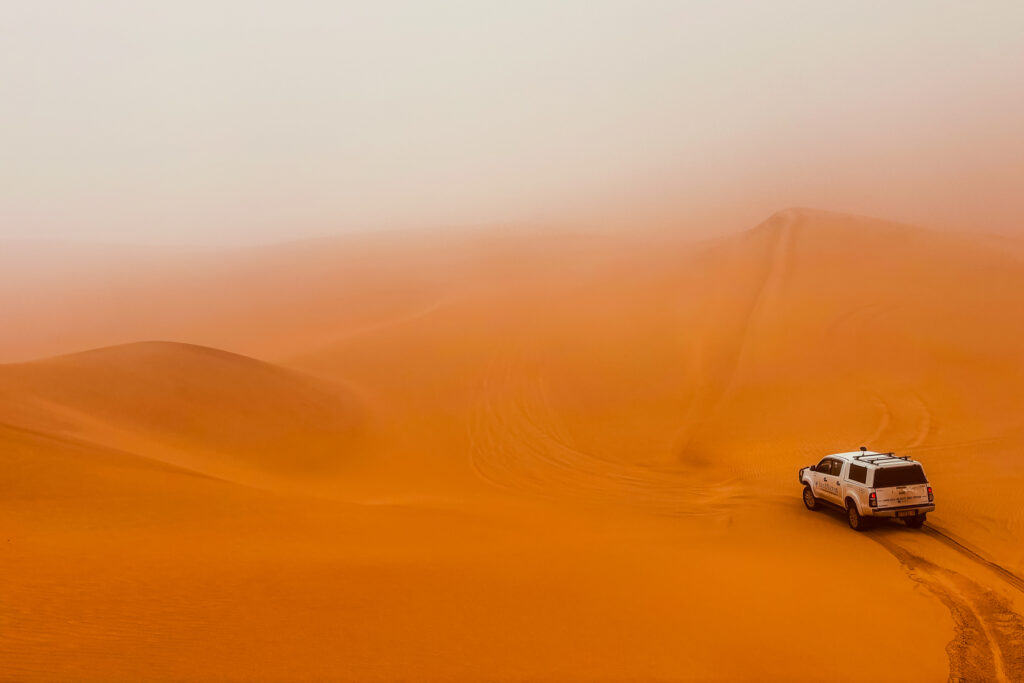
On our Sandwich Harbour drive day, the dunes emerged and disappeared in the mist, sometimes only a few metres ahead of us, giving the whole landscape a rather ghostly quality (image by Virginia Wilde)
Our three drivers, Neil, Ben and Gareth, were an excellent team. Ben, the owner of SandWave, is one of the world’s most experienced dune drivers and was part of the driving team when The Grand Tour came to Namibia, putting Jeremy Clarkson, Richard Hammond and James May through their paces across this very same desert.
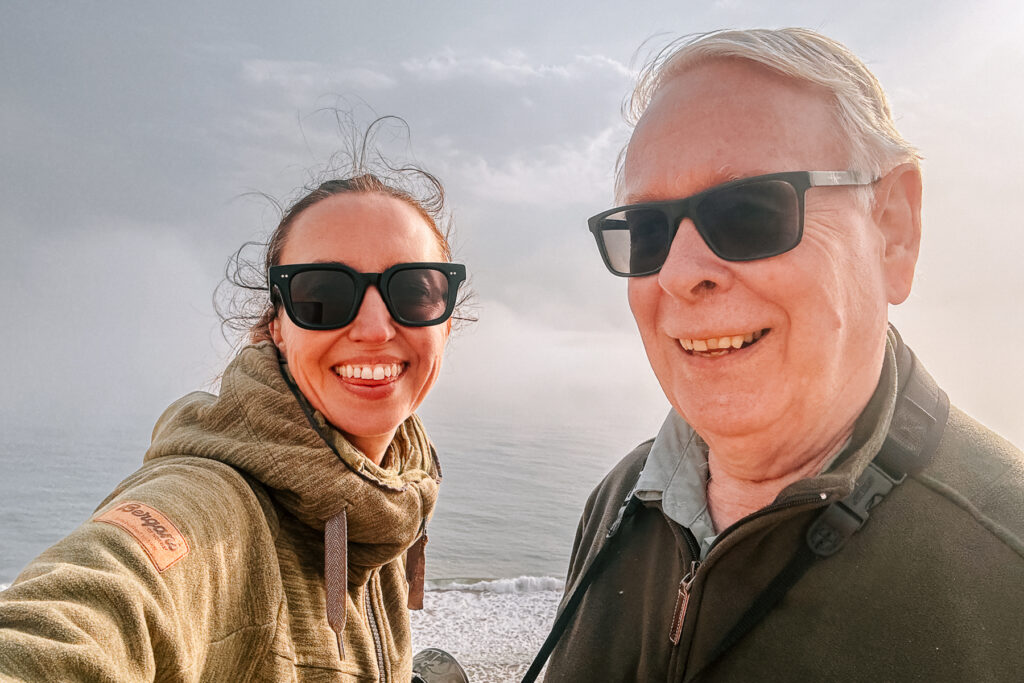
Wild Images client Martin has long been one of our most cherished repeat tour-members. Here tour leader Gin Wilde attempts a selfie with him overlooking the Atlantic Ocean (image by Virginia Wilde)
I chatted with former rally driver Gareth, otherwise known as ‘Scottie’. All three guides were extremely knowledgeable and possessed the slightly unnerving ability to look at a near-vertical wall of sand and see a perfectly sensible road.
After the storm the previous day, the coast was completely shrouded in fog. We had hoped the sun might eventually break through, but – despite hints of some sun – it never really did.
Instead, the dunes emerged and disappeared in the mist, sometimes only a few metres ahead of us, giving the whole landscape a rather ghostly quality.
It was not the golden Sandwich Harbour we had seen in photographs, but there was something wonderfully atmospheric about plunging into the fog and finding ourselves surrounded by enormous walls of sand.
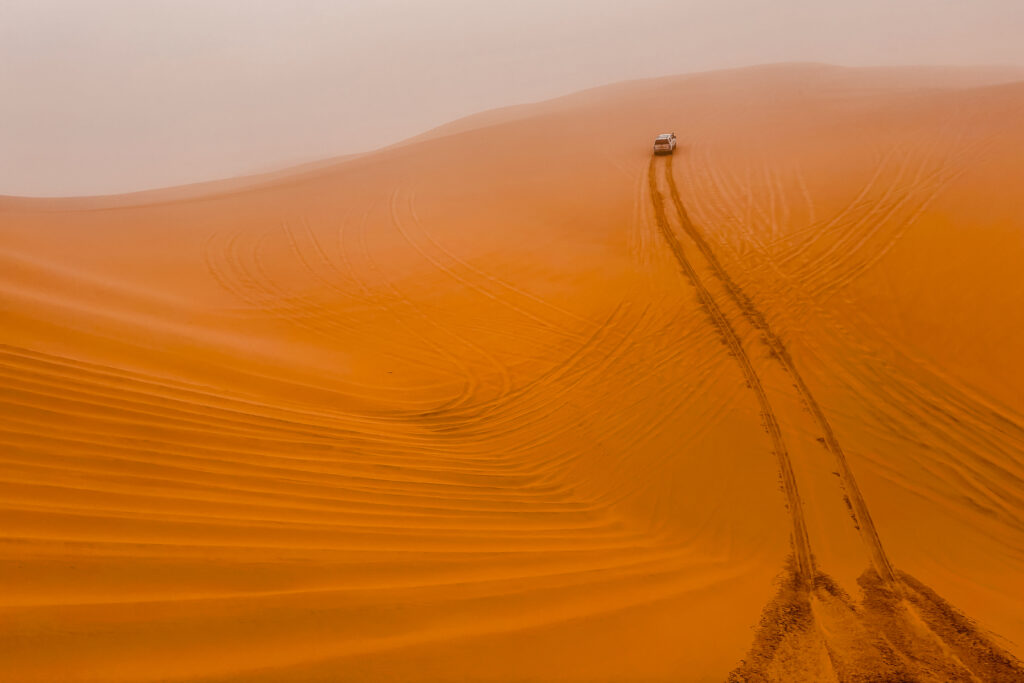
Our drivers on our Sandwich Harbour day were extremely knowledgeable – and possessed the slightly unnerving ability to look at a near-vertical wall of sand and see a perfectly sensible road (image by Virginia Wilde)
The driving itself was staggering. Our vehicles climbed steep dune faces before tipping over the crest and sliding down the other side, sometimes at angles that seemed to require a rather greater degree of faith than we were entirely comfortable with.
Our dream-find would be the Brown Hyena, one of the more elusive mammals of this remote coastal wilderness. But the fog made finding anything difficult.
We never did find our Hyena, but they more than made up for it by finding us two animals that had eluded us the previous day: a Peringuey’s Adder and a near-translucent Namib Sand Gecko.
The Adder was particularly satisfying after our unsuccessful search with Chantelle. This beautifully camouflaged little snake is so well adapted to the loose sand that it can disappear almost completely, leaving only its eyes exposed.
Finding one in that vast expanse of dune country felt like finding a needle in a very large, very sandy haystack.
The wildlife wasn’t confined to reptiles. Springbok bounded and pronked through the sand, somehow making the difficult terrain look considerably easier than it was, while distant Gemsbok appeared against the dune vegetation.
We eventually stopped on a high ridge, hoping that the fog might finally lift and give us the classic ‘dunes meet ocean’ view. Instead, we stood in the cold mist looking down over an almost invisible landscape, with the dunes fading into the Atlantic somewhere beyond us. It wasn’t the view we expected, but it was strangely beautiful.
After all the driving, we stopped for a very welcome lunch before continuing back towards Walvis Bay, where the scenery changed yet again. Here, wetland life was the draw, with our first finds being Greater Flamingos, Pied Avocets, Curlew Sandpipers, Chestnut-banded and White-fronted Plovers.
Other avian sightings included Caspian and Sandwich Terns, Cape Cormorants, Kelp, Hartlaub’s and Grey-headed Gulls, Eurasian Whimbrels, and Grey Herons. Rüppell’s Bustards and Scaly Weavers occupied some of the drier ground.
We spent time photographing the birds around the harbour and lagoon before setting off back through the desert, with the SandWave drivers taking us through the dunes once again.
By the end of the day we were sandy yet thoroughly exhilarated. It was one of those rare days when the journey itself becomes as much a part of the adventure as the wildlife, and Sandwich Harbour had delivered it in spades.
Returning to our new waterfront guesthouse, opposite a lagoon filled with flocks of Flamingos, we had time to rest before heading out for dinner at a charming little pizzeria. The food was so good that several of us called it one of the best meals of the entire trip.
The quality of the food during this Namibia tour was varied and exceptional. Probably the best food I’ve ever had on a wildlife tour. Here, tour member Mike enjoys some seafood (image by Virginia Wilde)
SOSSUSVLEI: NAMIBIA’S ICONIC DESERT LANDSCAPE IN LIGHT AND SHADOW
Leaving Walvis Bay in the dark after an early breakfast, we turned south toward our final destination, Sossusvlei, with a long drive ahead and some particularly vicious corrugations to contend with.
The road seemed determined to shake every bolt out of the vehicles before we reached Solitaire, the tiny desert settlement famous for its collection of rusty old cars, dusty Wild West appearance and, above all, its apple pie. We were very happy to stop for coffee and some doorstop-sized wedges of this incredible pie.
Beyond Solitaire, the country began to look increasingly like the Namibia that visitors imagine before they arrive: immense gravel plains giving way to the first great orange dunes of the Namib.
Sossusvlei is famous for the extraordinary concentration of elements that make up its landscape: enormous red dunes, white clay pans and the stark black Camelthorn trees of Deadvlei, all compressed into a scene of almost surreal graphic simplicity.
This is – rightly – one of the world’s great landscape photography locations, with the dunes’ shapes, colours and shadows changing almost constantly with the angle of the sun.
We eventually reached Dead Valley Lodge in time for a late lunch before heading out again – through the main reserve gate – for our first attempt at landscape photography.
We drove towards the more famous dunes near the Sesriem gate, looking for compositions that might work, before heading to Elim Dune, but we left rather late. By the time we pulled up, there wasn’t enough daylight left for the sunset we had hoped for, though there was enough of a view to see we would need to come back and do it properly.
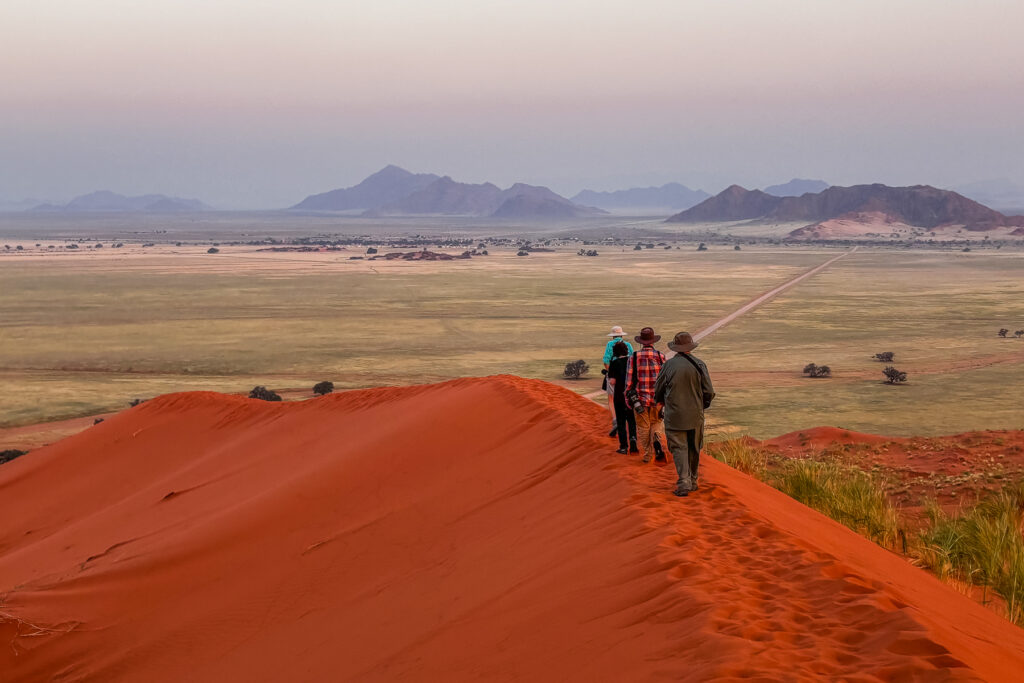
From a crest of ‘Elim Dune’, the vast plans of the Namib open towards the distant Naukluft Mountains – a landscape of extraordinary scale and colour (image by Virginia Wilde)
The next morning involved an altogether earlier start. Mike and I made sure we were the first vehicles through the gate, so the alarm went off well before sunrise, and we set off in darkness towards Deadvlei.
Mike had deflated both our tyres the night before – in preparation for the final five kilometres to Deadvlei. The tarmac ends at the 2×4 parking area, and from there the track runs through deep, soft sand, a stretch notorious for vehicles getting stuck. With the tyres down and the sand ahead of us, we had only one option: keep moving.
We reached Deadvlei while it was still dark and began the walk across the pan. The famous skeletal remains of Camelthorn trees – that died when the Tsauchab River changed course and stopped reaching the pan – were little more than black silhouettes at first, gradually emerging as the sky began to lighten.
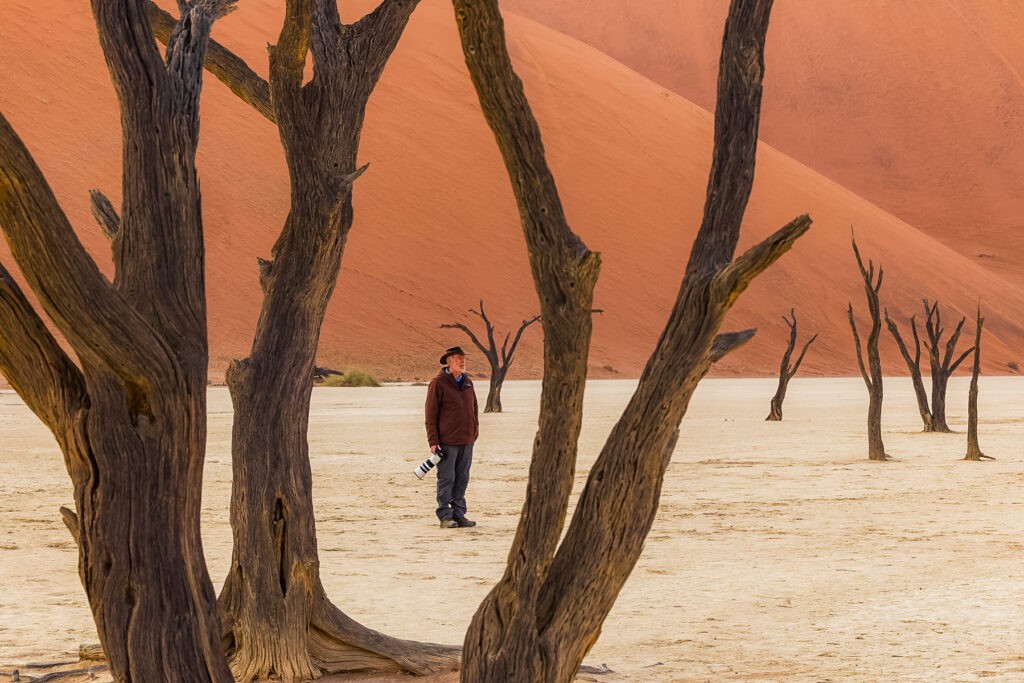
One of the toughest photographic challenges in Deadvlei is finding a composition you like between all the ancient Camel Thorn trees. Here, client Mike ponders his options (image by Virginia Wilde)
The result is a landscape with such a distinctive combination of colour, form and scale that it has become almost synonymous with Namibia itself.
Deadvlei is one of those landscapes so familiar from photographs that you wonder whether the real thing can possibly have the same impact. Standing there in the half-light, with the white pan beneath us and the enormous dunes rising behind it, it was every bit as extraordinary as you hope it will be.
We were among the first people onto the pan, which gave us a precious stretch of relative solitude before the numbers began to build. Then came the harder part: deciding which grouping of trees worked.
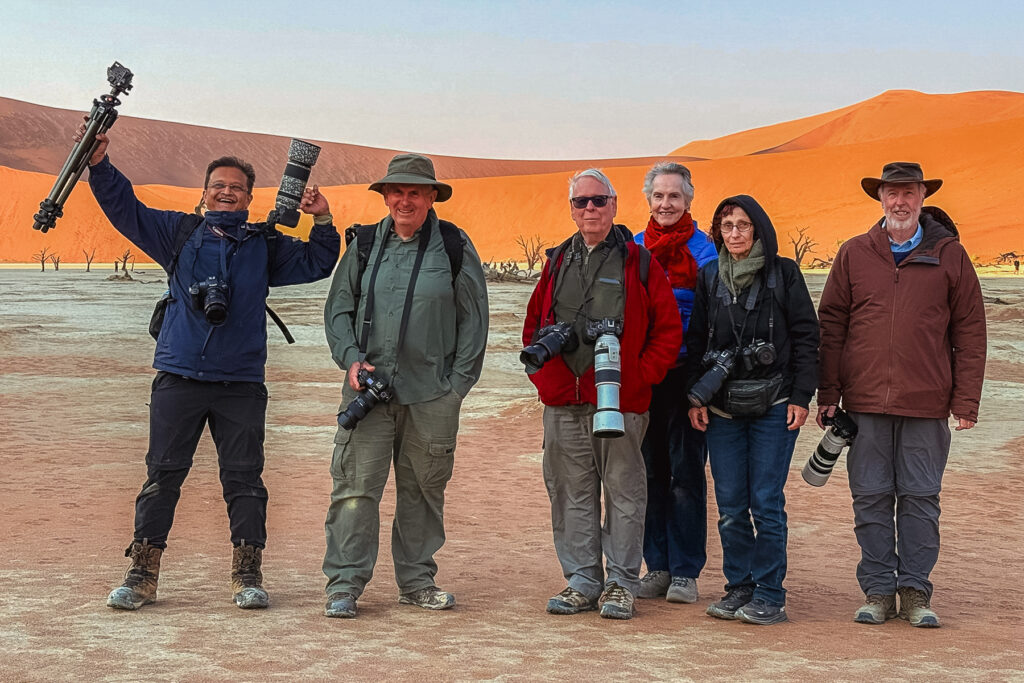
It’s a 25-minute hike into the incredible pan of Deadvlei – and we endeavoured to be the first group to reach it that morning after a 4 am (ish) start. I don’t know if your group here are elated or shattered! (image by Virginia Wilde)
As the sun climbed, the light began to catch the backs of the dunes, turning them progressively deeper orange while the trees remained almost black against the white clay.
We spent a ridiculous amount of time moving a few metres this way and that, trying to make the trees, dunes and shadows cooperate. It was frustrating, absorbing and enormous fun.
We were also exceptionally lucky with this year’s conditions in the pan just by Deadvlei. Heavy rain had filled the usually dry depression, creating a lake-sized pool of water that reflected the surrounding dunes.
This phenomenon is a rare occurrence and completely changes the familiar Sossusvlei images.
While I focused on helping the group with landscape images, Mike looked for anything that moved. He found Kalahari Tree Skinks and Wedge-snouted Desert Lizards in the sand.
After lunch, we moved to Sossus Dune Lodge for our final two nights. The chalets were raised on stilts above the desert and had wonderful views across the surrounding landscape.
After the pre-dawn start, it was tempting to sit down and stay there.
We resisted it and went back to Elim Dune that afternoon. This time we had plenty of time for the sunset hike to the summit – although the climb was considerably harder than it looked from below.
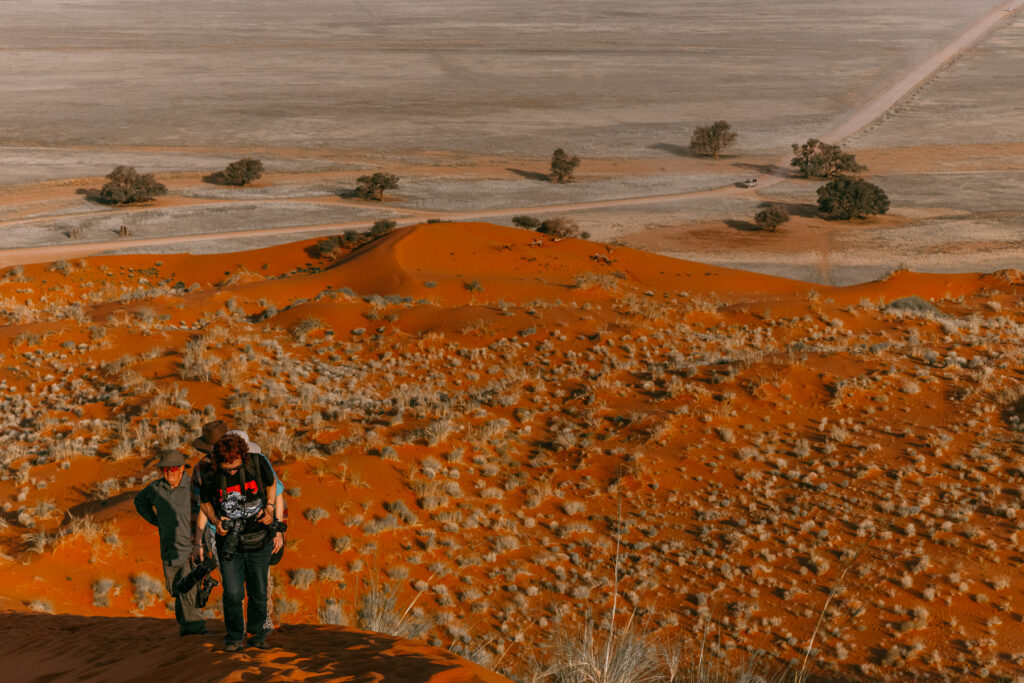
Namibia tour member Esther led the climb up Elim Dune – Sossusvlei’s famed sunset spot. We were gifted incredible views, but the hike wasn’t for the faint-hearted! (image by Virginia Wilde)
The sand seemed to slide away beneath our feet with every step, but the effort paid off as evening light spread across the dunes. From higher up we could also see the strange pattern of fairy circles scattered across the desert floor, scores of pale rings punctuating the otherwise empty landscape.
The following morning, we decided not to punish ourselves with another pre-dawn assault on Deadvlei. We had already had such a good session there that it seemed better to explore rather than try to repeat it. Instead, we drove deeper into the Sossusvlei area, moving from dune to dune as the sun began to rise.
This morning gave us Sossusvlei at its best. The early light threw long shadows across the dunes, exaggerating every ridge and hollow, while the illuminated sand took on a deep burnt-orange colour.
From one angle the dunes looked smooth and monumental; a few minutes later the shadows had carved them into an entirely different set of shapes.
That constant change makes this an extraordinary place for landscape photographers. Sand is everywhere, but repetition is rare. Wind redraws the surface, the sun moves the shadows, and every bend in the track reveals another curve, ridge or sweep of colour.
You can photograph the same dune several times and come away with completely different images. We spent a very happy morning doing exactly that.
Later that morning we found Lark-like Buntings and Rock Martins. Even here, where the eye initially sees little beyond sand, rock, and trees, wildlife was there if you knew where to look. A distant Oryx could appear almost insignificant against a dune, while a person walking along a ridge became little more than a tiny black mark.
Then it was back to the lodge for lunch and a much slower afternoon, enjoying the chalets and the views.
Late in the day, several of us headed to Sesriem Canyon, surprisingly close to the lodge. It turned out to be an excellent final outing. The canyon drops between towering walls of rock, with gnarled trees clinging to the sides and the temperature noticeably cooler below.
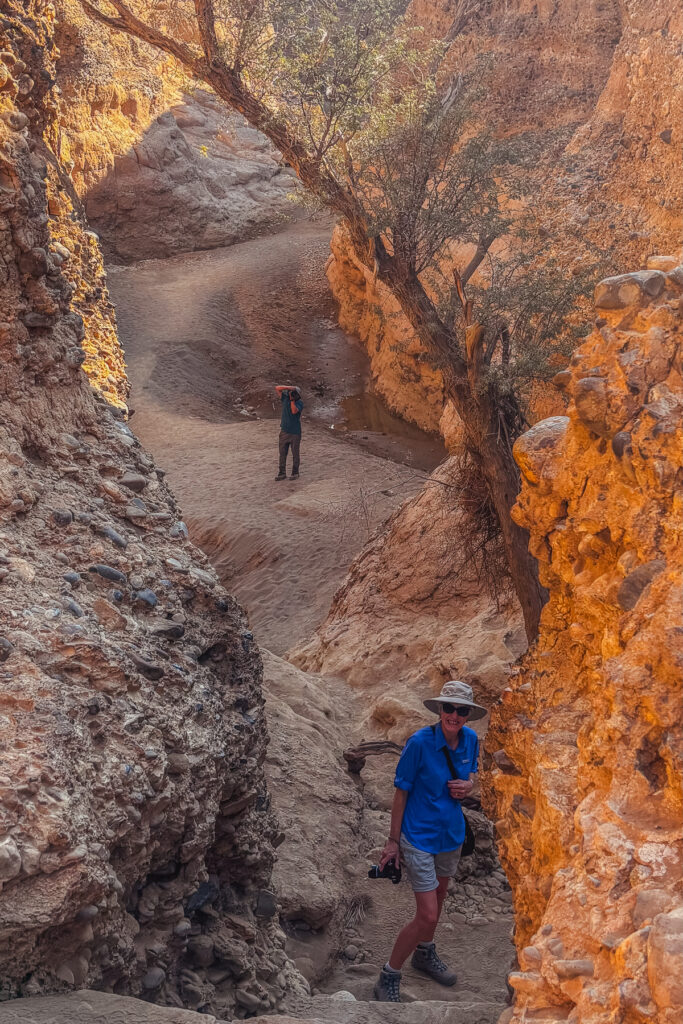
Namibia tour-member Ruth smiles at the mouth of Sesriem Canyon – a surprisingly fascinating excursion into a gorge by Sossusvlei’s Tsauchab River (image by Virginia Wilde)
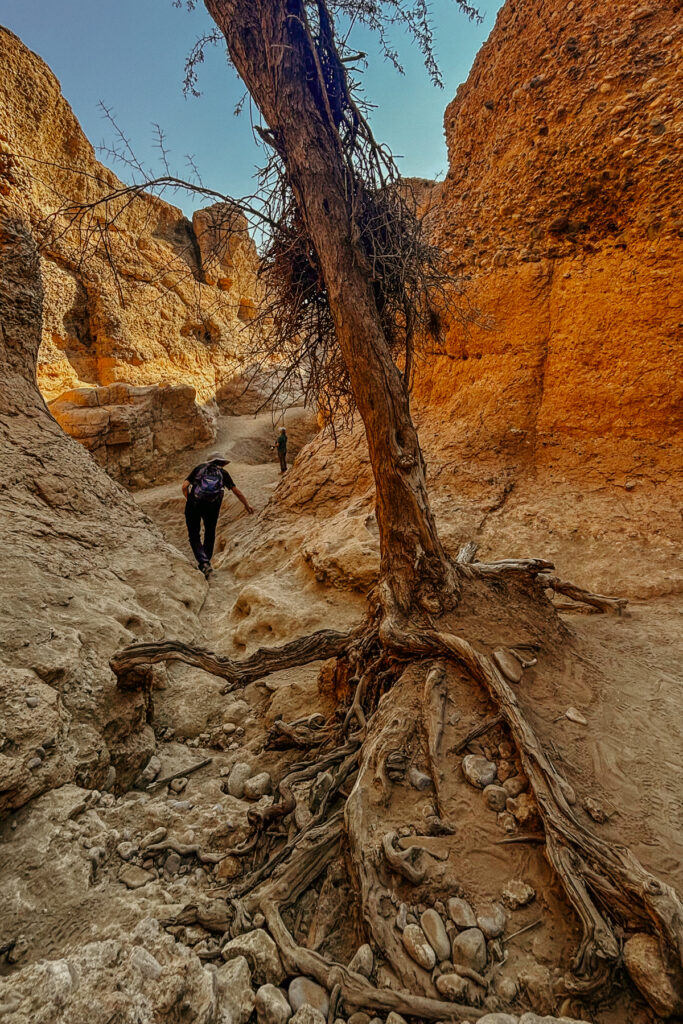
Namibia tour-member KC loved exploring the crevices and gnarled trees of Sesriem Canyon in Sossusvlei (image by Virginia Wilde)
The rock formations grew more dramatic as we walked farther in, and at times the whole place felt distinctly like a set from an Indiana Jones movie.
That evening, we had our final dinner together, which was rather too soon for my liking. The next morning, we packed the vehicles once again for the long drive back to Windhoek, stopping at Solitaire for one last apple pie before heading across the desert.
The road back had its own surprises, including some spectacular climbs and one particularly mountainous section, complete with endless switchbacks, that looked almost impossibly high from the bottom.
Eventually the desert gave way to the outskirts of Windhoek, and – after more than 2,000 kilometres on the road – the tour came to an end.
A rare photograph of any Wild Images tour leaders pictured together. Mike Watson and Gin Wilde attempt a selfie during our Sandwich Harbour dune driving day (image by Virginia Wilde)
Namibia had somehow managed to be several trips in one: a wildlife safari, a serious road trip and, in those final days, an extraordinary landscape photography expedition.
Wild Images had revamped the itinerary for this year’s tour, adding in the spectacular Onkolo hide and tightening the number of days.
This made for a wildlife-rammed whirlwind tour, but also perhaps the most exhilarating wildlife expedition I have ever had the pleasure of leading. A huge thank you to my co-guide, the incredibly warm and knowledgeable Mike Watson, and an absolutely wonderful group of tour members.
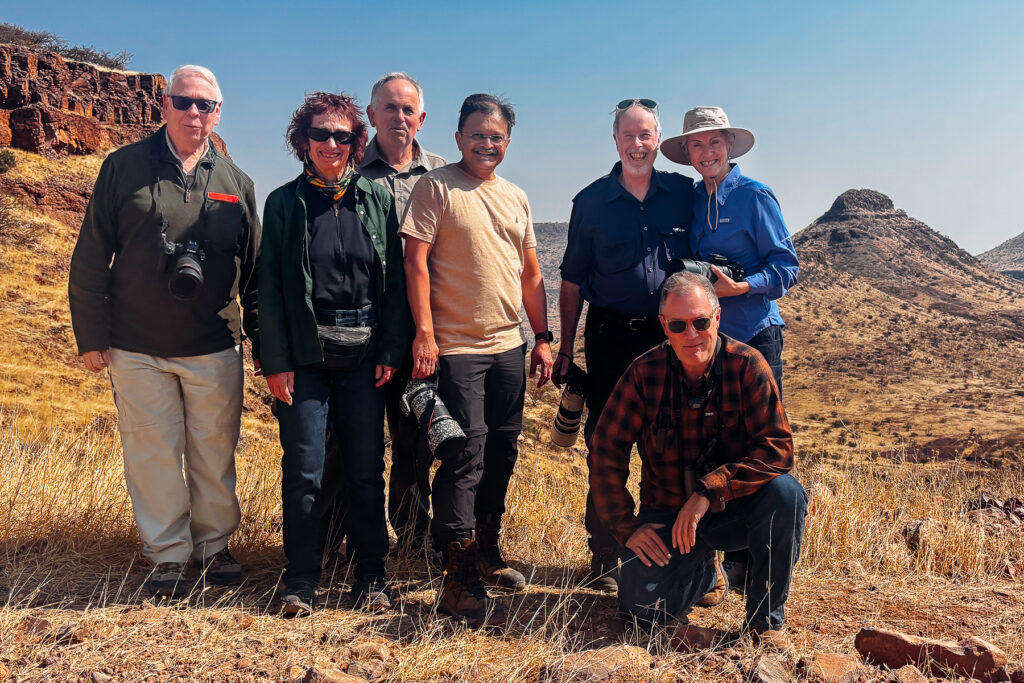
Our brilliant Namibia 2026 tour members pose with co-leader Mike Watson during a break from our road trip towards Namibia’s Hoanib River Valley (image by Virginia Wilde)
Virginia Wilde
Virginia Wilde lives in Edinburgh with her two children, Esme and Albie. Virginia is a photojournalist with a life-long passion for wildlife and the natural world. She spent years working in conflict zones such as Afghanistan and Libya – but has returned to her love of nature and is now based in Scotland. Virginia has […]