
Botswana Wildlife Spectacular Photography Tour Report 2025
5 January 2026

An African Fish Eagle swoops on Botswana's Chobe River. These are not 'true' eagles, but belong to the Haliaeetus genus of sea eagles, alongside seven other species worldwide that include the American Bald Eagle and the White Tailed Eagle (image by Virginia Wilde)

A Chacma Baboon climbing a tree is silhouetted against the sky in Botswana's Chobe National Park (image by Virginia Wilde)

A female Leopard rests on a tree branch in the Botswana's Moremi Game Reserve. Leopards frequently sleep in trees, dragging kills up with them, to keep them safe from other carnivores (image by Virginia Wilde)

Family members of Botswana's Northern Pride of Lions hurry along their newest cub, as the pride moves into the shade of the bushes to escape the rising heat of the day (image by Virginia Wilde)

A handsome Roan Antelope in woodland in Moremi Game Reserve. Roan Antelopes are elusive, and revered in many African cultures for their beauty and strength (image by Virginia Wilde)

Chacma baboons are one of the largest monkey species and known for their large, complex troops of sometimes 200+ members. They use grooming as a crucial behaviour for hygiene, social bonding and stress reduction (image by Virginia Wilde)

This bloat of hippos appeared to be having a raucous time as they bathed together, jostling for position and displaying dominance, in the cool waters of a delta pool (image by Virginia Wilde)

'The Conference of the Scavengers'. Two jackals and a vulture appear to be discussing tactics on how to separate a lion from his kill - before they can themselves feast (image by Virginia Wilde)

A Spotted Bush Snake winds its way around the trunk of a large tree in Botswana's Thamalakane River Lodge. These slim snakes are completely non-venomous and actually quite shy - but often mistaken for the highly poisonous Boomslang (image by Virginia Wilde)

A lone Tsessebe stands stationary - not taking his eyes off the stalking male lion just meters away, for one second. Adult Tsessebe are rarely prey for lions. As Africa's fastest antelopes (with speeds of 56mph) they can easily outrun most predators (image by Virginia Wilde)

A Southern Red-billed Hornbill hops onto a tree stump in Savuti, northern Botswana (image by Virginia Wilde)

Two immature male lion brothers greet each other tenderly in Savuti (image by Virginia Wilde)

A juvenile African Bush Elephant emerges from the trees after a day of rainstorms in Moremi Game Reserve, Botswana (image by Virginia Wilde)

A lone elephant walks in the meadows of Botswana's Khwai concession. These grasslands are full of Kalahari Apple-leaf trees, many destroyed by flood waters decades earlier (image by Virginia Wilde)

An immature Bateleur Eagle, before it develops the striking adult colouration. Bateleur's name derives from the French word for 'acrobat' reflecting its impressive flying abilities, which include diving, tumbling and rolling (image by Virginia Wilde)

A female Leopard acts fast to hide her freshly-killed Impala prey from lion thieves - having first dragged the carcass into bushes in Savuti (image by Virginia Wilde)

One of the benefits in visiting the Okavango delta at the beginning of the 'Green Season' is the many infants born at this time of year. Here, a Tsessebe with her calf (image by Virginia Wilde)

This year's Botswana tour was noted for its early rains, lush vegetation - and undeniably stunning sunset skies (image by Virginia Wilde)

A beautiful female Leopard rests high in the trees over the meadows of Moremi Game Reserve (image by Virginia Wilde)


A male lion takes some time out to rest by the banks of the Chobe River. Botswana's Chobe National Park is renowned for its significant lion populations (image by Virginia Wilde)

Some trees are perfect for Leopard lazing. And this one in Botswana's Moremi Game Reserve shows exactly why (image by Virginia Wilde)

Hold on tight little Chacma Baboon! The scurrying around and antics of a large troop of baboons kept us entertained for nearly an hour in Chobe National Park (image by Virginia Wilde)

A Botswana elephant enjoying a mud bath (image by Virginia Wilde)

A juvenile lion cub wakes, yawns, bares its canine teeth - and then slumps down again to sleep with its pride in the late morning heat, in Savuti (image by Virginia Wilde)

A Tower of Southern Giraffe move silently through the undergrowth in Botswana's Chobe National Park. All giraffes are classified as vulnerable by the IUCN - with around 44,000 Southern Giraffe left in the wild (image by Virginia Wilde)

An African Bush Elephant scoops water from the marshy meadows of the Okavango Delta, moments before heavy rain drenches everything around (image by Virginia Wilde)

Young Leopards often toy with their prey before learning how to kill them swiftly. Here, a juvenile leopard isn't sure quite what to do next with its captured Impala calf (image by Virginia Wilde)

And they're on the move again. Members of Botswana's famous Northern Pride head towards bushes to sleep, with two younger members seemingly wishing there was more time to scamper and play (image by Virginia Wilde)

Along with the thunderstorms, this year's Botswana tour experienced some incredible skies, running the gamut from every shade of purple, red and blue (image by Virginia Wilde)

A female Leopard drags her recently-killed Impala prey further into the bushes - away from potential Lion thieves (image by Virginia Wilde)

Dust clouds form beneath the hooves of a springing male Impala, illuminated by the first rays of the morning sun in Botswana's Chobe National Park (image by Virginia Wilde)

An African Openbill showing the peculiar shaped bill (with the characteristic mandible gap) that gives this stork its name (image by Virginia Wilde)

"We said 'Bedtime'. And there's no escaping when you have a tail as long as yours to tug" An escaping infant Chacma Baboon is caught by elder members of its troop. Chacma Baboons can live in troops of more than 200 individuals (image by Virginia Wilde)

If this year's tour report had a section entitled 'Images taken using a phone on our morning game drive coffee break, this could be one. A family of Elephants wade through one of the shallow channels in the Okavango Delta (image by Virginia Wilde)

A White-backed Vulture soars past the trees in Botswana's Moremi Game Reserve. White-backed vultures often gather in large groups of sometimes hundreds of birds, but are also very clean and like to bathe after meals (image by Virginia Wilde)

A male lion - believed to be the individual known as 'Mad Eye' - sits by his kill in Botswana's Moremi Game Reserve. 'Mad Eye' is the name given to this younger, upcoming male who was part of the coalition that challenged the dominant 'Toms Toms' males, with his eye condition attributed to an injury sustained in a severe territorial battle (image by Virginia Wilde)

Waiting patiently in his teacup-sized nest, an African Paradise Flycatcher in the grounds of the Thamalakane River Lodge, Maun (image by Virginia Wilde)

An early-arriving Rainy Season meant that waters along our route were already rising - with this meadow (that hid a usually-passable road) had to be manoeuvred around (image by Virginia Wilde)

The striking Woodland Kingfisher is still often heard before it is seen; with the call of this noisy river bird likened to a nail being run down the teeth of a metal comb (image by Virginia Wilde)

A Blue Wildebeest races around the plains of Botswana's Moremi Game Reserve. Wildebeest are keystone species in this grassland ecosystem, fertilising plants and creating pathways (image by Virginia Wilde)

The Hippo pool near our Khwai campsite, looking tranquil as the sun came out and bathed everything in warmer light. Our Khwai campsite was a favourite for a few tour members. With views like this, it's no wonder why (image by Virginia Wilde)

Impalas are famous for their incredible athletic leaps - jumping up to 10 ft high and able to cover a massive 33 ft in distance in their efforts to avoid predators (image by Virginia Wilde)

Impala mothers hide their young calves in the bushes in Moremi Game Reserve, hoping the cover offers some protection against a raft of predators (image by Virginia Wilde)

Male lion known as Pretty Boy in Savuti (image by Virginia Wilde)

A herd of African Bush Elephants - complete with newly-born calves - stroll single-file down towards the Chobe River (image by Virginia Wilde)

'Mud, mud, glorious mud. Nothing quite like it for cooling the blood...' etc etc. A herd of African Bush Elephants enjoy their morning mud bath in Botswana's Chobe National Park (image by Virginia Wilde)

A lioness pants from the exertion of her recent Kudu kill, with blood still marking her cheek and a visible injury from the hunt on her leg (image by Virginia Wilde)

'Down by the riverbank we will go!' An elephant and her young calf paddle in the shallows of Botswana's Chobe River (image by Virginia Wilde)

A young male lion stalks the bushes and grasslands of the Moremi Game Reserve, Botswana, looking for prey (image by Virginia Wilde)

A juvenile African Bush Elephant, also known as the African Savannah Elephant, splashes through a tributary of the Chobe River (image by Virginia Wilde)

An Ostrich picks its way through the bushes and grasses in Botswana's Moremi Game Reserve, emerging just as the hours of heavy rain stopped (image by Virginia Wilde)

The large Spur-winged Goose is a common sight around the inland channels of the Okavango Delta - showing the red frontal knob that darkens in the breeding season (image by Virginia Wilde)

What's the greatest toy a young lion cub can have, while the rest of his pride is sleeping? Yup, his dad's tail. Endless entertainment (image by Virginia Wilde)

One of Northern Botswana's most famous lions - 'Pretty Boy II' - sits by a pool in Savuti. This handsome beast is a key member of the 'Northern Renegades' - a powerful male lion coalition (image by Virginia Wilde)

Scores of Yellow-billed Kites and European Rollers filled the sky during a Termite swarm, one early evening. I could have spent hours trying to capture an image that summed up the moment (image by Virginia Wilde)

In Botswana's Chobe National Park, Elephants rule. Here one family group pads through the sand to reach the swelling Chobe River (image by Virginia Wilde)

A young Leopard stares over its shoulder, with the limb of its Impala calf prey just visible to the side. Juvenile leopard are known to play with their kills before finally dispatching them (image by Virginia Wilde)

Jousting male Impalas play-fight in practice for the often-brutal mating season, when such tussles can become intense and far more dangerous (image by Virginia Wilde)

'Eyes Front!' (Most of you, anyway.) A herd of Waterbuck stand out against the muted green vegetation after a thunderstorm in Moremi Game Reserve. One antelope shows the species' characteristic 'bulls-eye' marking on its rump (image by Virginia Wilde)

A mother Peters's Epauletted Fruit Bat wraps her infant in her wings, in the grounds of the Thamalakane River Lodge, Maun, Botswana (image by Virginia Wilde)

Tawny Eagles are known for being incredibly skilled hunters - frequently stealing food from other raptors (image by Virginia Wilde)

Warthogs can be surprisingly charismatic animals to photograph, although many are very skittish. Here, 'Pumbaa' darts towards cover in the Moremi Game Reserve (image by Virginia Wilde)

The shallow pools of the Okavango Delta allow for many reflection images - such as this one of a curious Black-backed Jackal padding through the Khwai Community Concession (image by Virginia Wilde)

A Common Slender Mongoose - one of four species of Mongoose we saw on our tour - scampers across a rock face in Botswana's Savuti (image by Virginia Wilde)

'The Amiability of Scavengers'. A Spotted Hyena and Black-backed Jackal share the leftovers of a lion's kill - seemingly untroubled by each other (image by Virginia Wilde)

Although common in Botswana's woodlands, the glossy colouration of the Burchell's Starling still make it a striking sight (image by Virginia Wilde)

Portrait of a male Lion stalking the grasslands of Moremi Game Reserve (image by Virginia Wilde)

No fewer than eleven Oxpeckers gather on the neck of a Southern Giraffe - enough for a party, surely! (image by Virginia Wilde)

Dark storm clouds gather behind a tree in Moremi Game Reserve, making the kind of dramatic sky that can be a gift for photographers (image by Virginia Wilde)

Dappled light ripples over the head of a female Leopard, as she hides her impala prey in Savuti, Botswana (image by Virginia Wilde)

A Giant Kingfisher - the largest kingfisher in Africa - waiting for fish along the banks of Botswana's Chobe River (image by Virginia Wilde)

"I'm young, so this kind of stretch is easy for me!" A juvenile Southern Giraffe displays its beautiful patched skin markings and ability to avoid a cricked neck in Savuti, Botswana (image by Virginia Wilde)

With the early rains of the 'Green Season' you can also get incredible reflections - both of wildlife and vegetation (image by Virginia Wilde)

This cute pair of Southern Giraffe twins seem pocket-sized when backdropped by their towering mother in Savuti, Botswana (image by Virginia Wilde)

"No you can't fit my entire nose inside your mouth!" Known for their playfulness and cunning, in the folklore of several indigenous tribes in southern Africa, the Black-backed Jackal travels in tandem with the lion, which it frequently outsmarts using its superior intelligence (image by Virginia Wilde)

Close-up of Hippos enjoying a communal bathing session. Hippos live in groups called pods, with their closest living relatives being whales, dolphins and porpoises (image by Virginia Wilde)

A juvenile Leopard rushing back to the impala calf it caught - seemingly unsure of what to do with its still-alive prey. Young Leopards often play with their kills while learning to hunt (image by Virginia Wilde)

A juvenile Martial Eagle appears to wonder quite how much more bombing it can take from a species of roller. When all he wanted to do was relax on this stick (image by Virginia Wilde)

A tender moment between a Lioness and her cub, nudging him to follow as other members of their Botswana Northern Pride move on from their resting place (image by Virginia Wilde)

A pair of young male impalas practice duelling using their distinctive lyre-shaped horns (image by Virginia Wilde)

A juvenile African Bush Elephant hurries to catch up with the rest of its herd, as they traverse from the woods to the Chobe River to cool down as the day heats up (image by Virginia Wilde)

Portrait of a Southern Carmine Bee-eater, a migratory bird in Botswana from August to November (image by Virginia Wilde)

Impala square off by the banks of a tributary of Botswana's Chobe River (image by Virginia Wilde)

'Left side, right side, and stretch!' A male Lion takes advantage of the warm morning light to have a good old stretch, in Savuti, Botswana (image by Virginia Wilde)

An African Bush Elephant mother cools herself and her calf with water from Botswana's Chobe River (image by Virginia Wilde)

An African Barred Owlet sitting and gently calling above our campfire in Savuti, part of Botswana's Chobe National Park (image by Virginia Wilde)

Impala males lock horns as they duel in Botswana's Chobe National Park. Impala fights during the rutting season can be intense, with males jousting for dominance and territory (image by Virginia Wilde)

An immature male Lion - one of the next generation of Marsh Pride lions yet to engage in fierce territorial battles - emerges from the shadows of the bushes in Savuti, Botswana (image by Virginia Wilde)

A frustrated Southern Giraffe sticks out its tongue and sends a small flock of Oxpecker flying - needing a break from the constant pecking for ticks (image by Virginia Wilde)

A juvenile Lion cub pads around sleeping members of Botswana's Northern Pride - in the hope at least one of them wakes up to play (image by Virginia Wilde)

Black and white portrait of one of Botswana's Northern Pride lionesses as she tends her cub, ensuring the infant is not left behind as the pride moves on (image by Virginia Wilde)

A Blue Wildebeest strolls in a meadow in Botswana's Moremi Game Reserve, seemingly permanently accompanied by Oxpeckers and Cattle Egrets (image by Virginia Wilde)

A male Lion bares his teeth in a former orchard area of Khwai Community Concession, where thousands of Kalahari Apple-leaf trees were destroyed by great floods decades ago (image by Virginia Wilde)

This curious Chacma Baboon infant couldn't stop staring at us - while still clinging to its mother - in Botswana's Moremi Game Reserve (image by Virginia Wilde)

The much-adored Lilac-breasted Roller - showcasing its incredible colours. Trying to snap an image of one mid-flight is a popular Botswana tour activity (image by Virginia Wilde)

A rare sighting of an African Wildcat - part of Africa's 'Secret Seven' elusive animals, known for being notoriously difficult to spot. We found this wildcat - the ancestor of all domestic cats - gingerly stepping around a Rock Python, while out on a night drive in Khwai Community Concession (image by Virginia Wilde)

"If dad's tail wasn't meant to be played with, why would it have a fluffy pompom on the end of it?" Little Lion cub, you have a point (image by Virginia Wilde)

An African Jacana displaying the long toes and claws that enable it to walk on floating vegetation in shallow lakes, seen here in Botswana's Chobe National Park (image by Virginia Wilde)

A pair of lion cubs wait for the rest of their Northern Pride family members to catch up with them, before heading into dense undergrowth to sleep amid the rising heat of the day (image by Virginia Wilde)

A female Leopard surveys her Okavango Delta kingdom, high in the branches of a Jackalberry Tree. Leopards are known for their incredible strength and stealth (image by Virginia Wilde)

An Oxpecker is briefly hurled into the air as a Southern Giraffe throws its neck up, temporarily frustrated by the birds clinging to its skin (image by Virginia Wilde)

The sunsets in this year's Wild Images Botswana trip were almost otherworldly in their colours and scope (image by Virginia Wilde)

A newly-born Impala is far from wobbly on its legs. Calves must be able to stand and walk within 10 to 30 minutes of birth - and attempt to run within an hour. A crucial survival tactic with so many predators around (image by Virginia Wilde)

Fans of 'Intimate Landscape' photography would do a much greater job than me at photographing some of the incredible bark on the trees whose shade we enjoyed during our morning game drive coffee breaks (image by Virginia Wilde)

The late evening sun lights up the distinctive throat pouch of a Marabou Stork in Savuti, Botswana. Sometimes nicknamed 'undertakers' for their dark wings, bald heads and hunched posture, Marabou Stocks are vital carrion eating 'clean-up crew' birds (image by Virginia Wilde)

Flocks of vultures and Marabou Storks roost together, backdropped by one of Botswana's beautiful sunset skies (image by Virginia Wilde)

An African Bush Elephant grazes by a Kalahari Apple-leaf Tree in the lush grasslands of the Khwai Community concession (image by Virginia Wilde)

The daily routine for many African Bush Elephants in the Chobe National Park is to journey from the woods down to the river - to roll in mud and bathe. Sounds like a pretty great routine to me (image by Virginia Wilde)
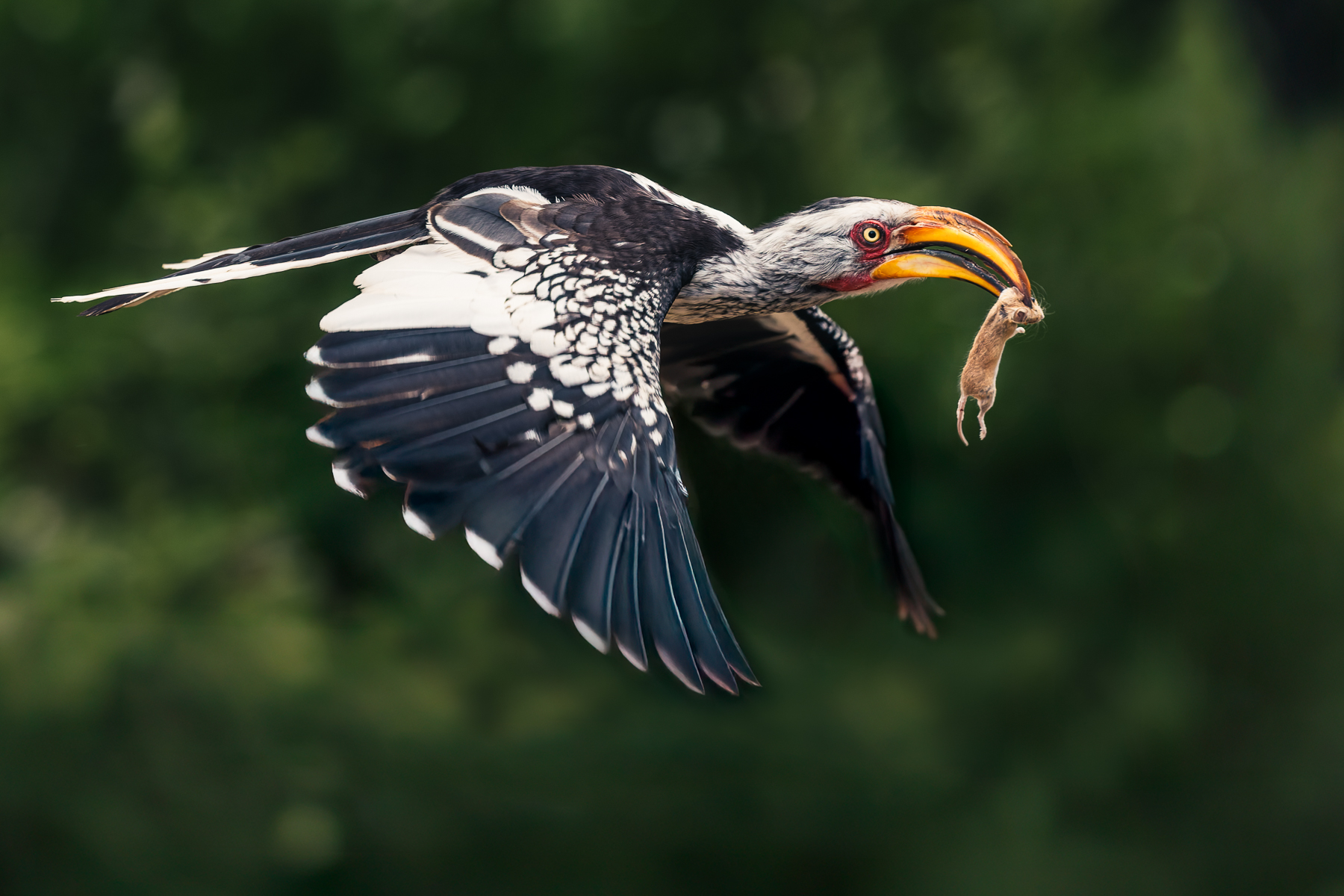
A Southern Yellow-billed Hornbill flies off with its prey - a recently-caught Desert Pygmy Mouse, that had scurried around our boots at lunchtime, hoping to escape the hornbill's prying eyes (image by Virginia Wilde)

A male Red Lechwe is reflected in the shallow waters of the Okavango Delta. Red Lechwe are semi-aquatic antelopes - known for living in wetlands, using their splayed hooves to move in deep water and find safety from predators (image by Virginia Wilde)

Black-and-white portrait of a female Leopard, resting on a tree branch in Botswana's Moremi Game Reserve Leopards favour the Jackalberry and Marula trees, for their broad branches and ease of climbing (image by Virginia Wilde)

A family of African Bush Elephants relish being in the cool waters of Botswana's Chobe River (image by Virginia Wilde)

Burchell's Zebra: not only highly watchable animals but a gift for black-and-white photography (image by Virginia Wilde)

A young Elephant calf races ahead of its herd members in its eagerness to reach the cooling waters and mud of Botswana's Chobe River (image by Virginia Wilde)

Dramatic weather was a feature of this year's Botswana tour - which would have been endlessly tantalising for landscape photographers (image by Virginia Wilde)

A Spotted Hyena and Black-backed Jackal share the spoils of a Lion's kill - after waiting for hours for the hunter to leave, so they could tuck in (image by Virginia Wilde)

A Black-backed Jackal pads across the shallow pools in Botswana's Moremi Game Reserve. Despite being the smallest of the jackals, the Black-backed can be an aggressive predator, often taking on predators larger than themselves (image by Virginia Wilde)

Warm morning sun lights up a tree as we arrived in the Khwai Community Concession, with lush meadows and beautiful woodlands mixing with the rising waters of the delta (image by Virginia Wilde)

A Kori Bustard puffs out his throat in an elaborate courtship display - which is totally wasted on the resting herd of Wildebeest nearby. During these displays the male bustard inflates his oesophagus to four times its size, enabling him to amplify his booming call and showcase his white throat feathers (image by Virginia Wilde)

Black-and-white image of one of Chobe National Park's African Bush Elephant herds - as they move from a grassland of mud holes towards the Chobe River (image by Virginia Wilde)

"Have you heard the one about the hyena? Always sleeping on the job!" A pair of jackals lark about and playfight in front of a patient Spotted Hyena - while waiting for a lion to leave his kill (image by Virginia Wilde)

Aww 'Pretty Boy', you are indeed a handsome Lion. One of Savuti's iconic individuals, known for his striking looks and his part in the powerful 'Renegades Coalition.' (image by Virginia Wilde)

The warm tones of an Okavango Delta sunset. This year's tour members were rewarded with some spectacular coloured skies amid the storms (image by Virginia Wilde)

The stunning adult colouration of a male Bateleur Eagle perched in a tree in Botswana's Moremi Game Reserve (image by Virginia Wilde)

"Right, listen up little'un. I tell you all the gossip and you let me pick off any ticks. That's how this symbiotic friendship thing works." An Oxpecker explains the concept of mutualism to a Zebra foal (image by Virginia Wilde)

The Southern Ground Hornbill is the largest species in the hornbill order. Local superstitions state that if you kill a ground hornbill the rains will come with such force that it will literally wash your land away (image by Virginia Wilde)

A Wildebeest calf - born within the last hour - stands up as his mother protectively looms nearby. The mother still had the afterbirth attached as we watched this beautiful post-birth moment from our safari vehicle (image by Virginia Wilde)

This baby Peters's Epauletted Fruit Bat has the best grin I'd seen for ages, still roosting wrapped in its mother's wings, in Maun (image by Virginia Wilde)

When the heavy rains fall, out come the frogs. This poor individual was breakfast for a Yellow-billed Stork, which repeatedly dipped her prey in the water to make it easier to swallow (image by Virginia Wilde)

We finally found some members of Savuti's famous Marsh Pride on this tour - renowned for their elephant-hunting abilities when the delta ran dry. But this younger generation looked more sweet than fierce (image by Virginia Wilde)

A Southern Giraffe stands backdropped by the last strands of sunset after a break in the rain in Botswana's Moremi Game Reserve (image by Virginia Wilde)

Water-lilies carpet the lagoon waters in the Khwai area of Botswana's Okavango Delta. The lilies form part of a rich ecosystem that attracts birds and other animals, and can create 'Monet-style' painterly water scenes (image by Virginia Wilde)




An African Fish Eagle swoops on Botswana's Chobe River. These are not 'true' eagles, but belong to the Haliaeetus genus of sea eagles, alongside seven other species worldwide that include the American Bald Eagle and the White Tailed Eagle (image by Virginia Wilde)
A Chacma Baboon climbing a tree is silhouetted against the sky in Botswana's Chobe National Park (image by Virginia Wilde)
A female Leopard rests on a tree branch in the Botswana's Moremi Game Reserve. Leopards frequently sleep in trees, dragging kills up with them, to keep them safe from other carnivores (image by Virginia Wilde)
Family members of Botswana's Northern Pride of Lions hurry along their newest cub, as the pride moves into the shade of the bushes to escape the rising heat of the day (image by Virginia Wilde)
A handsome Roan Antelope in woodland in Moremi Game Reserve. Roan Antelopes are elusive, and revered in many African cultures for their beauty and strength (image by Virginia Wilde)
Chacma baboons are one of the largest monkey species and known for their large, complex troops of sometimes 200+ members. They use grooming as a crucial behaviour for hygiene, social bonding and stress reduction (image by Virginia Wilde)
This bloat of hippos appeared to be having a raucous time as they bathed together, jostling for position and displaying dominance, in the cool waters of a delta pool (image by Virginia Wilde)
'The Conference of the Scavengers'. Two jackals and a vulture appear to be discussing tactics on how to separate a lion from his kill - before they can themselves feast (image by Virginia Wilde)
A Spotted Bush Snake winds its way around the trunk of a large tree in Botswana's Thamalakane River Lodge. These slim snakes are completely non-venomous and actually quite shy - but often mistaken for the highly poisonous Boomslang (image by Virginia Wilde)
A lone Tsessebe stands stationary - not taking his eyes off the stalking male lion just meters away, for one second. Adult Tsessebe are rarely prey for lions. As Africa's fastest antelopes (with speeds of 56mph) they can easily outrun most predators (image by Virginia Wilde)
A Southern Red-billed Hornbill hops onto a tree stump in Savuti, northern Botswana (image by Virginia Wilde)
Two immature male lion brothers greet each other tenderly in Savuti (image by Virginia Wilde)
A juvenile African Bush Elephant emerges from the trees after a day of rainstorms in Moremi Game Reserve, Botswana (image by Virginia Wilde)
A lone elephant walks in the meadows of Botswana's Khwai concession. These grasslands are full of Kalahari Apple-leaf trees, many destroyed by flood waters decades earlier (image by Virginia Wilde)
An immature Bateleur Eagle, before it develops the striking adult colouration. Bateleur's name derives from the French word for 'acrobat' reflecting its impressive flying abilities, which include diving, tumbling and rolling (image by Virginia Wilde)
A female Leopard acts fast to hide her freshly-killed Impala prey from lion thieves - having first dragged the carcass into bushes in Savuti (image by Virginia Wilde)
One of the benefits in visiting the Okavango delta at the beginning of the 'Green Season' is the many infants born at this time of year. Here, a Tsessebe with her calf (image by Virginia Wilde)
This year's Botswana tour was noted for its early rains, lush vegetation - and undeniably stunning sunset skies (image by Virginia Wilde)
A beautiful female Leopard rests high in the trees over the meadows of Moremi Game Reserve (image by Virginia Wilde)
A male lion takes some time out to rest by the banks of the Chobe River. Botswana's Chobe National Park is renowned for its significant lion populations (image by Virginia Wilde)
Some trees are perfect for Leopard lazing. And this one in Botswana's Moremi Game Reserve shows exactly why (image by Virginia Wilde)
Hold on tight little Chacma Baboon! The scurrying around and antics of a large troop of baboons kept us entertained for nearly an hour in Chobe National Park (image by Virginia Wilde)
A Botswana elephant enjoying a mud bath (image by Virginia Wilde)
A juvenile lion cub wakes, yawns, bares its canine teeth - and then slumps down again to sleep with its pride in the late morning heat, in Savuti (image by Virginia Wilde)
A Tower of Southern Giraffe move silently through the undergrowth in Botswana's Chobe National Park. All giraffes are classified as vulnerable by the IUCN - with around 44,000 Southern Giraffe left in the wild (image by Virginia Wilde)
An African Bush Elephant scoops water from the marshy meadows of the Okavango Delta, moments before heavy rain drenches everything around (image by Virginia Wilde)
Young Leopards often toy with their prey before learning how to kill them swiftly. Here, a juvenile leopard isn't sure quite what to do next with its captured Impala calf (image by Virginia Wilde)
And they're on the move again. Members of Botswana's famous Northern Pride head towards bushes to sleep, with two younger members seemingly wishing there was more time to scamper and play (image by Virginia Wilde)
Along with the thunderstorms, this year's Botswana tour experienced some incredible skies, running the gamut from every shade of purple, red and blue (image by Virginia Wilde)
A female Leopard drags her recently-killed Impala prey further into the bushes - away from potential Lion thieves (image by Virginia Wilde)
Dust clouds form beneath the hooves of a springing male Impala, illuminated by the first rays of the morning sun in Botswana's Chobe National Park (image by Virginia Wilde)
An African Openbill showing the peculiar shaped bill (with the characteristic mandible gap) that gives this stork its name (image by Virginia Wilde)
"We said 'Bedtime'. And there's no escaping when you have a tail as long as yours to tug" An escaping infant Chacma Baboon is caught by elder members of its troop. Chacma Baboons can live in troops of more than 200 individuals (image by Virginia Wilde)
If this year's tour report had a section entitled 'Images taken using a phone on our morning game drive coffee break, this could be one. A family of Elephants wade through one of the shallow channels in the Okavango Delta (image by Virginia Wilde)
A White-backed Vulture soars past the trees in Botswana's Moremi Game Reserve. White-backed vultures often gather in large groups of sometimes hundreds of birds, but are also very clean and like to bathe after meals (image by Virginia Wilde)
A male lion - believed to be the individual known as 'Mad Eye' - sits by his kill in Botswana's Moremi Game Reserve. 'Mad Eye' is the name given to this younger, upcoming male who was part of the coalition that challenged the dominant 'Toms Toms' males, with his eye condition attributed to an injury sustained in a severe territorial battle (image by Virginia Wilde)
Waiting patiently in his teacup-sized nest, an African Paradise Flycatcher in the grounds of the Thamalakane River Lodge, Maun (image by Virginia Wilde)
An early-arriving Rainy Season meant that waters along our route were already rising - with this meadow (that hid a usually-passable road) had to be manoeuvred around (image by Virginia Wilde)
The striking Woodland Kingfisher is still often heard before it is seen; with the call of this noisy river bird likened to a nail being run down the teeth of a metal comb (image by Virginia Wilde)
A Blue Wildebeest races around the plains of Botswana's Moremi Game Reserve. Wildebeest are keystone species in this grassland ecosystem, fertilising plants and creating pathways (image by Virginia Wilde)
The Hippo pool near our Khwai campsite, looking tranquil as the sun came out and bathed everything in warmer light. Our Khwai campsite was a favourite for a few tour members. With views like this, it's no wonder why (image by Virginia Wilde)
Impalas are famous for their incredible athletic leaps - jumping up to 10 ft high and able to cover a massive 33 ft in distance in their efforts to avoid predators (image by Virginia Wilde)
Impala mothers hide their young calves in the bushes in Moremi Game Reserve, hoping the cover offers some protection against a raft of predators (image by Virginia Wilde)
Male lion known as Pretty Boy in Savuti (image by Virginia Wilde)
A herd of African Bush Elephants - complete with newly-born calves - stroll single-file down towards the Chobe River (image by Virginia Wilde)
'Mud, mud, glorious mud. Nothing quite like it for cooling the blood...' etc etc. A herd of African Bush Elephants enjoy their morning mud bath in Botswana's Chobe National Park (image by Virginia Wilde)
A lioness pants from the exertion of her recent Kudu kill, with blood still marking her cheek and a visible injury from the hunt on her leg (image by Virginia Wilde)
'Down by the riverbank we will go!' An elephant and her young calf paddle in the shallows of Botswana's Chobe River (image by Virginia Wilde)
A young male lion stalks the bushes and grasslands of the Moremi Game Reserve, Botswana, looking for prey (image by Virginia Wilde)
A juvenile African Bush Elephant, also known as the African Savannah Elephant, splashes through a tributary of the Chobe River (image by Virginia Wilde)
An Ostrich picks its way through the bushes and grasses in Botswana's Moremi Game Reserve, emerging just as the hours of heavy rain stopped (image by Virginia Wilde)
The large Spur-winged Goose is a common sight around the inland channels of the Okavango Delta - showing the red frontal knob that darkens in the breeding season (image by Virginia Wilde)
What's the greatest toy a young lion cub can have, while the rest of his pride is sleeping? Yup, his dad's tail. Endless entertainment (image by Virginia Wilde)
One of Northern Botswana's most famous lions - 'Pretty Boy II' - sits by a pool in Savuti. This handsome beast is a key member of the 'Northern Renegades' - a powerful male lion coalition (image by Virginia Wilde)
Scores of Yellow-billed Kites and European Rollers filled the sky during a Termite swarm, one early evening. I could have spent hours trying to capture an image that summed up the moment (image by Virginia Wilde)
In Botswana's Chobe National Park, Elephants rule. Here one family group pads through the sand to reach the swelling Chobe River (image by Virginia Wilde)
A young Leopard stares over its shoulder, with the limb of its Impala calf prey just visible to the side. Juvenile leopard are known to play with their kills before finally dispatching them (image by Virginia Wilde)
Jousting male Impalas play-fight in practice for the often-brutal mating season, when such tussles can become intense and far more dangerous (image by Virginia Wilde)
'Eyes Front!' (Most of you, anyway.) A herd of Waterbuck stand out against the muted green vegetation after a thunderstorm in Moremi Game Reserve. One antelope shows the species' characteristic 'bulls-eye' marking on its rump (image by Virginia Wilde)
A mother Peters's Epauletted Fruit Bat wraps her infant in her wings, in the grounds of the Thamalakane River Lodge, Maun, Botswana (image by Virginia Wilde)
Tawny Eagles are known for being incredibly skilled hunters - frequently stealing food from other raptors (image by Virginia Wilde)
Warthogs can be surprisingly charismatic animals to photograph, although many are very skittish. Here, 'Pumbaa' darts towards cover in the Moremi Game Reserve (image by Virginia Wilde)
The shallow pools of the Okavango Delta allow for many reflection images - such as this one of a curious Black-backed Jackal padding through the Khwai Community Concession (image by Virginia Wilde)
A Common Slender Mongoose - one of four species of Mongoose we saw on our tour - scampers across a rock face in Botswana's Savuti (image by Virginia Wilde)
'The Amiability of Scavengers'. A Spotted Hyena and Black-backed Jackal share the leftovers of a lion's kill - seemingly untroubled by each other (image by Virginia Wilde)
Although common in Botswana's woodlands, the glossy colouration of the Burchell's Starling still make it a striking sight (image by Virginia Wilde)
Portrait of a male Lion stalking the grasslands of Moremi Game Reserve (image by Virginia Wilde)
No fewer than eleven Oxpeckers gather on the neck of a Southern Giraffe - enough for a party, surely! (image by Virginia Wilde)
Dark storm clouds gather behind a tree in Moremi Game Reserve, making the kind of dramatic sky that can be a gift for photographers (image by Virginia Wilde)
Dappled light ripples over the head of a female Leopard, as she hides her impala prey in Savuti, Botswana (image by Virginia Wilde)
A Giant Kingfisher - the largest kingfisher in Africa - waiting for fish along the banks of Botswana's Chobe River (image by Virginia Wilde)
"I'm young, so this kind of stretch is easy for me!" A juvenile Southern Giraffe displays its beautiful patched skin markings and ability to avoid a cricked neck in Savuti, Botswana (image by Virginia Wilde)
With the early rains of the 'Green Season' you can also get incredible reflections - both of wildlife and vegetation (image by Virginia Wilde)
This cute pair of Southern Giraffe twins seem pocket-sized when backdropped by their towering mother in Savuti, Botswana (image by Virginia Wilde)
"No you can't fit my entire nose inside your mouth!" Known for their playfulness and cunning, in the folklore of several indigenous tribes in southern Africa, the Black-backed Jackal travels in tandem with the lion, which it frequently outsmarts using its superior intelligence (image by Virginia Wilde)
Close-up of Hippos enjoying a communal bathing session. Hippos live in groups called pods, with their closest living relatives being whales, dolphins and porpoises (image by Virginia Wilde)
A juvenile Leopard rushing back to the impala calf it caught - seemingly unsure of what to do with its still-alive prey. Young Leopards often play with their kills while learning to hunt (image by Virginia Wilde)
A juvenile Martial Eagle appears to wonder quite how much more bombing it can take from a species of roller. When all he wanted to do was relax on this stick (image by Virginia Wilde)
A tender moment between a Lioness and her cub, nudging him to follow as other members of their Botswana Northern Pride move on from their resting place (image by Virginia Wilde)
A pair of young male impalas practice duelling using their distinctive lyre-shaped horns (image by Virginia Wilde)
A juvenile African Bush Elephant hurries to catch up with the rest of its herd, as they traverse from the woods to the Chobe River to cool down as the day heats up (image by Virginia Wilde)
Portrait of a Southern Carmine Bee-eater, a migratory bird in Botswana from August to November (image by Virginia Wilde)
Impala square off by the banks of a tributary of Botswana's Chobe River (image by Virginia Wilde)
'Left side, right side, and stretch!' A male Lion takes advantage of the warm morning light to have a good old stretch, in Savuti, Botswana (image by Virginia Wilde)
An African Bush Elephant mother cools herself and her calf with water from Botswana's Chobe River (image by Virginia Wilde)
An African Barred Owlet sitting and gently calling above our campfire in Savuti, part of Botswana's Chobe National Park (image by Virginia Wilde)
Impala males lock horns as they duel in Botswana's Chobe National Park. Impala fights during the rutting season can be intense, with males jousting for dominance and territory (image by Virginia Wilde)
An immature male Lion - one of the next generation of Marsh Pride lions yet to engage in fierce territorial battles - emerges from the shadows of the bushes in Savuti, Botswana (image by Virginia Wilde)
A frustrated Southern Giraffe sticks out its tongue and sends a small flock of Oxpecker flying - needing a break from the constant pecking for ticks (image by Virginia Wilde)
A juvenile Lion cub pads around sleeping members of Botswana's Northern Pride - in the hope at least one of them wakes up to play (image by Virginia Wilde)
Black and white portrait of one of Botswana's Northern Pride lionesses as she tends her cub, ensuring the infant is not left behind as the pride moves on (image by Virginia Wilde)
A Blue Wildebeest strolls in a meadow in Botswana's Moremi Game Reserve, seemingly permanently accompanied by Oxpeckers and Cattle Egrets (image by Virginia Wilde)
A male Lion bares his teeth in a former orchard area of Khwai Community Concession, where thousands of Kalahari Apple-leaf trees were destroyed by great floods decades ago (image by Virginia Wilde)
This curious Chacma Baboon infant couldn't stop staring at us - while still clinging to its mother - in Botswana's Moremi Game Reserve (image by Virginia Wilde)
The much-adored Lilac-breasted Roller - showcasing its incredible colours. Trying to snap an image of one mid-flight is a popular Botswana tour activity (image by Virginia Wilde)
A rare sighting of an African Wildcat - part of Africa's 'Secret Seven' elusive animals, known for being notoriously difficult to spot. We found this wildcat - the ancestor of all domestic cats - gingerly stepping around a Rock Python, while out on a night drive in Khwai Community Concession (image by Virginia Wilde)
"If dad's tail wasn't meant to be played with, why would it have a fluffy pompom on the end of it?" Little Lion cub, you have a point (image by Virginia Wilde)
An African Jacana displaying the long toes and claws that enable it to walk on floating vegetation in shallow lakes, seen here in Botswana's Chobe National Park (image by Virginia Wilde)
A pair of lion cubs wait for the rest of their Northern Pride family members to catch up with them, before heading into dense undergrowth to sleep amid the rising heat of the day (image by Virginia Wilde)
A female Leopard surveys her Okavango Delta kingdom, high in the branches of a Jackalberry Tree. Leopards are known for their incredible strength and stealth (image by Virginia Wilde)
An Oxpecker is briefly hurled into the air as a Southern Giraffe throws its neck up, temporarily frustrated by the birds clinging to its skin (image by Virginia Wilde)
The sunsets in this year's Wild Images Botswana trip were almost otherworldly in their colours and scope (image by Virginia Wilde)
A newly-born Impala is far from wobbly on its legs. Calves must be able to stand and walk within 10 to 30 minutes of birth - and attempt to run within an hour. A crucial survival tactic with so many predators around (image by Virginia Wilde)
Fans of 'Intimate Landscape' photography would do a much greater job than me at photographing some of the incredible bark on the trees whose shade we enjoyed during our morning game drive coffee breaks (image by Virginia Wilde)
The late evening sun lights up the distinctive throat pouch of a Marabou Stork in Savuti, Botswana. Sometimes nicknamed 'undertakers' for their dark wings, bald heads and hunched posture, Marabou Stocks are vital carrion eating 'clean-up crew' birds (image by Virginia Wilde)
Flocks of vultures and Marabou Storks roost together, backdropped by one of Botswana's beautiful sunset skies (image by Virginia Wilde)
An African Bush Elephant grazes by a Kalahari Apple-leaf Tree in the lush grasslands of the Khwai Community concession (image by Virginia Wilde)
The daily routine for many African Bush Elephants in the Chobe National Park is to journey from the woods down to the river - to roll in mud and bathe. Sounds like a pretty great routine to me (image by Virginia Wilde)
A Southern Yellow-billed Hornbill flies off with its prey - a recently-caught Desert Pygmy Mouse, that had scurried around our boots at lunchtime, hoping to escape the hornbill's prying eyes (image by Virginia Wilde)
A male Red Lechwe is reflected in the shallow waters of the Okavango Delta. Red Lechwe are semi-aquatic antelopes - known for living in wetlands, using their splayed hooves to move in deep water and find safety from predators (image by Virginia Wilde)
Black-and-white portrait of a female Leopard, resting on a tree branch in Botswana's Moremi Game Reserve Leopards favour the Jackalberry and Marula trees, for their broad branches and ease of climbing (image by Virginia Wilde)
A family of African Bush Elephants relish being in the cool waters of Botswana's Chobe River (image by Virginia Wilde)
Burchell's Zebra: not only highly watchable animals but a gift for black-and-white photography (image by Virginia Wilde)
A young Elephant calf races ahead of its herd members in its eagerness to reach the cooling waters and mud of Botswana's Chobe River (image by Virginia Wilde)
Dramatic weather was a feature of this year's Botswana tour - which would have been endlessly tantalising for landscape photographers (image by Virginia Wilde)
A Spotted Hyena and Black-backed Jackal share the spoils of a Lion's kill - after waiting for hours for the hunter to leave, so they could tuck in (image by Virginia Wilde)
A Black-backed Jackal pads across the shallow pools in Botswana's Moremi Game Reserve. Despite being the smallest of the jackals, the Black-backed can be an aggressive predator, often taking on predators larger than themselves (image by Virginia Wilde)
Warm morning sun lights up a tree as we arrived in the Khwai Community Concession, with lush meadows and beautiful woodlands mixing with the rising waters of the delta (image by Virginia Wilde)
A Kori Bustard puffs out his throat in an elaborate courtship display - which is totally wasted on the resting herd of Wildebeest nearby. During these displays the male bustard inflates his oesophagus to four times its size, enabling him to amplify his booming call and showcase his white throat feathers (image by Virginia Wilde)
Black-and-white image of one of Chobe National Park's African Bush Elephant herds - as they move from a grassland of mud holes towards the Chobe River (image by Virginia Wilde)
"Have you heard the one about the hyena? Always sleeping on the job!" A pair of jackals lark about and playfight in front of a patient Spotted Hyena - while waiting for a lion to leave his kill (image by Virginia Wilde)
Aww 'Pretty Boy', you are indeed a handsome Lion. One of Savuti's iconic individuals, known for his striking looks and his part in the powerful 'Renegades Coalition.' (image by Virginia Wilde)
The warm tones of an Okavango Delta sunset. This year's tour members were rewarded with some spectacular coloured skies amid the storms (image by Virginia Wilde)
The stunning adult colouration of a male Bateleur Eagle perched in a tree in Botswana's Moremi Game Reserve (image by Virginia Wilde)
"Right, listen up little'un. I tell you all the gossip and you let me pick off any ticks. That's how this symbiotic friendship thing works." An Oxpecker explains the concept of mutualism to a Zebra foal (image by Virginia Wilde)
The Southern Ground Hornbill is the largest species in the hornbill order. Local superstitions state that if you kill a ground hornbill the rains will come with such force that it will literally wash your land away (image by Virginia Wilde)
A Wildebeest calf - born within the last hour - stands up as his mother protectively looms nearby. The mother still had the afterbirth attached as we watched this beautiful post-birth moment from our safari vehicle (image by Virginia Wilde)
This baby Peters's Epauletted Fruit Bat has the best grin I'd seen for ages, still roosting wrapped in its mother's wings, in Maun (image by Virginia Wilde)
When the heavy rains fall, out come the frogs. This poor individual was breakfast for a Yellow-billed Stork, which repeatedly dipped her prey in the water to make it easier to swallow (image by Virginia Wilde)
We finally found some members of Savuti's famous Marsh Pride on this tour - renowned for their elephant-hunting abilities when the delta ran dry. But this younger generation looked more sweet than fierce (image by Virginia Wilde)
A Southern Giraffe stands backdropped by the last strands of sunset after a break in the rain in Botswana's Moremi Game Reserve (image by Virginia Wilde)
Water-lilies carpet the lagoon waters in the Khwai area of Botswana's Okavango Delta. The lilies form part of a rich ecosystem that attracts birds and other animals, and can create 'Monet-style' painterly water scenes (image by Virginia Wilde)


“More expeditionary than I anticipated!” laughed one of our Wild Images Botswana tour clients, when asked to sum up this year’s trip. “But extraordinarily beautiful.”
And it truly was. Beautiful both in the abundance of species that thronged through the Okavango Delta during ‘green season’ and in the melding together of atmospheric landscapes, light and pulsating life.
In terms of big-hitter moments, we had plenty. Five compelling Leopard encounters, Cheetah and a roll-call of Lions – from the tiniest of newborn cubs to some of the region’s most iconic males.
We had rarities, like the African Wildcat sidestepping a Rock Python, and a small herd of elusive Roan Antelope. We saw wobbly-legged wildlife infants everywhere: baby Lion, Elephant, Baboon, Giraffe, Bat and Zebra. While a Tsessebe antelope was born right in front of us.
And, of course, the Elephants. In Chobe these giants were not simply a spectacle, but an entire civilization. Mud-rolling, river-crossing and calf-rearing Elephants. Oh, the fascination of spending time among large herds of these modern-day mammoths.
But, Oh my God did we also have some weather. An unusually early-arriving rainy season brought a riot of colour to the delta, with scenery so verdant – and creating so many reflective pools of water – that this tour was a landscape photographer’s dream.
But these thunderstorms were heavier and more prolonged than is usual for this time of year (when the ‘green season’ colours make the delta arguably the most beautiful safari destination on Earth.)
And with these heavy rains came dark spectral clouds, waterlogged roads, inevitable truck breakdowns and vehicle changes amid an already (more than) 600-mile safari ‘road-trip’. All challenges that necessitated both resilience and a hearty sense of humour. Thankfully (for me) this year’s group had that in spades.
And despite the storms, we had sunset skies so hypnotic they deserved their own tour report. The November timing meant we had swathes of the delta – and many of our most cherished sightings – completely to ourselves.
One evening, we enjoyed sundowner drinks in our safari vehicle accompanied by two male lions resting in an orchard of Kalahari Apple-leaf trees to our left; Bateleur and Tawny Eagles visible in the foreground; and a sunset sky erupting in shades of crimson, indigo and gold to our right. Not a bad venue for a glass of red wine.

Wild Images tour members – and our lovely driver Tumi -enjoy a well-earned Sundowner drink , with a sunset on one side and resting male Lions on the other (image by Virginia Wilde)
Barely a night went past without the sound of roaring Lion, grunting Hippo or claps of thunder echoing around our campfire. But as well as the wildlife, our group had some real belly laughs. And I’m sure that all of this year’s wonderful tour members would agree that for a genuinely immersive and elemental safari experience, the Wild Images ‘Botswana: Wildlife Spectacular’ is hard to beat.
The Tour Begins: Croc Drama at the Thamalakane River Lodge and Onwards to Moremi
About half of our group had arrived at the picturesque and peaceful Thamalakane River Lodge a day early, hoping to wander the garden grounds and unwind following their journey into the ‘safari capital’ town of Maun.
Sure enough, no sooner had we dropped our bags in our riverside stone-and-thatch chalets, then the temptation to go and explore overcame the urge to have a rest.
Within a few minutes a few of us had spotted Hippos and Nile Crocodiles in the Thamalakane River in front of us – and even the shortest of walks revealed plenty of bird species. We quickly notched up sightings of Hartlaubs Babbler, African Jacana, Meyer’s Parrot, Pied Kingfisher and Southern Red-billed Hornbill, among others.
Just before the rest of the group arrived the following lunchtime, we spotted a very handsome large domestic dog crossing the river. After he safely reached the bank his companion dog started to cross – only to be snatched by a sizable Nile Crocodile. ‘That’s Africa’, as the saying goes, but also a brutal reminder of the ‘Eat or be eaten’ nature of life here on the edges of the Okavango Delta.
The following morning, after breakfast, we all got some shots of a roosting African Scops Owl and an African Paradise Flycatcher, sitting patiently in her tea-cup sized nest. While roosting in a large Jackalberry Tree, near the lodge reception, more than a dozen Peters’s Epauletted Fruit Bats were good fun to photograph – especially when the mother bats opened, then enveloped, their cute infant bats in folded wings.
Our driver/guide for this year’s tour was the knowledgeable and gentle-natured Tumi, who quickly tied our luggage to the roof as we jumped into the safari vehicle to start our adventure. In Botswana we always use a sizable Land Cruiser that’s specially adapted for photography and wildlife-viewing with multi-socketed inverters for charging batteries, a fridge of cold drinks, high arm-rests for lenses, and tiered seats.
Leaving Thamalakane, we drove for a few hours before reaching the South gate of Moremi Game Reserve, stopping regularly as the wildlife sightings started to mount up. It was incredible how much we saw in just our first morning: African Bush Elephant, Southern Giraffe, African Cape Buffalo, Burchell’s Zebra, and a raft of antelope species: Common Tsessebe, Wildebeest, Greater Kudu, Steenbok, Impala and Red Lechwe.
While eating our packed lunch at the gate, we were surrounded by hornbills, hoping for a sandwich crust to come their way. A cute Desert Pygmy Mouse darted around our feet before being leapt on by a hungry Yellow-billed Hornbill, who quickly spirited it away.

A Southern Yellow-billed Hornbill flies off with its prey – a recently-caught Desert Pygmy Mouse, that had scurried around our boots at lunchtime, hoping to escape the hornbill’s prying eyes (image by Virginia Wilde)
The Okavango Delta: “One of the most Astonishing Accidents of Geography on Earth.”
Moremi Game Reserve protects the central and eastern flanks of the Okavango Delta – one of Africa’s most significant ‘Seven Natural Wonders.’ The Okavango Delta is often called an “accident of geography” because a rare chain of natural circumstances converge – all effectively resulting in a great river ending up in the desert instead of reaching the sea: something that almost never happens on Earth.
The Okavango River first rises in the Angolan highlands, more than 1,000 km away, filling with winter and spring rains. Like most rivers, it should flow downhill to the sea. But, instead, it flows southeast – straight into the Kalahari Basin, Botswana’s vast, flat, sandy interior.
When the waters reach northern Botswana, they fan outward, slow down, and fracture into thousands of channels, funnelling water into shallow depressions.
This water feeds the delta’s network of glistening lagoons, fertile floodplains and wooded enclaves. It turns a desert interior into a wetland the size of a small country – serving as the lifeblood for a staggering number of species – before finally petering out into the clay-soiled earth.
A convergence of other unusual factors – such as tectonic faults subtly tilting the land; the out of synch rain in Angola vs the flooding season in Botswana and the fact that the Kalahari sands act like a vast sponge – mean that the delta’s very existence is one of sheer geographic happenstance.
Moremi is the largest reserve within the Okavango – covering almost 500 square km (40% of the delta) – and was also the first wildlife sanctuary on the African continent to be established by local residents: the Batawana people of Ngamiland.
Tribesmen and women took the bold move to declare the entire area a protected game reserve back in 1963, after becoming concerned about the declining species in their ancestral lands. The sanctuary is named after the then-Chief Moremi III and his wife, as a mark of respect.
As we ventured into the reserve, we had more sightings: Common Dwarf Mongoose, a large Nile Monitor Lizard and playful Chacma Baboon infants.
Our bird sightings for the day ran into more than 40 species – including four of colourful Roller: Broad-billed, Southern Red-billed, Lilac-breasted and the European. Added to this was a Verreaux Eagle Owl, Bateleur and Tawny Eagles, several Vulture species, Sacred Ibis and a glimpse of a Secretary Bird.
On arriving at the first of our four private wilderness campsites, in the Xakanaka region of Moremi – and next to a pool groaning with Hippos – we saw that ‘camping’ on our tour was made vastly more special by the friendliest team of camp-hands and chef that you could ever wish for.
Quite how they managed to serve us restaurant-quality meals and a daily cake, cooked on a campfire, is one of the mysteries of the year. Or make us laugh with their jokes, every day.
Our tents themselves were big enough to stand fully upright in, with a comfortable mattress bed, fresh linen and a bedside table, a front porch mirror and canvas ‘sink’ and an ensuite private bathroom area, with toilet and a hot-water bucket shower.
Our safari days mostly followed the same schedule: a 4.45am wake-up call and 5.15am breakfast. Then out for our main drive at 5.45am, before sunrise. We would return at any time between 11.30am and 1pm, then downtime, showers and lunch. Cake and coffee were served at 3.30pm and we were out for the evening drive between 4pm and nightfall. Then drinks around the campfire, dinner and bed.
Every night, Tumi would help tour member Linda position her trail camera somewhere new around our campsites. She skilfully caught shots of a Genet and other wildlife – with one image of a ‘grinning’ photo-bombing Hippo making me laugh out loud.

Tour member Linda’s night-time trail camera images – from the camera placed around our campsites – were a source of much entertainment. Here, a Hippo decides he wasn’t close enough (image by Linda Broome)
In our time in Moremi, we were perhaps unlucky to receive an extraordinary amount of daytime rain. Undeterred, we headed out anyway, knowing that many of Africa’s most iconic wildlife photographs are taken between storms – not in peak dry season.
Overcast days, with gentle, diffuse light and no harsh shadows can be incredible for high-key images of birds and animals against a white sky. And when the sun comes out after a shower, everything sparkles and colours pop with a real intensity. Animals can initially be harder to find, but – when they do emerge – the experiences can be extraordinary.

The sun was out, the morning wildlife drive was in full swing – no wonder this year’s Wild Images clients were in good spirits (image by Virginia Wilde)
So covering our gear, ourselves and the Land Cruiser’s plug-charging points with the vehicle’s giant ponchos, we tried to ignore the water that occasionally sloshed inwards from the roof. And the fact it could sometimes be quite chilly. And that I looked like I’d been thrown in the sea.
And over the next three days we were rewarded with enough breaks in the rain for some impressive sightings and some genuinely stunning light.
Leopard, Lion and Cheetah – and the Scavengers whose Antics Made Us All Laugh
Among our favourite sightings in Moremi was the incredibly photogenic female Leopard, resting on a branch up a Jackalberry Tree, in the last light of the day. We spent almost an hour photographing her as she came down to briefly drink from a puddle, before leaping back up to rest safely in the large woody boughs.
Over the days we had good sightings of Elephants, Vervet Monkeys and a large herd of Southern Giraffe – tossing rainwater and Oxpeckers from their necks – as they emerged from the Sage bushes. On one evening, a young male Cheetah appeared in the distance, and we were able to get close, before he collapsed to rest from the heat under a scrubby Acacia bush.
In the rich grassland meadows around Moremi’s shallow lagoons, many of the delta’s herbivores gathered in larger herds. Antelopes such as the Greater Kudu, Common Tsessebe, Waterbuck, Blue Wildebeest, pretty Steenboks and Impala with their newborn calves mingled with Burchell’s Zebra – while in the deeper pools lay bloats of semi-submerged hippos.
On one morning we found a Lioness with her muzzle still crusted with blood, panting with exhaustion by her Kudu kill.
And for birds, well, as ever in Botswana we were spoiled for choice, with too many to list here. But they included: Ostrich, Senegal and Coppery-tailed Coucal, Goliath Heron, Great Eagle Owl, Little Bee-Eater, Great White Pelican, a large number of waterfowl species, and Marabou Stork among the favourites.
Our best day in Moremi was also our final day there, and (by far and by accident) our longest. We’d packed up camp to spend our last morning searching again for the Wild Dogs that heartbreakingly eluded us – and all other groups in the area – for our entire trip. We believe this was due to the heavy rains that made these canines spend much longer than usual in the thick undergrowth and made tracking paw-prints far harder on the waterlogged trails.
But on our moving day, half of our camp team had headed out before first light to help rescue another crew’s camping vehicle that had been stuck and stranded overnight on one of the flooded roads. In their efforts to free the truck, our team’s vehicle had become lodged in the mire.
We headed to try and pull them out too – quickly abandoning the task after realising it was a job for a much larger vehicle (and the safari team’s head office truck.) On our way back towards the Xini floodplain, we had great sightings of a sprawling troop of Chacma Baboons – more than 100-strong – who strolled by, followed by herds of Zebra with the cutest of foals. And a Wildebeest infant, just that hour born, sticky and with the afterbirth still attached.
Then out on the floodplain, we found two male lions – one heading for the trees and one striking individual (known to guides as ‘Mad Eye’ due to his cloudy eye – believed to be lost in a fierce territorial battle) feasting on a Wildebeest.
Waiting for him to finish his meal were the most entertaining pair of young Black-backed Jackals any of us had seen. These two had a seemingly endless appetite for playfighting, rolling around and even nipping at an incredibly patient and even-tempered Spotted Hyena. The Jackals behaved like excited youngsters waiting for a rock concert to begin; with old hand Hyena remained generously calm, despite being constantly hassled.
Eventually – and a retreat to bushes for a tyre-change (due to a flat) for our vehicle later – the scavengers finally got their turn. The Hyena audibly cracking the bones and the Jackals eating – but still occasionally running amok.
As the morning progressed, we had a glimpse of a Bat-eared Fox, a family of Ostrich and some Northern Black Korhaan as we pressed on towards our next destination of Khwai. But – very frustratingly – we were forced to turn back to our Moremi campsite after lunch, after our camp team realised there was no way their truck (needed to transport our tents) could be pulled out of the quagmire in time to make it to our next destination before nightfall.
The waterlogged roads made for an incredibly-long journey back to our Moremi campsite. Yet some striking sunset light and a brief sighting of some elusive Roan Antelope on a woodland track made the drive less arduous.
Onwards to Khwai: A Rare Sighting of an African Wildcat and Monet-style Waterlilies
The next morning, we packed up again and drove to the outer reaches of the Moremi Game Reserve, over the Khwai River and into the Khwai Community Concession: a 200,000 hectare sprawl of pristine wilderness that lies on the north-eastern fringes of the Okavango Delta.
This meant several hours of Tumi skilfully manoeuvring our vehicle around and through heavily-flooded roads. Our journey showed how the whole region was starting to fill with water and how – in as little as a few weeks’ time – many of the sandy tracked roads we used would become completely inaccessible.
Along the way, the vegetation started to change as the Mopane trees grew taller and
played host to more species – such as the magnificent mature Leadwood. At times we drove through tracts of some of the most beautiful woodland I’ve ever seen, accompanied by dappled light and watery meadows full of wildflowers and reflections.
In some of the forest glades, we were able to photograph a magnificent juvenile Wahlberg’s Eagle, our first Kori Bustard and a mob of ridiculously entertaining Banded Mongoose.
Our new private camp was undoubtedly one of the most picturesque, nestled under tall trees and backdropped by a lagoon of Hippos, birds, and an occasionally deafening frog chorus. At night, we could also hear the distant roar of Lions and the thumping call of a Leopard.

Our Khwai campsite was a favourite for a few tour members. With views like this, it’s no wonder why (image by Virginia Wilde)
Over the next two days we experienced some of the most atmospheric photography of our tour, due to some Apocalyptic sunset skies and moody sculptural clouds. On our first evening – after spotting trees full of scavenging vultures and eagles – we came across a male Leopard, taking the last spoils of meat from his rapidly rotting kill.
And then there were our drives around the ghostly meadows that contained the remains of thousands of blackened Kalahari Apple-leaf trees – charred stumps and trunks caused not by fire but by incredibly-high floods several decades ago.
Here in Khwai we also started to witness the capacity of elephants to completely change the landscape. Huge areas of trees stripped bare of bark, trampled, or uprooted completely can resemble fire damage, at first glance.
But these former orchards made for endlessly fascinating photographic backgrounds, especially when accompanied by Elephants, raptors and families of Black-backed Jackals.
Three wildlife experiences in Khwai really stood out. The first, our sundowner session in the vehicle in these very orchards, where we sipped gin-and-tonic and wine just a few metres from a pair of resting male Lions – as the sunset to the right of us grew ever-more spectacular.

Wild Images tour members photograph one of the spectacular sunsets that were a real feature of this year’s trip (image by Virginia Wilde)
And then the night-drive, permitted only in Khwai of the regions in our trip, where I spotlighted using a powerful lamp as Tumi drove. We were initially hoping for Spring-hares for tour-member Linda (a fan of small mammals). But our drive also revealed a glimpse at a Honey Badger, nightjars, and – incredibly unusually – a sudden sighting of an African Wildcat as it gingerly picked its way past a large Rock Python.
Most of us managed to grab an image of the scene, lit up by powerful torch. As the ancestors of all domestic cats, African Wildcats are part of Africa’s ‘Secret Seven’ group – that includes the Aardvark and Pangolin: seven incredibly elusive animals all known for their shy, cryptic behaviours. No wonder we considered ourselves lucky indeed!
And the last highlight of Khwai was our stunning morning session gliding through some of the delta’s channels in traditional dugout canoes – known as mokoros. For almost two incredibly peaceful and meditative hours, we were able to experience close-up views of dragonflies, birds and other aquatic life while surrounded by abundant blue, white and violet water lilies.

Wild Images clients Sonja and Linda relax while exploring some of. the delta’s quite inland channels in a ‘Mokoro’ – traditional Botswana canoe (image by Virginia Wilde)
This dream-like session felt as if we’d stepped into one of Monet’s paintings, and was both a welcome break from the vehicle and the chance to capture some macro-style images.
Savuti: Botswana’s Lion Stronghold and some Incredible Leopard Encounters
The region of Savuti has always been my favourite on our Botswana tour – for both its otherworldly landscapes and for the chance to see some of the most incredible Lions anywhere in the world.
Savuti signals the end of the Okavango Delta (to the east) and forms the south-western corner of the Chobe National Park. This whole area was once submerged beneath a vast inland sea – the Paleo-Lake Makgadikgadi – with this prehistoric backstory credited with crafting some fascinating geological features. These include the Mababe Depression, wide open grasslands, a high sand ridge and unusual outcrops of volcanic rock.
Some of the inward roads into the desert-like landscape of the Mababe Depression were so waterlogged from the recent rains that we had to take an alternative route, but one that nevertheless delivered some beautiful sightings of African Bush Elephant, Southern Giraffe and Burchell’s Zebra.
We also had the issue that our Land Cruiser had sprung a leak in its oil tank; a problem Tumi tried to fix with a patch, as we sipped coffee by a pool full of Hippos jostling for dominance. But also one that required a new vehicle to be sent from Maun.

Our morning coffee breaks were a real treat. Here, tour members Linda and Kathrin join our driver/guide Tumi for a brew (image by Virginia Wilde)
This was a blessing in many ways: heavy rains had not only left our old vehicle with patchy electric charging points, but it also seemed to be home to a hidden mouse that – every night – came out to chew through iPhone charging cables and the rubber cover of Tumi’s binoculars.
Just before arriving in camp, we heard some crashing noises in the woodland to the left of our safari vehicle. Some of us got a glimpse of a herd of Zebra banding together to chase off a Leopard – which duly ran up a tree.
And as we neared our camp, one majestic bull Elephant stopped so close to us – pulling up grass and looking us all in the eye, for what seemed like minutes on end – that we could almost feel the warmth in his breath.
Our new woodland camp was in a forest clearing and perfect for enjoying a glass of wine while looking at the stars, in the handful of clear nights we enjoyed following the rains.

One of our most peaceful campsites was out of the Okavango Delta (and away from Hippos and chirping frogs) – in Chobe National Park (image by Virginia Wilde)
Savuti’s Lions are among the very largest and most powerfully built in all of Africa. What sets them apart is not just size, but mass, muscle, and stamina; these are big-bodied Lions adapted to unpredictable conditions, scarce water, and difficult prey.
Famously, in the early 2000s, the Marsh Pride learned to hunt elephants here: hunts that involved large, coordinated and unusually cooperative groups, and a behaviour documented during the drier phases of the Savuti Channel’s cycle.
Nowadays, the Marsh Pride – renowned for particularly fierce lionesses and powerful coalitions of males – dominate areas like Marabou Pan, Rhino Vlei, and Jackal Island in the Savuti Marsh region.
While the Northern Pride – which has seen several recent internal male challenges and reshuffling of dominance – traditionally occupies northern Savuti, especially around Harvey’s Pan and Pump Pan.
We were lucky enough to have encounters with both prides – most prominently with the Northern Pride, where, on one sunny morning, we were able photograph almost a dozen members emerging from the bushes. The prides’ newest addition being a cub barely a few weeks old (and so tiny in the long grass that he was barely visible at times) scampering to keep up with the larger youngsters.
On another morning, we watched as this same young cub played sweetly with his incredibly-patient sleeping father’s tail, patting and toying with it like a small cat with a felt mouse. He continued his game until his lioness mum clearly decided enough was enough, and pushed him back down to sleep with a firm paw.
Our one encounter with the Marsh Pride came when skirting the upper ridges of the Marabou Pan, where we happened across a group of lionesses and cubs snoozing by bushes to avoid the heat of the day.
Perhaps our best male Lion images of the trip were of an incredibly handsome male known as Pretty Boy II, firstly as he fed on a Wildebeest kill (while Jackals and Vultures waited nearby) and then as he stopped to drink in the colder waters of a pool nearby, his great mane reflected in the ripples.
Our time in Savuti also produced some great images of a male Kori Bustard, puffing out his ‘throat balloon’ to help amplify his deep resonant drum-sounding mating call to signal his impressiveness to females.
And we had one spectacular afternoon when a termite swarm attracted a sky full of Yellow-billed Kites and European Rollers. I, for one, could have spent hours just photographing this mesmerising display of swooping, acrobatic flying, trying to achieve the perfect shots of these birds in flight.
But it was the two Leopard sightings in Savuti that were a highlight for many in the group. The first was undoubtedly the most poignant: a young Leopard sat silently beside a tiny infant Impala, of whom he had broken one of the legs but was still very much alive and alert. With two young mammals together – predator and prey – this was almost like a biblical scene of the Lion laying down with the Lamb.
Juvenile Leopards are known to play with their prey, and this one – having chased and taken down an Impala – seemingly wasn’t sure what to do next. Frustratingly, thick vegetation obscured all but the most fleeting of photographic shots, until the Leopard scampered into nearby bushes, whereby the Impala – heartbreakingly – tried to escape on broken legs.
For two days the Impala’s mother remained at the spot where her infant vanished, set apart from the herd, and putting herself at risk of predation too.
Our second Leopard encounter was much stronger photographically and thanks entirely to the incredible tracking skills of Tumi, who noticed the markings in the sand of an animal dragged into the bushes. We were able to spend some time photographing this powerful cat dragging her freshly-killed Impala further into the undergrowth, while she moved in and out of the dappled light.
The Elephants of Chobe National Park: Our Long-awaited ‘Land of the Giants’
It was a wrench to leave Savuti behind. But we had a date with some incredible Elephants and so needed to press on northwards to the Chobe River area of the Chobe National Park.
Before leaving Savuti entirely, we stopped at the Gubatsa Hills ‘bushman’ rock paintings: These Khoe (Basarwa) people’s tribal paintings of Giraffe, Elephant, Sable and Eland Antelope remain visible on a rock face – and are dated at more than 1,500 years old.
The drive on towards Chobe was fascinating, both in the wildlife we saw along the way, to the way the landscape again changed completely. We stopped for an hour to watch a Tsessebe antelope give birth, willing her on as she first produced the legs, then finally head and body of her calf. We waited still longer after it was born, hoping we could see this infant stand up for the first time.
And then there was our first sighting of a Side-striped Jackal, larger than the Black-backed but far more elusive and not so commonly seen.
Chobe National Park – which covers a vast area spanning almost 12,000 square km – contains one of the most varied ecosystems in Botswana, due to the diversity of forest, pan and floodplain habitats.
As we descended a hill towards the river, the border to Namibia seemed so close that it felt as if we could almost walk over to it. Meanwhile, the dry expanse of Savuti gave way to lush green floodplains and more broad-leaved woodland. Here, forests of Zambezi Teak and Mahogany replace much of the Mopane, and jostle together with riparian woodlands of Sausage Trees, Jackalberry, palms and papyrus.
Hand on heart, there are few places on Earth that I think rival these woodlands for sheer magical beauty – especially when the low morning sun rays shine through the branches, and parades of Elephants emerge from the trees.
Chobe is home to the largest number of African Bush Elephants anywhere in the world, giving it the moniker of ‘Land of the Giants’. And in our time here we had fantastic sightings of Elephants heading down from the woods and marching towards mud-holes, at one time a herd marching within a few metres of us to paddle in the river (accompanied by one Elephant calf barely a week old).
One of our whole tour highlights was our boat trip along the Chobe River, where we were able to get very close to impressive African Fish Eagle, Hippo, Cape Buffalo, Nile Crocodile and – of course – herds of Elephants. We watched excitedly as a herd crossed the river right in front of us, to the Namibian side, mostly in single file and with water splashing all around.
The morning light in Chobe was the best of our entire tour, and this is where many of us took fantastic images of a large troop of Chacma Baboons – entertaining us for almost an hour with their antics. We had encounters with more Lions while bird sightings here included a Giant Kingfisher, Swallow-tailed Bee-eater, Brown Snake-eagle and a Juvenile Martial Eagle being repeatedly pestered by a European Roller.
Finally, after two nights camping in Chobe – and a farewell dinner with our camp-hands, Tumi and other group members, it was finally time to say goodbye to Northern Botswana. At its last count, my bird species list hovered at the 140 mark – a great number for 12 days. And we’d enjoyed encounters with almost 40 different mammal species, including some very special ones indeed.
As we pulled into Kasane, at the end of the tour – with some of the group continuing on to the mighty Victoria Falls and a few of us returning home – we all agreed we’d had a wonderful, albeit adventurous (and yes ‘expeditionary’) time in this staggeringly beautiful region of the world. Northern Botswana, and the Okavango Delta in particular, remains unparalleled for its majestic wildlife experiences.

This year’s lovely Botswana tour team and clients, pictured on our last day in Chobe National Park (image by Virginia Wilde)
Virginia Wilde
Virginia Wilde lives in Edinburgh with her two children, Esme and Albie. Virginia is a photojournalist with a life-long passion for wildlife and the natural world. She spent years working in conflict zones such as Afghanistan and Libya – but has returned to her love of nature and is now based in Scotland. Virginia has […]